
Trucking Company Liability for Accidents: Who May Be Responsible?

What if the truck driver wasn’t the only one whose decisions contributed to a crash? Trucking company liability for accidents may also depend on the company’s role, the driver’s work relationship, and what happened before the collision. It can be difficult to know who may be responsible, especially when evidence could be lost and several parties or insurers are involved.
This article explains when a trucking company may share responsibility, what records and other evidence could help clarify the facts, and why a Texas claim may raise questions beyond a driver-versus-driver dispute. It also covers practical steps after a truck wreck, including preserving information and getting legal guidance about your situation.
At The Dedric Brown Law Firm, ABC means Attorney Brown Cares. That commitment starts with listening and giving each client personal attention. Attorney and CPA Dedric Brown brings legal and financial perspectives to catastrophic injury matters, including traumatic brain injury claims. The firm’s focus is on helping clients understand the questions that may shape a claim, without promising a particular outcome.
Key Takeaways
Trucking company liability for accidents depends on the facts and applicable law. A crash alone doesn’t establish company fault.
Responsibility may involve the driver, the driver’s relationship with the carrier, or the company’s own decisions. Evidence helps distinguish these possibilities.
After a wreck, prioritize medical care, write down details you remember, and keep relevant records and images already in your possession.
Crash reports, witness accounts, photographs, and vehicle or company records may help clarify what happened.
Texas law may affect how responsibility and claim procedures are assessed. Consider getting legal guidance about your specific situation.
Table of Contents
When Can Trucking Company Liability for Accidents Arise?
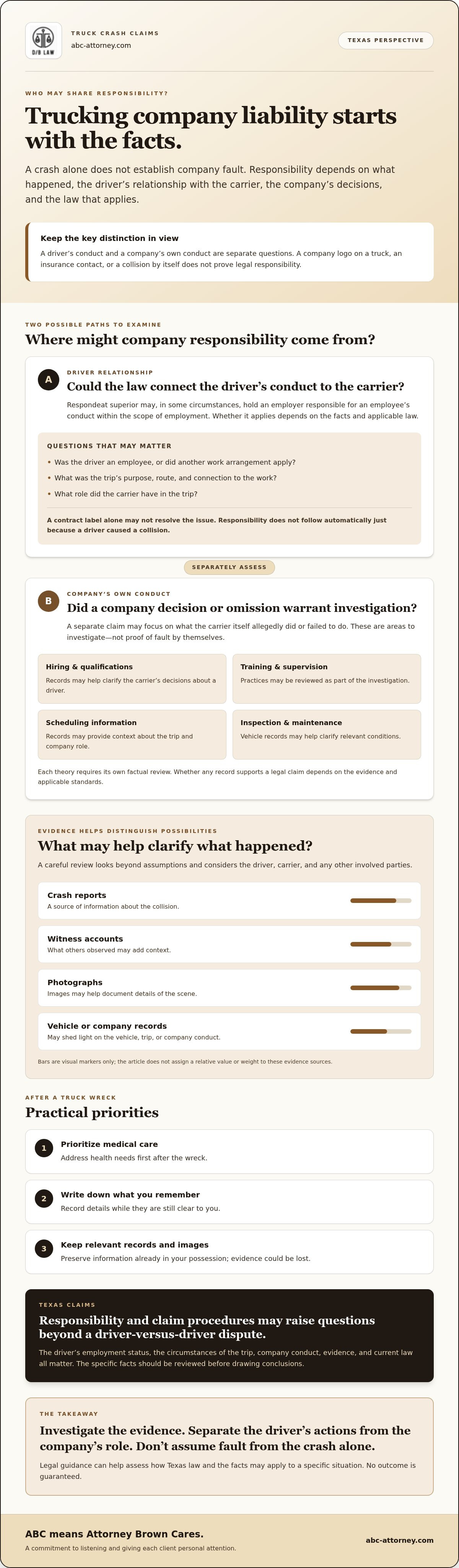
A trucking company may share legal responsibility for a crash, depending on the facts and the law that applies. But a collision alone doesn’t establish company fault or guarantee that an injured person has a valid claim. An investigation needs to determine what happened, whose conduct may have contributed, and whether the company’s relationship to the driver or its own decisions are legally relevant.
This distinction matters after a serious truck wreck. Identifying every potentially responsible party can help clarify which actions and records deserve investigation, as well as which insurance claims may be relevant. The driver, carrier, and any other involved parties should be assessed based on evidence, not assumptions.
What does trucking company liability mean?
Trucking company liability is legal responsibility a carrier may have for harm connected to a truck crash, based on its relationship to the driver or its own conduct, when supported by the facts and applicable law.
Being named in an insurance claim is not the same as being legally responsible. A company or insurer may be contacted while the facts are still being reviewed. That alone doesn’t prove fault or determine whether the company must pay damages. The evidence and rules that apply to the claim guide that legal question.
Why might the company and driver both be investigated?
Different conduct can contribute to the same collision. One question is what the driver did behind the wheel. Separately, investigators may examine the driver’s work relationship with the carrier and whether company decisions or omissions played a role. A company logo on a truck doesn’t answer those questions.
For example, after a driver collides with a car while changing lanes, investigators might review the driver’s actions and separately ask whether the carrier’s relationship with the driver creates a basis for responsibility or whether the company’s conduct needs review. Respondeat superior describes one possible route for holding an employer responsible for an employee’s conduct. Whether it applies depends on the circumstances and jurisdiction.
When several organizations and insurers are involved, it can be hard to know who may be accountable. A careful review separates what the driver did from what the company may have done, without assuming either party is responsible. At Dedric Brown Law Firm, ABC means Attorney Brown Cares, and that commitment starts with listening and giving each person personal attention.
How a Trucking Company's Conduct May Create Separate Liability
A company’s possible responsibility can arise through two distinct paths: its legal relationship to a driver, or its own alleged conduct. These are separate questions. A driver’s mistake doesn’t automatically make a carrier liable, and a company’s involvement in a crash doesn’t prove it acted negligently. Each claim needs support in the facts and applicable law.
When may a company answer for a driver's conduct?
Respondeat superior is a legal doctrine that may, in some circumstances, hold an employer responsible for an employee’s conduct within the scope of employment. Whether it applies to a Texas truck wreck depends on details such as the driver’s employment status and the circumstances of the trip. A contract label alone may not resolve the issue. Texas counsel should review current law and the facts before drawing conclusions.
For example, a driver transporting freight on an assigned trip may raise different questions from a driver using a truck for a personal purpose. The route, trip purpose, work arrangement, and company’s role may all warrant review. Responsibility doesn’t follow automatically just because the driver caused a collision.
What company decisions may warrant investigation?
A separate claim may focus on what the carrier itself allegedly did or failed to do, rather than attributing the driver’s conduct to the company. Investigators might examine hiring and qualification records, training and supervision practices, scheduling information, or vehicle inspection and maintenance records. These are areas to investigate, not proof of fault by themselves. Whether any supports a legal claim depends on the evidence and applicable standards.
The distinction is practical: employer responsibility asks whether the law may attribute an employee’s conduct to the company. Direct company negligence asks whether the carrier’s own decision or omission was legally relevant to the crash and resulting harm. The theories may involve overlapping records, but each requires its own factual and legal analysis.
Federal rules may also be relevant, depending on the carrier and operation. The Federal Motor Carrier Safety Regulations can help identify applicable federal requirements. A possible violation does not, by itself, establish liability. Texas legal standards and the application of any rule should be confirmed with qualified counsel.
Sorting out these issues can feel overwhelming while you’re dealing with the aftermath of a serious wreck. At Dedric Brown Law Firm, ABC means Attorney Brown Cares, and careful attention to the facts is part of treating each client as an individual. If you’re weighing questions about a Texas truck wreck, you can contact the firm to discuss your situation.
Driver, Carrier, or Contractor: Comparing the Possible Liability Paths
A truck crash can raise several distinct liability questions. Investigators may look at the driver’s actions, the driver’s relationship with the carrier, and the carrier’s own conduct. Naming one potentially responsible party doesn’t automatically rule out others, but it also doesn’t establish that every party is legally at fault.
Employee driver versus independent contractor
The driver’s work arrangement may affect whether the law allows responsibility for the driver’s conduct to be attributed to a carrier. An agreement calling someone an independent contractor is relevant, but shouldn’t be treated as decisive on its own. The legal doctrine of respondeat superior concerns possible employer responsibility for an employee’s conduct. Its application and limits depend on governing law and the facts.
Counsel may review agreements alongside dispatch records, trip assignments, and communications to understand how the arrangement worked in practice. Texas standards should be confirmed for the particular claim. A label alone can’t answer every question about the driver-company relationship.
Company conduct versus a driver's immediate actions
Driver conduct focuses on what happened at the wheel. A separate company-conduct theory examines the carrier’s own decisions or practices and whether evidence supports a connection to the crash. These are different paths, even when they involve some of the same records.
Illustrative example, not a legal conclusion: A driver allegedly looks away from the road and strikes another vehicle. Investigators might review that moment and also examine whether a company practice or decision is relevant to the events. Looking into both possibilities doesn’t mean either claim is proven or that recovery can be obtained from each party.
If you’re trying to make sense of competing explanations, comparing relevant records can help clarify which questions deserve attention. At Dedric Brown Law Firm, ABC means Attorney Brown Cares. That commitment includes listening closely and treating each client’s concerns with personal attention.
What Evidence Can Help Clarify Trucking Company Liability?
Evidence can help show what happened, who was involved, and whether driver conduct or a company decision may be relevant. After a serious collision, focus first on your health. Then document what you know and ask about preserving information. Records can be lost or become harder to obtain, and access depends on the type of evidence and applicable procedures. No single item guarantees a particular conclusion about trucking company liability for accidents.
Which records may help establish what happened?
The evidence that matters depends on the crash and the questions being investigated. Potentially relevant materials may include:
Crash-scene information: available crash reports, photographs, videos, and witness names or accounts.
Vehicle information: inspection or maintenance records and available electronic data from the truck or other vehicles.
Trip and company records: dispatch communications, trip documentation, and driver qualification or training files.
Some records may be held by a company or another organization and may require formal legal procedures to obtain. Don’t try to access restricted files or approach an opposing party on your own. A lawyer can assess which records may be relevant and explain available ways to request or preserve them.
What should an injured person do after a serious crash?
Take practical steps in order, without putting your recovery at risk:
Seek appropriate medical care. Keep copies of medical records and related paperwork you receive.
Write down details you know. Note dates, locations, names, and what you remember while the information is fresh. Save photographs, messages, and other materials already in your possession.
Ask about preservation promptly. A legal professional can explain which evidence may matter and what steps may be available. Timing and procedures vary, so don’t assume a particular record will be retained or accessible.
It’s understandable to feel uncertain about what to save or who to contact. At Dedric Brown Law Firm, ABC means Attorney Brown Cares, and personal attention starts with listening to your concerns. For guidance about evidence and a Texas truck wreck, talk with the firm about your situation.
Texas Trucking Company Accident Claims: Questions and Next Steps
Texas law may affect how responsibility is evaluated and how a truck-crash claim proceeds. The answer can depend on the facts, the parties involved, and the legal issues raised. General information can help you frame questions, but a Texas attorney should assess how current law applies to your situation. Avoid making assumptions about fault or deadlines.
What should Texas readers ask a truck accident attorney?
A focused conversation can help you understand what needs closer review. Consider asking:
Which parties and possible liability theories should be investigated?
What evidence may help clarify the driver’s conduct, the company’s role, or the relationship between them?
What steps may be available to preserve or request relevant records, and what procedures apply?
What uncertainties remain, and how will the legal process and case updates be explained?
These questions don’t guarantee that a particular claim can be brought or recovered. They can help you understand what is known, what still needs investigation, and what to expect next. Deadlines and procedures depend on the circumstances, so ask for advice based on current Texas law rather than relying on a general timeline.
How the firm may support a serious truck-crash claim
Questions about trucking company liability for accidents can involve detailed records, several parties, and serious injuries. The Dedric Brown Law Firm represents people in catastrophic personal injury matters, including commercial truck wrecks and traumatic brain injuries. The firm serves Texas clients in Houston, San Antonio, Dallas, Austin, Beaumont, Huntsville, Prairie View, and Brenham.
Dedric Brown is a licensed attorney and Certified Public Accountant. Those credentials don’t predict a case result, but they bring legal and financial perspectives to the review of issues and records. An initial conversation may help identify questions that deserve attention, discuss possible next steps, and clarify what remains uncertain. You can ask how communication works and what information may be useful to share.
ABC means Attorney Brown Cares. The message is personal attention for people facing difficult circumstances, not a promise about any claim’s outcome. If you or someone close to you is dealing with the aftermath of a serious truck wreck, contact the firm to discuss your situation.
Take the Next Step With a Clearer Picture
Understanding trucking company liability for accidents starts with separating the driver’s actions from the carrier’s relationship to the driver and any company decisions that may warrant investigation. A crash alone doesn’t establish company fault. The facts, relevant records, and applicable Texas law help determine which questions deserve closer review.
If you’ve been injured, prioritize medical care, keep information and records already available to you, and seek guidance about evidence and next steps. You don’t need to know every answer before asking questions. A conversation can help clarify what may need investigation and what remains uncertain.
The Dedric Brown Law Firm handles commercial truck wrecks and catastrophic personal injury matters. Dedric Brown is a licensed attorney and Certified Public Accountant, bringing legal and financial perspectives to careful record review without promising a particular result. ABC means Attorney Brown Cares. That commitment means personal attention during a difficult time. If you’re ready to discuss your situation, contact the firm.
Frequently Asked Questions
Can a trucking company be liable for an accident caused by its driver?
Yes, a trucking company may be responsible in some circumstances, but liability depends on the driver’s relationship to the company, the circumstances of the trip, and applicable law. A claim might examine whether the company could be responsible for an employee’s conduct or whether its own decisions contributed to the crash. A collision alone doesn’t establish either theory. A Texas attorney can review the specific facts without predicting an outcome.
What makes a trucking company directly liable for a crash?
A company’s own decisions or practices may warrant investigation, including hiring, driver qualification, training, supervision, scheduling, or vehicle upkeep. These are possible areas of inquiry, not automatic findings of fault. Evidence must connect the relevant conduct to the crash, and applicable legal standards determine whether a claim can proceed. Qualified counsel should verify Texas-specific requirements before drawing conclusions about a particular carrier’s responsibility.
Is a trucking company liable if the truck driver is an independent contractor?
Not automatically, and not necessarily never. Calling a driver an independent contractor doesn’t resolve every liability question by itself. The actual work arrangement, relevant agreements, the driver’s conduct, and governing law may all affect the analysis. A contract can be useful evidence, but its wording may not answer the whole question. A Texas attorney can review the agreements and surrounding facts to assess which issues may need further investigation.
What evidence can help prove trucking company liability?
Potentially useful evidence may include crash reports, scene photographs, witness accounts, vehicle data, dispatch records, and driver or company files. Which materials matter depends on the facts, and availability can vary. Some records may require formal legal steps to request or preserve. Keep documents and images already available to you, and seek legal guidance promptly. Don’t try to access restricted records or obtain them directly from an opposing party.
Can both the truck driver and trucking company be responsible?
Both may be investigated. A claim can examine the driver’s actions at the time of the crash and, separately, whether the company’s relationship with the driver or its own conduct is legally relevant. Whether responsibility may be assigned to one party or more depends on the evidence and applicable law. Naming multiple parties doesn’t prove fault or guarantee recovery from any of them. A case-specific investigation helps clarify which theories the facts may support.
Does Texas law affect trucking company liability for accidents?
Yes. Texas law may affect how responsibility is assessed and what procedures or deadlines apply, but the relevant rules depend on the circumstances and should be checked against current authority. The crash location and facts may also shape the analysis. Online information can’t determine how a rule applies to an individual claim. If the collision happened in Texas, seek current legal guidance promptly rather than relying on a general explanation or assuming a deadline.
When should I contact a lawyer after a truck accident?
Consider seeking legal guidance as soon as practical after urgent medical needs are addressed, particularly if injuries are serious, responsibility is unclear, or important records may need preservation. Evidence and legal timelines are case-specific, so don’t rely on a general deadline without confirming current law. The Dedric Brown Law Firm handles commercial truck wrecks and catastrophic personal injury matters across Texas, including Houston, San Antonio, Dallas, Austin, Beaumont, Huntsville, Prairie View, and Brenham. Contact the firm to discuss your situation.


Comments