
Fetal Distress Medical Malpractice Lawyer: What Texas Families Should Know

Could a delayed response to a concerning fetal monitor pattern have contributed to your child’s injury? The monitor strip alone may not answer that question. A fetal distress medical malpractice lawyer can help examine the full timeline: what staff observed, how they responded, and what happened before delivery. A concerning sign does not automatically prove negligence or explain a later diagnosis, but your questions deserve a careful review.
It is understandable to feel uncertain when medical records are technical and events unfolded quickly. This article explains what fetal distress can mean, when a delayed intervention may raise legal questions, and which records and expert reviews could help clarify whether care contributed to an injury.
The Dedric Brown Law Firm handles Texas birth injury and medical malpractice matters involving fetal monitoring. A review may consider monitoring records, care decisions, and how events during labor relate to a child’s diagnosis. If you are considering a review, you can start by gathering the records you have and noting what remains unclear.
Table of Contents
What fetal distress means during labor, and what it does not prove
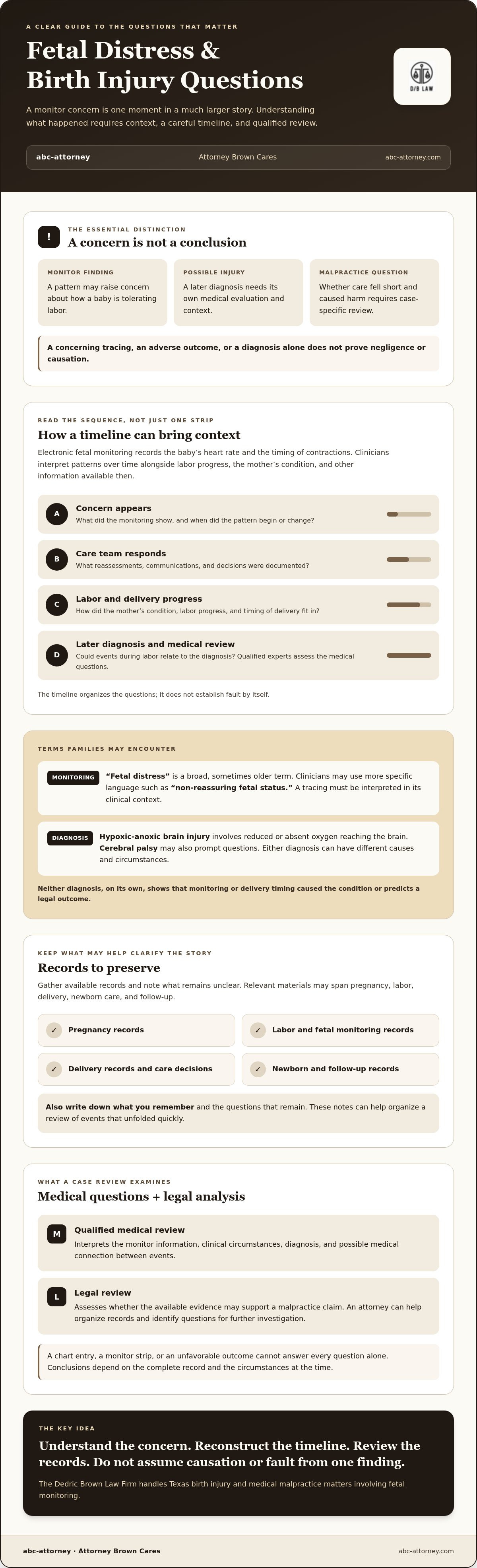
“Fetal distress” is a broad, sometimes older term for signs that a baby may not be tolerating labor as expected. Clinicians may use more specific language, such as “non-reassuring fetal status,” because a monitor finding needs to be interpreted in context. The overview of fetal distress also explains this shift in terminology.
Quotable takeaway: Fetal distress describes a concern about a baby’s condition during labor. By itself, it is not a diagnosis of injury or a conclusion that malpractice occurred.
What can fetal monitoring show during labor?
Electronic fetal monitoring records information about the baby’s heart rate and the timing of contractions. Clinicians assess how patterns change over time rather than treating one isolated reading as the whole story. They may also consider labor progress, the mother’s condition, and other information available at the time. A tracing can raise a concern, but its meaning depends on the broader clinical picture.
Can fetal distress happen without medical malpractice?
Yes. A complication or an unfavorable outcome can occur even when care was appropriate. The outcome alone does not establish that a provider made a mistake, and a concerning monitor pattern does not prove that a delay or omission caused an injury.
The key distinction is between what happened and whether care fell short in a way that caused harm. A record may show a concerning pattern, for example, but determining what it meant, what decisions followed, and whether those decisions contributed to a later diagnosis requires a case-specific review. Qualified medical experts can help interpret the records; legal analysis can assess whether the facts support a malpractice claim. Neither conclusion should rest on a monitor strip alone.
A fetal distress medical malpractice lawyer can help organize the timeline and identify questions for further review, but no single sign guarantees that a claim exists. The Dedric Brown Law Firm handles birth injury and medical malpractice matters involving fetal monitoring. A review can focus on the available records, the family’s concerns, and what additional information may be needed.
How fetal distress can lead to a birth injury, and why timing matters
A concerning finding is one point in a larger sequence. To understand whether events during labor may relate to a later injury, reviewers may examine when the concern appeared, how the pattern changed, what staff documented, and what happened next. The record may include reassessments, communications among the care team, decisions about intervention, and the timing of delivery. These details help build a timeline, but they do not establish fault on their own.
A timeline helps qualified experts assess how a concern, the care that followed, and a later injury may be connected, without assuming that one event caused another.
Which events may matter in the fetal distress timeline?
Experts may compare monitoring information with labor progress, the mother’s condition, and other available records. They may ask when a concern was recognized, whether it changed, how decisions were recorded, and how the team communicated. ACOG’s guidance on interpreting and managing fetal heart rate patterns offers clinical context. Applying guidance to a particular situation requires qualified review. A link or a single chart entry cannot determine whether care was legally negligent.
What injuries may prompt families to seek answers?
Families may have questions after a diagnosis of hypoxic-anoxic brain injury, which involves reduced or absent oxygen reaching the brain, or cerebral palsy. These conditions can have different causes and circumstances. Their presence alone does not show that fetal monitoring, a response to a concern, or delivery timing caused the condition. An individualized medical evaluation is needed to assess diagnosis and possible causation, and no diagnosis alone predicts a legal outcome.
The significance of a possible delay depends on the complete record and the circumstances at the time. Qualified medical reviewers can assess clinical questions, while legal review considers whether the evidence supports a claim. A fetal distress medical malpractice lawyer may help organize records and identify questions for expert review, but cannot determine causation from a brief summary or one monitor strip.
The Dedric Brown Law Firm handles birth injury and medical malpractice matters involving fetal monitoring and hypoxic-anoxic brain injury. If you are trying to understand the sequence of events, you can share your concerns with the firm and ask about possible next steps.
When a fetal distress case may raise malpractice questions
A difficult birth or an abnormal fetal heart-rate tracing does not automatically mean malpractice occurred. A concerning outcome deserves attention, but legal responsibility depends on more than the result. A case-specific review generally examines the care involved, whether it may have departed from applicable care, whether that conduct caused or contributed to harm, and what evidence supports each part.
What questions can a medical and legal review examine?
A review may ask what the care team knew, when it knew it, and what the records document about reassessments, communications, and decisions. A qualified medical expert may consider whether the care departed from what applied in the circumstances. Legal review then examines whether evidence supports a connection between any alleged conduct and the child’s injury. The answers depend on the complete facts, not hindsight alone.
Incomplete records or missing context can make it harder to reconstruct events. They do not, by themselves, prove that a provider was negligent or that care was appropriate. Reviewers may compare available monitoring records, clinical notes, delivery information, and newborn records while recognizing the limits of what each document can establish.
Why is expert review important in a fetal distress claim?
Fetal monitoring and obstetrical decisions require specialized clinical interpretation. An expert can help assess how the recorded information fits the circumstances at the time; legal counsel can organize the evidence and evaluate the related legal questions. That process is an investigation, not a presumption that a mistake occurred. The issues described here do not establish that an expert has reviewed your family’s records.
A fetal distress medical malpractice lawyer can help families identify what evidence may clarify responsibility. The Dedric Brown Law Firm handles obstetrical malpractice matters involving fetal monitoring failures. A case review can consider the records and questions that may need closer attention without promising a particular conclusion.
Records to Preserve and Initial Case Review Expectations
Organizing records can make an initial review more focused, but you do not need to prove negligence before asking questions. Start with what you already have. Keep original documents unchanged, store copies securely, and note what you are unsure about rather than trying to interpret the medical details yourself.
Which documents and details may help clarify what happened?
Through the appropriate records-request channels, consider gathering available documents from pregnancy, labor, delivery, newborn care, and later follow-up. Useful materials may include:
Fetal monitoring records and labor-and-delivery notes
Delivery, discharge, and newborn-care information
Later evaluations, diagnoses, and follow-up records
Write down dates, names or roles of people involved, conversations you remember, and questions you want answered. Separate what you recall from what a document says. Do not write on or alter original medical records. If a record seems incomplete or confusing, flag it for review instead of drawing conclusions from a missing entry.
Gather any diagnoses or evaluations that help explain your child’s current medical needs. Then seek legal guidance about what the records may show and whether additional documents could be relevant. Texas deadlines can apply to medical malpractice matters, and timing questions depend on the circumstances. Because the applicable rules and exceptions require current legal review, do not rely on a general article to calculate a deadline.
What happens when a Texas birth injury lawyer reviews a case?
An initial discussion may cover your family’s concerns, the pregnancy and delivery history, your child’s diagnoses, and records you can access. You can share what you know, even if you do not have every document. A lawyer may consider whether more records are needed and whether qualified medical expert review is appropriate. This is an assessment process, not a promise of a particular result.
A fetal distress medical malpractice lawyer can help organize the information and identify questions that may need closer review. The Dedric Brown Law Firm handles birth injury and medical malpractice matters involving fetal monitoring. An initial discussion can focus on your concerns, available records, and possible next steps.
Discuss your questions with the firm when you are ready to talk about your concerns and available records.
How a fetal distress medical malpractice lawyer can help Texas families
Reviewing a possible birth injury claim takes careful work. A lawyer may organize pregnancy, labor, delivery, and newborn records; identify questions about the documented timeline; and assess whether qualified medical expert review may help. The goal is to understand what the evidence can support, not to assume that a concerning tracing or difficult birth proves negligence.
The Dedric Brown Law Firm handles complex birth injury and medical malpractice litigation, including matters involving fetal monitoring failures and hypoxic-anoxic brain injury. The firm serves families in Houston, San Antonio, Dallas, Austin, Beaumont, Huntsville, Prairie View, and Brenham. A review can focus on the details in the records and how the events may relate to a child’s diagnosis. No review can promise a particular finding or outcome.
What should families look for when choosing a fetal distress lawyer?
Ask about the lawyer’s experience with birth injury and fetal monitoring matters, who will handle the case, and how the review process works. It is reasonable to ask how the legal team assesses medical records and whether it may coordinate review with qualified experts. Clear answers should include possible challenges and uncertainties, not just assurances.
Communication matters, too. Consider whether the lawyer listens to your concerns, explains next steps in plain language, and gives you a chance to ask questions. You do not have to reach a conclusion about what happened before speaking with counsel. A thoughtful review starts with the records and your family’s account, then considers what additional information may be needed.
How can Texas families take a careful next step?
Gather the records you already have, note the questions that remain, and share those materials during an initial discussion. You do not need a complete file to explain your concerns. A lawyer can assess what may be relevant and whether more records or expert input should be considered.
Texas legal deadlines may apply, and the time available can depend on the facts and the claims involved. Do not rely on a general article to calculate a deadline. Prompt, current legal advice can help clarify which timing rules may apply to your family’s situation.
If you are ready to discuss your concerns and available records, Contact The Dedric Brown Law Firm.
Take the Next Step Toward Clarity
A concerning fetal heart-rate pattern can raise important questions, but it does not prove that care was negligent or caused an injury. The full timeline matters: what the records show, how the care team responded, and whether qualified review supports a connection to your child’s diagnosis. Preserving available records and writing down your questions can help make an initial discussion more focused.
A fetal distress medical malpractice lawyer can help assess those details without assuming the answer in advance. The Dedric Brown Law Firm handles birth injury and medical malpractice cases involving fetal monitoring failures. A discussion can help identify what information may be relevant and what questions still need answers.
If you are ready to discuss your concerns, Talk with The Dedric Brown Law Firm. You do not have to sort through every record or question alone. Contact the firm to discuss your concerns and available records.
Frequently Asked Questions
Does fetal distress automatically mean medical malpractice?
No. Fetal distress or a concerning fetal heart-rate pattern is a clinical signal, not proof that a provider acted negligently. A difficult birth or injury can occur even when care was appropriate. A case review examines what the care team knew, how events unfolded, what the records document, and whether qualified expert analysis supports a connection between a possible departure from applicable care and harm.
Can fetal distress cause brain damage or cerebral palsy?
Fetal distress may prompt questions about oxygen deprivation, but it does not establish that oxygen loss occurred or caused a particular condition. Hypoxic-anoxic brain injury and cerebral palsy can have different causes, so an individual medical evaluation is needed to assess diagnosis and possible causation. A diagnosis alone cannot show what happened during labor, determine responsibility, or predict a child’s future needs or legal outcome.
What evidence matters in a fetal distress malpractice case?
Relevant evidence may include fetal monitoring records, labor and delivery notes, communications and documented decisions, delivery records, newborn-care information, and later evaluations or diagnoses. Together, these materials may help reviewers reconstruct the timeline and consider how events relate to an injury. No single record necessarily answers every question. A fetal distress medical malpractice lawyer may help organize available documents and determine whether qualified medical expert review is appropriate.
How do I know whether a delay in delivery was negligent?
You cannot determine negligence from the length of a delay alone. Reviewers need to consider the complete circumstances, including what concerns appeared, what the team knew at the time, what the records show, and how labor progressed. Qualified medical experts can assess the clinical questions, while legal review considers whether evidence supports a departure from applicable care and a connection to harm. A concerning pattern alone does not prove fault.
How long do I have to file a fetal distress malpractice claim in Texas?
Texas deadlines may apply, but the time limit can depend on the facts, the people bringing claims, and other case-specific issues. This FAQ cannot determine a filing deadline or account for possible exceptions. Do not rely on a general online answer to calculate how much time remains. If you are concerned about a possible birth injury, seek current legal advice promptly so the relevant timing rules can be assessed for your situation.
What should I bring to a consultation with a birth injury lawyer?
Bring any records you have from pregnancy, labor, delivery, newborn care, and later evaluations, along with diagnoses and a short timeline of events or questions. You do not need to collect everything or decide whether negligence occurred before speaking with a lawyer. The Dedric Brown Law Firm serves families in Houston, San Antonio, Dallas, Austin, Beaumont, Huntsville, Prairie View, and Brenham. You can discuss your concerns and the records available to you during an initial conversation.


Comments