
Negligent Hiring Practices in a Trucking Lawsuit: What Victims Should Know

Could a trucking company share responsibility for a crash if it hired a driver despite warning signs? After a serious wreck, it’s natural to focus on the driver behind the wheel. But a negligent hiring practices trucking lawsuit may also raise questions about what the company knew, which records it reviewed, and whether it overlooked risks that could have been discovered.
Not every truck-wreck claim supports a negligent-hiring allegation, and the answer depends on the facts. Hiring and qualification records can still be important, even when they’re difficult for an injured person to obtain while managing medical needs and financial pressure. This article explains the general role negligent hiring may play in a Texas truck-wreck claim, what information may help an attorney assess the issue, and what to consider when discussing next steps with counsel. The Dedric Brown Law Firm’s “abc” means “Attorney Brown Cares,” reflecting its commitment to attentive, personal guidance. You deserve a careful review of what happened and how the crash has affected your life.
Table of Contents
What negligent hiring practices can mean in a trucking lawsuit
Which hiring and driver records could matter in a Texas trucking lawsuit?
When could a trucking company’s hiring choices support a lawsuit?
What should you do after a truck wreck raises hiring questions?
How Attorney Brown Cares about serious Texas truck-wreck claims
What negligent hiring practices can mean in a trucking lawsuit
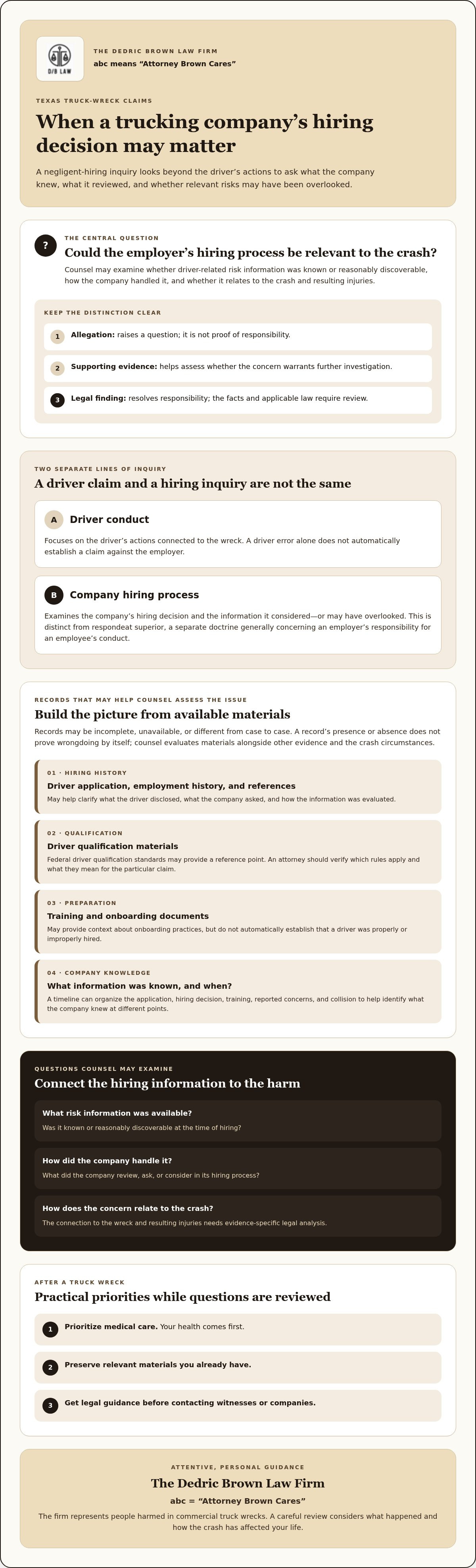
After a commercial truck wreck, there may be questions about both the driver’s actions and the company’s decision to hire that driver. A negligent-hiring claim is a potential legal theory focused on the employer’s hiring decision. It asks whether information about a driver-related risk, if known or reasonably discoverable, could have mattered to that decision and to the harm that followed. The phrase “negligent hiring practices trucking lawsuit” describes this kind of inquiry, not a conclusion that the company acted unlawfully.
A crash, a troubling history, or an allegation alone doesn’t establish employer liability. The facts must be investigated, and an attorney should verify which legal standards apply under Texas law. That review may include what the company knew or could have learned, what it did during hiring, and how the alleged risk relates to the crash and resulting injuries.
An allegation raises a question; supporting evidence helps assess it; only a legal finding resolves responsibility.
It’s also useful to distinguish negligent hiring from respondeat superior, a separate doctrine generally concerning an employer’s responsibility for an employee’s conduct. The doctrines are not interchangeable. Whether either theory applies depends on the evidence and legal analysis.
How hiring decisions may relate to a commercial truck wreck
Imagine, hypothetically, that a carrier receives information during hiring that raises questions about a prospective driver’s ability to operate safely, but the information isn’t reviewed or considered. If that driver later causes a crash, investigators might ask whether the hiring decision is relevant. This example doesn’t describe a particular case, and the legal elements counsel must establish under Texas law require separate review.
The central question isn’t simply whether the driver had a past problem. It’s whether relevant risk information was known or discoverable at the time, how the company handled it, and whether the issue bears on the crash and injuries.
How negligent hiring differs from a driver-negligence claim
A driver-negligence inquiry focuses on the driver’s conduct connected to the wreck. A hiring inquiry instead examines the company’s hiring process and the information it considered or may have overlooked. One driver error doesn’t automatically support a claim against the employer. Each potential theory calls for its own evidence-specific legal analysis, including review of how the alleged conduct and hiring decision relate to the harm.
Which hiring and driver records could matter in a Texas trucking lawsuit?
Hiring records can help an attorney reconstruct what information a trucking company considered before putting a driver on the road. They may also reveal gaps or inconsistencies that warrant follow-up. A particular record may not exist, and its presence or absence doesn’t prove wrongdoing by itself. In a negligent hiring practices trucking lawsuit, counsel evaluates records alongside other evidence and the circumstances of the crash.
A timeline can make that review more practical. Place the driver’s application, hiring decision, training, reported concerns, and collision in sequence. This can help identify what the company knew at different points and whether information emerged before or after the crash. An attorney can assess which records may be relevant and what legal standards apply in Texas.
Hiring, qualification, and training materials
Depending on the facts, counsel may seek or review a driver’s application, employment history, references, qualification materials, and training or onboarding documents. These records could help clarify what the driver disclosed, what the company asked, and how it evaluated the information. Materials may be incomplete or unavailable, so investigators may compare them with other evidence rather than draw conclusions from one file.
The federal driver qualification standards may provide a reference point when counsel assesses applicable qualification requirements. An attorney should verify which rules apply and what they mean for a particular claim. Training materials may also provide context about the company’s onboarding practices, but they don’t automatically establish that a driver was properly or improperly hired.
Prior driving history and company knowledge
Prior incidents, complaints, or safety concerns may prompt questions about what the company knew or could have discovered when it made its hiring decision. Counsel may compare those concerns with available applications, employment records, references, and other evidence. The legal significance of what was known, or reasonably discoverable, must be assessed under applicable Texas law.
A past event isn’t automatic proof that the driver caused a later crash or that the company is liable. Its relevance depends on the details, timing, and connection to the issues in the case.
A record’s significance depends on its context and corroboration, not merely on what it says in isolation.
If you’re unsure which records may matter after a commercial truck wreck, discuss the facts and your questions with counsel. The Dedric Brown Law Firm represents people harmed in commercial truck wrecks and offers attentive, personal guidance through complex investigations. Discuss your truck-wreck questions with the firm.
When could a trucking company’s hiring choices support a lawsuit?
A serious crash can leave an injured person and family searching for answers, but the severity of the wreck alone doesn’t prove negligent hiring. A potential claim generally calls for a closer look at the company’s hiring decision, relevant information about the driver, and whether the alleged failure connects to the collision and resulting harm. The exact legal elements and employer-liability standards require current review under Texas law.
The table below offers questions for an investigation, not conclusions. A concerning fact may deserve follow-up, but it doesn’t establish misconduct or liability on its own.
Warning signs are investigation leads, not automatic proof
An incomplete file or a documented safety concern can be a reason to ask questions, not a verdict about what happened. Investigators must consider the source, reliability, timing, and context of each item. A prior event, for example, doesn’t automatically prove fault in a later crash or show that the employer acted improperly. Research, such as the University of Minnesota Morris research on driver turnover, can provide broader industry context, but industry patterns don’t establish what a particular company knew or did.
Connecting hiring decisions to injuries and losses
In a negligent hiring practices trucking lawsuit, counsel may examine whether an alleged hiring failure relates to the driver’s conduct, the crash, and the injuries that followed. Medical documentation can help describe treatment and its effects. Financial records may help explain how a serious collision affected work or household finances. Their relevance depends on the facts and applicable law. No record guarantees a particular case value or means every claimed loss is recoverable.
What should you do after a truck wreck raises hiring questions?
A serious truck wreck can leave you dealing with medical care, disrupted work, and unanswered questions about the driver and trucking company. Focus first on your health and immediate needs. You don’t have to prove negligent hiring before asking an attorney whether a negligent hiring practices trucking lawsuit may be worth investigating.
Access to evidence and options for preserving it depend on the facts and applicable law. Keep materials you already have, but avoid contacting witnesses or the trucking company about the claim before discussing that step with counsel. An attorney can explain what may be relevant and how to approach further investigation.
Information to organize before speaking with an attorney
You don’t need a complete case file. If readily available, gather or note:
The collision date and location, and the vehicles involved.
Any crash report, insurance information, or correspondence you have received.
Medical records, bills, and communications related to the collision or your treatment.
Keep originals where possible and make a simple timeline if that feels manageable. If you’re still receiving care or don’t have certain records, that’s okay. Share what you know; counsel can help identify what else may be needed.
Questions to ask about a trucking-company investigation
A clear conversation can help you understand how an attorney would assess the facts. Consider asking:
How will you examine the company’s hiring decisions separately from the driver’s conduct?
What evidence might be available, and what important uncertainties remain?
How will you keep me informed and explain potential next steps?
These questions can help you understand the investigation without assuming that a particular claim or outcome is certain. The right analysis depends on the evidence and current Texas law.
The Dedric Brown Law Firm represents people harmed in commercial truck wrecks and catastrophic injury matters. Texas readers can discuss their circumstances with the firm.
How Attorney Brown Cares about serious Texas truck-wreck claims
A serious truck wreck can affect far more than the moments at the scene. Medical needs, changes to work, and uncertainty about responsibility can weigh on you and your family. The Dedric Brown Law Firm represents people harmed in commercial truck wrecks and handles catastrophic injury matters. The firm reviews the available facts carefully rather than assuming a company is liable because a collision occurred.
The firm serves clients in Texas, including Houston, San Antonio, Dallas, Austin, Beaumont, Huntsville, Prairie View, and Brenham. If you’re wondering whether a negligent hiring practices trucking lawsuit may apply, you can explain what happened and ask how the hiring questions might be evaluated alongside the driver’s conduct and the harm you report.
A careful review of hiring questions and serious injuries
A fact-led review may consider available hiring and qualification materials, information about the company’s actions, and records related to the collision and injuries. Each piece needs context. The goal is to understand what the evidence may show, what remains uncertain, and which legal questions require further review under Texas law.
When a person reports a traumatic brain injury, careful attention to medical documentation and the injury’s effects may be especially important. The firm focuses on catastrophic injuries, including traumatic brain injuries. Every person’s circumstances are different, and no particular legal theory or result should be assumed before the facts are assessed.
Talk with the firm about your next step
An initial conversation can be an opportunity to describe the collision, share your concerns, and ask about possible next steps. You don’t need to arrive with every record or have already determined whether the trucking company may bear responsibility. If you’re still managing treatment or other immediate needs, take the time you need to decide what feels right for you.
The firm’s “abc” identity, “Attorney Brown Cares,” reflects a commitment to attentive, personal communication. You deserve to be heard and to understand what questions an investigation may address, without pressure or promises about compensation or outcome. If you’re ready to talk about your circumstances, contact the Dedric Brown Law Firm.
Take the Next Step With a Clearer Picture
A serious truck wreck doesn’t, by itself, prove that a trucking company negligently hired its driver. A negligent hiring practices trucking lawsuit calls for an evidence-based review of the company’s hiring decision, relevant driver information, and the connection to the crash and resulting harm. The legal standards must be assessed under current Texas law.
Applications, qualification materials, training records, and information about prior concerns may help counsel investigate what happened. Their meaning depends on context and corroboration, not on any one document alone. While you focus on medical care and other immediate needs, keep relevant materials you already have and note questions you’d like answered.
The Dedric Brown Law Firm represents people harmed in commercial truck wrecks and catastrophic injury incidents. Its guiding message, “Attorney Brown Cares,” reflects a commitment to attentive, personal communication as you consider your options. To discuss your circumstances, talk with the Dedric Brown Law Firm about your truck-wreck concerns. You deserve a thoughtful conversation and a clear next step, at your pace.
Frequently Asked Questions
Is a trucking company automatically liable if it hired a driver with a poor record?
No. A poor driving record alone doesn’t make a trucking company automatically liable for a later crash. An attorney would review the available facts, including what the company knew or could have learned, how that information relates to its hiring decision, and whether the alleged risk connects to the collision. The applicable legal standards must be checked under current Texas law. A prior concern isn’t proof by itself.
Can I file a negligent hiring practices trucking lawsuit after a serious truck wreck?
Possibly, but whether a claim may proceed depends on the specific facts and applicable law. An attorney can assess the driver’s background, the company’s hiring process, the crash circumstances, and the injuries. A serious outcome deserves careful attention, but it doesn’t automatically prove negligent hiring. An online explanation can’t determine your eligibility. Seek case-specific legal advice to understand what the available evidence may support.
What evidence can help show negligent hiring in a trucking lawsuit?
Potentially relevant materials may include driver applications, employment history, qualification or training records, and documented safety concerns. Some records may not be available, and a document alone doesn’t establish wrongdoing. Its timing, source, reliability, and connection to the crash matter. Counsel can help identify appropriate evidence to investigate and assess what it may show, while verifying the legal standards that apply to a Texas claim.
What happens if the trucking company says it didn’t know about the driver’s history?
That statement doesn’t resolve the issue by itself. A fact-specific investigation may examine what information the company had, what records or processes existed, and whether relevant information could have been discovered. The legal significance of those facts depends on current law and supporting evidence. Avoid assuming the company is or isn’t responsible based only on its statement. An attorney can review the available information before drawing conclusions.
How much compensation can a negligent hiring trucking lawsuit recover?
There’s no reliable amount to quote without evaluating the injuries, their effects, the available evidence, and applicable law. A claim involving a traumatic brain injury or other catastrophic harm may require detailed medical and financial documentation to explain its consequences. No result is guaranteed, and another case’s outcome can’t predict yours. Ask an attorney to assess which losses may be relevant to your circumstances.
Should I contact a lawyer if I suspect a trucking company hired an unsafe driver?
Yes, you can ask an attorney to review your concerns even if you’re unsure whether the company’s hiring was improper. Share what you know about the collision and preserve relevant records you already have; you don’t need to prove a legal theory first. The Dedric Brown Law Firm represents people harmed in commercial truck wrecks and catastrophic injuries in Texas, including Houston, San Antonio, Dallas, Austin, Beaumont, Huntsville, Prairie View, and Brenham. Its “abc” means “Attorney Brown Cares,” reflecting personal guidance.


Comments