
Lawsuit for Truck Driver Fatigue Accident: How to Assess Your Case

What if the signs of fatigue are recorded in data the trucking company controls? A lawsuit for truck driver fatigue accident can’t rest on suspicion alone. It requires examining the driver’s hours, warnings, and decisions before the crash, then weighing what the evidence does and doesn’t show.
If you’re facing serious injuries, mounting bills, and unanswered questions, it’s understandable to worry that important records could disappear or remain out of reach. This article explains how electronic logging data, dispatch instructions, delivery schedules, and driver communications may help assess a fatigue claim, and how Texas-specific considerations can shape a truck accident lawsuit.
You’ll also learn why an investigation may look beyond the driver to a trucking company or other potentially responsible parties, without assuming anyone is liable before the facts are reviewed. When choosing counsel, ask how the lawyer evaluates complex evidence, communicates clearly, and considers the financial impact of catastrophic injuries. The Dedric Brown Law Firm’s “abc” means Attorney Brown Cares, a commitment to personal attention while carefully assessing a case.
Table of Contents
When can a truck driver fatigue accident lead to a lawsuit?
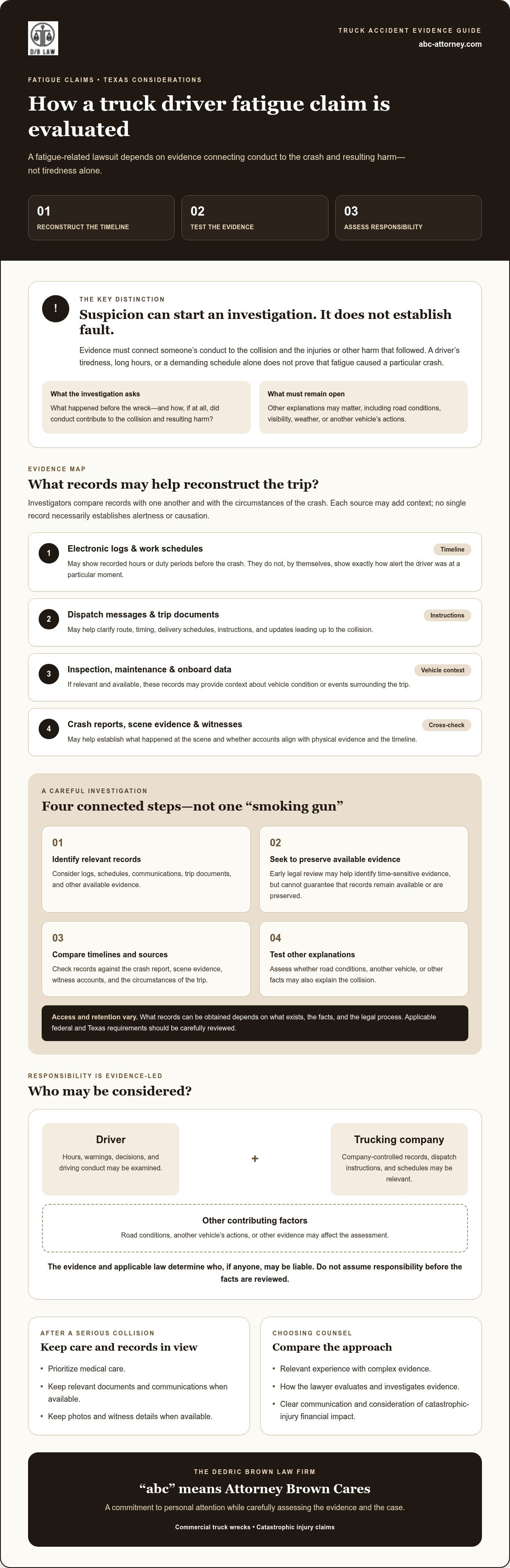
A fatigue-related truck accident lawsuit is assessed through evidence and applicable law. It asks whether someone’s conduct contributed to the crash and whether the collision caused injuries or other harm. A driver may have been tired, but tiredness alone doesn’t establish fault. The investigation must connect the facts to the collision and the losses that followed.
That distinction matters after a serious wreck. Injuries can bring pain, emotional strain, time away from work, and financial pressure, while the cause of the crash remains unclear. Suspected fatigue is a reason to investigate, not a conclusion about who is legally responsible.
What evidence may suggest driver fatigue?
Potential evidence includes the driver’s schedule, electronic logs, dispatch communications, and trip records. Together, these records may help show when the driver worked, whether the trip schedule was demanding, and what instructions or updates came before the collision. The Hours of Service (HOS) regulations offer an overview of rules designed to address driver hours. Check current legal sources to determine which federal and Texas requirements apply.
Records need context. An electronic log may document recorded hours, but it may not establish how alert a driver was at a particular moment. Dispatch messages or a tight delivery schedule may raise questions without proving fatigue caused the crash. Investigators must compare the records with other available facts, including the timing and circumstances of the wreck.
How does fatigue connect to crash responsibility?
Causation means showing how conduct helped bring about the collision and resulting injury. Evidence that a driver worked long hours is different from evidence that fatigue affected driving in this specific crash. Other explanations, such as road conditions or another vehicle’s actions, may also need to be considered.
Suspicion can start an investigation. Only evidence connecting conduct to the crash and harm can support liability. Whether a lawsuit for truck driver fatigue accident is viable depends on the complete record and the law that applies. A careful assessment separates what the evidence establishes from what remains uncertain.
How lawyers investigate a lawsuit for a truck driver fatigue accident
A fatigue investigation works best as a sequence, not a search for one document that proves everything. Lawyers may identify relevant records, seek to preserve available evidence, compare timelines, and test other explanations for the crash. Early legal review can help identify evidence that may be time-sensitive, but it can’t guarantee records will be available or preserved.
Access depends on the facts, the legal process, and whether records still exist. Verify applicable rules for driver logs and record retention before drawing conclusions about which records should exist or how long they must be kept. The federal Hours of Service (HOS) regulations provide a government reference for federal driving-hour rules. The rules that apply to a particular trip and driver require careful review.
Which records can help reconstruct a driver’s timeline?
Investigators may compare electronic logging device data with dispatch messages, trip documents, and available work schedules. If relevant and available, inspection or maintenance records and onboard vehicle data may add context about the truck’s condition or events surrounding the trip. No single record necessarily reveals how alert the driver was or establishes why the collision happened.
How do investigators test competing explanations?
Investigators compare records with the crash report, physical evidence from the scene, and witness accounts. They may also examine weather, visibility, road conditions, and possible mechanical issues. For example, a log showing a long work period may warrant closer review, but it doesn’t establish by itself that fatigue caused the driver to miss a hazard.
The goal is to build a supported timeline and assess inconsistencies, not to treat an allegation as a finding. If you’re considering what records may matter in your truck wreck, you can discuss your truck wreck case. The Dedric Brown Law Firm’s “abc” stands for “Attorney Brown Cares,” reflecting its commitment to personal attention.
Who may be responsible, and what can complicate a fatigue claim?
A fatigue allegation doesn’t automatically establish a winning lawsuit. Responsibility depends on what the evidence shows, who was involved, and the law that applies. A driver’s actions may warrant review, as may company decisions or other factors that contributed to the collision. Each possibility needs to be assessed on its own facts, rather than assumed from the severity of the wreck or an early suspicion of fatigue.
For someone dealing with serious injuries, uncertainty about responsibility can add to physical, emotional, and financial strain. A careful case review asks what can be supported, what remains unclear, and whether the evidence connects a person or company’s conduct to the crash and resulting harm.
When might a trucking company warrant investigation?
Company decisions may be relevant if available evidence raises questions about dispatch instructions, scheduling, supervision, or other actions connected to the trip. Company records may help clarify who made decisions and when. But an investigation is not proof of fault, and a trucking company isn’t automatically responsible just because its employee drove the truck. Any company responsibility requires case-specific evidence and legal analysis.
What arguments could challenge a fatigue allegation?
A defendant or insurer may dispute whether the records accurately show the driver’s timeline, whether fatigue affected driving, or whether another cause better explains the crash. They may also challenge whether the collision caused particular injuries or losses. Those are questions to test against the full record, not reasons to assume a claim will succeed or fail.
In a lawsuit for truck driver fatigue accident, the strongest analysis separates evidence of tiredness from evidence tying conduct to the crash and harm. The Dedric Brown Law Firm handles commercial truck wreck and catastrophic personal injury claims. The firm’s “abc” stands for “Attorney Brown Cares,” reflecting a commitment to personal attention and client well-being.
What should injured Texans do before pursuing a fatigue accident lawsuit?
After a serious truck collision, put your health first. Get medical care and follow the advice of your treating professionals. Injuries, including traumatic brain injuries, may need careful evaluation, and your medical records can help document the care you receive. You don’t need to determine on your own whether fatigue caused the crash before seeking help.
Keep relevant information you already have, but don’t put yourself at risk to collect more. Don’t enter a restricted area, approach a damaged vehicle, or try to obtain a trucking company’s records yourself. Avoid guessing publicly about the driver’s condition or assigning fault before the facts are clear. If you’re unsure what to say to an insurer or another party, ask a lawyer for guidance.
What information should you gather for an initial consultation?
You don’t need a complete file to start a conversation. Gather what’s reasonably available, such as:
The crash date and location, the people or companies involved, and any report or reference information.
Photographs of the scene, vehicles, or visible injuries, along with witness names and contact details.
Medical records or information about treatment, plus relevant messages, letters, or calls with insurers.
Keep original documents when possible and make a simple timeline of what you remember. Note uncertainty rather than filling gaps with guesses. A lawyer can help identify what additional records may matter and whether they can be pursued through the appropriate process.
What should you ask a Texas truck accident lawyer?
Use the first discussion to understand the lawyer’s approach and how they’ll work with you. Ask:
How would you investigate possible fatigue and identify records that may be relevant?
Who will communicate with me, and how will you explain case developments?
What experience do you have with commercial truck wrecks and serious injuries, including traumatic brain injury claims?
What Texas deadlines and procedural rules could apply, and how will you verify them for my situation?
Deadlines and exceptions can depend on the specific facts and current law. Ask counsel to confirm them promptly rather than relying on a general online summary. The Dedric Brown Law Firm handles commercial truck wreck and catastrophic personal injury claims for people in Texas, including Houston, San Antonio, Dallas, Austin, Beaumont, Huntsville, Prairie View, and Brenham. The firm’s “abc” stands for “Attorney Brown Cares,” a commitment to personal attention and client well-being. If you’re ready to discuss your circumstances, contact the firm about your truck wreck.
Choosing counsel for a truck driver fatigue accident lawsuit
Choosing counsel is a serious decision, especially when injuries affect your health, work, and family. Look for a lawyer who can evaluate a fatigue claim carefully, explain the uncertainties, and treat you as a person rather than a case file. You don’t need promises of a particular result. You need clear answers about the work involved and how the lawyer will keep you informed.
Use three points to compare your options:
Relevant experience: Ask about the lawyer’s work with commercial truck wrecks and serious injuries, including traumatic brain injury claims.
Evidence strategy: Ask how the lawyer would examine available driver, dispatch, and trip records, and how they approach conflicting evidence or alternative explanations.
Communication: Ask who will be your main contact, how often you can expect updates, and how the lawyer will explain decisions that need your input.
Answers should help you understand the proposed approach without treating an investigation as a guarantee of what the evidence will show. Notice whether the lawyer welcomes questions and speaks plainly about what’s known, what remains uncertain, and what may happen next.
How do you assess a lawyer’s fit for a serious truck wreck?
Ask for examples of relevant experience without expecting confidential details about other clients. Find out how the lawyer would assess fatigue allegations and handle disputes over records or causation. Ask how case progress will be explained and which choices may require your participation. A thoughtful lawyer should give you room to consider your options, not pressure you to hire immediately.
What happens when you contact The Dedric Brown Law Firm?
The Dedric Brown Law Firm handles commercial truck wrecks and catastrophic personal injury claims, including traumatic brain injuries. Dedric Brown is an attorney and Certified Public Accountant. Those credentials may be relevant when reviewing financial records, but they shouldn’t be taken as a claim that the firm provides forensic accounting services.
The firm describes its client-centered approach as “abc,” which stands for “Attorney Brown Cares.” The message is personal attention and concern for your well-being. Contact the firm to ask how it would approach your circumstances and what to expect from an initial discussion. You can discuss your situation with the firm without assuming the facts or outcome of a potential lawsuit for truck driver fatigue accident.
Take the Next Step Toward Clarity
A lawsuit for truck driver fatigue accident depends on evidence connecting conduct to the crash and resulting harm. Driver records, company decisions, and other possible causes all need careful review. Tiredness alone doesn’t prove fault, and no single document tells the whole story.
After a serious wreck, prioritize medical care and keep relevant records you already have. Ask a lawyer how they would investigate, explain uncertainty, communicate about developments, and verify deadlines that may apply to your situation.
The Dedric Brown Law Firm handles commercial truck wreck and catastrophic injury claims, including traumatic brain injury cases. Dedric Brown is both an attorney and a Certified Public Accountant, and “abc” means “Attorney Brown Cares,” reflecting a commitment to personal attention and client well-being. To discuss your circumstances, talk with the firm about your truck accident.
You don’t have to resolve every unanswered question alone. A careful conversation can help you understand possible next steps.
Frequently Asked Questions
Can you sue a truck driver for causing an accident while fatigued?
Yes, you may have grounds to sue if evidence supports that the driver’s conduct contributed to the crash and caused injury or other harm. Fatigue alone doesn’t prove legal fault. A claim may be evaluated using the driver’s timeline, available records, crash circumstances, and medical documentation. The specific facts and applicable law matter, so a lawyer should assess the evidence before anyone reaches a conclusion about responsibility.
How do you prove a truck driver was fatigued before a crash?
Fatigue may be investigated through electronic logging data, work schedules, dispatch communications, trip documents, and other available records. Investigators compare these materials with the crash timeline, witness accounts, and scene evidence. No single record necessarily proves the driver was fatigued or that fatigue caused the collision. A lawsuit for truck driver fatigue accident requires evidence connecting the relevant conduct to the crash and resulting harm.
Can a trucking company be sued for a driver fatigue accident?
A trucking company may warrant investigation, but it isn’t automatically liable because its employee drove the truck. Depending on the evidence and applicable law, relevant questions may include whether dispatch instructions, scheduling decisions, supervision, or other company actions contributed to the crash. Available company records may help clarify what happened. A lawyer can assess the facts and determine whether a claim against the company may be appropriate.
What evidence should I preserve after a truck accident?
Keep materials you already have, including crash reports, photographs, medical records, witness names and contact details, and relevant messages or insurer communications. Write down the crash date, location, and details you remember, noting anything uncertain rather than guessing. Don’t enter restricted areas, approach damaged vehicles, or put your safety at risk to collect evidence. A lawyer can advise what additional records may be relevant and how they may be pursued.
How long do I have to file a truck accident lawsuit in Texas?
In most Texas personal injury cases, including truck accident claims, the general deadline to file suit is two years from the date the injury occurred. Exceptions or other factors may affect the deadline, so don’t assume the general rule resolves your situation. Ask a Texas lawyer to verify the current filing deadline and any applicable exceptions promptly. Missing a deadline can put a claim at serious risk.
What compensation can someone seek after a fatigue-related truck crash?
Depending on the evidence and applicable law, an injured person may seek compensation for losses such as medical expenses, lost income, and the effects of physical pain or lasting impairment. The types and amount of recoverable damages depend on the individual injuries, supporting records, and case circumstances. No particular recovery is guaranteed. A lawyer can review the available documentation and explain which losses may be relevant to your claim.
Should I contact a lawyer if I am not sure the truck driver was tired?
You don’t need to prove fatigue before asking a lawyer to assess a crash. A careful review may help identify what records could clarify the driver’s timeline and whether fatigue or another factor contributed. The Dedric Brown Law Firm handles commercial truck wreck and catastrophic injury claims, including traumatic brain injuries, in Texas communities such as Houston, San Antonio, Dallas, Austin, Beaumont, Huntsville, Prairie View, and Brenham. “abc” means “Attorney Brown Cares.”


Comments