
Texas Medical Malpractice Statute of Limitations and Filing Deadlines

A Texas medical malpractice claim generally must be filed within two years of the breach or tort, or the end of the relevant treatment or hospitalization. The Texas medical malpractice statute of limitations also operates alongside a ten-year statute of repose, so waiting for an injury to become clear can put a claim at risk. Limited exceptions, including a narrow rule for foreign objects left inside a patient, may affect how the deadline applies.
It’s understandable to think the clock starts when you discover what went wrong. Texas law does not apply that broad discovery rule to most malpractice claims, and claims involving children have distinct, sometimes complex deadlines. This article explains the standard filing period, narrow discovery-related exceptions, notice rules, and special considerations for children, including birth-injury cases. The date of treatment, type of injury, and nature of the claim can all matter when protecting a legal right.
Table of Contents
What Is the Medical Malpractice Statute of Limitations in Texas?
Yes, Texas sets a ten-year statute of repose for medical malpractice claims, measured from the negligent act or omission. Filing a lawsuit does not extend the limitations period, although proper pre-litigation notice can add 75 days to that period.
Medical Malpractice Statute of Repose
A statute of repose sets an outer filing limit measured from the event that allegedly caused harm, rather than from discovery. In Texas, the medical malpractice statute of repose generally runs for ten years from the negligent act or omission. This matters when treatment occurred long before an injury became apparent, because discovering the harm later does not reset the ten-year clock.
The ten-year limit differs from the general two-year limitations period for health care liability claims. Under Texas Civil Practice and Remedies Code § 74.251, the two-year period generally runs from the breach or tort, or from completion of the relevant treatment or hospitalization. The ten-year repose period creates a separate outer boundary, so identifying both starting points matters.
For example, if an alleged negligent act happened during treatment, the repose clock is measured from that act, not from the date a patient later connects an injury to care. The deadline can therefore matter even when the starting point for the two-year period is disputed. Texas recognizes narrow possible exceptions, including certain claims involving foreign objects, fraud or concealment, and continuing treatment.
Filing and the Statute of Limitations
Filing a Texas medical malpractice lawsuit does not itself extend the deadline for bringing that lawsuit. A separate step, such as sending pre-litigation notice, may affect the limitations calculation. This is a limited extension, not a replacement deadline.
The distinction is important because notice and filing are different actions. A notice letter sent within the two-year limitations period may provide additional time under the statute, but it does not extend the ten-year statute of repose. A claimant who relies on the 75-day period must still account for the original deadline and the repose limit.
For instance, if the two-year deadline is approaching, timely notice may toll the limitations period for 75 days. It does not restart the clock from the date the letter is sent, nor does it add 75 days to the ten-year repose period. Reviewing the treatment dates, alleged breach, and notice timing together helps clarify which deadline controls.
Medical malpractice claims involving children
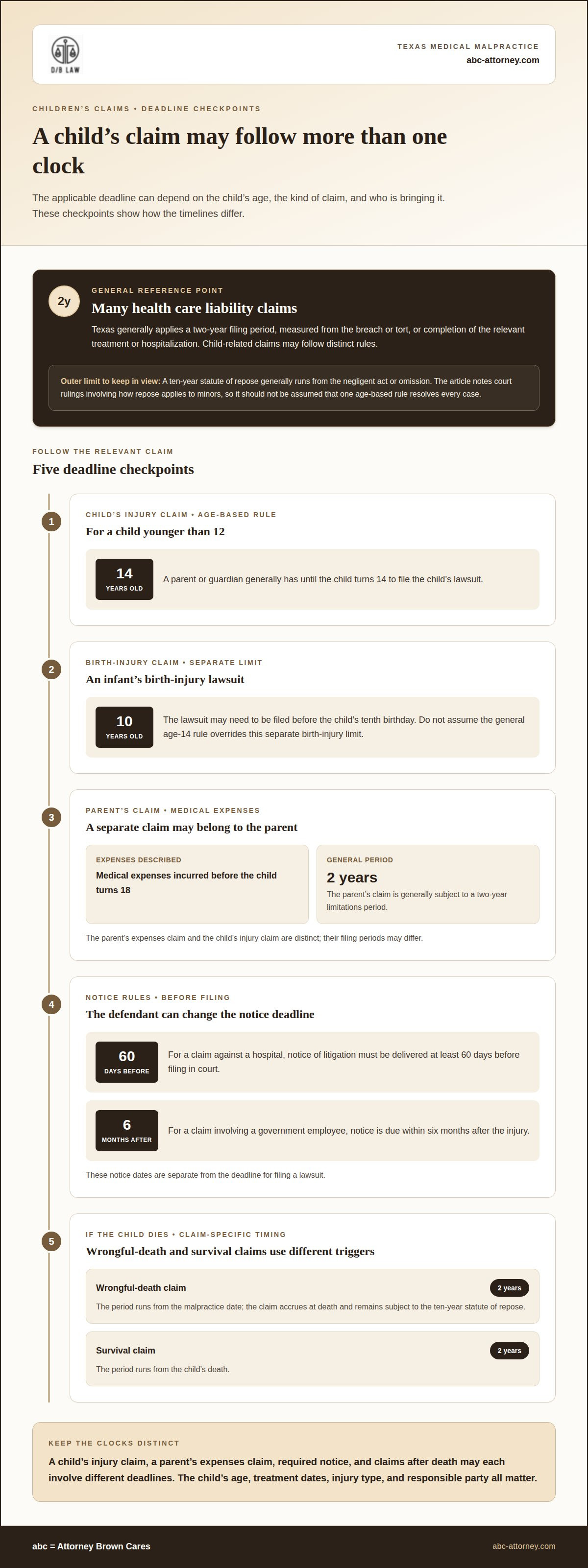
Deadlines for children’s medical malpractice claims in Texas depend on the child’s age and the type of claim. For a child younger than twelve, a parent or guardian generally has until the child turns fourteen to file the child’s lawsuit. Birth-injury claims can involve a different limit: an infant’s lawsuit may need to be filed before the child’s tenth birthday.
These timelines do not make every claim involving a child the same. The child’s injury claim, a parent’s claim for medical expenses, and a wrongful-death or survival action can have separate deadlines. The ten-year statute of repose may also matter. In Adams v. Gottwald, a Texas appeals court held that the repose period was unconstitutional as applied to minors. Later, the Texas Supreme Court ruled in Rivera v. Tenet Hospitals Ltd. that the ten-year repose period barred a claim involving a minor. These decisions make careful review essential.
A parent’s claim for a child’s medical expenses incurred before the child turns eighteen belongs to the parent, not the child. That claim is generally subject to a two-year limitations period. The child’s separate claim follows rules based on the child’s age and the nature of the injury. A parent may therefore face an expenses deadline while the child’s own injury claim follows a different filing period.
Notice requirements can create an earlier deadline. For a claim against a hospital, the claimant must deliver notice of litigation at least sixty days before filing in court. A claim involving a government employee has a separate notice rule: notice is due within six months after the injury. These notice dates are distinct from the deadline for filing a lawsuit.
Death can create additional claims and timelines. A child’s wrongful-death claim has a two-year limitations period running from the malpractice date, while the wrongful-death claim accrues at death and remains subject to the ten-year statute of repose. A survival claim for a deceased child has a two-year period running from the child’s death. Both the claim type and the relevant dates matter.
These overlapping rules make early legal review especially important in birth-injury cases. A lawyer can assess the child’s age, treatment dates, responsible parties, and whether the claim belongs to the child or a parent. For a child younger than twelve, do not assume the general age-fourteen deadline overrides the separate rule that may apply to an infant’s birth injury.
If you’re weighing a child’s injury claim, discuss the filing deadlines with a lawyer promptly. A careful review can distinguish the child’s claim from a parent’s expenses claim and identify any hospital or government notice deadlines.
Texas medical malpractice filing deadline
Texas generally applies a two-year filing period to health care liability claims. If a claim involves a government employee, notice is due within six months after the injury occurred.
The General Filing Deadline
The general filing deadline is two years from the breach or tort, or from completion of the relevant medical treatment or hospitalization. Texas Civil Practice and Remedies Code § 74.251 governs this limitations period. The starting event matters: the date of an alleged error may differ from the date treatment ends, so identifying the relevant care and timeline is essential.
For example, a patient may receive treatment over a course of visits after an alleged breach. The claim’s deadline may depend on when the relevant treatment or hospitalization ended. The two-year period is a filing limit, not simply a target for beginning a claim. A notice letter may affect the calculation only if it meets the statute’s requirements.
Claims against a Texas government employee have a separate notice requirement. Claims involving government employees may have a separate notice requirement, so check the applicable deadline. The specific defendant and claim type matter, so identify whether the claim concerns a government employee and treat the notice deadline separately from the lawsuit filing period.
Deadlines for Minor Patients
Texas applies special timing rules to medical malpractice claims involving minors. For a child younger than twelve, a parent or guardian generally has until the child turns fourteen to file the child’s lawsuit. The standard limitations period takes effect when a minor turns twelve, making the child’s age at the time of the injury important.
These rules do not give every claim connected to a child the same deadline. A child’s injury claim and a parent’s claim for medical expenses may have different filing periods. The applicable exception depends on the claim, the child’s age, and the relevant treatment dates. Map those details before relying on a general deadline.
For instance, a parent reviewing an injury that occurred when a child was younger than twelve must distinguish the child’s lawsuit from a separate expenses claim. The age-fourteen rule concerns filing the child’s action; it does not automatically set the deadline for every claim arising from the same care.
Provider Identity and Filing Time
Learning a provider’s identity later does not extend Texas medical malpractice filing deadlines. The clock does not wait simply because a patient discovers later who provided the care. Records identifying clinicians and facilities can help evaluate a claim, but later identification alone does not create additional filing time.
When several providers participated in treatment, the timeline and each provider’s role may need separate review. The alleged act or omission, treatment dates, and claim against each defendant can affect the analysis. Organize the care timeline and identify the providers involved, rather than assuming a newly discovered name restarts the period.
Because government notice and lawsuit deadlines may operate on different schedules, prompt legal review can help clarify which dates control. A timely review of a malpractice claim can assess the treatment timeline, provider identities, and any government-notice issue.
Discovery rule
The filing period generally runs from the breach or tort, or from completion of relevant treatment or hospitalization. Texas has a narrow discovery-related exception, not a broad rule for every injury discovered later.
When the Filing Deadline Begins
The Texas deadline generally begins with the breach or tort, or when relevant treatment or hospitalization ends. That starting point matters because a patient may discover an injury after the care that caused it.
Texas does not generally restart the limitations period when a patient discovers a condition or connects it to medical care. A later diagnosis alone may not change the deadline. Key dates include the alleged negligent act, the end of relevant treatment, and when the injury could reasonably have been discovered.
If a lawsuit is filed after the applicable deadline, the claim may be barred unless a recognized exception applies. A late filing does not automatically qualify for the discovery rule or the Open Courts provision.
Reasonable Time After Discovery
The Open Courts provision may allow a reasonable time to sue when an injury could not reasonably have been discovered before the two-year period expired. It does not automatically give a patient another full two years after discovery.
The Texas Supreme Court held in 1967 that applying the general two-year limit to an injury that could not be discovered within that period was unconstitutional. But the provision has limits. If a patient discovers the injury before the two-year period ends, it does not apply, even if discovery happens shortly before the deadline.
Texas courts have generally treated four to six months after discovery as a reasonable time to retain an attorney and file. This makes prompt action important once an injury and its possible connection to medical negligence become apparent. Waiting after discovery can weaken an argument for additional time.
Discovery Rule and Foreign Objects
Texas’s narrow discovery-rule exception applies to a tangible foreign object negligently left inside a patient. It generally does not cover a missed diagnosis, a treatment decision, or an error in professional judgment.
The distinction turns on the nature of the alleged negligence. A tangible object left inside a patient differs from a condition that became apparent later or a disagreement about medical care. The foreign-object exception therefore does not create a general extension for every injury discovered after treatment.
For example, a patient who later learns of a misdiagnosis cannot rely on the foreign-object exception simply because the diagnosis came late. A patient who discovers a tangible object left inside must still act promptly and assess the applicable filing period and repose limit.
If an injury surfaced after the ordinary deadline, discuss the discovery timeline with an attorney promptly. The dates of treatment, discovery, and filing can determine whether a narrow exception applies.
Texas medical malpractice statute of limitations
Texas medical malpractice deadlines involve overlapping rules, not one simple date. The controlling timeline may depend on the alleged negligent act, treatment, notice, and claim type.
Texas Civil Practice and Remedies Code § 74.251 generally requires a health care liability lawsuit within two years of the breach or tort, or the end of relevant treatment or hospitalization. A separate ten-year statute of repose runs from the negligent act or omission. These clocks measure different events, so meeting one deadline does not necessarily satisfy the other.
For a continuing course of treatment, a claimant may argue that the two-year period began near the end of treatment rather than its start. Texas cases have treated this issue inconsistently, and the facts matter. The course of care, alleged breach, and end of treatment can affect the argument. A continuing relationship alone does not establish a later deadline.
Notice can change the limitations calculation, but only within defined boundaries. Proper pre-litigation notice under § 74.251, sent within the two-year period, may toll the statute for 75 days. That extension does not add time to the ten-year statute of repose. A notice letter and a filed lawsuit are separate steps, each with its own timing consequences.
Other deadlines can apply during litigation. In a Texas medical malpractice lawsuit, the claimant must serve an expert report within 120 days after the defendant files an original answer. A claim against a hospital requires notice of litigation at least 60 days before filing in court. These procedural requirements do not replace the deadline for starting the lawsuit.
Fraudulent concealment may toll limitations when a provider actively prevents discovery of a claim. Mere nondisclosure does not qualify. Texas law also recognizes a narrow foreign-object exception, while continuing treatment may affect the limitations analysis. These are distinct theories, not automatic extensions. The evidence must fit the specific rule being raised.
A practical deadline review should map the alleged act or omission, the end of treatment, notice dates, and each defendant’s role. It should also separate the two-year limitations period from the ten-year repose period and later litigation deadlines. For example, a timely notice letter may add 75 days to limitations, yet leave the repose deadline unchanged.
If treatment involved several providers or an extended course of care, request a review of your filing timeline. A focused analysis of dates, notice, and alleged concealment can identify which deadline may govern the lawsuit.
The Dedric Brown Law Firm: Medical Malpractice Litigation
The Dedric Brown Law Firm handles Medical Malpractice Litigation involving serious harm from alleged medical negligence. If you are weighing a claim and need to understand how filing deadlines may affect your options, the firm can help assess the legal issues involved. Its work includes cases involving Traumatic Brain Injuries, Hypoxic & Anoxic Brain Injury, and Birth Injuries.
The abc in abc-attorney stands for “Attorney Brown Cares,” reflecting a commitment to personal attention for people facing consequential decisions. Timing questions can be especially difficult when an injury emerges after treatment or involves a child. The applicable deadline may depend on the dates of care, the alleged harm, and the type of claim. If you have questions about a potential medical malpractice claim, contact The Dedric Brown Law Firm for a free case review.
Take the Next Step With Clarity
A medical injury can affect health, work, and family life long after treatment ends. You deserve space to explain what happened and understand the choices ahead. A focused conversation can help turn scattered concerns into a clearer plan for moving forward.
Before reaching out, consider what you most need answered. You might want help organizing the events, understanding the legal process, or deciding what information to share. A careful discussion of how the Texas medical malpractice statute of limitations applies can put your concerns in context without losing sight of the person behind the claim.
The Dedric Brown Law Firm handles medical malpractice litigation and related serious injury matters. Contact the firm to discuss your situation and the questions weighing on you. Contact The Dedric Brown Law Firm when you’re ready to take that step. You don’t have to sort through the process alone, and a thoughtful conversation can help you move ahead with greater confidence.
Frequently Asked Questions
Can the statute be extended if the provider's identity is discovered later?
No. Discovering a health care provider’s identity later does not extend the filing deadline in Texas. For example, finding a clinician’s name in records after treatment does not, by itself, restart the limitations period. Identifying each provider involved can still matter when assessing who may be responsible and which dates apply. Reviewing records and treatment history can help clarify the claim, but late identification alone adds no filing time.
When Can You Sue a Hospital?
A person bringing a medical malpractice claim against a Texas hospital must deliver notice of litigation at least 60 days before filing in court. This notice requirement is separate from the lawsuit deadline. For example, a patient planning to sue a hospital must account for the notice interval as well as the applicable limitations period. The identity and legal status of the facility may affect which notice rules apply, so distinguish a hospital from other care providers.
What is the statute of limitations for medical malpractice in Texas?
The Texas medical malpractice statute of limitations generally gives a claimant two years from the breach or tort, or from completion of relevant treatment or hospitalization, to file. A separate ten-year statute of repose runs from the negligent act or omission. Proper notice under Chapter 74 can toll limitations for 75 days when sent within the applicable period, but it doesn’t extend repose. A calendar should track each relevant event, not just the date of diagnosis.
What exceptions extend or toll the Texas medical malpractice deadline for minors?
Birth-injury claims involving an infant may have a distinct deadline before the child’s tenth birthday. A parent’s claim for a child’s medical expenses follows its own two-year period. These are different claims with separate interests, so a family should identify whether it seeks recovery for the child, a parent, or both.
How does the discovery rule affect Texas medical malpractice limitations?
Texas does not apply a broad discovery rule to most medical malpractice claims. A narrow exception covers a tangible foreign object negligently left inside a patient, not a missed diagnosis or treatment judgment. The Open Courts provision may help when an injury could not reasonably have been discovered within the limitations period, but it does not automatically grant a fresh two years. A later diagnosis alone, for instance, does not establish that an injury was undiscoverable.
How do Texas medical malpractice deadlines differ for wrongful death claims?
A Texas medical malpractice wrongful-death claim accrues at death and remains subject to the ten-year statute of repose. Claims involving a deceased child can also include a survival action, which has a separate two-year period running from the child’s death. The claims protect different legal interests, so the family should distinguish losses arising from the death from claims the deceased child could have pursued. The event dates and claim type shape the deadline analysis.



Comments