
Texas Medical Malpractice Lawsuit: A Family's Guide

Holding a negligent hospital accountable in Texas is a high-stakes battle that demands fierce advocacy and rigorous analytical precision. If you are coping with a catastrophic injury while healthcare providers dismiss your concerns, knowing the exact steps to file a medical malpractice lawsuit is your vital first move toward justice. At our firm, abc stands for Attorney Brown Cares, and we believe no family should have to confront this formidable legal system alone.
You already know how overwhelming this crisis feels, particularly when facing rigid Texas filing deadlines, confusing liability caps, and constant worry about your loved one's lifelong care. We promise to clarify the legal journey ahead with a structured, step-by-step framework designed to protect your family's future and restore financial peace of mind. In this guide, you will examine the mandatory Texas pre-suit notice rules, the critical expert report requirements, and the strategic evidence needed to hold negligent practitioners accountable.
Table of Contents
What Qualifies as Medical Malpractice in Texas?
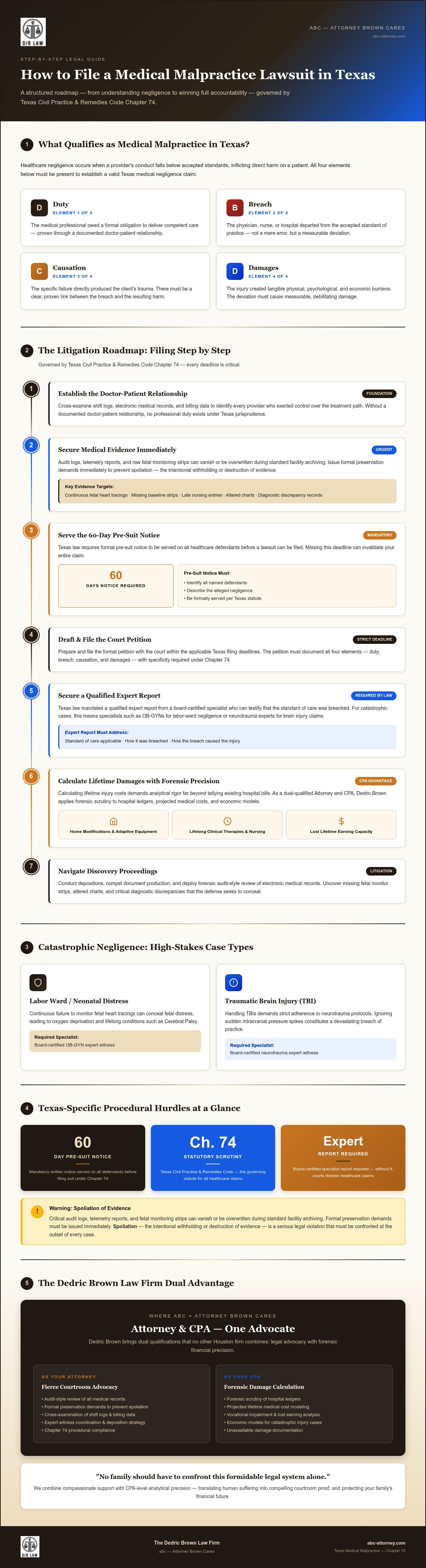
A medical crisis throws a family's entire life into turmoil. When a clinical procedure goes wrong, distinguishing between an unavoidable complication and actionable negligence requires meticulous legal scrutiny. Under established principles of medical malpractice in the United States, healthcare negligence takes place when a provider's conduct falls below accepted standards, inflicting direct harm on a patient. Knowing the precise steps to file a medical malpractice lawsuit begins with verifying that four vital legal criteria are present:
Duty: The medical professional owed a formal obligation to deliver competent care.
Breach: The physician, nurse, or hospital departed from the accepted standard of practice.
Causation: This specific failure directly produced the client's trauma.
Damages: The injury created tangible physical, psychological, and economic burdens.
An undesirable outcome or minor clinical error does not automatically constitute malpractice. The deviation must cause measurable, debilitating damage. At our practice, abc means Attorney Brown Cares. We dig beneath the sterile clinical charts to uncover the personal story of trauma, translating human suffering into compelling courtroom proof.
The Standard of Care in Catastrophic Cases
Board-certified specialists like OB-GYNs and neurosurgeons must operate according to elite professional benchmarks, not entry-level clinical standards. In catastrophic labor scenarios, a continuous failure to monitor fetal heart tracings can conceal fetal distress, leading to oxygen deprivation and lifelong conditions such as Cerebral Palsy. Similarly, handling traumatic brain injuries demands strict adherence to neurotrauma protocols. Ignoring sudden intracranial pressure spikes constitutes a devastating breach of practice.
Establishing the Doctor-Patient Relationship
Every valid liability claim rests on proving a clear doctor-patient relationship. Without this documented legal anchor, no professional duty exists under Texas jurisprudence. As both an attorney and a CPA, Dedric Brown applies an audit-style approach to legal discovery. We cross-examine shift logs, electronic medical records, and billing data to pinpoint every provider who exerted control over your treatment path. Clarifying these legal baselines is one of the most critical steps to file a medical malpractice lawsuit and secure full accountability.
The Investigation Phase: Building an Analytical Foundation
Proving clinical fault requires moving past surface assumptions into deep, methodical discovery. The initial steps to file a medical malpractice lawsuit in Texas demand an evidentiary foundation that can withstand aggressive defense tactics. Under Texas Civil Practice and Remedies Code Chapter 74, healthcare claims face intense statutory scrutiny from day one. Gathering an incomplete chart or waiting on standard hospital summaries will compromise your claim. Because abc stands for Attorney Brown Cares, our team treats your family's trauma with exhaustive personal attention, ensuring no detail of your loved one's suffering is overlooked.
Securing Medical Evidence and Fetal Monitoring Strips
Speed is essential when obtaining electronic medical records. Critical audit logs, telemetry reports, and raw monitoring strips can vanish or suffer overwrites during standard facility archiving schedules. In neonatal distress and labor-ward emergencies, continuous fetal heart tracings provide the timeline of oxygen starvation. Missing baseline strips or late nursing entries reveal institutional negligence. Spoliation is the intentional withholding or destruction of evidence. We move swiftly with formal preservation demands to protect critical documentation before altered timelines take root.
The CPA Advantage: Calculating Life-Altering Damages
Calculating lifetime injury costs demands analytical rigor far beyond tallying existing hospital bills. Families dealing with traumatic brain injuries or lifelong conditions like Cerebral Palsy face continuous financial pressures:
Specialized clinical therapies, in-home nursing, and adaptive mobility equipment
Home modifications, architectural retrofitting, and specialized transportation
Total loss of lifetime earning capacity and compounding vocational impairment
Dedric Brown brings dual qualifications as both an attorney and a CPA. We apply forensic scrutiny to hospital ledgers, projected medical costs, and economic models. This forensic calculation creates an unassailable financial foundation for your claim. If your family is confronting the realities of permanent injury, reach out to our legal team to begin reviewing your medical evidence.
Texas-Specific Legal Requirements: The Procedural Hurdles
Texas enforces some of the nation's most stringent statutory barriers against injured patients. Understanding the procedural steps to file a medical malpractice lawsuit requires total command of state codes, filing calendars, and strict evidentiary hurdles. Under Texas Civil Practice and Remedies Code Chapter 74, missing a single procedural prerequisite results in mandatory dismissal with prejudice. At our practice, the acronym abc means Attorney Brown Cares. We insulate grieving families from lethal procedural traps by applying disciplined, deadline-driven oversight to every catastrophic claim.
The Texas Notice of Claim and Tolling Rules
In Texas, a medical negligence lawsuit must generally be filed within two years from the breach or completed treatment course, backed by an absolute 10-year statute of repose. Prior to initiating litigation, you must deliver a formal 60-day written notice of health care claim via certified mail to every prospective defendant. Timely service of this notice tolls the two-year deadline for 75 days, granting vital room to finalize case preparation.
Texas law also provides special tolling rules for injured children. When an infant suffers neonatal harm or delivery-room trauma before age 12, the limitation clock extends until their 14th birthday. For children aged 12 and older, the standard two-year window applies. Missing any of these strict statutory thresholds extinguishes your family's legal rights forever.
The 120-Day Expert Report Deadline
Surviving early defense challenges hinges on delivering a comprehensive Chapter 74 expert report within 120 days of each defendant filing an answer. This submission cannot rely on generalized opinions. A qualified medical specialist in an identical or related practice area must explicitly state the standard of care, specify how the provider breached it, and prove the exact causal link to the injury.
If the report fails to satisfy statutory requirements, the court must dismiss the case and award attorney fees to the defense. Because locating top-tier, practicing specialists requires extensive coordination, our team vets credible medical authorities well before entering court. This methodical rigor reinforces the vital steps to file a medical malpractice lawsuit and protects your financial future.
The Litigation Journey: From Filing to Resolution
Initiating a formal court action transforms quiet negotiations into active, courtroom confrontation. When you file an Original Petition in a Texas District Court, your legal battle begins in earnest. Hospital defense counsel will respond quickly with motions seeking summary dismissal. Overcoming these initial defense tactics represents one of the defining steps to file a medical malpractice lawsuit. At our firm, abc stands for Attorney Brown Cares. We guide you through each procedural phase with disciplined resolve, providing the emotional security and aggressive advocacy your family deserves.
The Intensity of Discovery and Depositions
Discovery constitutes the search for factual truth behind closed hospital doors. Defense attorneys use written interrogatories, mandatory production requests, and hostile oral examinations to challenge your credibility. A deposition is a sworn, out-of-court testimony used as evidence. Facing intense questioning from corporate healthcare defense lawyers feels intimidating. We prepare our clients thoroughly, turning vulnerability into poise so they can recount their medical trauma with clear conviction.
During discovery, we focus on exposing institutional breakdowns that standard medical charts attempt to disguise:
Internal hospital incident logs and clinical communication chains
Staffing rosters reflecting unassigned units or overworked nursing staff
Deposition admissions from attending physicians regarding delayed interventions
Mediation: A Path to Resolution Without a Trial
Most Texas trial judges mandate formal mediation before assigning a courtroom docket date. Mediation brings both parties together before an independent legal mediator to negotiate financial terms. Unlike typical personal injury lawyers who evaluate cases using guesswork, Dedric Brown applies his background as an attorney and CPA to craft detailed economic life-care models. We project lifetime specialized care costs, vocational losses, and adaptive therapies down to the penny. This analytical rigor prevents insurance carriers from undervaluing life-altering harm.
If mediation cannot secure full accountability, we present the evidence directly to a Texas jury. For strategic, data-driven legal counsel from petition to final resolution, contact our office today.
Why Attorney Brown Cares (abc): Your Ally in Catastrophic Claims
Catastrophic injuries shatter lives, strain finances, and demand tireless courtroom advocacy. Rather than operating as a high-volume settlement mill, our practice focuses specifically on severe, life-altering trauma, including birth injuries and traumatic brain injuries. We believe our clients are never just file numbers. They are resilient families facing enormous hardships who deserve an uncompromising champion. That belief guides everything we do, because the acronym abc means Attorney Brown Cares. Knowing the formal steps to file a medical malpractice lawsuit is only half the battle; partnering with a firm that treats your recovery as a personal calling completes the equation.
Principles and Combat: A Disciplined Approach to Law
Litigating against well-funded hospital networks demands relentless discipline. Drawing from deep competitive roots in community athletics, Dedric Brown approaches trial preparation like a championship contest. We combine aggressive courtroom advocacy with strict ethical standards, ensuring every legal maneuver remains bulletproof. In severe neurological and brain trauma claims, success requires total analytical precision during discovery. We leave no chart unexamined, no electronic discrepancy unquestioned, and no medical protocol unchallenged.
Our commitment to client welfare reflects deep community connections across Southeast Texas:
Decades of rooted advocacy serving families across Houston, Beaumont, and neighboring regions
Direct access to lead counsel throughout the entire litigation timeline
Dual legal and financial oversight designed to eliminate defense undervaluation
Taking the Next Step with the Dedric Brown Law Firm
Stepping forward after clinical negligence should not introduce financial fear. We handle catastrophic injury cases on a contingency fee basis, which means you pay nothing out of pocket unless our team recovers compensation for your family. During your initial free consultation, we review your clinical timeline, examine potential liability, and outline the precise steps to file a medical malpractice lawsuit tailored to your circumstances. Contact the Dedric Brown Law Firm today—because Attorney Brown Cares (abc).
Take Command of Your Family's Legal Future
Confronting clinical negligence requires unyielding advocacy and forensic financial scrutiny. From serving the certified 60-day notice to delivering qualified Chapter 74 expert reports, properly navigating the steps to file a medical malpractice lawsuit ensures healthcare systems answer for traumatic brain injuries and birth trauma. Holding wrongdoers accountable creates the foundation your household needs to heal and rebuild.
As a dual-licensed attorney and CPA, Dedric Brown applies audit-style precision to uncover hidden institutional breakdowns and calculate the true lifetime cost of specialized care. We champion your recovery every day because abc stands for Attorney Brown Cares. You don't have to carry this immense emotional and financial weight by yourself. Start your free case review with Attorney Dedric Brown to demand justice and secure the lifelong stability your loved one deserves.
Frequently Asked Questions
How long do I have to file a medical malpractice lawsuit in Texas?
You generally have two years from the date of the negligent act or completion of treatment to file a lawsuit in Texas. The state also enforces a strict 10-year statute of repose, barring claims discovered after a decade. Tolling exceptions apply for minors injured before age 12, extending their deadline until their 14th birthday. Missing these statutory deadlines permanently extinguishes your legal right to pursue compensation.
What is the 'Notice of Health Care Claim' in Texas?
A Notice of Health Care Claim is a mandatory written notification sent by certified mail to each healthcare provider at least 60 days before filing a lawsuit. This formal notice outlines the factual basis of your claim and includes an authorization form for medical records. Properly serving this document tolls the standard two-year Texas statute of limitations for an additional 75 days, giving counsel time to finalize court pleadings.
Do I need to hire a medical expert before filing a lawsuit?
Yes, securing a qualified medical expert before filing is practically essential under Texas law. Within 120 days of the defendant filing an answer, you must serve a sworn Chapter 74 expert report detailing the standard of care, the breach, and causal link. Coordinating these vital steps to file a medical malpractice lawsuit early ensures your claim withstands aggressive defense motions to dismiss.
Can I sue a hospital if my child suffered a birth injury like Cerebral Palsy?
Yes, you can sue a hospital and medical team if clinical negligence caused your child's Cerebral Palsy or neonatal brain injury. Common grounds include failure to monitor fetal distress, delayed emergency C-sections, or improper use of delivery forceps. At our firm, abc means Attorney Brown Cares. We aggressively investigate labor-and-delivery teams across Texas to hold negligent healthcare institutions accountable for preventable delivery trauma.
What kind of compensation can I recover in a medical malpractice case?
You can recover both economic and non-economic damages in a Texas medical malpractice claim. Economic damages have no cap and cover past medical bills, projected lifetime therapy costs, adaptive home equipment, and lost earning capacity. Non-economic damages cover physical pain, mental suffering, and disfigurement. Texas law caps non-economic damages at $250,000 for individual physicians and up to $750,000 across multiple healthcare institutions.
What happens if the doctor's insurance company offers a settlement early?
You should never accept an early settlement offer before speaking with an experienced malpractice attorney. Insurance adjusters present lowball offers early to minimize payouts before the true extent of a catastrophic injury becomes clear. Signing a release terminates your right to seek additional recovery forever. We evaluate claims with CPA precision to guarantee settlements cover a lifetime of medical expenses and specialized care.
How do I prove a traumatic brain injury (TBI) was caused by medical negligence?
Proving a medical malpractice TBI requires connecting healthcare errors directly to measurable neurological damage using objective diagnostic data. Our firm audits telemetry files, oxygenation logs, medication administration records, and neuroimaging scans. Aligning these investigative steps to file a medical malpractice lawsuit allows us to isolate the exact moment clinical errors or delayed interventions produced irreversible brain damage.
Why is it important that my lawyer is also a CPA?
Having an attorney who is also a CPA ensures your catastrophic damages are calculated with forensic auditing precision. Severe injuries involve complex, compounding future medical costs, in-home care requirements, and vocational losses. Dedric Brown uses analytical accounting methods to prevent defense lawyers from understating your lifetime financial requirements. That combination of financial scrutiny and courtroom advocacy reinforces why Attorney Brown Cares (abc) for your family.


Comments