
Structured Settlement for a Minor: A Parent’s Guide

Updated: 3 days ago
Could a stream of future payments protect your child better than receiving settlement funds at once? A structured settlement for a minor can provide money over time, but the schedule needs to account for your child’s changing medical, educational, and personal needs.
It’s natural to wonder who manages the money, when your child can access it, and whether the proposed plan will still make sense years from now. The right choice depends on more than the payment schedule. Families need to understand the trade-offs and assess whether the settlement serves the child’s interests.
This guide explains how structured payments work, how they compare with other arrangements, and what to review before a settlement is approved. At abc, meaning “Attorney Brown Cares,” we approach serious injury matters with personal attention and a focus on the people behind the case. A careful review of the underlying claim can help your family understand its options.
Table of Contents
What Is a Structured Settlement for a Minor, and How Does It Work?
How Should a Minor’s Settlement Payment Schedule Be Designed?
Structured Settlement vs. Lump Sum, Trust, or 529 Plan: What Should Families Compare?
What Should Texas Families Know About Court Review and Managing a Minor’s Settlement?
How Can a Parent Protect a Child’s Interests Before Accepting a Settlement?
What Is a Structured Settlement for a Minor, and How Does It Work?
A structured settlement for a minor provides compensation through payments over time instead of delivering the entire amount at once. The agreement sets out when payments are due and how they are arranged. There is no single schedule that fits every child or claim. The terms depend on the case and call for individualized legal and financial consideration.
A structured settlement pays agreed compensation over time; a lump-sum settlement delivers it all at once. A payment plan may trade immediate access to the full amount for funds scheduled at selected future times. That distinction matters when weighing current needs against possible expenses later.
The payment arrangement is separate from the underlying personal injury or medical malpractice claim. The claim concerns the injury and the compensation being pursued; the structure concerns how settlement funds will be paid. Reviewing both helps families understand what the proposed resolution addresses and how the funds may reach the child over time. The structured settlement overview offers general background, but it cannot determine which terms fit a particular child or case.
How periodic payments can be arranged
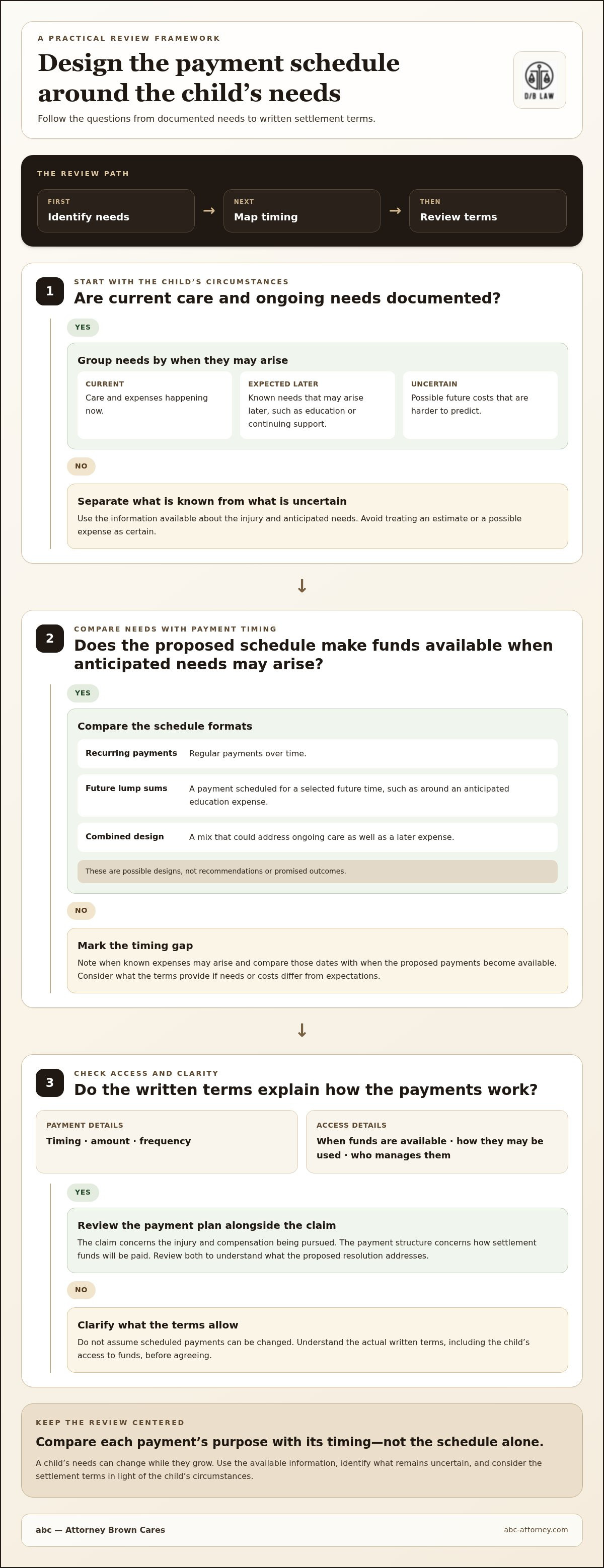
A plan might provide recurring payments, future lump sums, or a combination. For example, recurring payments could provide support over a period of time, while a future lump sum could be scheduled around anticipated education expenses. A combined design might address ongoing care as well as a later expense.
These are examples of possible designs, not recommendations or promised outcomes. Review the written terms closely: note the payment timing, amount, and frequency, along with the child’s access to funds under the arrangement. Even a straightforward schedule needs to be considered in light of the child’s circumstances and the settlement terms.
Why a child’s settlement needs special consideration
A child’s needs may change while they grow. A family may need to account for near-term care while considering possible later expenses, such as education or continuing support. No one can predict an individual child’s future with certainty, so evaluate the schedule alongside the information available about the injury and anticipated needs.
It can also be difficult to separate a child’s interests from immediate household financial pressures. Both deserve attention, but they are different considerations. A careful review focuses on what the settlement is intended to address for the child, what the payment terms allow, and whether those terms reflect the child’s circumstances. That clarity helps parents weigh the proposal without assuming one payment structure is automatically best.
How Should a Minor’s Settlement Payment Schedule Be Designed?
There is no universal payment schedule that suits every child. Start with what the family knows about the child’s needs, then consider how different payment timings could address them. For a structured settlement for a minor, the goal is not to predict every future expense. It is to understand what the proposed schedule covers, when funds become available, and where uncertainty remains.
Use this framework to organize the review:
Identify needs. Gather available information about current care and documented ongoing needs related to the injury.
Map timing. Note when known expenses may arise and distinguish them from possible future costs that are harder to predict.
Compare access. Consider whether regular payments, payments at selected milestones, or a combined schedule best fits those needs and the required access to funds.
Review legal terms. Confirm that the written settlement terms clearly explain the schedule and how it relates to the resolution of the claim.
This process helps families compare each payment’s purpose with its timing, rather than focusing on the schedule alone. The overview of structured settlements for minors also discusses designing payments around anticipated future needs. Examples are illustrative only. They cannot predict a particular child’s needs or replace case-specific legal and financial advice.
Matching payment timing to anticipated needs
Start with documented needs. If ongoing treatment or care is anticipated, consider whether the schedule addresses its expected timing. Do not assume those expenses apply in every case. Education or a transition-to-adulthood goal may also shape when a family wants funds to become available. Separate known expenses from uncertain possibilities, and do not treat an estimate as certain.
To prepare, group needs by timing, such as current, expected later, and uncertain. This can make gaps or mismatches easier to spot. It also keeps the discussion grounded in the child’s circumstances instead of relying on a sample schedule that may not fit the family’s situation.
Balancing scheduled payments and flexibility
A fixed schedule can offer predictability, but it may limit immediate access to funds. Examine what the terms provide if an expense arises earlier than expected, costs differ from estimates, or the child’s circumstances change. Do not assume scheduled payments can be changed. Understand the actual settlement terms before agreeing.
For families with a Texas injury or malpractice matter, a legal review can clarify how the proposed schedule relates to the claim and the child’s interests. You can request a free case review with Attorney Brown to discuss the injury matter and settlement choices.
Structured Settlement vs. Lump Sum, Trust, or 529 Plan: What Should Families Compare?
When comparing settlement arrangements, look beyond each option’s name. Ask when funds may be available, who controls access, what purpose the arrangement serves, and which terms need legal review. A structured settlement for a minor may schedule payments over time, while other arrangements hold or allocate funds differently.
The right comparison depends on the child’s needs and the settlement terms. Neither scheduled payments nor a lump sum is automatically the better choice. The practical fit depends on the claim, the child’s circumstances, and the rules that apply to the proposed arrangement.
Structured paymentsTiming: Payments are scheduled for future dates or periods.Access: Follows the written schedule, which may limit access to the full amount at once.Purpose: Can be designed around anticipated needs over time.Review: Examine the timing, payment terms, and what options exist if needs change.
Lump sumTiming: Settlement funds are provided at once, subject to the applicable terms and safeguards.Access: Offers a different pattern of access, but legal arrangements may affect a minor’s ability to use the funds.Purpose: May appeal when flexibility is important, though the funds still require careful management.Review: Clarify who controls the funds and any limits on access or use.
Trust or blocked accountTiming: Funds are held under the arrangement’s terms.Access: A trust generally involves a trustee managing funds; a blocked account generally restricts access under applicable terms or orders.Purpose: These are ways to hold or manage funds, not payment schedules in themselves.Review: Understand authority, permitted access, and the terms governing management.
529 planTiming: Funds are set aside for education-related savings.Access: Use and control depend on the plan’s terms and applicable rules.Purpose: Education savings, rather than general settlement management.Review: Verify eligibility, tax treatment, and how settlement funds may be used.
Structured payments compared with a lump sum
Scheduled payments can make timing more predictable, but they may not provide immediate access to the full settlement amount. A lump sum may allow more flexibility in managing funds, while placing greater importance on planning for future needs. Those priorities can pull families in different directions. Compare the actual terms rather than assuming either arrangement guarantees growth, protection, or a better result.
Trusts, blocked accounts, and education savings
A trust, blocked account, and 529 plan serve different general functions. None should be treated as interchangeable with a payment schedule. Legal, tax, and eligibility details can vary by circumstances and jurisdiction, so understand the rules that apply before relying on a particular arrangement. For families looking into how trusts operate as part of broader asset protection, resources such as patrickdwilliamsestateplanner.com demonstrate how estate planners structure trusts to safeguard assets for younger family members. Settlement funds and education savings may have different purposes and rules. Legal review can help clarify how the proposed terms resolve the injury claim and address the child’s interests.
What Should Texas Families Know About Court Review and Managing a Minor’s Settlement?
A child’s settlement can involve court procedures, but the process and requirements depend on the case, the proposed arrangement, and applicable Texas law. Do not assume every settlement follows the same steps or that a judge must approve every payment structure. A structured settlement for a minor should be reviewed in the context of the underlying claim and the specific terms proposed.
Before relying on general guidance, determine which Texas process applies to your child’s case. Families can use this sequence to organize a discussion with their attorney. It is not a substitute for checking current law or court procedure:
Identify the decision. Clarify whether the issue is resolving the injury claim, choosing how funds will be paid, deciding who will manage them, or more than one of these.
Review current rules. Determine which Texas statutes, court rules, and procedures apply to the child’s specific settlement and proposed arrangement.
Assess the child’s interests. Compare the proposal with the child’s documented circumstances, anticipated needs, access to funds, and the terms of the claim resolution.
Document the terms. Make sure the agreement and any related court documents accurately describe the payment schedule, management arrangement, and applicable safeguards.
Questions to resolve before settlement approval
Ask what payment terms are proposed and how they relate to the child’s documented circumstances. Clarify who will manage any funds, what limits or safeguards apply under the arrangement, and which document sets those terms. Review what the agreement says about future payments. If circumstances change, does it address a requested change, or does that question depend on applicable law or further review? Clear answers matter more than assumptions.
Keep the claim resolution distinct from the method of managing the funds. Your family should understand what legal claims the settlement resolves as well as what happens to the proceeds. Reviewing both can uncover gaps, such as a clear payment schedule but uncertain control or access.
Who manages the settlement and when control may change
Management depends on the arrangement and current applicable law. A parent or guardian may provide information or participate in a process, but that alone does not establish authority to control settlement funds. The documents and legal framework determine who manages the money, what limits apply, and whether or when control changes as the child grows older. Do not assume that guardianship, a blocked account, or another arrangement works the same way in every case.
Before agreeing, have the proposed terms reviewed against current Texas requirements, especially if they describe who can access funds or how future payments are handled. The Dedric Brown Law Firm reviews personal injury and medical malpractice matters with care for the people behind each claim. To discuss how the injury claim relates to the proposed terms, contact the firm about your child’s settlement.
How Can a Parent Protect a Child’s Interests Before Accepting a Settlement?
Before agreeing to a settlement, understand both how the money will be paid and managed and what legal claims the settlement resolves. The proposed terms should be clear enough for you to explain what happens, when it happens, and what questions remain. Get those questions answered before accepting.
A parent’s review checklist before agreeing
Use this checklist to organize your review and keep your child’s interests at the center:
Clarify the payment terms. Summarize the amount and timing of each proposed payment, any conditions attached, and any terms affecting future access.
Map your child’s needs. Compare the arrangement with documented and reasonably anticipated needs, distinguishing established expenses from uncertain possibilities.
Compare access. Identify when funds become available, who manages them, and what limits or safeguards apply.
Understand the claim resolution. Confirm what claims the agreement resolves and how its terms relate to the child’s circumstances and injury-related losses.
List open questions. Note unclear language or concerns about future payments and changes, then raise them during legal review.
A sample schedule or general explanation cannot determine what fits your child’s case. The written agreement contains the specific terms, and their legal effect depends on the circumstances. If the payment proposal seems clear but the claim resolution does not, pause and get an explanation of both before deciding.
When to seek legal review of the underlying injury claim
Consider the payment terms alongside the personal injury or medical malpractice claim. The schedule describes how settlement funds may be paid; the claim resolution defines what the settlement addresses. Reviewing both can reveal unanswered questions about the agreement as a whole.
The Dedric Brown Law Firm represents individuals in personal injury and medical malpractice matters in Texas, including Houston, San Antonio, Dallas, Austin, Beaumont, Huntsville, Prairie View, and Brenham. At abc, “Attorney Brown Cares” means giving personal attention to what the case means for the child and family, without promising a particular result. Families can discuss their injury claim and settlement terms with the firm.
Fighting for your rights with integrity and dedication.
Move Forward With a Clearer View of Your Child’s Interests
Make sure you can explain the proposed settlement in plain terms: what it resolves, how it works, and which questions still need answers. Before agreeing, gather those questions and seek guidance specific to your child’s case. A careful decision starts with clarity, not pressure.
If you’d like to discuss the injury claim and its proposed terms, connect with The Dedric Brown Law Firm. You do not have to sort through every detail alone. Move forward one question at a time, keeping your child’s interests at the center.
Frequently Asked Questions
What is a structured settlement for a minor?
A structured settlement for a minor is compensation paid over time under agreed settlement terms rather than entirely at once. Payment amounts and timing depend on the individual arrangement. The phrase describes how settlement money is paid, not a separate injury claim. For a Texas family, the key documents are the settlement terms and any related orders. Review their language rather than assuming another child’s arrangement works the same way.
Can a structured settlement for a minor pay for future medical care?
Payment timing may be planned around anticipated care needs, but whether a particular schedule fits depends on its terms and the child’s circumstances. Separate expenses supported by current records from possible needs that remain uncertain. If care needs change, do not assume payments can be redirected or rescheduled. Review the agreement before relying on settlement funds for a treatment expense that was not anticipated.
Does a minor’s structured settlement affect Medicaid or other public benefits?
It can, but the effect depends on the benefit program, settlement arrangement, and child’s circumstances. Do not assume scheduled payments are ignored or that a lump sum automatically ends eligibility. Benefit rules are program-specific and can change. Identify the benefits the child receives or may need, and consider how the settlement terms could affect them before accepting an arrangement.
Are payments from a minor’s structured settlement taxable?
Tax treatment depends on the claim and payment arrangement, so families should not assume every payment receives identical treatment. Rules for compensation tied to physical injury may differ from rules that apply to other components, such as interest or punitive damages. Working with experienced accounting professionals, such as the team at Tax Partners, can help clarify how different types of income and distributions are treated. Consider the actual settlement documents and applicable tax rules, and do not choose a payment arrangement based on a tax assumption alone.
Can parents use a child’s settlement money for ordinary household expenses?
Settlement funds are intended to serve the child’s interests, but whether a particular expense is permitted depends on the arrangement and applicable law. A household bill may benefit several people, so do not assume it qualifies simply because the child lives in the home. Before using funds for shared expenses, review the governing documents and current Texas requirements. Keep records showing the expense and how it relates to the child.
What happens to a minor’s structured settlement if the child dies?
The outcome depends on the payment agreement, any beneficiary terms, and applicable law. Payments might not automatically stop, continue, or pass to a particular person, so avoid relying on a general assumption. Review the settlement documents for language addressing the recipient’s death and future payments. Texas-specific inheritance and payment rules may affect the result, so the actual agreement must be considered under current law before drawing conclusions.



Comments