
Hypoxic Brain Injury Lawyer: Guidance for Texas Families

What if the medical records hold clues about how your child’s brain was deprived of oxygen, but the timeline still doesn’t make sense? After a hypoxic brain injury, families can face urgent questions about what happened, who may be responsible, and how to plan for ongoing care. A hypoxic brain injury lawyer can investigate those questions, but an injury alone doesn’t establish that negligence occurred.
It’s understandable to feel overwhelmed by complex medical records and uncertain about the future. A careful claim evaluation examines the timeline, the care provided, and whether evidence connects any preventable conduct to the injury and its effects.
This guide explains what a Texas lawyer may investigate, which medical and other records could matter, and how a legal review assesses responsibility and harm. It also explains how Attorney Dedric Brown’s legal and CPA background can inform the analysis of complex case details.
At The Dedric Brown Law Firm, abc means “Attorney Brown Cares.” That commitment means treating your family with compassion, examining the evidence carefully, and explaining possible next steps in clear terms.
Table of Contents
When Should a Family Contact a Hypoxic Brain Injury Lawyer in Texas?
A frightening diagnosis can bring more questions than answers. Your family may be trying to understand what happened, whether the injury could have been prevented, and what your child may need in the future. You don’t have to answer those questions alone or decide for yourself whether someone made a mistake.
A hypoxic brain injury involves brain damage associated with inadequate oxygen reaching the brain. Hypoxia means too little oxygen; anoxia refers to an absence or near-absence of oxygen. These terms describe different degrees of oxygen deprivation, but a medical label by itself doesn’t explain when or why the injury occurred.
A diagnosis identifies an injury; evidence must connect it to legally actionable conduct. A poor outcome, including a serious birth-related injury, doesn’t automatically establish negligence or responsibility. Relevant facts may involve pregnancy care, labor and delivery, newborn treatment, or another medical-care setting. Each situation has its own timeline, medical circumstances, and questions to examine.
How can oxygen deprivation lead to a potential legal claim?
A legal evaluation asks what happened, when it happened, and who may have been responsible. For a birth-related injury, that can mean examining how the care team responded to changing conditions, what fetal monitoring documented, and what happened around delivery and after birth. A concern about monitoring is a question for case-specific review, not proof of a failure.
Medical records often contain technical details that are difficult to interpret in isolation. Qualified analysis is needed to assess what the records show, what standards may apply to the care, and whether the events medically connect to the brain injury. The goal is to test whether the evidence supports each link, not to assume that oxygen deprivation proves fault.
What should families do when the cause remains unclear?
Start with what you have. Keep copies of available medical records, discharge paperwork, and follow-up documents. Write down questions as they arise and note the sequence of events as you remember it, including appointments, changes in condition, and conversations with care providers. Your notes don’t need to be complete or medically precise.
An early discussion with a hypoxic brain injury lawyer can help organize known facts, identify missing information, and explain what may need further review. It doesn’t mean a claim exists, and your family isn’t responsible for investigating medical fault or reaching a legal conclusion alone. Bring the records and questions you have. Uncertainty is a reasonable place to begin.
How Do Lawyers Evaluate Hypoxic Brain Injury and Medical Negligence?
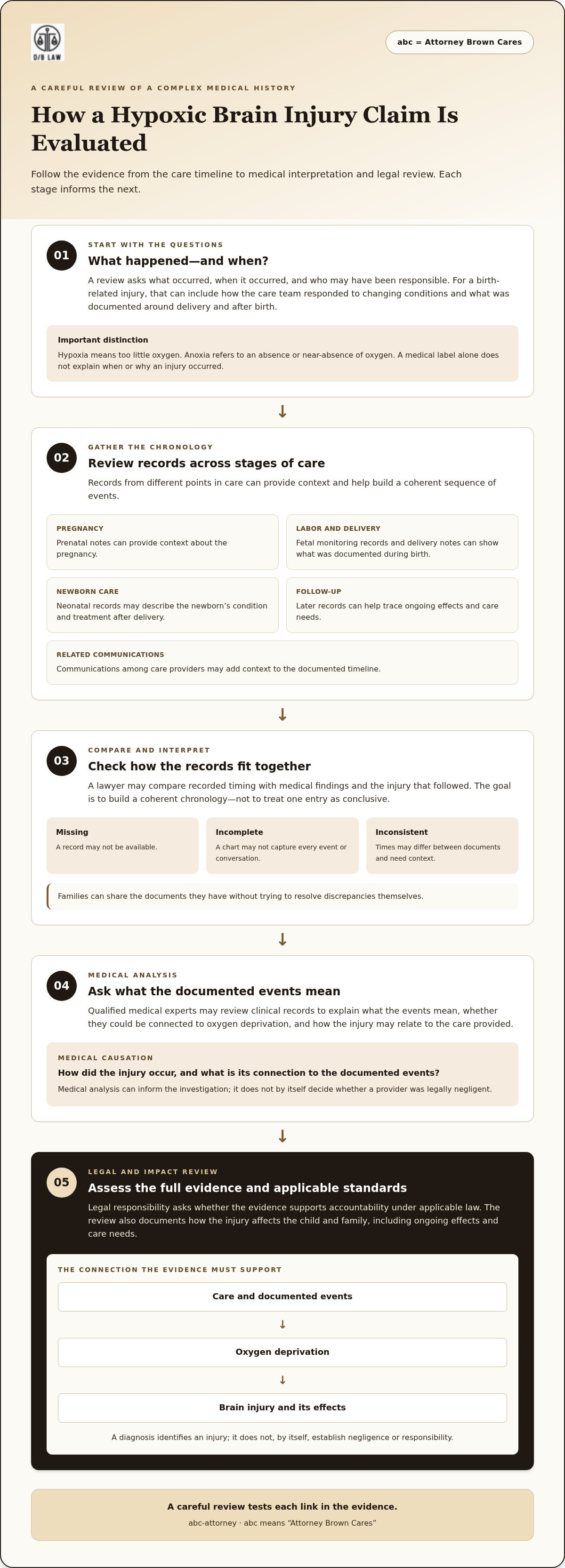
A careful review turns a complicated medical history into a sequence of questions. A hypoxic brain injury lawyer may identify the care involved, investigate the events surrounding the suspected oxygen deprivation, assess whether the evidence connects those events to the injury, and document how the injury affects the child and family. Each step informs the next. A gap in the timeline may point to an issue that needs closer examination.
Records may span pregnancy, labor, delivery, newborn care, and later follow-up. Prenatal notes can provide context about the pregnancy; labor and delivery records can show what was documented during birth; and neonatal records may describe a newborn’s condition and treatment after delivery. Follow-up records can help trace ongoing effects and care needs.
Medical causation asks how an injury occurred; legal responsibility asks whether the evidence supports accountability under applicable law. The questions are related, but they aren’t interchangeable. A medical explanation alone does not settle the legal analysis.
What evidence can help reconstruct the timeline?
Potential sources include fetal monitoring records, delivery notes, neonatal records, and relevant communications among care providers. A lawyer may compare what each record says about the timing of events with the medical findings and the injury that followed. The aim is to build a coherent chronology, not to treat one entry as conclusive.
Records can be missing, incomplete, or inconsistent. A time recorded in one document may differ from a time in another, or a chart may not capture every conversation. Those details need interpretation in context. Your family can share the documents you have without trying to resolve discrepancies yourselves.
Why do medical experts matter in a hypoxic brain injury case?
Qualified medical experts may review clinical records to explain what the documented events mean, whether they could be connected to oxygen deprivation, and how the injury may relate to the care provided. For information about one condition associated with oxygen deprivation, the National Institute of Neurological Disorders and Stroke describes Hypoxic-Ischemic Encephalopathy (HIE).
An expert’s medical opinion can help clarify injury and causation. It does not, by itself, decide whether a provider was legally negligent or who is legally responsible. Medical analysis informs the investigation; the legal evaluation considers the full evidence and applicable standards.
Your family can bring questions and available records to a legal discussion without having a complete timeline or knowing what caused the injury. A conversation with The Dedric Brown Law Firm can help organize which facts may need further review.
What Must a Texas Hypoxic Brain Injury Claim Establish?
A claim evaluation follows the evidence from the care provided to the harm that followed. The diagnosis matters, but it doesn’t answer whether anyone acted negligently or whether that conduct caused the injury. Each link needs support from medical records, other relevant evidence, and appropriate analysis.
A useful framework is to ask four connected questions:
Potentially responsible parties depend on the facts. A review may consider the actions of individual providers or an organization involved in care, but a birth complication alone doesn’t identify who, if anyone, bears legal responsibility. A hypoxic brain injury lawyer can examine who provided the relevant care and how the evidence relates to each party, rather than assuming responsibility based on a diagnosis or outcome.
How are negligence and causation different?
Negligence is a legal question about conduct, considered under applicable Texas law and the specific facts. Causation asks whether the evidence connects the conduct being questioned to oxygen deprivation and the resulting injury. These are distinct inquiries. A complication may prompt an investigation, but it doesn’t automatically prove that care fell below an applicable standard or caused the injury.
Texas-specific legal rules can affect how a claim is evaluated. An attorney should assess the relevant standards and requirements for the particular case rather than rely on broad assumptions. Your family doesn’t need to resolve these legal questions before seeking guidance.
How can a family document the injury’s effects?
Organize records describing treatment and ongoing care, along with documents showing how the injury affects everyday activities. Depending on the child’s circumstances, useful materials may include medical and therapy records, care instructions, and notes about support needed at home or in other settings. Keep information factual and dated where possible. It can help show how needs change over time.
Future needs call for evidence-based assessment, not guesswork. A child’s care requirements may develop, so projections should rely on relevant records and appropriate evaluation rather than assumed lifetime costs or expected awards. Careful documentation can help a legal team understand present effects and identify questions that may need further review. No diagnosis, document, or single opinion answers every part of a claim; the full picture matters.
What Should Texas Families Do Before Speaking With a Lawyer?
After a serious diagnosis, even simple tasks can feel like a lot. You don’t need to reconstruct every medical event or understand the records before asking for legal guidance. A little organization can make an initial conversation more focused, but it shouldn’t delay that conversation.
Useful preparation means gathering available records, noting key dates, and listing questions; none is a prerequisite to getting help. Start with what’s within reach, and let a legal team help identify what may need closer review.
Which records and details may be useful?
Gather documents you already have, such as medical records, discharge information, and relevant written communications. If you can, keep them together in one folder or digital file. Don’t worry if there are gaps or you haven’t obtained every record. You can discuss your concerns with incomplete information.
A brief, factual timeline may also help. Note dates, providers or facilities involved, major events you recall, and unanswered questions. Separate what you personally remember from what a document says. You don’t need to interpret medical terminology or decide whether anyone was at fault. The purpose is to explain what you know and where the story remains unclear.
Keep copies of the medical and discharge documents you have.
Write down dates and names as accurately as you can, marking anything you’re unsure about.
List questions about the diagnosis, the care, and what information may be missing.
These steps provide a starting point, not a complete case file. Don’t wait for every record or a perfect timeline before having a discussion. A hypoxic brain injury lawyer can help assess what information may be relevant and what further review may be needed.
Why should families address timing early?
Legal filing deadlines can affect a family’s rights, and the rules that apply may depend on the facts of the case. Texas limitation periods and possible exceptions require careful, current legal review. Don’t rely on a general online summary to determine how much time may apply to your family’s situation. Raise timing early so an attorney can assess the relevant dates and law.
As you prepare, write down dates that may matter, including when the care occurred, when the injury was identified, and when treatment or follow-up took place. These details aren’t a substitute for legal advice, but they can help an attorney begin evaluating the timeline. If you’re unsure about a date, say so rather than guessing.
You can talk with the firm about your family’s situation without first assembling a complete file. A focused conversation can clarify what is known, what remains uncertain, and which next steps may make sense.
How The Dedric Brown Law Firm Supports Hypoxic Brain Injury Families
A hypoxic or anoxic brain injury can leave a family facing difficult questions about medical care, a child’s needs, and what the records may reveal. The Dedric Brown Law Firm handles hypoxic and anoxic brain injury, birth injury, and medical malpractice matters. This work is relevant when an injury involves pregnancy, labor and delivery, newborn care, or another medical setting.
Support starts with listening. Your family should have room to explain what you understand, what remains uncertain, and what is weighing on you. You aren’t expected to arrive with a complete medical timeline or a legal conclusion. The firm can review available information and help identify questions that require closer evaluation.
What does a careful case review involve?
A thoughtful review considers your family’s account alongside available records and questions about the circumstances of the injury. The investigation can examine what the documents show about the care and timing, how the evidence may relate to causation, and what consequences are documented. Each matter is fact-specific. Reviewing information assesses the issues; it doesn’t promise that a claim exists or will lead to a particular result.
Families deserve clear explanations of what the evidence supports, what remains uncertain, and which issues may need further analysis. A careful legal review should account for the human impact while keeping conclusions tied to the facts.
How does Attorney Brown’s background support detailed analysis?
Dedric Brown is both an attorney and a Certified Public Accountant. His legal background informs the assessment of potential legal issues, while accounting training provides relevant analytical context for examining documented losses. This combination can be useful when records, care needs, and financial consequences require close attention. It does not guarantee a specific outcome.
The firm’s approach is also expressed through abc, which stands for “Attorney Brown Cares.” That message means treating families with respect and personal attention, not reducing a child’s experience to a file or a set of figures. You should be able to ask questions, share concerns, and understand the review process in plain language. Care and rigor belong together: listen closely, examine the details, and explain next steps honestly.
If your family is considering a legal review, you can Contact The Dedric Brown Law Firm to discuss your situation. A conversation can help clarify what is known and what may need further evaluation, without presuming what the evidence will show.
Take the Next Step With Clarity
Your family doesn’t have to settle every question before asking for guidance. The next step can simply be a conversation about what you know, what remains uncertain, and what matters most for your child. That can help turn a difficult situation into a clearer path forward, one decision at a time.
Choosing a hypoxic brain injury lawyer means more than reviewing a diagnosis. It also means finding a legal team that listens, examines details carefully, and treats your family with respect. You deserve clear explanations and room to make informed choices without pressure.
Attorney Brown’s commitment to care is reflected in the firm’s abc message. Families across Texas, including Houston, San Antonio, Dallas, Austin, Beaumont, Huntsville, Prairie View, and Brenham, can seek guidance as they consider their options. Contact The Dedric Brown Law Firm to discuss your family’s situation. Your questions are a worthy place to begin, and you don’t have to face them alone.
Frequently Asked Questions
Is a hypoxic brain injury automatically evidence of medical malpractice?
No. Oxygen deprivation and a brain injury, even when diagnosed after birth, don’t alone prove medical malpractice. A review examines the care at issue, the standards that apply to those circumstances, and whether evidence connects a particular act or omission to the injury. Records may raise questions without resolving them. Qualified medical and legal analysis can help assess the facts; an adverse outcome by itself doesn’t establish a claim.
Can a family bring a claim for a baby’s hypoxic brain injury?
A family can seek legal guidance to evaluate whether a baby’s injury supports a claim, but the answer depends on the medical facts and applicable law. Investigating a possible birth injury isn’t a conclusion that negligence occurred. Families in Houston, San Antonio, Dallas, Austin, Beaumont, Huntsville, Prairie View, and Brenham can discuss the timeline and available records with the firm. A prompt conversation can clarify questions without assuming a case can proceed.
How do lawyers prove oxygen deprivation caused a brain injury?
Lawyers may organize records by date, compare documented events around labor, delivery, and newborn care, and seek qualified expert review of whether those events medically relate to oxygen deprivation and the diagnosed injury. A record may help establish timing without proving fault on its own. Medical causation concerns how the injury occurred; legal responsibility is a separate determination based on the full evidence and applicable law. The available proof varies by case.
What records should I bring to a hypoxic brain injury lawyer?
Bring whatever is available, such as prenatal visit notes, labor and delivery paperwork, newborn or follow-up records, discharge instructions, and written messages about care. A simple note of dates, provider names, and questions can help focus the conversation. You don’t need to obtain every chart first. A hypoxic brain injury lawyer can discuss what additional information may help evaluate the circumstances and how it could be organized for further review.
How long do I have to file a hypoxic brain injury lawsuit in Texas?
There isn’t one answer that safely applies to every Texas case. The filing deadline may depend on the type of claim, the parties involved, and other case-specific circumstances, so an attorney should assess current law against the relevant timeline. Because delay can affect legal rights, seek guidance promptly rather than relying on an online estimate. This article can’t determine the deadline for an individual case.
How much compensation can a hypoxic brain injury case recover?
No reliable amount can be stated without reviewing the case-specific evidence, legal issues, and documented effects of the injury. Records of treatment, support needs, and other consequences may help explain the impact, but no single document predicts an outcome. A lawyer can assess what losses may be considered under applicable law. Settlement averages and promises can’t determine what a particular case may recover, and no result is guaranteed.
Does a family need complete medical records before contacting a lawyer?
No. Your family can start a conversation with incomplete records. Bring what’s on hand, such as a discharge summary or appointment notes, and share what you remember and what remains unclear. Preserve existing documents and note dates when possible. A legal team can discuss whether additional information may help evaluate the situation. You don’t need to decide for yourself whether the medical care was faulty before seeking guidance.



Comments