
Preserving Evidence After a Commercial Vehicle Accident: A Texas Guide

Could evidence that explains a commercial vehicle crash disappear before you know it matters? After a wreck, preserving evidence after a commercial vehicle accident can feel overwhelming, especially while you’re focused on medical care and recovery. Your concern is valid: photos, damaged belongings, messages, and your recollections may help document what happened, while important truck and company records may be outside your reach.
You don’t have to put your safety or healing aside to protect what you can. Save relevant paperwork and communications, photograph injuries or property damage when it’s safe, and write down what you remember. Avoid guessing or altering records. For evidence controlled by a trucking company or others, prompt legal action may help identify what matters and seek its preservation.
This guide explains what to save, how to organize your observations, and why commercial vehicle evidence may need formal preservation efforts. It also covers when an attorney can investigate records you can’t access yourself. ABC stands for Attorney Brown Cares, a commitment to supportive, attentive guidance through a stressful recovery and a careful pursuit of the facts.
Table of Contents
Why preserving evidence after a commercial vehicle accident matters
A serious commercial vehicle crash can leave you hurt, shaken, and unsure what happened in the moments before impact. Sorting out the facts may take time. Preserving evidence after a commercial vehicle accident means protecting relevant information from loss, alteration, or avoidable damage so it can be reviewed later. That information can help investigators compare accounts, understand how the collision unfolded, and document reported injuries.
Evidence is more than a photograph of damaged vehicles. Depending on the circumstances, it may include vehicle and debris positions, road and weather conditions, witness observations, nearby video, or records connected to the truck’s operation and maintenance. Comparing different sources can help show whether accounts match the physical details. An overview of traffic collision reconstruction and evidence types describes how investigators may analyze physical and electronic information to understand a collision.
Commercial crashes can also involve evidence held by someone other than the injured person. A motor carrier, vehicle owner, repair provider, or another business may have records relevant to the truck, driver, route, or vehicle condition. Which sources matter depends on the crash. A careful investigation can help identify where relevant information may be found.
Safety and medical care come first. Don’t delay treatment, approach damaged vehicles, enter traffic, or cross into an unsafe area to collect evidence. Follow emergency responders’ instructions. If you’re unable to document anything safely, your health takes priority. Evidence gathering should never create another risk for you or anyone helping you.
Why commercial vehicle crash evidence can be time-sensitive
The scene begins changing as soon as the crash ends. Vehicles are moved, debris is cleared, weather shifts, and road conditions return to normal. Nearby surveillance or business video may be recorded over or otherwise become unavailable. Truck, driver, and company records may be controlled by separate organizations, so an injured person may not be able to access or preserve them directly. Prompt attention can help identify what to seek before circumstances change.
What evidence preservation can, and cannot, do
Evidence preservation means keeping relevant facts intact so they can be examined later. It supports an investigation, but it doesn’t decide who caused a crash or guarantee a legal result. A photo can show a vehicle’s position, but it can’t explain every event leading up to the collision on its own. Record what you directly observed and keep conclusions separate. Investigators can assess how the available details fit together, including whether they support or challenge different accounts.
That distinction matters. A witness’s description, a company record, and physical damage may each tell part of the story, and they may not initially appear to agree. Preserving them allows those details to be compared rather than relying only on memory or assumptions. The purpose isn’t to prove a theory at the roadside. It’s to protect information that may help establish what happened and clarify reported injuries.
What evidence to preserve after a commercial vehicle accident
Evidence can come from several places: the crash scene, people who saw what happened, your medical care, and records connected to the commercial vehicle or business. Keeping these categories distinct helps you focus on what you can safely preserve yourself and what may require a formal investigation. Don’t try to collect everything at once. Your health and safety still come first.
Photos, videos, witness details, and personal records
If it’s safe and you’re allowed to do so, take photos or video from a safe location without entering traffic or moving objects. Capture the overall scene first, then closer views of visible vehicle damage, debris, road conditions, signs, and relevant surroundings. Keep original files when possible, and note when and where you made them. Don’t put yourself or a helper in danger for a better angle.
If a witness is willing to share their information, record their name and contact details. You can also write down what you personally remember, separating what you saw from what someone else told you. Save documents and messages related to the crash, such as medical records, prescriptions, repair estimates or invoices, and communications with an insurer or company. Keep copies in a secure place and avoid editing original files or messages.
A police crash report may also be relevant. For Texas-specific information about requesting reports, consult the Texas Department of Transportation crash report procedures. A report is one source of information, not a substitute for your own records or a complete investigation.
Commercial vehicle and business records
Some potentially useful material may be held by a trucking company, vehicle owner, or another business. Depending on the crash and vehicle, relevant records may include driver logs, dispatch or route records, inspection and maintenance documents, and onboard electronic information. A vehicle may have an electronic control module (ECM) or an event data recorder (EDR), but terminology and available data can vary by vehicle.
You can preserve the records and observations in your possession; company-controlled records may require a separate request or investigation. Don’t access another party’s devices, remove equipment, or alter records. Instead, note what you know about the truck, company, or equipment and share that information with an attorney. Which records exist, apply, or can be obtained depends on the crash.
Keep personal files together and retain originals when possible.
Record where each item came from and when you received it.
Don’t delete relevant texts, emails, photographs, or repair paperwork.
If you’re unsure which records may matter or how to address evidence held by others, you can discuss your commercial truck wreck with The Dedric Brown Law Firm. Preserving evidence after a commercial vehicle accident starts with what you can safely keep, while a case-specific investigation can consider what else may be relevant.
Personal documentation or formal evidence preservation: what is the difference?
After a crash, you can protect information already in your hands, but you generally can’t preserve records stored on a trucking company’s systems or access a vehicle’s electronic data yourself. These are complementary steps. Your notes and files can help guide an investigation; formal legal work may address evidence held by others. Neither approach replaces the other, and neither guarantees that evidence will be available or determines the outcome of a claim.
Evidence you can usually document yourself
Preserving evidence after a commercial vehicle accident often starts with simple, careful recordkeeping. Keep files in their original form and create a separate backup if you can. Don’t crop, annotate, or otherwise edit the original images. If you need to mark up a copy for your own notes, retain the unaltered version too. Memories can become less precise over time, so write down what you recall and identify uncertainty instead of presenting a guess as a verified fact.
Evidence that may need formal investigation
Commercial records and vehicle data are generally outside an injured person’s control. The Federal Motor Carrier Safety Administration provides information about commercial motor carrier oversight and record-related requirements in its Federal Motor Carrier Safety Administration regulations resources. That material can offer context, but it doesn’t establish which records exist or apply to a particular crash. An attorney can evaluate the circumstances and consider whether preservation correspondence or another appropriate step is warranted. A request doesn’t guarantee that records will be produced or that particular data can be recovered.
Your documentation and an attorney’s investigation can work together: your account may point toward a record or witness worth exploring, while formal steps may address evidence beyond your reach. To discuss possible next steps, you can request a case review.
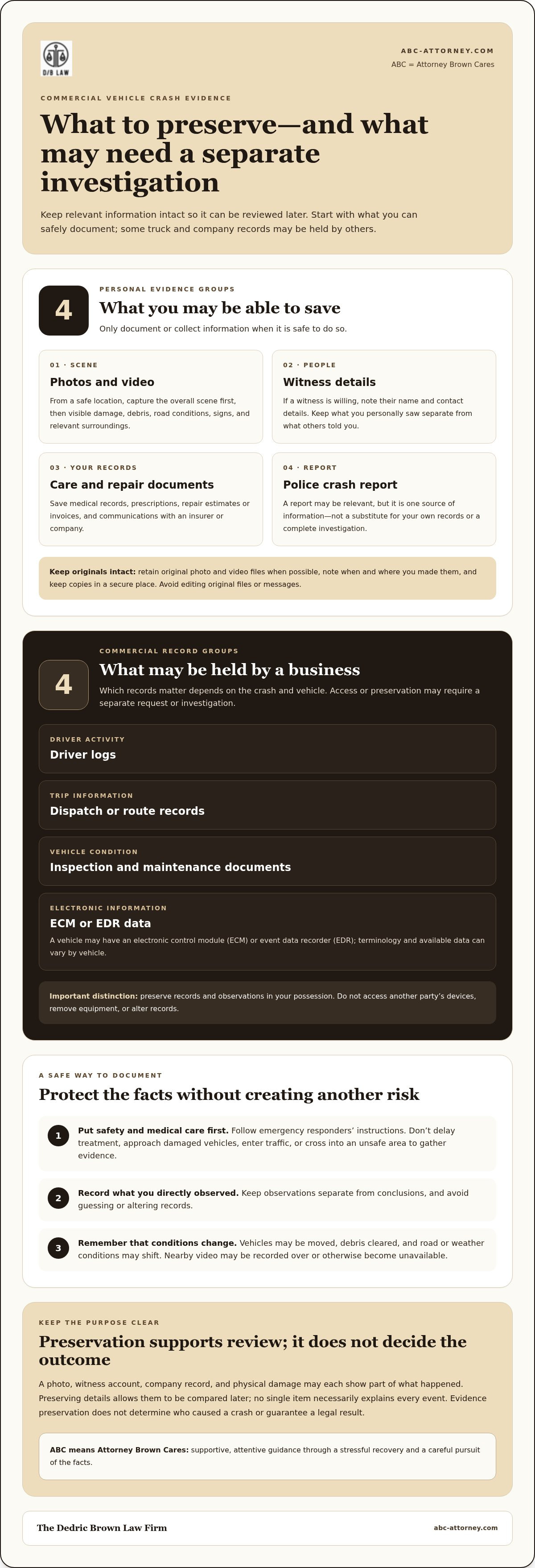
How to preserve commercial vehicle accident evidence safely
Use a simple sequence, and don’t let evidence gathering interfere with care or safety. Get safe, get care, document what you can, and store it without changing it. You don’t need to collect everything at the scene. Follow emergency responders’ instructions and leave investigation of company-controlled records to appropriate legal channels.
Address immediate safety and medical needs. Move away from traffic or other hazards if you can do so safely, and follow directions from emergency responders. Don’t enter a roadway, approach unstable vehicles, or delay medical attention to take pictures. If you’re injured or overwhelmed, let a trusted helper handle simple recordkeeping when appropriate.
Document only from a safe place. If conditions allow, capture the scene without crossing barriers or disturbing objects. Record what is visible, such as vehicle positions, damage, road conditions, and nearby signs. Avoid staging or moving anything to improve a photo. If you can’t document safely, leave it to responders or investigators.
Write a factual account. Note the date, approximate time, location, direction of travel, and what you remember seeing or hearing. Separate direct observations from estimates, later conversations, or details you’re unsure about. A clear note such as “I heard a horn before impact” is more useful than guessing why a driver acted.
Save and organize records. Keep original photos, videos, messages, reports, medical documents, and receipts. Create a clearly labeled folder and, when practical, a separate backup. Record when you received each item and who provided it. Don’t edit original files, rename them in a way that removes useful context, or delete related communications.
Preserve relevant physical items when feasible. Keep damaged personal property or vehicle parts only if you can do so safely and lawfully. Photograph their condition before repair, cleaning, or disposal when practical. If an item is unsafe, needed for treatment, or cannot reasonably be kept, don’t put yourself at risk. Make a record of its condition and what happened to it.
Avoid common evidence-preservation mistakes
Don’t post unreviewed crash details, photos, or opinions on social media. Public comments can omit context or be misunderstood. Don’t repair, discard, or modify relevant items before documenting their condition when feasible. And don’t threaten, pressure, or try to access a driver’s or company’s records or devices yourself. Keep communications calm, retain what you receive, and ask an attorney how to address evidence outside your control.
These steps help you preserve what you can without interfering with recovery or a later investigation. If you’re unsure what to save or how to handle records controlled by a trucking company, request a case review about your crash with The Dedric Brown Law Firm.
How a Texas truck accident attorney can help protect evidence
After a commercial truck crash, you may have photos and medical paperwork but no way to see what the company or vehicle records show. An attorney can help identify potential evidence sources, consider which ones matter to the facts, and evaluate appropriate steps to ask that relevant material be preserved. That work is case-specific. A record may not exist, apply to your crash, or be available, so an investigation cannot promise a particular piece of evidence or result.
Evidence-focused legal guidance can also help connect separate details. A note about the truck’s company, for example, may help identify where to direct an inquiry; a repair record may raise questions about vehicle condition. Counsel can assess those leads alongside your account, available documents, and reported injuries. The goal is a careful investigation, not a premature conclusion about fault.
What to expect from an evidence-focused case review
A case review gives you space to discuss what happened, your injuries, documents you already have, and evidence questions that remain unanswered. You don’t need to arrive with a complete file. Dedric Brown, the firm’s founding attorney and an experienced trial lawyer, can consider the information you share and discuss potential next steps for your commercial truck wreck matter without promising an outcome.
Depending on the circumstances, an attorney may assess whether relevant information could be held by the motor carrier, vehicle owner, or another organization. Counsel can consider whether preservation correspondence or another appropriate request makes sense. Such a step doesn’t guarantee that a recipient will produce records or that data can be recovered. It is one potential part of a broader, fact-specific effort to understand the crash.
A supportive next step for injured Texans
Recovery can bring enough uncertainty on its own. Attorney Brown Cares reflects a commitment to attentive, personal guidance while you consider your options. The firm represents people after commercial truck wrecks in Texas, including in Houston, San Antonio, Dallas, Austin, Beaumont, Huntsville, Prairie View, and Brenham. Its mission is “Fighting for your rights with integrity and dedication.” A free case review gives you a chance to raise evidence concerns and discuss the information available so far.
The firm states, “You Pay Nothing Unless I Win Your Case!” This does not promise a particular result. If questions about company-held records or your next steps are weighing on you, request a free case review to discuss your crash with the firm.
Move forward one step at a time
After a serious crash, it’s easy to feel responsible for figuring out every detail yourself. You don’t have to. Preserving evidence after a commercial vehicle accident isn’t about building a complete case on your own. It’s about giving the facts room to be examined and making informed decisions as questions come up.
Your priorities may shift as treatment, work, and family needs evolve. Let the investigation fit around your recovery, not the other way around. If you’re uncertain about what should happen next, a conversation with an attorney can help you understand what information may matter and what options are appropriate to your situation. You don’t need to have every answer before asking for guidance.
The Dedric Brown Law Firm offers a free case review for people dealing with commercial truck wrecks and catastrophic personal injuries. Dedric Brown is the firm’s founding attorney and an experienced trial lawyer. The firm states, “You Pay Nothing Unless I Win Your Case!” Request a free case review and discuss your next steps. You can focus on healing while getting support to consider the path ahead.
Frequently Asked Questions
What evidence should I preserve after a commercial vehicle accident?
Keep material that helps establish what happened before, during, and after the crash. That may include scene and vehicle photos, witness contact details, treatment records, repair paperwork, relevant messages, and your own dated notes. Preserve originals and identify where each item came from. Remember that driver, vehicle, or company records may be held by others. An attorney can help assess which evidence may matter in your situation.
How soon should evidence be preserved after a commercial vehicle crash?
Document what you safely can as soon as practical, because the scene can change and memories may become less precise. There’s no single deadline that applies to every type of evidence or crash circumstance. For example, a nearby business may handle its video differently from a person who keeps photos on a phone. A Texas attorney can assess suitable next steps. Don’t delay emergency care or medical treatment to gather information.
Can I obtain a commercial truck’s electronic data after an accident?
Possibly, but availability and significance depend on the vehicle and the crash. Some trucks may have electronic information related to vehicle operation, and another party may control the equipment or data. Don’t connect to, remove, or attempt to download information from another party’s devices. An attorney can help identify what may be relevant and assess whether a formal request or legal process is appropriate, without guaranteeing the data exists or can be obtained.
Should I keep the original photos and videos from the accident scene?
Yes, keep original files when possible and make a separate backup. Avoid cropping, filtering, or annotating originals; create a clearly labeled copy if you need to highlight details for discussion. If you know it, note when and where each image was taken. For example, identify whether a photo shows the roadway before vehicles were moved. Never enter an unsafe area to record footage, and follow emergency responders’ directions.
What if the trucking company or insurer contacts me before evidence is preserved?
Stay factual, and don’t guess about the crash or the extent of your injuries. You can keep copies of letters, emails, and texts, and note the date, time, and person involved in a call. You don’t need to assume every contact is improper, but you can pause before answering questions you’re unsure about. A lawyer can help you consider how to respond and whether evidence questions call for further steps.
Can evidence I collect myself prove who caused a commercial vehicle accident?
Evidence you collect may help clarify events, but no photo, note, or witness account automatically establishes fault by itself. For instance, a picture can show vehicle damage without explaining how the collision began. Investigators assess information in context and may consider records held by other parties. Preserve what you have accurately, note uncertainty in your records, and raise unanswered questions during a legal review rather than drawing conclusions from one item.
Does a Texas attorney help preserve evidence after a commercial vehicle accident?
Yes. An attorney may assess potential evidence sources, communicate preservation concerns, and consider investigation steps tailored to the facts. That doesn’t guarantee access to a record or a particular result. The Dedric Brown Law Firm handles commercial truck wrecks and offers a free case review. Dedric Brown is its founding attorney and an experienced trial lawyer. The firm states, “You Pay Nothing Unless I Win Your Case!” for people seeking guidance in Houston and across Texas.


Comments