
What Questions to Ask a Birth Injury Lawyer: A Family’s Checklist for Justice

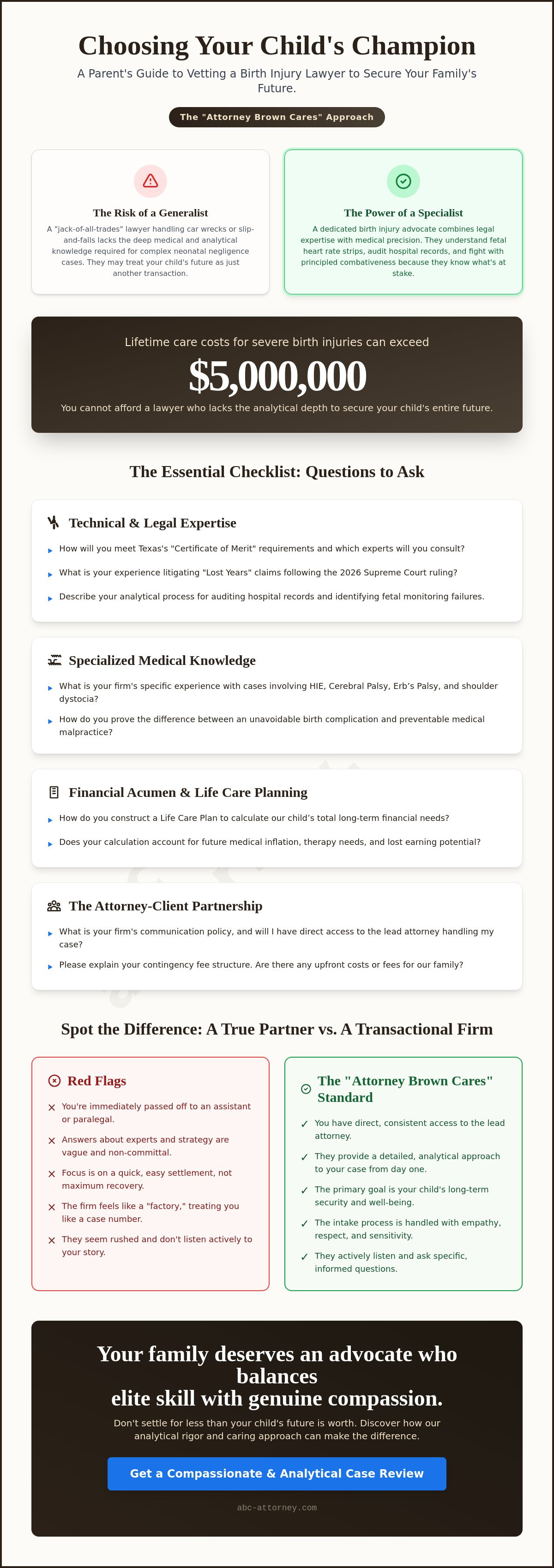
What if the most dangerous part of your legal journey isn't the hospital's defense team, but a lawyer who treats your child's future like a simple transaction? With lifetime care costs for severe birth injuries often exceeding $5 million, you can't afford a representative who lacks analytical depth. Knowing what questions to ask a birth injury lawyer is the difference between a settlement that barely covers today's bills and a recovery that secures your child's entire life. You're likely feeling overwhelmed by medical jargon and the fear of being ignored by a massive firm.
We understand that you need a champion who balances aggressive advocacy with steady, professional reassurance. You deserve an ally who masters the February 2026 Supreme Court ruling on "Lost Years" claims and can calculate the true lifetime cost of conditions like cerebral palsy. This article provides a rigorous checklist to help you identify an attorney with both the elite credentials to win and the compassion to support your family. We'll show you how to find a protector who conducts thorough investigations, pursues every dollar of justice, and proves daily that Attorney Brown Cares.
Key Takeaways
Discover why a generalist personal injury firm isn't enough for neonatal negligence and how the Attorney Brown Cares philosophy ensures your family receives elite advocacy.
Learn the analytical advantage of hiring a lawyer with the technical precision to audit hospital records and identify hidden fetal monitoring failures.
Identify exactly what questions to ask a birth injury lawyer regarding specific medical conditions like HIE, Erb’s Palsy, and shoulder dystocia.
Understand the vital role of a Life Care Plan in calculating your child’s long-term financial security while accounting for medical inflation and lifetime therapy needs.
Confirm the details of a true legal partnership; including clear communication standards and a contingency fee structure with no upfront costs for your family.
Table of Contents
Why Choosing the Right Birth Injury Advocate Starts with the Right Questions
Evaluating Technical Expertise: Questions for the Analytically Rigorous Attorney
Medical Specifics: Questions to Uncover Hospital Negligence and Failure to Monitor
Beyond the Courtroom: Questions About Calculating Your Child’s Long-Term Financial Security
The Partnership Phase: Questions About Communication, Fees, and Case Management
Why Choosing the Right Birth Injury Advocate Starts with the Right Questions
Choosing a legal representative for your child is a high-stakes decision that dictates their financial security for decades. This isn't a standard personal injury claim. A "generalist" lawyer who handles car wrecks or slip-and-falls lacks the technical precision required for neonatal negligence cases. When you are deciding what questions to ask a birth injury lawyer, you must look for a specialist who understands that these cases are won or lost in the details of fetal heart rate strips and arterial blood gas results. You need a champion who balances aggressive advocacy with the steady, professional reassurance your family deserves during this crisis.
The "Attorney Brown Cares" (abc) philosophy is rooted in the belief that empathy is a prerequisite for effective justice. We don't view your child as a case number. We view them as a person whose future depends on our diligence, honesty, and attention to detail. Your first consultation sets the tone for a multi-year journey. It's your opportunity to audit the attorney’s methodology. Pay close attention to these initial indicators of a high-quality partnership:
Responsiveness: Does the firm return your calls promptly and respect your time?
Active Listening: Do they ask specific questions about your child's diagnosis, such as Cerebral Palsy or HIE?
Genuine Concern: Do they focus on your child’s long-term recovery goals or just the immediate legal fees?
The "abc" Factor: Screening for Genuine Care
Attorney Brown Cares means that the intake process for grieving families is handled with extreme sensitivity. You should ask if you will speak to the attorney directly or be passed to an assistant. A firm committed to your success will provide direct access to the lead counsel. We initiate change, pursue goals, and conduct thorough investigations from day one. If a firm feels like a factory, it's likely because they treat litigation as a transaction rather than a mission for justice.
Beyond the Law: The Need for Specialized Advocacy
Birth injury litigation requires a deeper medical understanding than almost any other field of law. Understanding Birth Injuries involves distinguishing between unavoidable birth trauma and preventable medical malpractice. This requires a firm that understands the Texas medical malpractice landscape and the specific hurdles families face when holding large hospital systems accountable. We employ a principled combativeness that refuses to settle for less than your child deserves. Screening for an attorney who combines legal expertise with a background in rigorous analytical disciplines ensures that no medical error goes unnoticed during the discovery phase.
Evaluating Technical Expertise: Questions for the Analytically Rigorous Attorney
Birth injury litigation is as much a financial audit as it is a legal battle. Families often focus on the emotional resonance of a firm, but securing your child’s future requires a lawyer who handles numbers as well as they handle juries. Determining what questions to ask a birth injury lawyer requires moving beyond surface-level experience; you must probe their analytical methodology. At our firm, the Attorney Brown Cares philosophy is backed by CPA-level precision. We don't just guess at your child's needs. We calculate them. We audit the hospital’s actions. We pursue the maximum recovery through rigorous financial scrutiny.
In Texas, the legal landscape is particularly demanding. You must ask if the attorney is prepared to meet the "Certificate of Merit" requirements under Chapter 74 of the Civil Practice and Remedies Code. This requires a network of elite medical experts who can testify specifically to the failure to monitor fetal conditions. If a lawyer cannot explain their process for securing these experts, they aren't prepared for the principled combativeness required to win. If you are unsure where to start, you can reach out for a case review to see how an analytical approach changes the outlook of your claim.
The Audit Process: How They Scrutinize Medical Records
Proving negligence often comes down to what the hospital didn't say. You should ask what specific software or specialists the firm uses to analyze electronic fetal monitoring (EFM) data. We look for the "gaps" in charting that suggest a nurse ignored distress signals. Distinguishing between a genetic condition and a Clinical Definition of Birth Trauma is where many generalists fail. We scrutinize the timing of oxygen deprivation to prove that the injury was a preventable failure to monitor fetal conditions rather than an unavoidable birth defect.
The Financial Scrutiny: Leveraging Analytical Precision
A brain injury claim involves costs that span decades. You must ask how the lawyer’s background helps them calculate the true cost of Hypoxic & Anoxic Brain Injury. We use our financial expertise to audit the hospital’s insurance coverage and liability limits. This prevents the defense from lowballing the future value of medical care. We account for medical inflation, specialized equipment, and lifetime therapy. Our goal is a settlement that provides a sense of security, ensuring your child is never just another case number in a hospital’s ledger.
Medical Specifics: Questions to Uncover Hospital Negligence and Failure to Monitor
The medical mechanism of a birth injury is rarely a single catastrophic event. It's usually a sequence of missed signals. If you want to hold a hospital accountable, you must know what questions to ask a birth injury lawyer regarding their clinical fluency. A lawyer who doesn't understand "decision-to-incision" timing or the nuances of fetal heart rate strips cannot effectively cross-examine a defensive OB-GYN. Attorney Brown Cares about the scientific truth behind your child's injury. We utilize a network of board-certified neonatologists and obstetric experts to reconstruct the final minutes of labor, ensuring the "Standard of Care" isn't just a phrase, but a measurable benchmark.
Failure to monitor fetal conditions is a leading cause of Hypoxic & Anoxic Brain Injury. We look for the exact moment the medical team should have pivoted to an emergency C-section. In Texas, proving this requires meeting rigorous evidentiary standards. You need a representative who views the medical chart with the same scrutiny as a financial auditor, looking for inconsistencies in nursing notes and electronic monitoring data. The clock is the enemy in the delivery room. When a nurse ignores a non-reassuring fetal heart rate pattern, the result is often permanent brain damage that could've been prevented by a timely intervention.
Questions for Oxygen Deprivation and Brain Damage Cases
Brain damage from oxygen deprivation, often diagnosed as HIE, requires immediate intervention. Ask your potential lawyer about their experience with neonatal therapeutic hypothermia (cooling) cases. This treatment is often the first sign that a hospital knows something went wrong. We ask the hard questions: Why did the OB-GYN wait to move to the operating room? How do we link the specific fetal distress patterns on the monitor to the damage shown on an MRI? Attorney Brown Cares enough to find these answers, using analytical precision to bridge the gap between medical records and legal liability.
Questions for Physical Trauma (Erb’s Palsy / Forceps)
Physical trauma during delivery, such as Erb’s Palsy or Brachial Plexus Palsy, often results from excessive traction. When shoulder dystocia occurs, doctors must follow specific maneuvers. Ask the lawyer how they prove that a physician used too much force rather than following the McRoberts maneuver or other accepted protocols. We investigate the misuse of delivery tools like vacuum extractors and forceps with principled combativeness. Our goal is to uncover if the medical team prioritized speed over your child's safety, leading to permanent nerve damage or skeletal injuries.
Beyond the Courtroom: Questions About Calculating Your Child’s Long-Term Financial Security
Proving a hospital’s negligence is only the first phase of your journey toward justice. The second, and perhaps more critical phase, involves securing a recovery that lasts for your child’s entire life. Many firms settle for a "rough idea" of what a claim is worth; this is a dangerous gamble. When you are deciding what questions to ask a birth injury lawyer, you must evaluate their ability to project costs 40 or 50 years into the future. A settlement that feels large today can be decimated by medical inflation if it isn't calculated with CPA-level precision. Attorney Brown Cares about your child’s long-term survival and quality of life, which is why we treat the damages phase like a high-stakes financial audit.
We don't just ask for a lump sum. We build a comprehensive Life Care Plan that serves as the roadmap for your child's future. This document details every anticipated expense, from 24/7 nursing care to specialized home modifications. If your lawyer isn't discussing the difference between standard inflation and the much higher rate of medical inflation, they are leaving your child’s future at risk. You can schedule a financial case audit with our team to see how our analytical methodology maximizes these projections.
The Math of a Lifetime: Questions for the CPA-Attorney
Calculating the "Present Value" of medical expenses is a sophisticated financial exercise that requires more than just legal knowledge. You should ask what economists or life-care planners the firm will hire to testify. We look at your child's specific needs, such as:
Adaptive equipment and specialized vehicle modifications.
Private education and vocational training tailored to their abilities.
Repeated surgeries, medication, and long-term physical therapy.
Our background in rigorous analytical disciplines ensures we don't just accept the hospital’s first offer. We conduct a thorough investigation into their liability limits to prevent their "accounting tricks" from hiding available settlement funds.
Protecting the Recovery: Trust and Tax Questions
Winning a settlement is only the start; you must protect that money from taxes and ensure it doesn't disqualify your child from government benefits. Ask how the firm assists with setting up a Special Needs Trust. In Texas, the tax implications of a birth injury settlement are complex. We provide steady, professional reassurance by guiding you through structured settlements versus lump sums. This ensures the recovery stays in a safe, controlled environment that prioritizes your child’s health over all else.
The Partnership Phase: Questions About Communication, Fees, and Case Management
A birth injury lawsuit is a marathon, not a sprint. These complex cases often span two to three years of intense litigation. During this time, your legal team becomes your most important partner. When you're determining what questions to ask a birth injury lawyer, you must look beyond the initial consultation. You need a partner who offers steady, professional reassurance throughout the entire process. The Attorney Brown Cares (abc) philosophy means we prioritize your family's stability while we engage in principled combativeness against hospital defense teams. We don't just manage cases; we protect futures.
Trial readiness is another critical factor to investigate. You should ask if the lawyer is prepared to take your case to a jury in Houston, Dallas, or San Antonio if the insurance company refuses to be fair. Many generalists prefer quick settlements because they lack the technical expertise to survive a high-stakes trial. We conduct thorough investigations and build every case as if it's going to court. This proactive stance signals to the defense that we won't be bullied into a lowball settlement that fails to cover your child’s lifetime care.
Communication Standards: The "Cares" Aspect
The "abc" promise ensures you are never left in the dark about your child’s future. You should ask about the firm's specific policy for returning phone calls and the frequency of case updates. Will you have a direct line to the lead attorney, or will you only speak with assistants? At our firm, we believe direct access is essential for building trust. We also provide mentorship and support during difficult milestones, such as depositions. We act as your protective ally, ensuring you feel safe, prepared, and empowered at every turn.
The Financial Agreement: No-Risk Litigation
Financial risk mitigation is a core pillar of our advocacy. You should confirm that there are $0 upfront costs for your family to begin the legal journey. Ask specifically who pays for the expensive medical experts and filing fees during the discovery phase. In our practice, we cover these significant expenses to ensure the highest level of analytical precision. We work on a contingency fee basis. This means we only receive payment if we successfully secure a recovery. You should also ask for a clear explanation of what happens to case expenses if the case doesn't win, ensuring your family is fully protected from financial debt.
Take the Next Step Toward Your Child’s Lifetime Security
Your child’s journey toward justice requires a protector who combines the methodical authority of a technical expert with the heart of a community mentor. You've learned that identifying the right advocate involves auditing their investigative process and their ability to calculate decades of medical inflation. Now that you've mastered what questions to ask a birth injury lawyer, you can move forward with the confidence that your child’s future is no longer a matter of chance. The Dedric Brown Law Firm provides a unique advantage by utilizing dual credentials as both an Attorney and a Certified Public Accountant (CPA).
We pursue every dollar your family deserves with principled combativeness, serving families in Houston, Dallas, San Antonio, and throughout Texas. We operate with zero upfront costs; we only get paid when we win for your child. This structure ensures your financial safety while we conduct a thorough investigation into hospital negligence. Our commitment is rooted in the belief that every family deserves a champion who is both elite in credentials and grounded in the community.
Schedule your free, confidential "Attorney Brown Cares" consultation today.
You aren't alone in this fight. We're ready to stand by your side and secure the lifetime of care your child deserves.
Frequently Asked Questions
What is the statute of limitations for a birth injury claim in Texas?
In Texas, the statute of limitations for medical malpractice is generally two years from the date of the negligent act. However, birth injuries involving minors often fall under different tolling rules that may extend the filing deadline until the child’s 14th birthday. Because these rules are complex and subject to a 10-year statute of repose, you should consult a specialist immediately to ensure your child’s rights remain protected.
Can I still sue for medical malpractice if I signed a consent form?
Signing a consent form does not give a healthcare provider permission to commit medical negligence. A consent form signifies that you understand the inherent risks of a procedure, but it never waives your right to hold a hospital accountable for a failure to monitor fetal conditions or surgical errors. If a provider deviates from the accepted standard of care, that form is not a valid shield against a lawsuit.
How much does it cost to hire a birth injury lawyer in Houston?
Hiring our firm in Houston involves zero upfront costs because we operate on a contingency fee basis. We only receive payment if we successfully secure a financial recovery for your family. This structure ensures that families facing high medical costs can still access elite technical expertise and CPA-level analytical precision without any immediate financial risk or out-of-pocket litigation expenses.
What is the difference between a birth defect and a birth injury?
A birth defect is typically a genetic or structural condition that develops during pregnancy, while a birth injury is physical damage caused by medical errors during labor or delivery. Distinguishing between the two requires a rigorous medical audit of hospital records. When determining what questions to ask a birth injury lawyer, ensure they have the expertise to link your child’s condition to specific delivery room failures like oxygen deprivation.
How long does a birth injury lawsuit typically take to resolve?
Most birth injury cases take between two and three years to reach a final resolution. This timeline allows for a thorough investigation, the gathering of expert testimony, and the creation of a comprehensive Life Care Plan to secure your child's future. We provide steady, professional reassurance throughout this multi-year journey, ensuring your family is updated and supported at every critical milestone of the litigation process.
What happens if the doctor who delivered my baby has moved to a different state?
You can still pursue a legal claim even if the delivering physician has moved to another state. Legal jurisdiction is determined by where the injury occurred rather than where the doctor currently resides or practices. We conduct thorough investigations to locate and hold negligent parties accountable, utilizing our resources to ensure that a change in location does not prevent your family from seeking justice for your child.
Can I file a claim for an injury that happened several years ago?
You may still be able to file a claim for an injury that occurred several years ago due to specific Texas tolling rules for minors. While the standard adult deadline is two years, children often have an extended window to initiate litigation. However, medical evidence and fetal monitoring strips can become harder to secure over time. It's vital to begin a medical and financial audit as soon as possible.
Will I have to testify in court against my doctor?
While many birth injury cases reach a settlement before trial, you may be required to testify if the insurance company refuses to be fair and the case goes before a jury. We provide approachable mentorship to prepare you for this process, ensuring you feel empowered to speak on behalf of your child. Our principled combativeness in the courtroom is designed to protect your family while holding the hospital accountable.



Comments