
Health Insurance Subrogation and Your Personal Injury Claim

A settlement check may not be yours to keep in full. In health insurance subrogation, an insurer that paid for accident-related medical care may seek reimbursement from a personal injury settlement or from the party responsible for the injury. Whether it can recover, and how much, depends on the plan terms and applicable law.
That can feel frustrating when a settlement is meant to help cover medical bills, lost income, and other losses. But an insurer’s reimbursement demand is not automatically final. Rules and exceptions may affect the amount, and the Common Fund Doctrine may require an insurer to share some legal costs involved in obtaining the recovery.
This article explains subrogation, how repayment claims can affect a settlement, and how plan type and state law may change the analysis. It also covers common exceptions involving Medicare, Medicaid, and ERISA plans, and why a reimbursement demand deserves careful review before settlement funds are distributed.
Table of Contents
Exceptions for ERISA, workers’ compensation, Medicare, and Medicaid
Subrogation rules can differ when an employer plan, workers’ compensation insurer, or government program paid for medical treatment. Identifying who paid the bills helps determine which reimbursement rules may affect a settlement.
ERISA Plan Reimbursement Rights
The Employee Retirement Income Security Act of 1974 governs many employer-sponsored health insurance plans, according to the U.S. Department of Labor. A plan’s written terms can give it rights to recover medical payments from an injury settlement. Self-insured employer plans may also assert reimbursement rights under ERISA, so the plan type and its governing documents matter.
The Supreme Court of the United States decided Sereboff v. Mid-Atlantic Medical Services, Inc. at 547 U.S. 356 (2006). That case is part of the legal framework for evaluating ERISA plan reimbursement claims. Reviewing the plan language helps establish what the plan says it can recover and what funds it claims are subject to repayment.
ERISA Preemption of State Laws
ERISA preemption means federal law can displace state rules that would otherwise limit a plan’s subrogation rights. As a result, a state’s made-whole doctrine or other consumer protections may not apply to some ERISA plans, particularly self-funded plans.
Employer-sponsored coverage is not automatically governed by the same state rules as every other health plan. The Summary Plan Description and plan documents can show whether ERISA applies and which reimbursement terms control. Reviewing them helps distinguish the plan’s federal-law position from state-law arguments that may apply to other coverage.
Workers’ Compensation Claims
Workers’ compensation creates a separate reimbursement issue when a workplace injury also supports a claim against another responsible party. In Pennsylvania, a workers’ compensation insurer with subrogation rights must share proportionately in the costs of recovering compensation from that third party, including attorney fees and litigation expenses.
That cost-sharing rule can affect the insurer’s net recovery. The injured worker’s settlement analysis should account for benefits paid and the costs of pursuing the third-party claim. Because a workers’ compensation claim differs from an ordinary health plan reimbursement demand, the source of each payment matters. For organisations seeking to properly structure their workplace liability protections, consulting commercial risk specialists such as patersonib.co.uk can help businesses navigate complex insurance and risk management requirements.
Medicare and Medicaid Recovery
Medicare has reimbursement and collection rights for covered, accident-related medical payments under the Medicare Secondary Payer Act. Its recovery is governed by statute, and Medicare reduces recovery for collection costs. Future medical care can also matter because Medicare may consider injury-related future costs when calculating its interest.
Medicaid recovery rules vary by state and generally cover payments for accident-related treatment. Federal law requires Medicare and Medicaid claims on personal injury settlements to be addressed. Ignoring a valid government claim can lead to repayment demands and penalties, so identify these interests before distributing settlement funds.
Trace each payment to its source: an employer plan, workers’ compensation, Medicare, or Medicaid. That distinction determines which reimbursement framework applies and which documents need close review.
What does subrogation mean in health insurance?
Subrogation allows a health insurer to seek repayment for medical expenses it paid after another party caused an injury. After a personal injury settlement, the insurer may claim part of the recovery for those payments.
Reimbursement Limits
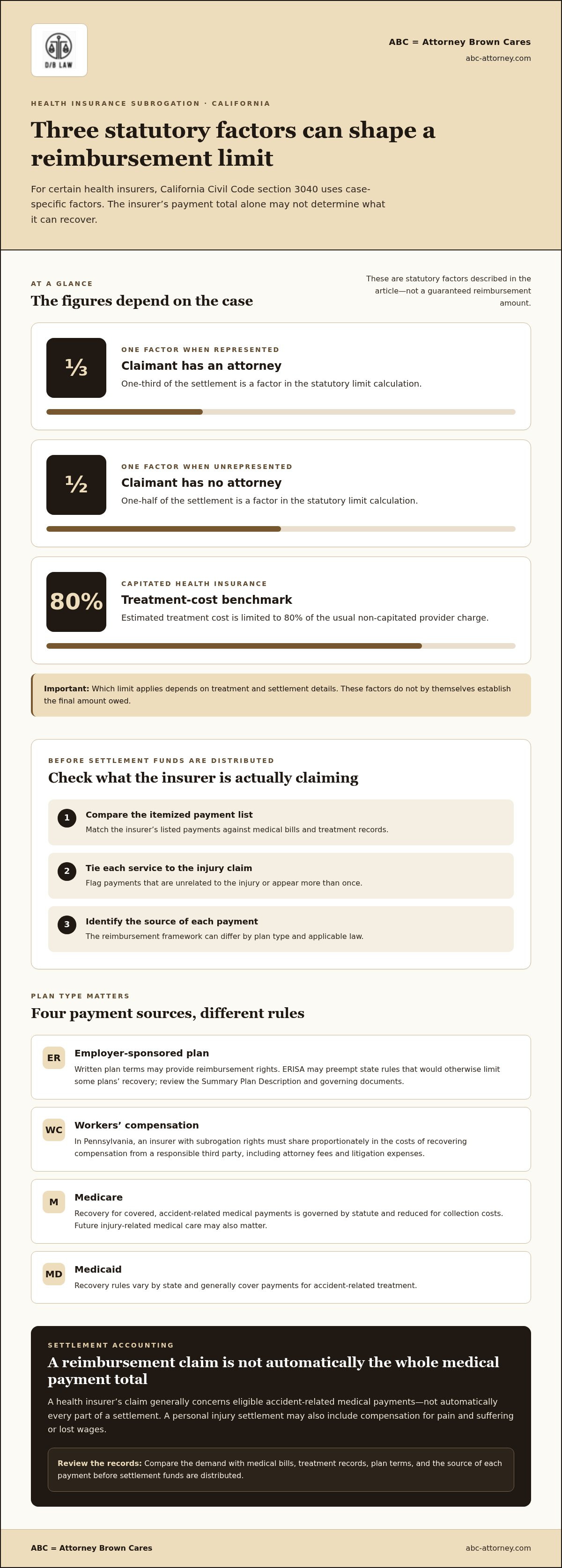
California Civil Code section 3040 limits certain health insurers’ recovery from personal injury settlements by applying statutory factors. The limit matters because the insurer’s payment total alone may not determine the amount it can recover.
For a claimant with an attorney, one-third of the settlement is one factor; without an attorney, the factor is one-half. For capitated health insurance payments, the estimated treatment cost is limited to 80% of the usual non-capitated provider charge. The applicable limits depend on the treatment and settlement details.
Repaying Medical Expenses From Settlements
Reimbursement from a settlement means paying back eligible medical expenses covered by the health plan for the injury. The claim generally concerns accident-related medical payments, not every loss included in a personal injury case.
Before settlement funds are distributed, compare the insurer’s itemized payment list with the medical bills and treatment records. Match each service to the injury claim, then flag unrelated or duplicate payments. This accounting clarifies what the insurer is claiming and how much may remain for other losses.
A settlement can include compensation for pain and suffering or lost wages as well as medical expenses. Those categories matter because a health insurer’s reimbursement claim concerns medical payments, not automatically every part of the settlement.
Settlement Reimbursement Examples
The example shows why the settlement, treatment-cost calculation, and representation status all matter.
Capitated payments require a different calculation: the estimated treatment cost is measured against 80% of the usual non-capitated provider charge. Keep the plan’s payment information and provider billing details together, so the reimbursement calculation can be assessed against the correct treatment costs.
For another illustration, a $50,000 settlement with $20,000 in health-insurance-paid medical bills does not automatically mean the insurer receives $20,000. Fees, case expenses, plan terms, and applicable limits can affect the amount available and the final distribution.
If an insurer’s calculation appears to include unrelated treatment or overlook California’s limits, organize the settlement statement and payment records. A lawyer handling a disputed reimbursement claim can assess how the demand affects your injury recovery.
How does the Common Fund Doctrine apply?
Yes. A personal injury lawyer can challenge or negotiate a health plan’s reimbursement demand, including by raising the Common Fund Doctrine or the made-whole doctrine. The plan terms, governing law, and settlement’s ability to compensate your losses all matter.
The Common Fund Doctrine may require an insurer to contribute proportionally to attorney fees and case costs when the lawyer’s work secured money that also benefits the insurer. For example, an attorney charges a 33% fee and incurs $5,000 in costs while obtaining a settlement. If the insurer seeks repayment from that recovery, the doctrine may require it to bear a proportional share of those expenses. That contribution can reduce the reimbursement claim and preserve more settlement funds for the injured person.
The made-whole doctrine addresses a different question: whether an injured person must be fully compensated before an insurer can recover. In states that recognize the doctrine, an insurer may have to wait until the person’s total damages are covered. If a settlement falls short of documented losses, that may support an argument against immediate reimbursement, but the plan and state law shape the result.
California recognizes both concepts in injury claims. The made-whole doctrine may support an argument that an insurer should not receive reimbursement until the settlement fully compensates the injured person. Separately, the Common Fund Doctrine may require an insurer to share attorney fees incurred to obtain a recovery that benefits it. One doctrine concerns full compensation; the other concerns recovery costs.
Pennsylvania’s made-whole doctrine generally requires full compensation before a health insurer asserts subrogation rights. Its Common Fund Doctrine also requires insurers seeking subrogation to contribute to attorney fees and costs incurred to obtain a settlement. These doctrines may not apply to self-funded ERISA health plans governed by federal law, so plan status can change which arguments are available.
Georgia law also recognizes a Made Whole Doctrine for qualifying claims. O.C.G.A. § 33.24.56.1(b)(1) is cited alongside the doctrine, and non-ERISA plans are subject to Georgia law. In qualifying circumstances, private insurers may need to accept a reduced subrogation amount. The Georgia Supreme Court’s decision in Duncan v. Integon General Insurance Corp., 267 Ga. 636 (1997), is also part of the legal landscape.
After a car accident, preserve the settlement breakdown, attorney-fee agreement, case-cost records, and insurer’s reimbursement demand. These documents can help show whether the insurer benefited from the recovery and whether the settlement made you whole. An attorney can assess which doctrine applies and present a supported position in negotiations.
Health insurance subrogation in personal injury claims
After an accident, an insurance company may seek repayment for covered medical treatment from a recovery. The claim’s basis, the plan type, and the state involved shape what the insurer can pursue and collect.
Elements of a Subrogation Claim
A subrogation claim generally rests on an insurer’s right to reimbursement, payments it made for accident-related care, and a recovery connected to the injury. A demand should identify its legal basis and the medical expenses it seeks to recover.
Compare the insurer’s itemized payment statement with treatment records and the settlement claim. Separate accident-related services from unrelated care, and identify whether the asserted right comes from plan language or law. A clear accounting can reveal disputes about coverage, payment amounts, or which settlement funds the claim reaches.
Repayment Obligations and Texas Law
In Texas, federally protected health insurance may require full reimbursement of a subrogation claim. The plan’s federal status matters because state-law limits may not govern its recovery. For clients working with The Dedric Brown Law Firm, understanding how federal ERISA rules interact with state regulations is vital to protecting your settlement.
Non-ERISA plans are subject to Texas law and the Made Whole Doctrine, along with statutes such as the Texas Civil Practice and Remedies Code Chapter 140. In qualifying circumstances, Texas rules may require private insurers to accept a reduced amount. If a settlement involves both private coverage and an employer plan, identify each payer separately before calculating repayment. Do not assume one claim’s rules control another.
Workers’ compensation creates a distinct issue when a workplace accident also supports a third-party liability claim. Under Texas workers' compensation laws, the carrier often has a subrogation lien against a third-party recovery, but this must be carefully balanced against statutory credits and attorney fee allocations.
Claim Deadlines
There is no single deadline for every health insurance reimbursement claim; applicable plan terms and state law govern timing. For a specific claim, review the plan documents, the insurer’s written notice, and any stated response or repayment dates.
Keep the notice and settlement communications together, and record each date associated with a demand or response. An ERISA plan, a state-regulated policy, and a workers’ compensation claim may follow different frameworks. Treating them as interchangeable can make it harder to preserve objections or resolve the claim before distribution.
Spending Settlement Funds Before Lien Resolution
Spending settlement money before resolving a valid lien can leave you personally responsible for repayment and expose you to a lawsuit. The risk arises when the insurer’s claim remains unpaid after the funds have been distributed.
Before using settlement proceeds, identify each insurer or program that paid injury-related medical bills and resolve its claim. If a demand is disputed, keep the disputed funds available while addressing its basis and amount. This protects the settlement accounting and avoids treating the gross recovery as money free of reimbursement claims.
Subrogation surveys from insurers
When a health insurer sends a subrogation or lien notice, save it, note any response date, and compare its payment details with your medical records. Before agreeing to an amount, request an itemized list of accident-related payments and the plan language or legal basis for reimbursement.
An insurer’s survey or questionnaire may gather information about an accident, treatment, other coverage, and a possible claim against the responsible party. For example, after a hospital visit following a car crash, the insurer may ask whether another driver caused the collision and whether that driver’s insurance could cover medical expenses.
Answer accurately and keep your responses consistent with the records. If a question is unclear, ask what information the insurer needs rather than guessing. Distinguish confirmed facts from estimates, especially when describing the accident, the hospital or providers involved, and treatment payments.
Use a simple recordkeeping process:
Keep the notice, questionnaire, envelope, and any related email together.
Compare listed payments with bills, explanation-of-benefits statements, and treatment dates.
Record what you send, when you send it, and the insurer’s response.
Review any requested authorization so you understand what information it permits the insurer to obtain.
These steps can help identify errors before they affect settlement discussions. A payment list, for example, may include treatment unrelated to the accident or omit a credit already applied by a provider. Mark the specific entry and provide a document supporting your correction. A clear record also helps distinguish health plan payments from auto coverage or other sources.
State law and plan terms can affect subrogation rights, so a survey alone does not establish how much an insurer can collect. Read the notice for the asserted basis of the claim, the payments identified, and any response instructions. If the insurer seeks reimbursement, request its calculation in writing and compare it with the settlement information before funds are distributed.
Do not ignore a questionnaire or make unsupported statements about fault or coverage. Failing to cooperate with an insurer’s subrogation efforts may leave you responsible for amounts the insurer paid. Careful, truthful responses matter even when you dispute the demand.
If an insurer’s survey or lien notice raises questions about payments, coverage, or responsibility for an injury, discuss the reimbursement claim with an attorney before settlement funds are distributed.
The Dedric Brown Law Firm: Traumatic Brain Injuries
The Dedric Brown Law Firm represents people and families facing traumatic brain injuries, hypoxic and anoxic brain injuries, and birth injuries. If an injury claim also involves an insurer’s reimbursement demand, legal representation can address that issue alongside the broader case.
The firm’s abc-attorney identity stands for “Attorney Brown Cares,” reflecting a commitment to personal attention and care for clients navigating difficult circumstances.
If you’re considering an injury claim, contact The Dedric Brown Law Firm or visit abc-attorney.com.
Protect Your Recovery as You Move Forward
Keep the reimbursement question connected to the larger injury claim. How health insurance subrogation is handled in a personal injury claim can affect the funds available after resolution, so consider the payment demand, settlement terms, and injury-related records together.
The Dedric Brown Law Firm represents people and families affected by traumatic brain injuries, hypoxic and anoxic brain injuries, and birth injuries. These cases can involve extensive medical needs and complex financial questions, including insurer reimbursement demands. Attorney Brown Cares reflects a commitment to treating clients with personal attention while pursuing a careful, evidence-based case.
If you’re weighing an injury claim alongside a reimbursement demand, take the next step when you’re ready. Contact The Dedric Brown Law Firm to discuss your situation. Clear information can help you approach the road ahead with greater confidence.
Frequently Asked Questions
What Is Subrogation?
Subrogation is an insurer’s effort to recover payments it made for treatment from a responsible party or related recovery. For example, after a Texas car crash, a health plan may seek repayment for covered care if the injured person receives money from the at-fault driver’s insurer. The demand should identify the payments at issue and the basis for the insurer’s claimed recovery rights.
What is the “Made Whole” Doctrine?
The made-whole doctrine generally addresses whether an injured person must receive full compensation before an insurer can recover its payments. Its effect depends on the governing law and plan type. For instance, Pennsylvania recognizes the doctrine for personal injury claims, while self-funded ERISA plans may be treated differently under federal law. The settlement amount and the person’s total losses are relevant to the analysis.
Does my health insurance qualify as an ERISA plan?
An employer-sponsored health plan may qualify under ERISA, but the employer’s role and the plan’s structure matter. Start with the Summary Plan Description and plan documents, which can identify the plan administrator, funding arrangement, and reimbursement language. A plan funded directly by an employer may raise different federal-law questions than coverage purchased from an insurer. These documents help classify the plan before evaluating a Texas settlement demand.
Can I be sued for not paying a subrogation claim?
Yes. An insurer may sue an insured person who fails to reimburse a valid subrogation claim, and ignoring the demand can create personal financial exposure. Before paying, compare the claimed treatment payments with your records and review the plan terms or legal basis cited in the notice. Keep written communications and settlement documents together, especially if the insurer disputes your response or seeks repayment after distribution.
What is health insurance subrogation in a personal injury claim?
It is the process through which a health plan seeks recovery for covered treatment connected to an injury caused by another party. In a Texas injury claim, reimbursement can affect how settlement proceeds are allocated after medical payments are identified. Keep the insurer’s payment list separate from other damages, such as lost income, and preserve records showing which services relate to the accident.
Can health insurance seek reimbursement from a personal injury settlement?
Yes. A health insurer may seek reimbursement from a settlement for covered, accident-related treatment, subject to the plan terms and applicable law. Before funds are distributed, compare the insurer’s demand with the payment history and settlement accounting. In Texas, Chapter 140 addresses and limits certain subrogation claims, while ERISA plans, workers’ compensation, Medicare, and Medicaid can involve different rules.
How do ERISA health plans differ from state-regulated plans in subrogation rights?
ERISA plans are governed by federal law, which can preempt state rules that would otherwise restrict subrogation. State-regulated plans may instead be subject to state protections and doctrines, depending on their structure and applicable law. For a Texas claim, identifying whether coverage is self-funded or insured helps determine which framework to assess. The Summary Plan Description and plan documents are useful starting points.
What state laws limit health insurer subrogation or reimbursement in personal injury cases?
Limits vary by state and may depend on plan type. California Civil Code section 3040 limits certain health insurer recoveries; Minnesota Statutes section 62A.095 addresses reimbursement clauses for fully insured plans. Texas Chapter 140 limits certain claims, and Pennsylvania and Georgia recognize made-whole protections in qualifying situations. These examples don’t mean every plan receives the same protection: federal ERISA rules can change the analysis.



Comments