
Multi-Vehicle Pile-Up Lawyer: How to Choose the Right Texas Advocate

What if the first impact in a pile-up wasn’t the only one that caused your injuries? When several vehicles collide, the sequence of impacts, each driver’s actions, and competing insurance claims can make responsibility difficult to untangle. Choosing a multi-vehicle pile-up lawyer means finding someone who will examine the details carefully, explain the process clearly, and keep your circumstances at the center of the case.
If you’re recovering from a serious crash, it’s understandable to feel overwhelmed by adjusters’ questions and worry that key evidence could be missed. A pile-up claim can involve more accounts, records, and unanswered questions than a two-car collision. This guide explains what to look for in legal representation, from investigative approach to communication and personal attention.
At The Dedric Brown Law Firm, ABC means “Attorney Brown Cares.” Founding attorney Dedric “Dee” Brown is an experienced trial lawyer and CPA. His legal advocacy and accounting background support a careful review of complex injury claims and related financial information. The firm represents people injured in serious automobile accidents in Texas and offers a free case review. Its mission is “Fighting for your rights with integrity and dedication.”
Table of Contents
Why a Multi-Vehicle Pile-Up Claim Is More Complicated Than a Two-Car Crash
A chain-reaction crash can leave families facing urgent questions: Who was involved? Which impact may have caused a particular injury? Why do drivers describe the same moments differently? In a multi-car collision, people may be hurt, vehicles may block the roadway, and accounts can arrive while families are focused on medical care. It’s a lot to process at once.
A multi-vehicle collision involves connected impacts among several vehicles. One collision may trigger another, and damage to the vehicles can make the sequence difficult to determine from appearance alone. The general overview of a multiple-vehicle collision describes this type of event. For an individual claim, the specific circumstances and available evidence matter.
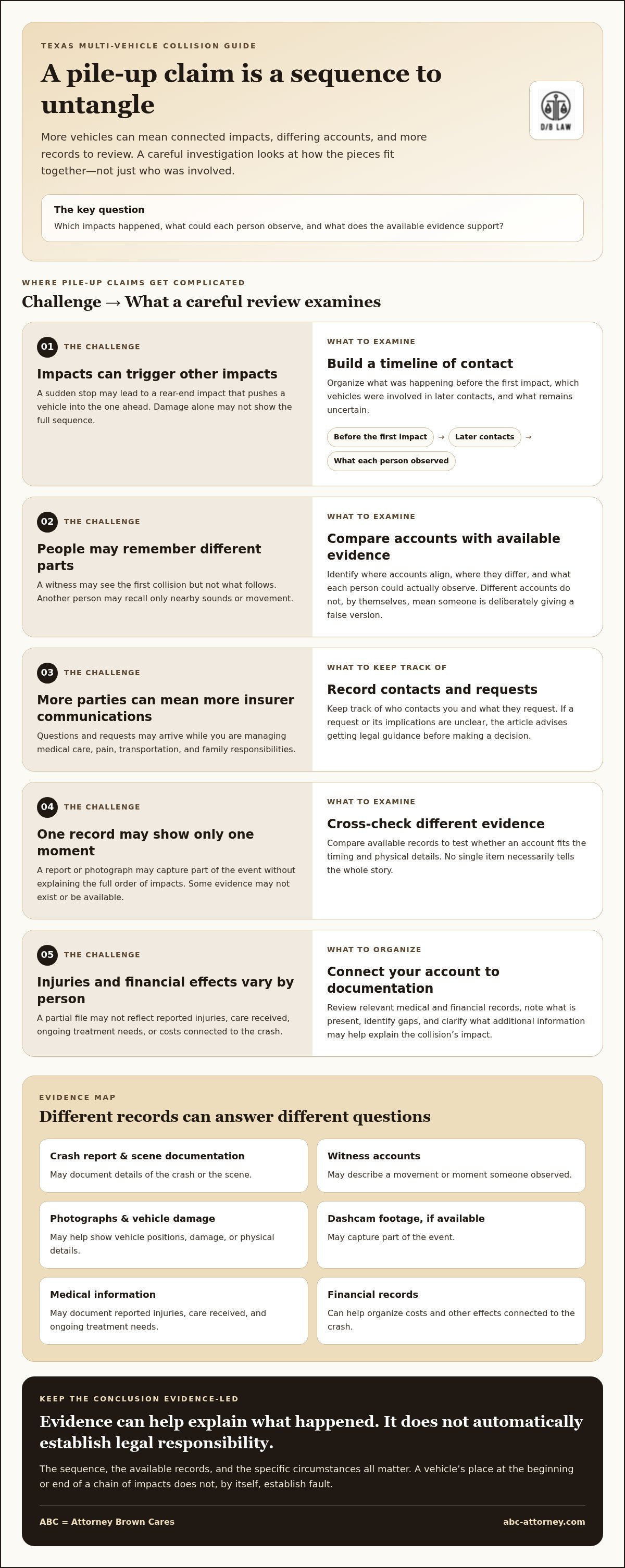
A pile-up investigation must examine how a sequence of impacts unfolded, rather than simply compare two drivers’ accounts. The order of contact, vehicles’ positions, and timing may help explain what happened. For example, a vehicle struck more than once may have been pushed into another car, or it may have moved before a later impact. Those possibilities need to be assessed against the evidence, not assumed.
How can one collision turn into a chain reaction?
A sudden stop may lead to a rear-end impact, and the force may push a vehicle into the one ahead. A driver losing control could also contribute to further collisions. Speed, traffic, or limited visibility may be relevant conditions in some crashes, but none alone proves who was at fault.
Impacts can happen within seconds. A witness may see the first collision but not what follows, while another person may remember only the sound or movement of nearby vehicles. Their accounts can differ without either person deliberately giving a false version. Comparing what each person observed with available evidence can help build a clearer timeline.
Why do multiple drivers and insurers complicate the aftermath?
With several drivers involved, accounts may differ about who stopped, changed lanes, or struck another vehicle first. Each person may have seen only part of the event. A careful review accounts for those gaps instead of treating the first explanation as the whole story.
More parties can also mean more insurer communications. You may be asked for information while managing appointments, pain, transportation, and family responsibilities. Keep track of who contacts you and what they request. If you don’t understand a request or its implications, get legal guidance before making a decision.
Each pile-up has its own facts. A driver should not be presumed responsible simply because their vehicle appears at the beginning or end of a chain of impacts. A multi-vehicle pile-up lawyer can examine the sequence and explain how available information may affect your claim, treating unanswered questions as questions rather than conclusions.
How a Lawyer Investigates a Texas Multi-Vehicle Pile-Up
An investigation aims to reconstruct what happened, not force the facts toward a predetermined conclusion. A lawyer may organize available information around a timeline: what was happening before the first impact, which vehicles were involved in later contacts, and what each person could observe. This can help identify where accounts align, where they differ, and what remains uncertain.
Evidence varies from crash to crash. A report or photograph may capture one moment without explaining the full sequence. For Texas-wide crash data and trends, the Texas Department of Transportation Crash Statistics offers general context, but statewide figures cannot establish what happened in an individual collision. A case review must focus on the specific records and evidence available for that crash.
What evidence may help reconstruct the sequence of impacts?
Depending on the circumstances, potentially relevant material may include a crash report, witness accounts, photographs, available dashcam footage, vehicle damage, and documentation of the scene. Each item can answer a different question. A photograph may show where vehicles came to rest; a witness may describe a movement they saw; footage, if available, may capture part of the event.
Comparing these pieces can help test whether an account fits the timing and physical details. No single record necessarily tells the whole story, and some types of evidence may not exist or be available in a particular case.
How are injuries and financial effects considered?
Medical information may document reported injuries, care received, and ongoing treatment needs. Relevant financial records can help organize costs and other effects connected to the crash. What matters depends on the person’s circumstances and the records available, so conclusions shouldn’t be drawn from a partial file.
A careful review connects your account to the documentation. It can note which records are present, identify gaps, and clarify what additional information may help explain the collision’s impact. That review is not a prediction of case value or a promise of a result.
Collecting evidence can help explain what happened, but evidence alone does not automatically establish legal responsibility. Its meaning depends on how the pieces fit together and how the relevant issues apply to the specific claim. A multi-vehicle pile-up lawyer should explain both what the available information supports and what it cannot yet show.
If you’re unsure how to organize the information you have, you can request a case review and discuss the circumstances of the crash with The Dedric Brown Law Firm.
How to Compare Multi-Vehicle Pile-Up Lawyers Before You Decide
After a serious crash, choosing legal representation can feel like one more difficult decision. Look beyond confident language. Consider whether the attorney takes time to understand your account, explains how the case may be reviewed, and answers practical questions in terms you can follow. A clear conversation can help you decide whether the approach fits your needs, in Houston or elsewhere in Texas.
What questions reveal how a lawyer will handle a complex crash?
Ask how the attorney would work to understand the sequence of impacts and connect it with your reported injuries. You’re not looking for a guaranteed conclusion before the facts are reviewed. You’re looking for a thoughtful explanation of how the available information will be assessed and what may happen next.
Notice how the attorney responds. Do they listen without rushing you, address your concerns, and explain how communication will work? Can they describe how you’ll discuss important decisions? Those details offer a practical sense of whether your circumstances will receive personal attention rather than being treated as a standard case.
Investigation: Does the lawyer explain how they’ll examine the collision’s sequence and the information relevant to your account?
Communication: Do they explain how updates and questions will be handled in clear, understandable language?
Personalization: Do they ask about your injuries, concerns, and circumstances before describing a path forward?
Fee clarity: Can they explain the fee arrangement plainly, including what the stated terms mean?
How should you assess experience, analysis, and fee transparency?
Experience with serious automobile accidents and personal injury litigation can matter because these cases may involve detailed records, difficult questions, and high stakes for an injured person. Ask how the attorney’s experience informs the investigation, communication, and decisions about the case. Credentials can add context, but they don’t promise compensation or determine the outcome.
Founding Attorney Dedric “Dee” Brown is an experienced trial lawyer and CPA. His accounting background is relevant to reviewing complex financial information, while his legal work addresses the injury claim itself. Consider whether the lawyer can explain how financial records may be organized and discussed without making unsupported predictions.
Fee terms should be understandable before you decide how to proceed. The Dedric Brown Law Firm states, “You Pay Nothing Unless I Win Your Case!” The firm’s contingency-fee model means you pay nothing unless the case is won. That wording describes the fee model, not a promise that a case will succeed.
A suitable multi-vehicle pile-up lawyer should make room for your questions and explain the next steps with care. The Dedric Brown Law Firm offers a free case review, an opportunity to discuss the crash and your concerns.
What to Do After a Pile-Up While Preserving Your Options
A pile-up can leave you shaken, hurt, and unsure what deserves your attention first. You don’t have to solve the whole crash scene in the moment. Put safety and health ahead of paperwork or photographs. Once immediate needs are addressed, preserve useful information as it becomes available and get guidance about questions specific to your circumstances.
Which immediate steps should come before legal paperwork?
Start with safety. Move away from danger if you can do so safely, and seek emergency help for urgent injuries or hazards. Get medical attention even if you’re focused on other people or the damaged vehicles. Your health comes first. Don’t walk into traffic, approach unstable vehicles, or put yourself at risk to take pictures or gather information.
After a sudden collision, people may be frightened, disoriented, or unable to remember every impact in order. That’s understandable. When you’re safe and it feels practical, write down what you recall in your own words. Note what you saw, heard, or remember about the moments before and after the crash. Treat this as a personal record, not a requirement or a final account of fault.
How can you keep useful information organized afterward?
As you recover, collect relevant items in one place, whether in a folder or another system that works for you. For example, keep together:
Crash documents and any available photographs
Medical records and information about treatment
Letters, emails, and other communications from insurers
Your notes about the crash and follow-up questions
Keep original documents where possible, and note when new records or messages arrive. Don’t assume the first impact establishes responsibility or that the order vehicles were struck tells the whole story. Those conclusions depend on the particular facts. An organized record can make it easier to explain what you know and identify what you still need to clarify.
Deadlines and reporting duties can depend on the circumstances, including who was involved and what happened. General online guidance may not fit your situation. Before relying on a deadline or deciding that a step is unnecessary, ask a lawyer to review the issue and verify applicable requirements against current Texas legal sources. Keep copies of relevant communications and note questions you want answered.
When you’re ready to discuss the crash and what information you’ve gathered, you can request a free case review from The Dedric Brown Law Firm. A multi-vehicle pile-up lawyer can help you understand what may matter in your particular situation, without asking you to make sense of every detail alone.
How ABC, Attorney Brown Cares, Supports Texas Pile-Up Clients
After a serious pile-up, the legal questions are only part of what you’re carrying. You may be trying to recover, support your family, and make sense of several accounts of the crash. The Dedric Brown Law Firm’s approach centers on personal attention and respect for what each client is facing. You’re more than a collection of documents or a case number.
What does Attorney Brown Cares mean for a client?
Support begins with listening. You should have the chance to explain what you remember, what injuries and disruptions you’re facing, and what worries you most. From there, legal advice can be tailored to your circumstances, with clear explanations of the issues and decisions that may arise. If a case proceeds toward a courtroom, advocacy should remain grounded in your account and your needs.
Care also means explaining uncertainty honestly. No lawyer can promise how a claim will end. Attentive communication can help you understand what is known, what still needs review, and what the next steps may involve. The firm’s mission is “Fighting for your rights with integrity and dedication.” That means pursuing your interests with principled advocacy while treating your questions and choices with respect.
Dedric “Dee” Brown, the firm’s founding attorney, is an experienced trial lawyer. He provides legal representation informed by the facts of your situation, rather than a one-size-fits-all answer before hearing from you. Your concerns, injuries, and priorities may differ from those of everyone else involved, so the conversation should make room for what matters to you.
What can you expect from a free case review?
A free case review is an opportunity to discuss the crash, raise questions, and learn how the firm views the situation. You don’t need to have every detail organized before starting a conversation. The review can help identify information that may be relevant and give you a clearer understanding of possible next steps. It’s a conversation, not a promise about the result.
The firm describes its contingency-fee model with the exact wording, “You Pay Nothing Unless I Win Your Case!” That statement explains the fee model and does not guarantee that a case will succeed. You can use the review to discuss the arrangement and understand the terms of representation before deciding how to proceed.
Choosing a multi-vehicle pile-up lawyer is about more than legal knowledge. It’s also about being heard, receiving straightforward explanations, and having an advocate who takes your circumstances seriously. If you’re ready to talk about the crash and your concerns, request your free case review.
Take the Next Step Toward Clarity
You don’t have to resolve every unanswered question before getting legal guidance. A conversation can help you identify what you know, what still needs attention, and which next steps make sense for your circumstances. Choosing a multi-vehicle pile-up lawyer is ultimately about finding support that takes your concerns seriously and helps you move forward with a clearer understanding of your options.
The Dedric Brown Law Firm’s approach is grounded in care and personal attention. If you’re ready to talk about what happened, request your free case review. You deserve a thoughtful conversation and a path forward that feels manageable.
Frequently Asked Questions
What does a multi-vehicle pile-up lawyer do?
A multi-vehicle pile-up lawyer represents an injured person in a claim arising from a crash involving several vehicles. The lawyer can help assess the person’s account, review available information, communicate about the claim, and explain decisions as they arise. For example, if different insurers ask questions about separate injuries or impacts, legal guidance can help you understand what each request concerns before you respond.
How is fault determined in a multi-car pile-up in Texas?
Fault depends on the evidence and the circumstances of the crash. Texas uses a modified comparative responsibility system: an injured person generally can recover damages only if their share of responsibility is 50% or less, and any recovery may be reduced by their percentage of responsibility. The 51% threshold is one reason it matters to examine each person’s actions rather than assume the first or last driver caused the pile-up.
Can more than one driver be responsible for a pile-up?
Yes. The facts may support assigning responsibility to more than one driver. For instance, one driver’s actions might contribute to an initial collision, while another driver’s conduct may have contributed to a later impact. That possibility doesn’t establish anyone’s fault by itself. Investigators and legal representatives assess the evidence and each person’s role, with responsibility considered under the rules that apply to the individual claim.
What evidence can help explain how a multi-vehicle crash happened?
Potentially useful information can include photographs, witness contact details, available video, crash documents, and records showing vehicle damage. If you have digital files, keep the originals and note when and where they were created; avoid cropping or editing the only copy. Medical records may also help connect an injury to the collision. What matters will depend on which information exists and is relevant to the crash.
Should I speak with multiple insurance companies after a pile-up?
You may hear from more than one insurer, but you don’t have to guess at answers or treat every request as identical. Keep a record of who contacted you, the date, and what they asked for. If a question is unclear, ask for it in writing. Before giving a detailed recorded statement or signing a document that could affect your claim, consider getting legal advice about your circumstances.
How much does it cost to hire The Dedric Brown Law Firm?
The Dedric Brown Law Firm uses a contingency-fee model: “You Pay Nothing Unless I Win Your Case!” The firm also offers a free case review. Discuss the fee arrangement and the terms of representation during your case review so you understand them before deciding how to proceed.
Can I request a free case review after a serious Texas pile-up?
Yes. The Dedric Brown Law Firm offers a free case review so you can discuss the crash and raise questions about your situation. The firm represents people injured in serious automobile accidents across Texas, including Houston, San Antonio, Dallas, Austin, Beaumont, Huntsville, Prairie View, and Brenham. You don’t need to know who was responsible before asking for a review; share what you know and what remains uncertain.



Comments