
What Is Considered a Preventable Birth Injury? A Guide for Texas Families

Updated: Jun 30
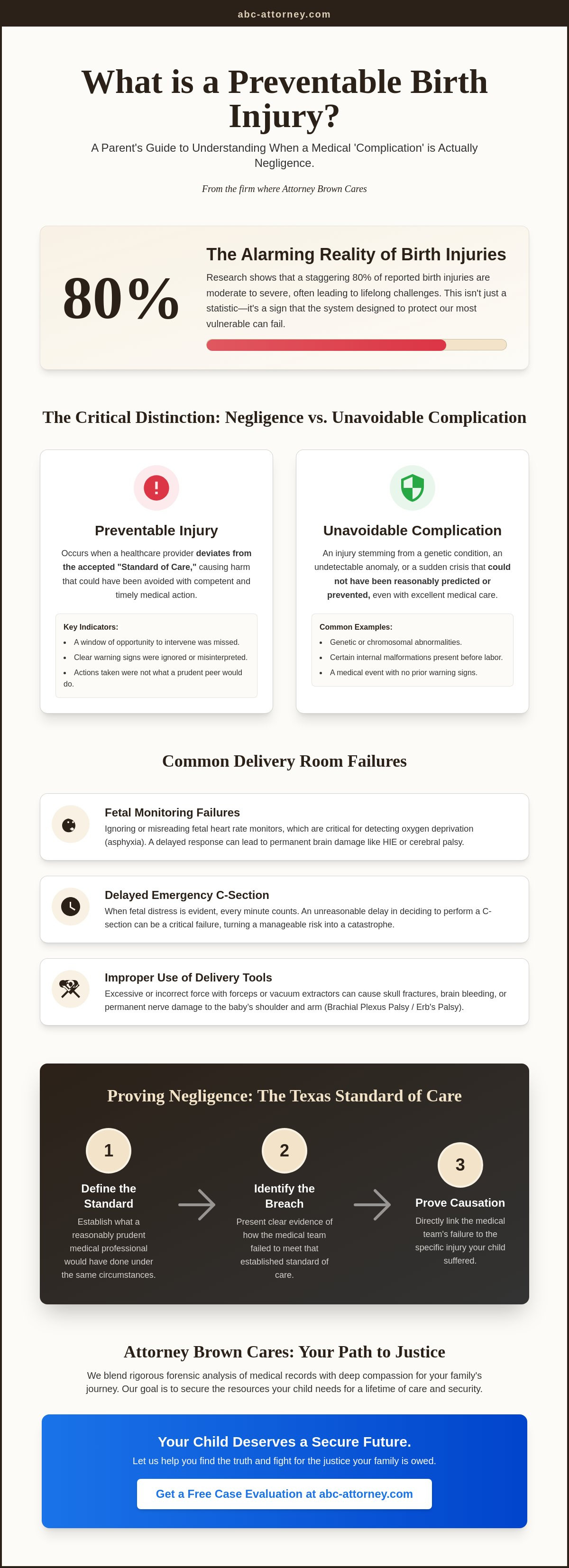
What if the "complication" your doctor described wasn't an unavoidable accident, but a failure to follow the medical standards your family deserved? It's a question that haunts many parents in Texas, especially when research shows that 80% of reported birth injuries are moderate to severe. You're likely facing mounting medical bills, feeling ignored by hospital staff, and carrying a heavy weight of guilt. Attorney Brown Cares was built on the principle that you need a champion who balances aggressive advocacy with deep compassion. Understanding what is considered a preventable birth injury is the only way to move from uncertainty toward a stable financial future for your child.
You deserve to know if the medical team failed you. A preventable injury isn't just a bad outcome. It's a breach of the standard of care that a reasonably prudent professional would have maintained. This guide defines the medical criteria for negligence, details the Texas laws governing these claims, and identifies the signals of fetal distress that were ignored. We'll explore the path toward securing the resources your child needs for a lifetime of care. By blending technical expertise with unwavering commitment, we help you find the truth and pursue the justice your family is owed.
Table of Contents
Defining 'Preventable' in the Context of Birth Injuries
Hospitals often use complex medical jargon to mask a simple, painful truth: many injuries suffered during labor are not unavoidable "accidents." When a family asks what is considered a preventable birth injury, they are seeking a clear line between a natural complication and a professional failure. A preventable injury occurs when a healthcare provider deviates from the accepted standard of care. This means the harm could have been avoided if the doctor, nurse, or midwife had acted with the same level of caution and skill as their peers. At the Dedric Brown Law Firm, we believe that Attorney Brown Cares (ABC) means digging through every medical chart to find these deviations. We don't just accept the hospital's explanation; we audit the evidence with technical precision.
The Legal Standard of Care in Texas
In Texas courts, the "Standard of Care" is the ultimate benchmark for justice. It represents the specific actions a "reasonably prudent" medical professional would have taken under similar circumstances. Proving a breach of this standard requires a combination of high-level analytical rigor and expert testimony. Attorney Brown Cares involves a deep dive into the specific protocols and internal guidelines of major medical systems in Houston and Dallas. We use qualified medical experts to establish preventability by testifying on three critical points. They define what the specific medical standard required during your delivery. They identify how the medical team failed to meet that standard. They explain how that specific failure directly caused your child's injury. This methodical approach ensures your case is built on data, not just theory.
Unavoidable vs. Preventable: The Grey Area
Distinguishing between an unavoidable complication and medical negligence is often the most difficult part of a case. Truly unavoidable issues usually stem from genetic conditions or internal malformations that exist long before labor begins. However, a Birth injury becomes preventable when a window of opportunity to intervene was missed by the staff. Red flags often include ignoring abnormal fetal heart rate patterns, failing to perform a timely C-section despite signs of distress, or the improper use of delivery tools like forceps. If there was a moment where different medical choices could have changed the outcome, the injury was preventable. We focus on the timing of these decisions to prove that your child's condition wasn't inevitable. Our firm acts as a protective ally, ensuring that "caring" translates into a relentless pursuit of the facts.
Common Medical Failures That Lead to Preventable Harm
Identifying what is considered a preventable birth injury requires an objective look at the data trails left behind by hospital staff. Medical teams are trained to spot risks, but fatigue, poor communication, or simple negligence often lead to catastrophic errors. These failures aren't just unfortunate mistakes. They represent a breakdown in the safety systems meant to protect your child during their most vulnerable moments. Attorney Brown Cares (ABC) means we use the analytical rigor of a CPA-attorney to audit these systems and uncover where the medical team failed to meet their obligations.
Fetal Monitoring Failures and Asphyxia
Electronic Fetal Monitoring (EFM) provides a chronological record of your baby's heart rate and your contractions. When the baby's oxygen supply drops, the monitor shows specific deceleration patterns that any trained professional should recognize. Failure to monitor these signals leads directly to Hypoxic-Ischemic Encephalopathy (HIE) or other forms of asphyxia. Fetal distress signals must be acted upon within minutes to prevent permanent and irreversible brain damage. When nurses or doctors ignore these alarms, they turn a manageable situation into a lifelong disability.
Obstetrical Complications and Surgical Errors
Physical trauma during delivery often stems from high-pressure situations where the medical team panics or uses outdated techniques. This clinical overview of birth trauma highlights how mechanical forces can cause permanent nerve damage during labor. Shoulder dystocia is a prime example. If a doctor pulls with excessive force instead of using standard maneuvers, they can cause Erb's Palsy or Brachial Plexus Palsy. Delayed C-sections also fall under this category. If a uterine rupture occurs or the baby is too large for a safe vaginal birth, every second of delay increases the risk of oxygen deprivation.
Medication errors also play a significant role in preventable harm. Pitocin is frequently used to induce labor, but it requires constant oversight. If it's not managed correctly, it can cause "uterine tachysystole," where contractions happen too frequently, essentially choking off the baby's oxygen supply. Additionally, failures in prenatal care, such as ignoring the signs of preeclampsia or gestational diabetes, create unnecessary risks for both the mother and the infant. These are documented medical failures that could have been avoided with proper attention. If you believe your child's condition was caused by a delay or a mistake in the delivery room, you can reach out for a detailed review of your medical records to find the truth.
Birth Injuries vs. Birth Defects: Understanding the Difference
Hospitals often use "birth defect" as a shield. It suggests an act of nature rather than an act of negligence. A birth defect is typically a structural or functional change, such as a heart malformation, that develops early in pregnancy due to genetic or environmental factors. In contrast, what is considered a preventable birth injury is damage sustained during the labor and delivery process itself. This includes physical trauma, bone fractures, or acute oxygen deprivation. When a hospital tries to label a skull fracture or brain damage as an "unavoidable defect," they're often attempting to mitigate their financial risk. We look beyond these clinical labels. Attorney Brown Cares means conducting a forensic medical review that follows the data trail to the truth.
Cerebral Palsy: Injury or Defect?
Cerebral Palsy (CP) is a diagnosis that changes a family's life forever. While some cases result from developmental issues, many are caused by physical trauma or oxygen deprivation during birth. If a medical team fails to recognize fetal distress, the resulting brain damage can manifest as CP. This makes the diagnosis a potential outcome of medical malpractice litigation. Identifying the root cause requires a meticulous audit of labor and delivery records. We scrutinize fetal monitor strips and nursing notes to find the exact moment the standard of care was breached. The ABC approach provides a supportive, expert voice for families. We ensure that if negligence caused your child's condition, the responsible parties are held accountable for their future medical needs.
Identifying Prenatal Negligence
Preventability doesn't always start in the delivery room. It can begin months earlier during routine prenatal visits. Failure to treat maternal infections or monitor conditions like gestational diabetes often leads to preventable neonatal harm. For instance, untreated gestational diabetes can result in fetal macrosomia, or an oversized baby. This significantly increases the risk of shoulder dystocia and subsequent nerve damage during birth. Attorney Brown's analytical precision identifies these missed diagnostic opportunities. We examine whether your doctor ignored clinical signals that required a more aggressive management plan. By uncovering these prenatal failures, we prove that the injury wasn't a random defect. It was a failure of medical oversight. We act as a protective ally, ensuring your child's financial future is secured against the high costs of long term care.
Forensic Analysis: Proving Preventability Through Data
Most law firms discuss medical mistakes in broad, emotional terms. We take a different approach. Proving what is considered a preventable birth injury requires the analytical rigor of a forensic audit. Hospitals are data-driven environments. Every heart rate fluctuation, every medication dose, and every page to a surgeon leaves a digital footprint. Dedric Brown brings the specialized background of a CPA-attorney to this process. We don't just read medical charts; we audit them. We follow the paper trail of fetal monitor strips and nursing notes to identify the exact moment the medical team deviated from their protocols. This technical scrutiny allows us to spot inconsistencies between what a doctor claims happened and what the hospital's own data proves.
The Power of the Audit Trail
Modern hospitals use Electronic Medical Records (EMR) that track every interaction with a timestamp. This metadata is often the key to proving a "delay in treatment." If a fetal monitor showed sustained distress but the EMR shows the OB-GYN wasn't paged for thirty minutes, we have objective proof of negligence. We cross-reference these timestamps with nursing flow sheets to build a minute-by-minute timeline of the labor. Forensic accounting principles apply directly to calculating long-term medical damages by projecting future costs with mathematical certainty. This level of detail makes it difficult for hospital insurance companies to dismiss your claim as a simple complication.
Quantifying the Financial Impact on Texas Families
A birth injury creates a financial burden that lasts for decades. Families in Houston and San Antonio often feel overwhelmed by the immediate medical bills, but the long-term costs are even more staggering. We develop a comprehensive "Life Care Plan" for your child. This plan quantifies the costs of specialized schooling, physical therapy, and potential 24/7 home care. Attorney Brown Cares (ABC) means we ensure your child's financial future is secured for their entire lifetime, not just the next few years. We use complex financial modeling to account for inflation and changing medical needs. If you suspect the hospital is hiding the truth behind medical jargon, you can schedule a forensic audit of your records to uncover the facts. We act as your protective ally, using data to turn your suspicions into a powerful case for justice.
Taking the Next Steps: Justice for Your Child
Moving from suspicion to action requires a clear, methodical strategy. Hospitals rarely volunteer information that points to their own failures. To determine what is considered a preventable birth injury in your specific case, you must first secure the raw data from your delivery. This means requesting your complete medical records, specifically the electronic fetal monitor strips and the "audit trail" of the nursing staff. These documents contain the evidence of distress that the hospital staff might have overlooked. Consulting with a specialized birth injury attorney who understands the unique Texas legal landscape is the only way to transform these records into a viable claim for your child's future.
Timing is your most critical enemy in Texas medical malpractice litigation. The state's legal deadlines are rigid and unforgiving. Generally, a lawsuit must be filed within two years from the date the negligent act occurred. However, Texas provides a vital exception for minors: a lawsuit can be filed on a child's behalf until they reach the age of 14. You must also be aware of the 10-year statute of repose, which acts as an absolute deadline regardless of when the injury was discovered. The Dedric Brown Law Firm provides a no-cost initial forensic review to help families navigate these hurdles before time runs out. We act as a protective ally, ensuring that procedural delays don't cost your child the financial security they deserve.
The ABC Consultation Process
Your first meeting with Attorney Dedric Brown is designed to provide both clarity and comfort. We know that grieving parents are often exhausted and overwhelmed by the clinical jargon they've heard from hospital staff. Our firm creates a compassionate, client-centered environment where your story is heard and respected. We balance this empathy with a commitment to aggressive advocacy. We don't just listen; we begin the process of building a formidable case. Attorney Brown Cares (ABC) means we treat your child's future as our primary mission, combining a mentor's guidance with a litigator's strength.
Protecting Your Family's Future in Texas
Texas law imposes significant hurdles on medical malpractice victims, including a $250,000 cap on non-economic damages like pain and suffering. Because of these caps, our strategy focuses on meticulously documenting economic damages. We build robust Life Care Plans that project the real-world costs of therapy, equipment, and medical care over your child's entire life. Local expertise in Houston, Dallas, and Austin courts is essential because every jurisdiction has its own procedural nuances. We use our deep roots in these communities and our technical auditing skills to fight for a resolution that truly covers your child's needs. Attorney Brown Cares about your journey—contact us today for a free case evaluation.
Securing Your Child's Future Through Expert Advocacy
Identifying the truth behind a complex delivery requires moving past hospital jargon and into the hard data. We've seen how medical records and audit trails reveal the difference between an unavoidable event and professional negligence. Understanding what is considered a preventable birth injury empowers your family to seek the financial security your child will need for a lifetime of care. This journey toward justice demands a protective ally who combines technical precision with aggressive advocacy.
Dedric Brown is a dual-credentialed CPA and Attorney with a specialized focus on HIE and Traumatic Brain Injuries. This unique analytical background ensures that every medical chart is audited for truth and every dollar of future care is accurately projected. Attorney Brown Cares about the challenges Texas families face; we are prepared to engage in high-stakes legal battles to protect your rights. You don't have to carry this burden without a sophisticated expert by your side.
Attorney Brown Cares—Schedule Your Free Birth Injury Case Review Now
Take the first step toward validation and peace of mind today. Your child's future is worth the fight, and we are here to ensure you're heard.
Frequently Asked Questions
Is Cerebral Palsy always considered a preventable birth injury?
Cerebral Palsy is not always preventable, but many cases stem directly from medical errors during labor. While some instances result from unavoidable genetic or developmental issues, injuries caused by oxygen deprivation or physical trauma are often avoidable. Attorney Brown Cares about finding the root cause of your child's condition. We investigate whether the medical team failed to intervene when your baby showed clear signs of distress.
How do I know if my baby's oxygen deprivation was the hospital's fault?
Identifying fault requires a forensic audit of the labor and delivery records. You should look for red flags like emergency resuscitation, low Apgar scores, or immediate transfers to the NICU. These events often indicate that the hospital staff missed critical windows of opportunity. Our firm analyzes fetal monitor strips to prove if the medical team ignored clear signals of distress that required immediate action.
What is the statute of limitations for birth injury claims in Texas?
In Texas, the general statute of limitations for medical malpractice is two years from the date of the negligent act. However, a child has until their 14th birthday to file a claim for birth related injuries through a parent or guardian. It's also vital to remember the absolute 10-year statute of repose. This law acts as a final cutoff for all claims, regardless of when the injury was discovered.
Can I still file a claim if my baby's injury wasn't diagnosed until months after birth?
Yes, you can file a claim even if the diagnosis came later. Many conditions, such as developmental delays or motor skill issues, only become visible as the child misses certain growth milestones. Texas law allows for these scenarios within the established legal deadlines. We help you connect these late diagnoses back to the original events in the delivery room to determine if negligence played a role.
What kind of compensation can a family receive for a preventable birth injury?
Do I need a lawyer if the hospital has already offered a settlement?
You should never accept an initial settlement without a professional review. Hospital offers are typically designed to minimize their financial liability and rarely cover a lifetime of specialized care. A specialized attorney ensures the settlement accounts for inflation, future surgeries, and 24/7 support needs. We act as your protective ally to ensure your child's future is not left underfunded by a quick settlement offer.
How does Attorney Brown's CPA background help my birth injury case?
What does 'failure to monitor fetal conditions' actually mean in a legal sense?
In a legal sense, this refers to a medical team's failure to recognize or respond to changes in the baby’s health during labor. This failure is a primary factor in what is considered a preventable birth injury. It involves ignoring fetal heart rate decelerations or failing to page a surgeon when the data indicates a crisis. We use hospital timestamps to prove these delays occurred and caused harm.



Comments