
What Are the Signs of a Traumatic Brain Injury After a Car Accident? A Checklist for Texas Families

A clean CT scan in a Texas emergency room doesn't mean your brain is healthy; it simply means your brain isn't currently bleeding. You know something is wrong, even if the hospital staff dismissed your symptoms as a minor concussion or a lingering headache. It's exhausting to fight for validation when insurance adjusters treat your very real cognitive fog like a minor inconvenience. Many Texas families find themselves searching for what are the signs of a traumatic brain injury after a car accident because the most life-altering symptoms are often the hardest to see on a medical chart.
We understand that you're looking for more than just legal advice. Attorney Brown Cares about your total recovery, which is why we've developed a comprehensive checklist to help you identify the hidden physical, cognitive, and emotional red flags that others might miss. This guide will provide the evidence you need to show your doctor, the validation that your "mild" symptoms are serious, and the strategic knowledge to protect your legal rights under Texas law. We'll walk through the specific symptoms that demand medical attention and explain how to secure the specialized care you deserve.
Table of Contents
Immediate Physical Signs of TBI: The First 48 Hours
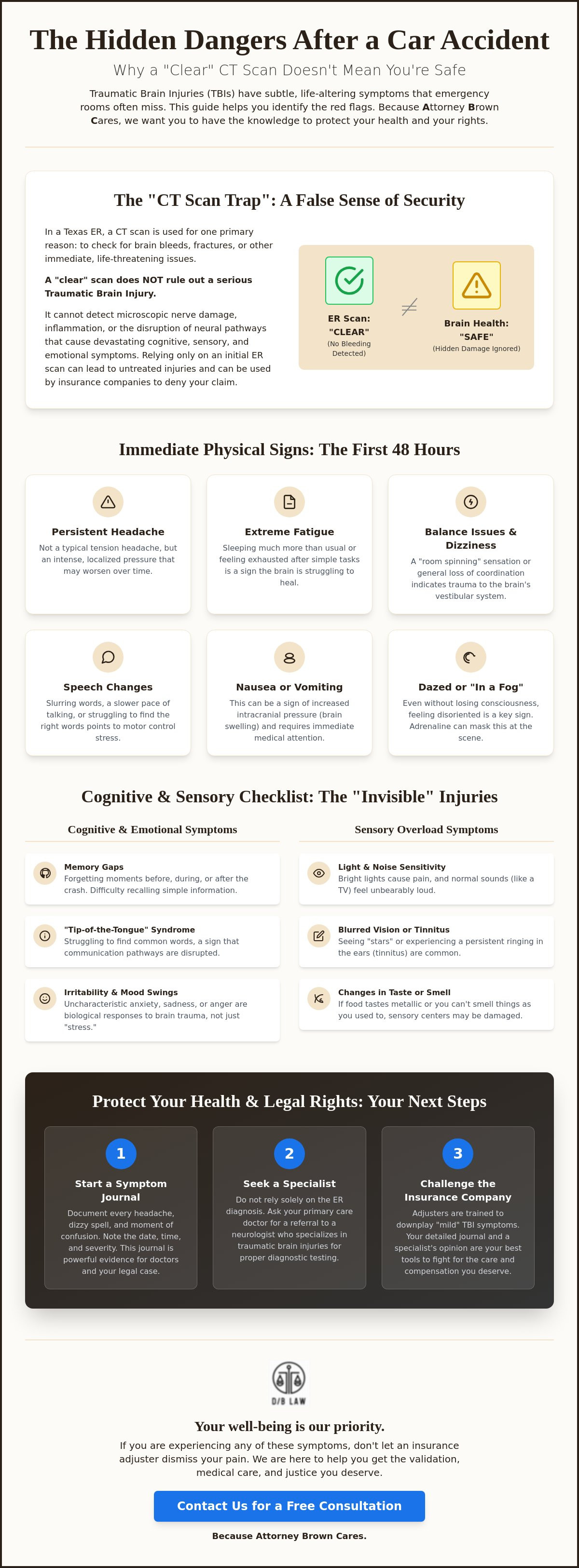
A Traumatic brain injury is a complex physiological event, not just a simple bump on the head. It occurs when a violent jolt or blow to the skull disrupts the brain's delicate neural pathways. These injuries trigger wide-ranging physical and psychological effects that can last for weeks, months, or even a lifetime. One of the biggest mistakes families make is assuming a "mild" TBI is just a minor concussion that will go away on its own. Even a mild injury can lead to permanent cognitive changes if left untreated. Attorney Brown Cares about your future, so we focus on these early indicators to ensure you receive proper diagnostic testing before symptoms worsen.
The most frequent physical indicator is a headache that simply won't go away. This isn't your typical tension headache. It often feels like intense, localized pressure that worsens as the hours pass. You might also notice "invisible" symptoms that are easy to dismiss during the stress of an insurance claim. Fatigue is a major red flag. If you're sleeping significantly more than usual or feel exhausted after performing simple tasks, your brain is likely struggling to heal. Subtle changes in speech, such as slurring words or a slower pace of talking, also indicate that the brain's motor control centers are under significant stress.
The 'Dazed' State and Loss of Consciousness
There is a dangerous myth that you must black out to have a brain injury. This is false. Many people remain awake but feel "in a fog" or dazed immediately following a high-speed collision on I-10 or I-45. This disorientation is a key part of what are the signs of a traumatic brain injury after a car accident. Adrenaline often masks these symptoms at the scene of the wreck. You might tell the police you're fine because your body is in "fight or flight" mode, but the cognitive damage is already present. The "abc" in our firm name stands for Attorney Brown Cares, and that means we look past the initial adrenaline to see how you are truly functioning in the days that follow.
Nausea, Vomiting, and Balance Issues
If you experience persistent nausea or vomiting after a wreck, you shouldn't ignore it. These are often signs of increased intracranial pressure, which means the brain is swelling against the interior of the skull. This is a medical emergency that requires immediate intervention from a specialist. Many survivors also report a "room spinning" sensation or a general loss of physical coordination. Balance disruption indicates vestibular system trauma where the brain can no longer process spatial information correctly. It's a clear signal that the jolt was powerful enough to damage the brain's internal GPS.
The Cognitive and Sensory Checklist: Signs You Shouldn't Ignore
Physical pain is obvious, but the invisible damage to your mind is often more devastating. When we talk about what are the signs of a traumatic brain injury after a car accident, we must look at how your brain processes the world around you. You might find yourself struggling with "tip-of-the-tongue" syndrome, where simple words feel just out of reach. This isn't just a lapse in memory; it is a sign that the neural pathways responsible for communication are struggling to connect. Attorney Brown Cares about these subtle shifts because they impact your ability to work and lead a normal life.
Your environment can also become an enemy. In the bright Texas sun, you might find that light sensitivity is so intense it causes physical pain. Loud noises that never bothered you before, like a television or a crowded restaurant, may now feel unbearable. These symptoms of a concussion or more severe TBI often include memory gaps. You might not remember the moments leading up to the crash or the minutes immediately following the impact. If you're feeling uncharacteristically irritable or anxious, don't dismiss it as "stress." These emotional shifts are biological responses to brain trauma.
Sensory Overload and Changes
Sensory changes are frequently overlooked in the chaos of a legal claim. Many survivors experience a persistent ringing in the ears, known as tinnitus, even if there was no direct injury to the ear itself. You might see "stars" or experience blurred vision that makes reading or driving difficult. Some of the most startling signs involve changes in taste or smell. If your favorite food suddenly tastes like metal or you can't smell coffee in the morning, your brain's sensory processing centers have likely been compromised. If you've noticed these changes, it's time to reach out for a professional evaluation to ensure your health is prioritized.
Mental Processing and Emotional Shifts
A TBI can make you feel like you're moving through molasses. You might feel "slow" when trying to follow a conversation or complete a simple task at work. This cognitive lag is a major indicator of brain dysfunction. Uncharacteristic bouts of depression or sudden anger can also emerge without warning. Often, family members are the first to notice that you "just aren't yourself anymore." They see the personality shifts before you do. Attorney Brown Cares about restoring the person you were before the accident, and that starts with acknowledging that these emotional struggles are real medical symptoms.
Moderate to Severe TBI: Emergency Red Flags
If your loved one's condition shifts from "dazed" to "dangerous," you are no longer dealing with a wait-and-see situation. Moderate to severe brain injuries manifest through unmistakable physical crises that require instant intervention. Seizures or convulsions are perhaps the most terrifying red flags; these occur when the brain’s electrical activity is violently disrupted by trauma. Another critical sign is the dilation of one or both pupils. If you notice uneven pupils, it often signals significant brain swelling or a hematoma pressing against the skull. Attorney Brown Cares about the survival and long-term health of our clients, so we urge families to look for clear fluids draining from the nose or ears. This is often cerebrospinal fluid (CSF), indicating a skull fracture and a high risk of infection.
Lethargy is another hallmark of a worsening condition. If a crash survivor is impossible to awaken from sleep or appears profoundly drowsy even after rest, their brain is struggling to maintain consciousness. Understanding what are the signs of a traumatic brain injury after a car accident means knowing when "rest" is actually a sign of neurological failure. These emergency red flags for TBI represent a race against time. You must act decisively to ensure the damage doesn't become permanent.
Physical Weakness and Coordination Loss
Neurological damage frequently mimics spinal cord trauma. You might notice your loved one complaining of numbness or weakness in their fingers and toes. This isn't always a localized nerve issue; it's often the brain's inability to send signals through the central nervous system correctly. Significant loss of coordination, such as fumbling with a phone or stumbling while walking, shows that the motor cortex is compromised. Worsening symptoms require immediate Level 1 Trauma Center attention.
Profound Confusion and Agitation
The brain controls our filters and our speech. When it is severely damaged, speech may become slurred or incoherent. To an untrained observer or a busy ER doctor, this might look like intoxication, but it is actually a neurological breakdown. Extreme combativeness or agitation is also common. A normally calm person might become violent or scream at hospital staff because their frontal lobe can no longer regulate emotions. Attorney Brown Cares means ensuring you have a guardian to watch for these signs, as the injured person is often unable to advocate for themselves in this state. Monitoring these shifts in the first 72 hours is vital for both medical recovery and any future legal pursuit regarding what are the signs of a traumatic brain injury after a car accident.
Why TBIs are Often Missed in Texas Emergency Rooms
If you left the hospital with a clean bill of health but still feel "off," you are likely a victim of the CT Scan Trap. Most Texas emergency rooms rely on CT scans to rule out immediate life-threats like brain bleeds or skull fractures. These machines are excellent at finding blood, but they are notoriously poor at detecting microscopic axonal shearing. This type of cellular damage occurs when brain fibers stretch and tear during an impact. According to data from the Brain Injury Association of America, emergency rooms miss TBI diagnoses up to 80% of the time. This massive failure rate doesn't just threaten your health; it creates a significant hurdle in your Texas personal injury litigation. Insurance adjusters will point to your "normal" scan as proof that you aren't injured. Attorney Brown Cares about the truth of your condition, which is why we always recommend a comprehensive evaluation by a neurologist who specializes in brain trauma.
Understanding what are the signs of a traumatic brain injury after a car accident requires looking past the surface-level results of a standard emergency room visit. A negative CT scan does not mean you are in the clear. It simply means your brain isn't currently hemorrhaging. When medical records show no diagnosis at the scene, insurance companies use that gap to devalue your claim. We bridge that gap by connecting you with specialists who use advanced imaging. Our firm applies CPA-level precision to your medical timeline to ensure every symptom is documented and every injury is accounted for. We believe that professional advocacy is a journey toward a successful conclusion, not just a transaction.
The Role of Adrenaline and Delayed Onset
Adrenaline is a powerful mask. Immediately after a wreck, your body is in "fight or flight" mode, which can suppress pain and cognitive confusion for several days. You might feel perfectly fine for 48 to 72 hours before the "brain fog" finally sets in. This 72-hour window is the most critical period for medical documentation. If you wait a week to see a doctor, the insurance company will claim your injury happened elsewhere. The Dedric Brown Law Firm uses rigorous analytical discipline to track these timelines. We investigate the crash, analyze the medical data, and pursue the full value of your recovery. Attorney Brown Cares enough to ensure your "delayed" symptoms are given the weight they deserve in court.
Advocating for Your Own Brain Health
When you are searching for what are the signs of a traumatic brain injury after a car accident, you must be prepared to advocate for yourself in the exam room. If a doctor tries to discharge you with "just a concussion," ask specific questions. Inquire about the necessity of an MRI or a DTI (Diffusion Tensor Imaging) scan, which can visualize the "invisible" white matter damage that CT scans miss. You should also ask about identifying TBI symptoms after a Houston truck wreck, as the higher force of impact often leads to more complex neurological issues. Don't let a busy ER doctor dismiss your concerns. If you feel your symptoms are being ignored by insurance adjusters or medical staff, contact our team today to ensure your rights are protected by an ally who understands the science of your injury.
Next Steps: A Checklist for Health and Legal Protection
Identifying what are the signs of a traumatic brain injury after a car accident is the critical first step toward recovery. However, the actions you take in the days and weeks following your diagnosis will determine the quality of your medical care and the strength of your legal claim. You need a clear plan to navigate the complex path ahead. Attorney Brown Cares about your physical and financial well-being, which is why we recommend following this protective checklist to ensure nothing falls through the cracks.
Seek a Secondary Medical Opinion: Do not rely solely on the emergency room discharge papers. ER physicians are trained to stabilize life-threatening conditions, but they often lack the specialized equipment to diagnose long-term neurological dysfunction. Schedule an appointment with a neurologist or a TBI specialist who can perform advanced neurocognitive testing.
Maintain a Symptom Journal: Document your daily struggles in a dedicated notebook. Record instances of memory loss, mood swings, or physical pain. This journal serves as powerful evidence of the "silent" impact the injury has on your quality of life.
Stay Off Social Media: Insurance adjusters are trained to monitor your public profiles. A single photo of you smiling at a family dinner can be used to argue that your injury is not as severe as you claim. Protect your case by keeping your recovery private.
Consult a Specialized Lawyer: Brain injuries involve medical complexities that general practice lawyers may overlook. You need an advocate who understands the science of axonal shearing and the long-term costs of cognitive rehabilitation.
Documenting the 'Silent' Impact
A TBI often changes how you interact with the world, affecting your career and your relationships. These injuries can significantly diminish your earning capacity if you can no longer perform high-level tasks or maintain a full-time schedule. Dedric Brown’s background as a CPA provides a unique advantage during settlement negotiations. We use rigorous analytical precision to calculate the true cost of your lost wages and future financial needs. We also recommend gathering statements from friends and coworkers who can describe "the new you." These personal accounts illustrate the human cost of the accident. Attorney Brown Cares means fighting for the maximum compensation required to fund your long-term care and household stability.
Why The Dedric Brown Law Firm is Your Protective Ally
Our firm is built on a foundation of principled combativeness against negligent drivers and trucking companies. We don't just process files; we lead investigations to hold the responsible parties accountable for the harm they caused. The "ABC" promise is our core value: Attorney Brown Cares about your recovery, not just your case. We treat the legal process as a journey toward a successful conclusion where you feel heard and protected. If you are struggling with the aftermath of a wreck, you don't have to face the insurance companies alone. Contact The Dedric Brown Law Firm for a compassionate, free evaluation of your TBI claim.
Secure Your Health and Your Legal Rights Today
A "clear" hospital scan is often just the beginning of your journey. Real recovery requires looking deeper into the cognitive fog and emotional shifts that follow a crash. Identifying what are the signs of a traumatic brain injury after a car accident allows you to seek the specialized care you deserve. You now have the tools to advocate for your health and document the silent impact of your injury. Don't let an insurance adjuster tell you that your pain isn't real.
Dedric Brown brings CPA-level analytical precision to every catastrophic TBI and truck wreck case. We provide aggressive advocacy for families across Houston, Dallas, and San Antonio. We don't just see a case number; we see a neighbor who needs a champion. Our firm is dedicated to ensuring you have the resources for long-term care and financial stability. You've been through enough; let us handle the insurance adjusters while you focus on healing.
Attorney Brown Cares: Get Your Free TBI Case Review Today
Take the first step toward justice with a partner who truly hears you. We're ready to fight for your future and ensure you feel supported every step of the way.
Frequently Asked Questions
Can I have a brain injury if I didn't hit my head during the car accident?
Yes, you can sustain a serious brain injury without ever striking your head against the steering wheel or window. The violent jolt of a collision causes the brain to rattle against the interior of the skull. This rapid movement can lead to microscopic tearing of brain fibers known as axonal shearing. Many people ignore these injuries because they don't see a bruise, but the internal damage is a significant medical concern.
What should I do if the ER doctor said my CT scan was normal but I still have symptoms?
You should seek a second opinion from a neurologist immediately. Standard emergency room CT scans are designed to find life-threatening bleeding, not the subtle cellular damage common in brain trauma. If you are still asking what are the signs of a traumatic brain injury after a car accident while suffering from "fog" or headaches, a normal scan isn't the final word. We help our clients find specialists who utilize advanced imaging to prove these injuries.
How long do I have to file a TBI claim in Texas after a car wreck?
You generally have two years from the date of the accident to file a personal injury claim in Texas. This deadline is mandated by the Texas Civil Practice and Remedies Code Section 16.003. If the victim is a minor, the two-year clock doesn't begin until their 18th birthday. Because TBI symptoms can be delayed, it's vital to begin the legal process early. We ensure your medical timeline is documented with CPA-level precision to protect your rights.
Are mood swings and anger common signs of a traumatic brain injury?
Yes, sudden mood swings and uncharacteristic anger are very common signs of a brain injury. These changes occur when the frontal lobe, which regulates emotions and impulses, is damaged during a collision. Family members often notice these shifts before the survivor does. Attorney Brown Cares about restoring your quality of life, which includes fighting for compensation that covers the specialized psychological care and rehabilitation required to manage these difficult emotional changes.
What is the difference between a concussion and a traumatic brain injury?
A concussion is actually a form of traumatic brain injury, specifically classified as a "mild" TBI. While the term sounds less intimidating, even a mild injury can cause long-term cognitive problems if it's not treated correctly. The primary difference lies in the severity of symptoms and the duration of recovery. Whether a doctor labels it a concussion or a moderate TBI, our firm treats every brain injury with the same level of aggressive advocacy and technical scrutiny.
Can a 'minor' fender bender cause a serious brain injury?
Yes, even a low-speed "fender bender" can cause a serious brain injury. The force of a 15 mph impact is often enough to cause the brain to strike the skull. This is especially true in rear-end collisions where the head snaps forward and back violently. You don't need a totaled vehicle to suffer from what are the signs of a traumatic brain injury after a car accident. We investigate the physics of every crash to prove the severity of your injury.
How does Attorney Brown Cares help victims with 'invisible' injuries?
We help victims by bridging the gap between medical science and legal proof. Attorney Brown Cares about the details that insurance adjusters try to ignore. By applying a background in analytical disciplines, we track every "silent" symptom and document how it affects your daily earning capacity. We act as your protective ally, ensuring that your cognitive fog and sensory issues are translated into a compelling case for the maximum compensation possible.
Will my car insurance pay for my TBI treatment and long-term care?
Your treatment should be covered by the at-fault driver's insurance, but they will likely fight to minimize the payout. Texas is an "at-fault" state, meaning the person who caused the wreck is responsible for your damages. If you have Personal Injury Protection (PIP) or MedPay on your own policy, those can provide immediate relief. We calculate the true cost of long-term care to ensure that any settlement covers your medical needs for years to come.



Comments