
Wernicke’s Disease: Symptoms, Causes, and Your Legal Rights After a Missed Diagnosis

On a Tuesday evening in October 2023, you watched your loved one struggle to walk or form a coherent sentence. When you arrived at the emergency room, the medical staff saw the symptoms of wernicke's disease but chose to see a stigma instead of a patient in crisis. You felt the anger of being ignored while clear warning signs were dismissed as just another case of wet brain. It's frustrating to know that a simple thiamine injection could have stopped the damage, yet the hospital failed to act during that critical 48 hour window.
You're right to feel that something went wrong. At the Dedric Brown Law Firm, we believe that medical providers must be held to a standard of rigorous care. This article provides the critical medical facts you need and explains how a failure to treat this thiamine deficiency can constitute life altering medical malpractice. We'll walk through the disease mechanism, validate your concerns about negligence, and outline a path toward securing the financial support your family needs for long term care. Our team applies the precision of a Certified Internal Auditor and the tenacity of a litigator to fight for the justice you deserve.
Key Takeaways
Recognize the "triad" of symptoms—confusion, ataxia, and vision problems—that signal an acute neurological emergency requiring immediate intervention.
Identify non-traditional risk factors for wernicke's disease to challenge the misconception that this condition only affects those with chronic alcohol use disorder.
Understand the medical "Golden Hour" and why a hospital's failure to administer IV thiamine constitutes a life-altering breach in the standard of care.
Access a clear checklist to help your family identify neurological decline and learn the immediate steps to take when medical professionals ignore critical symptoms.
Discover how a CPA-attorney uses financial precision to audit hospital charts and uncover the hidden evidence necessary to win complex medical malpractice victories.
Table of Contents What is Wernicke’s Disease? The Acute Brain Crisis Explained Beyond Alcoholism: Identifying Non-Traditional Risk Factors When Wernicke’s Disease Becomes Medical Malpractice Recognizing Symptoms and the Path to Recovery Securing Justice: The CPA-Attorney Advantage in Brain Injury Claims
What is Wernicke’s Disease? The Acute Brain Crisis Explained
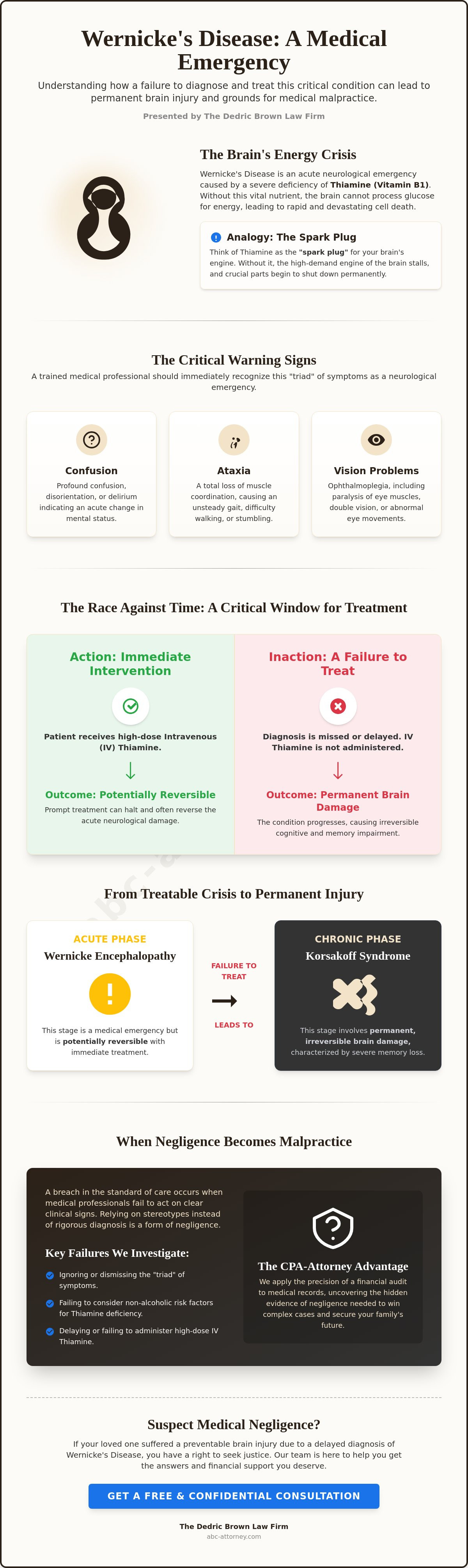
Wernicke’s disease is not a slow-onset condition; it is a full-scale neurological emergency. Also known as Wernicke Encephalopathy, this acute brain crisis stems from a severe deficiency of thiamine, or Vitamin B1. When the body lacks this essential nutrient, the brain loses its ability to process energy. The result is rapid, devastating cellular death. Medical professionals are trained to recognize a specific "triad" of symptoms that signal this crisis: profound confusion, ataxia (a total loss of muscle coordination), and ophthalmoplegia (paralysis of the eye muscles or vision problems). If you or a loved one are asking What is Wernicke’s Disease?, you must understand that every minute without treatment counts. Doctors who overlook these signs aren't just making a mistake; they are failing a critical standard of care.
Think of thiamine as the "spark plug" for your brain’s energy metabolism. Your brain is a high-demand organ that requires a constant supply of glucose to function. Thiamine allows the brain to convert that glucose into usable fuel. Without it, the "engine" of the brain stalls. Within hours of severe depletion, brain cells begin to die. This is a high-stakes medical scenario that requires aggressive intervention, meticulous monitoring, and immediate thiamine replacement. Our firm approaches these cases with the same precision we use in financial auditing. We search for the facts, identify the failure, and fight for the justice you deserve.
The Biological Mechanism: Why Thiamine Matters
Thiamine plays a foundational role in the Krebs cycle. This is the chemical process that generates energy within your cells. When thiamine levels bottom out, brain glucose metabolism collapses. Certain regions of the brain are particularly vulnerable to this metabolic failure, specifically the thalamus and the mammillary bodies. These structures manage sensory information and memory. Thiamine serves as a critical cofactor for enzymes that prevent neurotoxicity and maintain the blood-brain barrier. Without this protection, the brain effectively begins to poison itself. This biological breakdown is why wernicke's disease requires a rapid, high-dose intravenous response to prevent permanent disability.
Wernicke-Korsakoff Syndrome: The Progression to 'Wet Brain'
There is a narrow window to reverse the damage of wernicke's disease. If a physician misses the diagnosis during the acute phase, the condition often progresses into Korsakoff Syndrome. This is the chronic, permanent stage of the disorder characterized by severe memory loss and "confabulation," where the brain creates false memories to fill in gaps. Together, these two stages are known as Wernicke-Korsakoff Syndrome (WKS). The progression represents a "point of no return" where acute inflammation transforms into irreversible structural brain damage.
Society often uses the derogatory term "wet brain" to describe this condition. This label carries a heavy social stigma that often masks the underlying medical failure. We don't accept excuses or stigmas. We focus on the clinical facts: a treatable vitamin deficiency was allowed to become a life-altering brain injury. Our legal team applies a rigorous, auditor-like scrutiny to medical records to determine exactly where the system broke down. You deserve an advocate who is both a sophisticated expert and a relentless fighter.
Acute Phase: Wernicke Encephalopathy (potentially reversible).
Chronic Phase: Korsakoff Syndrome (permanent brain damage).
The Cause: Failure to provide immediate, high-dose thiamine.
Beyond Alcoholism: Identifying Non-Traditional Risk Factors
Many people mistakenly believe that wernicke’s disease is strictly a "drinker’s illness." This dangerous misconception leads to missed diagnoses and lifelong neurological damage. At the Dedric Brown Law Firm, we approach medical malpractice with the same scrutiny a forensic auditor applies to a complex ledger. We look for the technical failures that others miss. While chronic alcohol use is a common cause, any condition that leads to rapid thiamine (Vitamin B1) depletion can trigger this crisis. Doctors who rely on stereotypes instead of clinical data put their patients at extreme risk.
Research into Beyond Alcoholism: Identifying Non-Traditional Risk Factors shows that thiamine deficiency often hides in plain sight within modern hospitals. "Hidden" malnutrition occurs when medical teams focus on a primary illness while ignoring the patient's basic nutritional status. We see this in patients receiving long-term IV fluids without proper supplementation, those suffering from severe infections, or individuals with undiagnosed gastrointestinal disorders. Our firm fights for justice when these clinical red flags are ignored by the very people paid to notice them.
Hyperemesis Gravidarum and Pregnancy Risks
Severe morning sickness, or Hyperemesis Gravidarum, is a significant risk factor that many obstetricians fail to manage properly. When a pregnant woman cannot retain food or water for extended periods, her thiamine stores can deplete in as little as 20 days. Obstetricians have a clear duty to monitor electrolyte levels and provide aggressive vitamin supplementation. If a doctor ignores persistent vomiting and neurological symptoms emerge, it represents a failure in maternal health care. We utilize our expertise in birth-related malpractice to hold these providers accountable for their negligence.
Bariatric Surgery and Post-Operative Malnutrition
Weight-loss surgeries like gastric bypass or sleeve gastrectomy fundamentally alter how the body absorbs essential nutrients. The risk of developing wernicke’s disease is highest during the first 6 months following surgery. Surgeons must provide comprehensive post-operative guidance and conduct regular blood work to ensure thiamine levels remain stable. Legal claims in these cases often center on a "failure to warn" about nutritional risks or a "failure to monitor" the patient's recovery. We use a methodical, detail-oriented approach to prove that a surgical center’s oversight led to your injury.
If you or a loved one suffered a neurological injury after a medical procedure, you can speak with our legal team to explore your options. We provide the aggressive advocacy, technical precision, and unwavering support you need to win your case.
When Wernicke’s Disease Becomes Medical Malpractice
When a patient enters an emergency room showing signs of confusion, poor balance, or malnutrition, the standard of care is absolute. Doctors must act immediately. In the medical world, this period is known as the Golden Hour for thiamine administration. Withholding IV thiamine when a patient is at risk isn't just a simple mistake; it's a breach of professional duty. At the Dedric Brown Law Firm, we treat medical records with the same scrutiny as financial statements. We audit every chart, timestamp, and physician note to find exactly where the system failed you. Our background in internal auditing allows us to spot the technical inconsistencies and skipped protocols that other firms overlook.
Failure to Diagnose and Misdiagnosis
Wernicke’s disease is frequently mislabeled as simple alcohol intoxication, dementia, or a sudden psychiatric break. Data suggests this condition is missed in up to 80% of cases during initial clinical evaluations. This lazy diagnostic path costs lives and destroys families. Legally, a breach of duty occurs when a doctor fails to order an inexpensive thiamine treatment despite clear red flags. Doctors shouldn't wait for blood tests to confirm their suspicions. Wernicke’s is a clinical diagnosis, meaning medical professionals must initiate treatment based on physical symptoms alone to prevent permanent brain damage. Recognizing Symptoms and the Path to Recovery depends entirely on a physician's willingness to follow established diagnostic checklists rather than relying on biases.
The 'Glucose First' Error: A Fatal Hospital Mistake
One specific error stands out in malpractice litigation as a smoking gun. Medical protocols strictly forbid administering IV glucose to a malnourished patient before giving them thiamine. The science is straightforward: glucose requires thiamine to be metabolized. If a doctor provides sugar first, it consumes the body's last remaining thiamine stores instantly. This mistake pushes the patient off a neurological cliff, often triggering a coma or permanent brain death within hours. This isn't a complex medical mystery; it's a fundamental violation of basic emergency medicine.
We approach these cases with a unique blend of legal aggression and analytical precision. Dedric "Swish" Brown uses his experience as a Certified Public Accountant and Internal Auditor to dissect hospital workflows. We don't just ask what happened; we prove how the hospital's internal controls failed to protect you. Our firm provides a protective path for victims, ensuring that a hospital’s technical failure results in a victory for the patient. You pay nothing unless we win your case, because our commitment to your justice is unwavering and results-driven.
Recognizing Symptoms and the Path to Recovery
Early detection of wernicke's disease is the difference between a full recovery and a lifetime of specialized care. When a loved one is hospitalized, you are their first line of defense. You must observe their condition with the precision of an investigator. Doctors often overlook the subtle shifts in neurological function, but your documentation can force a change in treatment or provide the foundation for a legal claim.
The Clinical Checklist for Families
Watch for the classic triad of symptoms that signal acute thiamine deficiency. First, look at their eyes. Nystagmus, which is rapid and involuntary eye twitching, is a primary indicator. You might also notice a "lazy eye" or an inability to track your finger. Second, observe their movement. Ataxia, or a wide-based and stumbling gait, suggests the brain is losing its ability to coordinate balance. Third, monitor their mental state for profound confusion.
A hallmark of progression into Korsakoff’s syndrome is confabulation. This occurs when a patient "invents" memories to fill gaps in their mind. They aren't intentionally lying; their brain is simply attempting to make sense of a fractured reality. Keep a detailed log of these occurrences. Note the date, the specific behavior, and the staff member you alerted. This record creates a clear timeline of medical neglect if the hospital fails to respond to these red flags.
Post-Acute Care and Rehabilitation
Recovery requires aggressive and immediate intervention. Medical standards typically dictate high-dose thiamine therapy, often 500 mg administered intravenously three times daily, to stop the progression of brain damage. If the clinical team misses this window, the damage to the thalamus can become irreversible. Statistics show that roughly 80 percent of untreated cases lead to permanent cognitive impairment, making the first 48 hours of symptoms a critical period for survival and recovery.
Survivors often face a long road that requires a triad of professional support. Physical therapy helps patients regain the ability to walk safely. Occupational therapy assists them in relearning daily tasks like dressing or cooking. Speech and cognitive therapy are essential for managing memory deficits. This process is grueling for families and requires a robust support system to manage the emotional and financial toll. Our firm applies an auditor's scrutiny to your medical records to ensure every failure in this care path is identified and addressed.
If your family is struggling with the aftermath of a missed diagnosis, contact our legal team for a comprehensive case evaluation.
Securing Justice: The CPA-Attorney Advantage in Brain Injury Claims
Dedric Brown isn't just your lawyer. He's your lead auditor. When a hospital fails to diagnose wernicke's disease, they leave behind a complex trail of digital and paper evidence. Most personal injury firms look at the medical record's surface. We go deeper. As a Certified Public Accountant (CPA) and Certified Internal Auditor (CIA), Dedric Brown applies a level of scrutiny that typical attorneys simply don't possess. We approach every brain injury claim with principled combativeness. This means we fight for your rights with the precision of a financial expert and the intensity of a seasoned litigator. You deserve a champion who understands both the courtroom and the balance sheet. Our firm provides the technical expertise, the aggressive advocacy, and the professional reassurance you need during this crisis.
Auditing the Medical Record for Negligence
We don't just read medical charts. We audit them for systemic failures. Our firm cross-references nursing notes with physician orders to identify critical gaps in care. If a doctor ordered thiamine but the nursing staff never administered the dose, we find that discrepancy immediately. Our deep knowledge of Information Systems (CISA) allows us to track electronic health record (EHR) timestamps with surgical precision. We see exactly when lab values were ignored. We see when the window for life-saving treatment closed. This methodical approach transforms dense medical data into a clear, undeniable narrative of negligence for a jury. We prove the hospital failed their own internal protocols and your family paid the price.
Calculating Maximum Compensation for Life-Long Care
A diagnosis of wernicke's disease often leads to permanent cognitive impairment or Korsakoff syndrome. This requires a lifetime of 24/7 assistance and specialized medical support. We calculate your recovery using a proven triad of damages: medical expenses, lost earning capacity, and pain and suffering. Our firm partners with life-care planners to project the true cost of care over 20 to 40 years. We account for every variable. This includes cognitive therapy, home health aides, and specialized housing needs. We fight for a recovery that covers your family's future, not just your current bills. You pay nothing unless we win your case. We provide the expertise, the track record, and the unwavering commitment needed for a total victory.
Contact The Dedric Brown Law Firm today for a relentless audit of your case.
Protect Your Rights and Your Future
A diagnosis of wernicke's disease is a life-altering event that requires immediate medical intervention. Medical data indicates that 80 percent of untreated cases progress to permanent brain damage known as Korsakoff Syndrome. This isn't just a medical failure; it's a violation of the trust you place in healthcare providers. Dedric Brown brings a unique advantage to your side. By combining the skills of a trial attorney with the precision of a Certified Public Accountant, he audits your case with surgical accuracy. We look for the technical errors that insurance companies hope you'll miss. Our team provides relentless advocacy, specialized expertise in complex traumatic brain injury litigation, and a commitment to personalized service. You don't have to face the complexities of medical malpractice alone. We stand as your protective ally, fighting for the victory your family needs to move forward. Our "No Win, No Fee" guarantee ensures you can pursue justice without any financial risk. You have the strength to recover, and we have the tools to win.
Fight for the justice your family deserves; get a free consultation with The Dedric Brown Law Firm.
Frequently Asked Questions
Is Wernicke's disease reversible if caught in time?
Wernicke's disease is often reversible if medical staff administer high-dose thiamine immediately. Research shows that 75% of patients see ocular symptom improvement within 24 hours of starting intravenous B1. However, if treatment is delayed by even 48 hours, brain damage can become permanent. We fight to ensure negligent doctors are held accountable for these critical delays that change lives forever.
Can you sue a hospital for failing to diagnose thiamine deficiency?
You can file a medical malpractice lawsuit if a hospital ignores clear symptoms of thiamine deficiency. Failure to diagnose this condition often constitutes a major breach of the standard of care. Our legal team uses a rigorous auditing approach to examine your medical records for signs of clinical neglect. We relentlessly pursue justice for families devastated by these entirely avoidable brain injuries.
What is the difference between Wernicke's encephalopathy and wet brain?
Wernicke's encephalopathy is the acute stage of what people colloquially call "wet brain." While the acute phase involves sudden symptoms like confusion and loss of muscle coordination, "wet brain" typically refers to the chronic phase known as Korsakoff syndrome. Approximately 80% of patients who survive the acute stage without proper treatment will develop this permanent memory impairment. We search for the truth in every chart.
What are the first signs of Wernicke-Korsakoff syndrome?
The first signs include a triad of symptoms: mental confusion, ataxia, and abnormal eye movements. Medical literature identifies that only 16% of patients present with all three symptoms simultaneously, making early detection difficult for untrained staff. If a doctor misses these red flags, it's a failure of their professional duty. Our firm advocates for victims who suffer due to these preventable diagnostic errors.
How much thiamine is needed to treat Wernicke's disease?
Current medical guidelines recommend at least 500 mg of thiamine administered intravenously three times daily to treat Wernicke's disease. This high-dose regimen must continue for at least two days to saturate the brain's receptors effectively. Oral supplements are insufficient because the body only absorbs about 5% of thiamine through the gut in severe cases. We use our detailed expertise to prove when hospitals used inadequate protocols.
Can Wernicke's disease occur after weight loss surgery?
This neurological condition occurs in roughly 1 out of every 1,000 bariatric surgery patients. Rapid weight loss and frequent vomiting after gastric bypass can deplete thiamine levels in as little as 21 days. Surgeons must monitor these levels closely during the first year post-surgery. If a surgical team fails to recognize post-operative malnutrition, they may be liable for the resulting neurological damage and lifelong care.
What happens if a doctor gives glucose before thiamine?
Giving glucose before thiamine can trigger or worsen a metabolic crisis in a thiamine-deficient patient. Glucose metabolism rapidly consumes the body's remaining B1 stores, which can lead to sudden brain cell death. This is a well-known medical error that requires an auditor's eye to uncover in complex hospital records. We fight to hold providers responsible for this fundamental breach of patient safety protocols.
How long do I have to file a medical malpractice claim for a brain injury?
In many jurisdictions, the statute of limitations for medical malpractice is two years from the date of the injury. Some states allow for a discovery rule, which might extend the deadline if the injury wasn't immediately apparent. You shouldn't wait to seek legal counsel, as gathering medical evidence takes months of preparation. Our firm provides a nothing-to-lose approach with contingency fees to start your fight.


Comments