
How Long Does It Take to Die From Sepsis? The Critical Timeline
- Dedric Brown

- Apr 27
- 13 min read
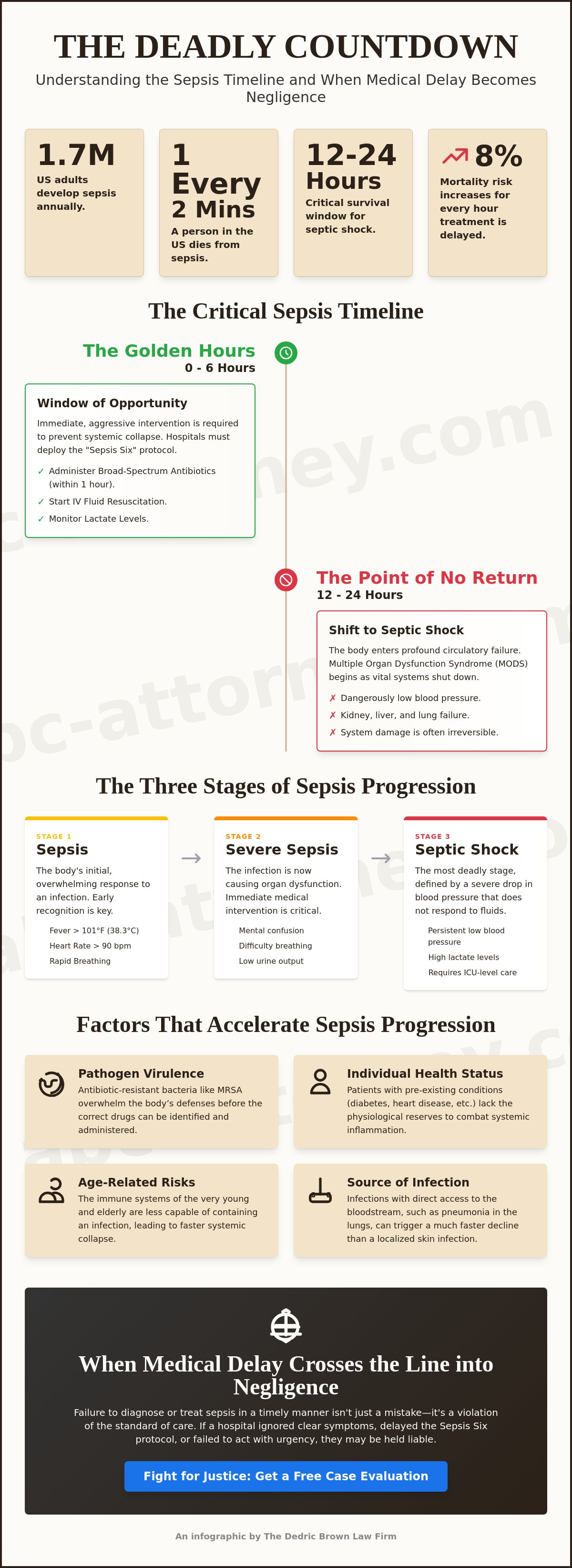
On a Tuesday morning, Sarah noticed a minor fever after a routine surgery; by Wednesday night, her family was saying their final goodbyes. This rapid decline is the reality for the 1.7 million American adults who develop sepsis annually, a condition that kills one person every 2 minutes in the United States according to Sepsis Alliance data. If you're searching for answers, you need to know how long does it take to die from sepsis when medical intervention is delayed. The window for survival is narrow, often closing within 12 to 24 hours if a hospital fails to administer the proper protocols.
It's natural to feel a heavy weight of guilt or anger when a minor infection turns fatal because staff ignored your pleas for help. You aren't alone in feeling that the medical system failed your family. We'll provide a detailed breakdown of the clinical timeline and explain why a delay of just one hour can increase mortality rates by up to 8%. This article clarifies the stages of septic shock, validates the need for rapid response, and highlights the legal paths available to fight for the justice your family deserves.
Key Takeaways
Learn exactly how long does it take to die from sepsis and why the first 12 to 24 hours represent the most critical window for life-saving intervention.
Identify the specific factors, including the source of infection and pre-existing health conditions, that can rapidly accelerate the body’s descent into septic shock.
Recognize the three distinct stages of sepsis progression and the early warning signs of organ dysfunction that medical professionals must never ignore.
Understand when a healthcare provider’s failure to diagnose or treat an infection crosses the line into medical negligence and actionable malpractice.
Discover how a CPA-led forensic audit of medical records can pinpoint the exact minute care failed to provide the technical evidence needed for a successful legal victory.
Table of Contents The Sepsis Timeline: How Rapidly Can an Infection Become Fatal? Factors That Accelerate the Speed of Sepsis Progression Recognizing the Three Stages of Sepsis Progression When Medical Delay Crosses the Line into Negligence Auditing the Medical Record: A CPA-Led Approach to Justice
The Sepsis Timeline: How Rapidly Can an Infection Become Fatal?
Sepsis isn't just a severe infection; it's a catastrophic failure of the body’s internal systems. When your immune response triggers widespread organ damage, every second counts. Families often ask, how long does it take to die from sepsis? In its most aggressive form, known as septic shock, a patient can lose their life in as little as 12 to 24 hours. This isn't a slow process. It's a rapid, violent medical emergency that demands immediate intervention. As a firm built on the principles of scrutiny and aggressive advocacy, we understand that medical precision is the difference between life and death.
Sepsis occurs when the body’s response to an infection damages its own tissues. Medical data shows that the risk of mortality increases by approximately 8% for every hour that antibiotic treatment is delayed. This statistic isn't just a number; it's a countdown. Doctors must act with the same urgency an auditor uses to find a critical error in a high-stakes financial record. When hospital staff fail to recognize these signs, they aren't just making a mistake; they're failing their duty to protect the patient.
The First 6 Hours: The Window of Opportunity
The first six hours represent the "Golden Hour" of treatment. During this window, medical teams must prioritize fluid resuscitation and blood cultures to identify the specific pathogen. Patients often present with a fever above 101 degrees Fahrenheit, a heart rate exceeding 90 beats per minute, and rapid breathing. These symptoms require immediate attention, rigorous testing, and unwavering clinical focus.
Immediate fluid resuscitation to maintain blood flow to vital organs.
Administration of broad-spectrum antibiotics within the first 60 minutes.
Constant monitoring of lactate levels to assess tissue oxygenation.
To stabilize patients, hospitals utilize the "Sepsis Six" protocol, which is a set of six evidence-based interventions designed to be delivered within the first hour of recognition. When this protocol is ignored, the window for survival begins to slam shut.
From 12 to 24 Hours: The Shift to Septic Shock
If the infection isn't halted during the initial hours, the body enters a phase of profound circulatory failure. Blood pressure drops to dangerous levels, often failing to respond to aggressive fluid administration. This is the onset of multiple organ dysfunction syndrome (MODS). When the kidneys, liver, and lungs begin to shut down, the window for effective intervention closes. Understanding how long does it take to die from sepsis highlights the necessity of early detection. By the 24-hour mark, the body’s systems are often too damaged to recover, making the initial response the only path to victory.
Factors That Accelerate the Speed of Sepsis Progression
Sepsis does not follow a linear path; it moves with a terrifying velocity that varies from one patient to the next. When families ask how long does it take to die from sepsis, they must understand that the clock starts at different times depending on the infection's origin. A lung infection like pneumonia often triggers a faster systemic collapse than a urinary tract infection because the lungs provide immediate access to the bloodstream. We apply the same level of scrutiny to these medical timelines that a Certified Public Accountant applies to a complex financial audit. Every minute of delay is a recorded failure in the hospital's ledger of care.
Several critical variables dictate the speed of this decline:
Pathogen Virulence: Antibiotic-resistant bacteria, such as MRSA, don't just resist treatment; they accelerate the progression of sepsis by overwhelming the body's defenses before doctors can identify the correct drug.
Individual Health Status: Patients with pre-existing conditions like diabetes or heart disease have a weakened immune "budget." They lack the physiological reserves to combat systemic inflammation, leading to faster organ failure.
Age-Related Risks: The very young and the elderly have significantly less time to recover. In older adults, the immune response is often sluggish, while infants have underdeveloped systems that can't contain even minor localized infections.
Our firm fights relentlessly to uncover the truth behind these rapid declines. We look for the precise moment a physician ignored a rising heart rate or a dropping blood pressure reading. If you believe a medical team missed the window for life-saving intervention, you should speak with a legal advocate to review your case details.
Neonatal Sepsis: A Rapid Threat to Newborns
For a newborn, the question of how long does it take to die from sepsis is measured in hours, not days. Birth-related infections can turn fatal for an infant within a 6 to 12-hour window if not caught immediately. Our firm focuses heavily on cases where medical staff failed to monitor fetal distress signals or ignored maternal fever during labor. Neonatal sepsis requires an aggressive diagnostic timeline; any hesitation in the NICU is often a breach of professional standards that leads to permanent tragedy.
Post-Surgical Sepsis and Hospital-Acquired Infections
Post-surgical sepsis is often a "silent" killer because medical staff misinterpret early warning signs as standard recovery pain. Whether it's a routine procedure or a C-section, a patient's vital signs tell a story that doctors sometimes choose to ignore. Contaminated medical equipment or poor sterile technique can introduce pathogens directly into the body, bypassing natural barriers. When hospital staff fail to distinguish between surgical soreness and the onset of a systemic infection, they rob the patient of the critical hours needed for survival.
Recognizing the Three Stages of Sepsis Progression
Sepsis isn't a static condition. It's an aggressive, cascading failure of the body's internal systems that requires precision, scrutiny, and unwavering advocacy to address. To understand how long does it take to die from sepsis, you must first recognize that this condition moves through three distinct, measurable stages. The initial stage is the systemic inflammatory response to a documented infection. If the medical team fails to intervene, it progresses to severe sepsis, where organ dysfunction begins. You might notice a sharp decrease in urine output, specifically less than 0.5 mL/kg per hour, which signals the kidneys are struggling to function. The final stage is septic shock. This involves life-threatening low blood pressure and profound cellular abnormalities. Medical literature confirms that Sepsis can lead to septic shock within hours, often resulting in death in as little as 12 to 24 hours if the standard of care is ignored.
Stage 1: The Warning Signs Doctors Often Miss
Early detection requires a rigorous application of the Systemic Inflammatory Response Syndrome (SIRS) criteria. Doctors must look for a heart rate exceeding 90 beats per minute or a respiratory rate over 20 breaths per minute. Subtle indicators like sudden confusion, shivering, or extreme shivering known as rigors are frequently dismissed as minor symptoms. A normal body temperature doesn't rule out a life-threatening infection because the body’s immune system may be too overwhelmed to mount a fever response. Our firm analyzes medical records with an auditor’s precision to find these missed indicators. We fight to prove that these early warnings were the exact moment the medical provider failed their duty to the patient.
Stage 3: The Point of No Return
Septic shock represents a total metabolic breakdown. At this stage, your cells can no longer utilize oxygen effectively, regardless of how much is being pumped into the lungs. This leads to a dangerous buildup of lactic acid in the bloodstream. Blood lactate levels higher than 2 mmol/L serve as a definitive red flag for impending mortality. When lactate levels exceed 4 mmol/L, the risk of death climbs significantly. The physiological reality is that septic shock is incredibly difficult to reverse because the blood vessels lose their ability to constrict. This creates a state of permanent low blood pressure that starves the brain and heart of vital nutrients. When families ask how long does it take to die from sepsis, the answer often depends on how quickly the transition from stage two to stage three occurred. We search for the truth in these numbers to ensure justice for those lost to medical negligence.
When Medical Delay Crosses the Line into Negligence
Medical malpractice occurs when a healthcare provider fails to meet the established standard of care for sepsis. This isn't a matter of opinion; it is a precise legal threshold. When a patient presents with infection markers, doctors must follow strict protocols, such as the "1-hour bundle" of care. If they miss these critical windows, the question of how long does it take to die from sepsis becomes a tragic reality for families. We don't accept "we did our best" as a valid defense. If a hospital ignored a 2018 Surviving Sepsis Campaign guideline, they are accountable for the outcome. Our firm approaches these cases with principled combativeness. We use my background as a Certified Public Accountant and Internal Auditor to scrutinize medical records for every missed data point and clinical failure.
Failure to Monitor: The Most Common Sepsis Malpractice
Vital sign trends tell a clear story. Overworked staff often ignore a rising heart rate or a dropping blood pressure. These aren't just numbers; they are early warning signs. In neonatal cases, failing to track fetal heart rate patterns can lead to devastating neonatal sepsis. A delay of just 60 minutes in administering antibiotics can increase the risk of death by 7.6 percent. We look for missed "code blue" or rapid response opportunities. If the data showed a steady decline and no one acted, that's negligence. We fight to ensure these failures are exposed through rigorous evidence, professional scrutiny, and unwavering advocacy.
The High Cost of Misdiagnosis
Doctors frequently mistake sepsis for the flu or common post-operative fatigue. This error is often fatal. Discharge negligence is a major focus of our investigations. We have seen patients sent home with a temperature of 103 degrees only to collapse hours later. It's about securing justice for families who were told their loved one was "fine" shortly before they passed. The timeline matters because how long does it take to die from sepsis depends entirely on the speed of intervention. We search for the truth in the charts. We hold negligent facilities accountable through precision, persistence, and a refusal to back down.
If your family suffered due to a hospital's failure to act, you need an advocate with an auditor's eye for detail. Schedule a free consultation with Dedric Brown today to discuss your rights and start your path to justice.
Auditing the Medical Record: A CPA-Led Approach to Justice
Dedric Brown isn't your typical personal injury attorney. He's a Certified Public Accountant (CPA) and a Certified Internal Auditor (CIA). This dual background gives our firm a lethal advantage in medical malpractice litigation. While other firms see a stack of medical records, we see a data set that requires a forensic audit. We don't just skim the pages; we dissect the hospital's financial and operational systems to find the exact minute care failed. When families ask how long does it take to die from sepsis, they are often looking for accountability in the timeline of care. We use our auditor's precision to find it.
Hospital systems are massive, bureaucratic, and prone to error. Our firm uses an analytical approach to uncover hidden gaps in staffing and response times. We look at the hospital's internal metrics to see if they were understaffed on the night of the incident. A 10% decrease in nursing staff can lead to a 7% increase in patient mortality in critical care settings. We find those numbers. We use our "principled combativeness" to ensure the hospital's corporate negligence doesn't stay hidden behind complex jargon.
Searching for the Truth in Hospital Data
Electronic Medical Records (EMR) are the key to winning a sepsis case. These systems track every click, every login, and every ignored alert. We look for discrepancies between what a nurse wrote in a late-night note and what the electronic monitoring data actually shows. If a doctor claims they saw a patient at 2:00 PM, but the audit trail shows they didn't log into the system until 4:30 PM, we've found the truth. We time-stamp every medical decision to show the jury exactly where the "Golden Hour" of treatment was lost. This level of scrutiny is why we are known for our technical capability and unwavering commitment to the facts.
Fighting for Maximum Recovery
Our firm relentlessly pursues settlements that cover more than just immediate bills. We calculate long-term loss, future earnings, and the profound emotional trauma of losing a loved one to a preventable infection. We apply the same rigor to calculating your damages that an internal auditor applies to a Fortune 500 company. We understand that how long does it take to die from sepsis is a question of minutes, but the impact of that loss lasts a lifetime.
We offer a "nothing-to-lose" contingency fee promise.
You pay zero dollars unless we win your case.
Our team provides a protective, elite level of advocacy from start to finish.
You deserve a champion who is both a sophisticated expert and a relatable ally. Dedric "Swish" Brown brings the discipline of a coach and the precision of an auditor to every case. We transform complex data into a clear path toward justice.
Contact The Dedric Brown Law Firm for a comprehensive case audit today.
Demand Accountability for Medical Timing and Negligence
Sepsis is a relentless race against the clock where every hour dictates the final outcome. Medical data indicates that for every 60 minutes a patient remains without antibiotics during septic shock, the risk of mortality increases by 7.6 percent. When healthcare providers fail to recognize the three stages of progression, they're often ignoring a window of survival that can close in under 24 hours. You deserve an advocate who audits medical records with the precision of a forensic expert to expose these fatal delays. Understanding how long does it take to die from sepsis helps clarify exactly when a hospital's inaction crossed the line into malpractice. Dedric Brown brings the analytical scrutiny of a Certified Public Accountant and the tenacity of a veteran trial lawyer to your corner. Our firm handles complex medical malpractice and neonatal injury litigation with unwavering integrity. We work on a contingency fee basis, meaning you pay nothing unless we win your case. You don't have to face this legal battle alone.
Get a Free Case Evaluation from a Lawyer and CPA Who Understands the Numbers and the Law
We're ready to fight for the justice and security your family deserves.
Frequently Asked Questions
Is sepsis always fatal if not treated within 12 hours?
No, sepsis isn't always fatal within that window, but the risk of death increases by 8% for every hour treatment is delayed. Medical professionals recognize the first 60 minutes as the "Golden Hour" for administering antibiotics. If a hospital misses this window, they're disregarding critical safety protocols. We fight to hold providers accountable because quick action determines how long does it take to die from sepsis versus making a full recovery.
Can you survive septic shock if it is diagnosed late?
Survival is possible, but the mortality rate climbs significantly once the body reaches multi-organ failure. According to the Sepsis Alliance, nearly 80% of sepsis deaths are preventable with rapid diagnosis. Late diagnosis often results in permanent organ damage or limb amputations. Our firm uses an auditor’s precision to scrutinize medical records and identify exactly where the healthcare team failed to act on your behalf.
What are the first signs of sepsis in a newborn baby?
Newborns often display subtle symptoms like a body temperature above 100.4°F or below 96.8°F, extreme lethargy, and difficulty breathing. You might also notice a heart rate exceeding 160 beats per minute or a sudden refusal to feed. These signs require immediate medical intervention. If a neonatal unit ignores these red flags, they've failed a fundamental duty of care to your child and your family.
How do I know if my loved one died from medical negligence related to sepsis?
Medical negligence is likely if the hospital failed to follow the CMS SEP-1 measure, which requires specific diagnostic actions within 3 hours of symptom onset. We look for ignored lab results, missing vital sign checks, or delayed fluid resuscitation. Our team brings a unique hybrid of legal expertise and analytical scrutiny to uncover the truth. You pay nothing unless I win your case.
What is the survival rate for someone in septic shock?
The survival rate for septic shock is approximately 60%, meaning 40% of patients do not survive this advanced stage of infection. Factors like age and the speed of the medical response dictate the final outcome. Understanding how long does it take to die from sepsis often depends on how quickly a doctor identifies a dangerous drop in blood pressure. We relentlessly pursue justice when preventable delays lower these survival odds.
How long do I have to file a medical malpractice claim for a sepsis death?
In most jurisdictions, the statute of limitations for medical malpractice is 2 years from the date of the injury or death. Some states may shorten this window to 1 year or extend it based on when the negligence was discovered. You must act quickly to preserve evidence and secure expert testimony. Our firm provides the unwavering advocacy and rigorous detail needed to meet these strict legal deadlines.
Can a hospital be held liable if they didn’t catch the infection in time?
Yes, a hospital is liable if their failure to diagnose the infection falls below the standard of care expected of a competent professional. This includes dismissing a patient's worsening symptoms or failing to order necessary blood cultures. We use a proven track record of success to prove that the facility’s negligence directly caused the patient’s decline. Our approach is comprehensive, tailored, and focused on securing the victory you deserve.


Comments