
Crash Report Texas: How to Request, Read, and Use Your CR-3 Form

Last Tuesday, a driver named Marcus sat at his kitchen table, staring at a confusing grid of numerical codes on his official Texas Peace Officer’s Crash Report. He knew the other driver ran the red light, but the insurance company used a single digit in a "Contribution Factor" box to deny his $12,500 claim. Securing a crash report texas is only the first step in a high-stakes battle for justice. You need the analytical precision of an auditor to ensure a simple clerical error doesn't strip away your rights.
It's frustrating to feel like you're losing a case before it even begins because of a document you can't read. We believe in providing the steady, professional reassurance you need to fight back against aggressive insurance adjusters. This guide will show you exactly how to secure your official CR-3 form and decode its hidden data to protect your financial future. We'll walk you through the TxDOT purchase system to pay your $6.00 fee, translate complex police codes into clear evidence, and show you how to use this report to build a winning personal injury claim.
Key Takeaways
Secure your official record from the Texas Department of Transportation by mastering the specific search parameters required for a successful retrieval.
Uncover the meaning behind the "Disposition" codes on your crash report texas to ensure the officer's assessment of your injuries doesn't undermine your claim.
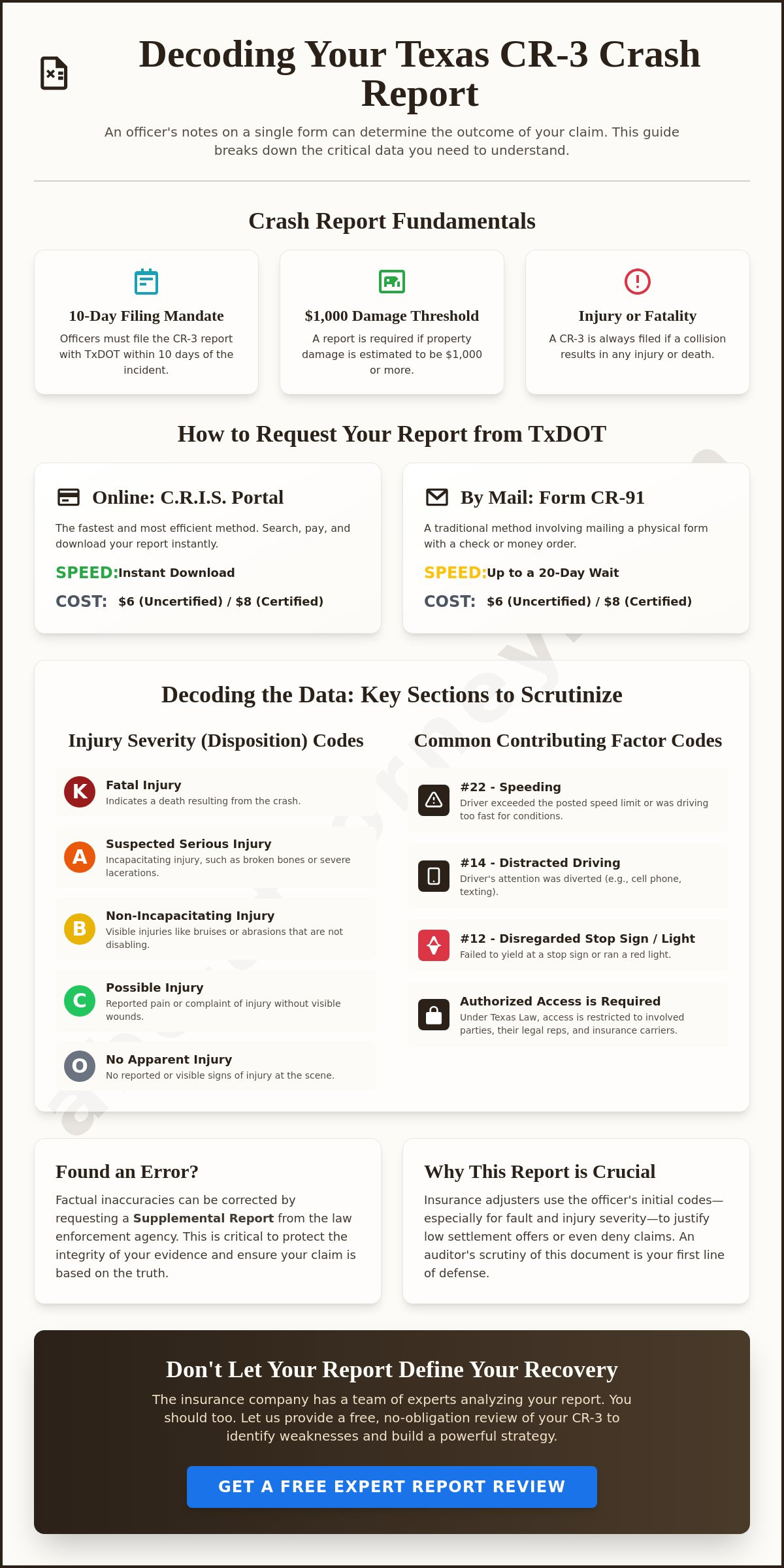
Understand the strict 10-day legal mandate for filing and why the $1,000 damage threshold determines if a CR-3 form even exists for your case.
Learn the precise steps to correct factual inaccuracies through a Supplemental Report, protecting the integrity of your legal evidence.
Leverage an auditor’s scrutiny to identify critical data gaps in police reports that can be used to hold negligent parties relentlessly accountable.
Table of Contents How to Request Your Texas Peace Officer’s Crash Report (CR-3) Decoding the Data: Understanding Texas Crash Report Codes Texas Transportation Code §550.062: Legal Filing Requirements Correcting Errors in Your Texas Crash Report Why a CPA-Attorney Scrutinizes Your Crash Report Differently
How to Request Your Texas Peace Officer’s Crash Report (CR-3)
Securing your crash report texas is the first critical step in building a foundation for your legal claim. The Texas Department of Transportation (TxDOT) acts as the official custodian for these records. After a Traffic collision, you need a document that reflects the facts with absolute precision. Our firm approaches these reports with an auditor’s eye, searching for the details that win cases. You'll need specific search parameters to locate your file: the full name of a driver involved, the Vehicle Identification Number (VIN), or the unique Transaction ID provided by the responding officer.
TxDOT offers two versions of the CR-3. An uncertified copy costs $6 and works well for insurance claims or personal records. A certified copy costs $8. We always recommend the certified version for litigation. It includes an official seal that validates the document for use in a courtroom. Don't settle for less when your recovery is on the line. Precision matters when you're fighting for justice.
When dealing with these official records, having a personal injury lawyer mesquite tx review your documentation can ensure that every detail is accurately represented before it reaches the insurance company.
Online vs. Mail-In Requests
The TxDOT Crash Report Online Purchase System (C.R.I.S.) portal provides the most efficient delivery. You can search, pay, and download your digital crash report texas instantly. This speed is vital when you're fighting to meet insurance deadlines. If you prefer a traditional approach, you must submit Form CR-91 by mail. This involves a more methodical process: print the form, include a check or money order, and mail it to the TxDOT headquarters in Austin. While online delivery is immediate, mail-in requests often face a 20-day wait period. We value speed, accuracy, and results, so we suggest the digital route whenever possible.
Who is Legally Authorized to Access Reports?
Texas law maintains strict privacy standards for sensitive data. Under Texas Transportation Code §550.065, crash reports are confidential and restricted to authorized parties. This isn't public gossip; it’s a legal record that requires integrity to handle. Authorized parties include:
Drivers and passengers involved in the incident.
Legal representatives or attorneys fighting for your rights.
Insurance carriers and policyholders.
Owners of property or vehicles damaged in the crash.
If an individual or entity falls outside these categories, they can't simply buy your report. They must obtain a subpoena to access restricted or bulk crash data. This protection ensures that your personal information remains secure while you focus on your physical and financial recovery. Our firm utilizes expertise, a proven track record of success, and a commitment to personalized service to ensure these records are used effectively in your favor.
Decoding the Data: Understanding Texas Crash Report Codes
The Texas Peace Officer’s Crash Report, known as the CR-3, isn't just a simple summary of an accident. It's a technical ledger. Law enforcement officers use this standardized form for any collision involving injury, death, or property damage estimated at $1,000 or more. As a firm built on the precision of an auditor and the tenacity of a trial lawyer, we treat this document as the primary evidence in your crash report texas file. Every code and checkbox requires rigorous scrutiny to ensure the facts align with your right to recovery.
The "Injury Severity" or Disposition section is one of the first areas we analyze. Officers use a specific letter system to categorize the physical toll of the wreck. "K" denotes a fatal injury, while "A" represents a suspected serious injury. "B" and "C" cover non-incapacitating and possible injuries, and "O" indicates no apparent injury. These codes are often assigned at the scene before the full extent of your medical condition is known. We work relentlessly to ensure these initial assessments don't limit your ability to seek justice for delayed-onset trauma.
The Most Common Contributing Factor Codes
Officers use numerical codes to identify what caused the collision. These numbers carry significant weight during a liability audit. Code 12 indicates a driver "Disregarded Stop Sign," which provides a clear path to establishing fault. Code 22 signifies "Speeding," and Code 14 points to "Distracted Driving." In high-stakes commercial truck wreck litigation, we look specifically for "Under the Influence" codes (45 or 46). These designations transform a standard claim into a battle for maximum accountability. If you need a professional to look over these codes with you, contact our team for a comprehensive evaluation of your case.
To begin this process, you must have the official document in hand. You can secure your records through the Texas Crash Report Online Purchase System, which serves as the authoritative source for all state-filed accident data.
Reading the Vehicle and Occupant Diagrams
The vehicle grid provides a visual map of the point of impact. This diagram is crucial because it prevents insurance companies from disputing the physics of the crash later. We examine these grids alongside notations for seatbelt usage and airbag deployment. If an officer notes that safety equipment functioned correctly, it reinforces the integrity of your claim. We also use this section to verify the insurance information listed for every involved party. While the numerical codes provide the data, the "Officer’s Narrative" provides the story. This qualitative section is where the officer explains the sequence of events, often revealing nuances that the standardized codes might miss. It's the most critical part of your crash report texas when building a winning narrative for the courtroom.
Texas Transportation Code §550.062: Legal Filing Requirements
Texas Transportation Code §550.062 isn't a suggestion; it's a legal mandate. This statute dictates that a law enforcement officer must submit a crash report texas within 10 days of an accident. This requirement triggers when a collision results in injury, death, or property damage estimated at $1,000 or more. Many drivers overlook the $1,000 threshold. In a world of high-tech sensors and expensive vehicle components, a minor "fender bender" often exceeds this amount. If the officer fails to file because they underestimated the damage, your path to recovery hits a wall.
Securing this document is the first step in our principled combat against insurance companies. We look for precision, accuracy, and detail. The law also establishes a 10-year retention policy for these records. While a decade sounds like a long time, evidence can vanish if you don't act. We secure your report, verify the data, and protect your rights. Our firm treats every report with the scrutiny of a certified auditor, ensuring no detail is missed.
When an Officer Does Not Attend the Scene
The 2017 legislative session fundamentally shifted how Texas handles self-reported accidents. Previously, drivers used "Blue Forms" (CR-2) to document minor wrecks where an officer didn't respond. Today, the Texas Department of Transportation no longer retains these driver-filed reports in their central database. While you should still document the scene for your personal records, these forms lack the official weight of a CR-3. If a crash involves injury or death, the law requires an official report. Failing to ensure a report is filed can jeopardize your legal standing and your financial future.
Retention Schedules and Long-Term Claims
For victims of catastrophic injuries, such as a Traumatic Brain Injury (TBI), the legal battle is a marathon. These cases require a sophisticated approach to valuation. As a CPA-Attorney, I use the data from your crash report texas to build a comprehensive damages model. We analyze the trajectory, calculate the loss, and pursue the maximum recovery. This analytical rigor is what sets us apart.
Securing the report early prevents data loss from the 10-year custodial purge.
Historical data provides the foundation for expert testimony in complex litigation.
Precise documentation stops insurance adjusters from rewriting the facts of the case.
The risk of data loss after the 10-year custodial period expires is a silent threat to long-term claims. We fight to secure every piece of evidence before the clock runs out. You deserve an advocate who understands both the law and the numbers. We don't just read reports; we audit them for the truth.
Correcting Errors in Your Texas Crash Report
Errors in a crash report texas are more than just typos. They're direct threats to your financial recovery and your reputation. You must distinguish between factual mistakes and subjective opinions. Officers are humans; they make mistakes during high-pressure investigations. If the report lists the wrong street name or misspells your name, that's a factual error. If the officer blames you for the wreck, that's a subjective opinion. We fight to ensure the record reflects the truth with principled combativeness.
Filing a Supplemental Statement
Fixing a report requires contacting the specific investigating agency. This might be the Texas Department of Public Safety (DPS), a county Sheriff office, or a local municipal police department. For objective errors like an incorrect VIN, insurance policy number, or date of birth, provide physical proof immediately. Send copies of your vehicle registration or insurance card to the reporting officer.
Changing "Contributing Factors" is a different battle. Once an officer files their opinion, they rarely retract it without overwhelming evidence. You need an advocate who applies rigorous scrutiny to the scene. We gather external evidence to challenge these conclusions, including:
Dashcam footage from your vehicle or nearby businesses.
Witness statements collected within 72 hours of the incident.
Private investigator photos of skid marks and vehicle rest positions.
Data from the vehicle's Event Data Recorder (EDR).
Using the Report in Insurance Negotiations
Insurance adjusters treat the CR-3 as the primary source of truth. They use it to assign a percentage of fault, which can slash your settlement or result in a total denial. I apply an "Auditor’s Scrutiny" to every report I review. We look for technical inconsistencies where the officer’s diagram contradicts their written narrative. If the diagram shows a rear-end collision but the narrative suggests a side-swipe, that’s a gap we exploit to protect your rights.
Don't accept a flawed report as the final word on liability. Adjusters look for any reason to lower the value of your claim. A single misplaced checkmark in the "Factors and Conditions" section can cost you thousands of dollars. We use our background in auditing and precision to dismantle weak police reports and force insurance companies to look at the actual facts of the case. Integrity and detail are our primary weapons in this fight.
If your report contains inaccuracies that jeopardize your case, you need a relentless advocate to set the record straight. Schedule your free consultation today and let us fight for the justice you deserve.
Why a CPA-Attorney Scrutinizes Your Crash Report Differently
Most lawyers see a list of facts when they look at a crash report texas. Dedric Brown sees a ledger. As a Certified Public Accountant (CPA) and Certified Internal Auditor (CIA), he applies an auditor's vocabulary to every piece of legal evidence. This means looking for the missing entries that others overlook. He does not just read the officer's narrative. He audits the evidence for technical precision, financial accuracy, and legal weight.
Trucking companies often hide behind complex corporate shells. They use layers of insurance and subcontracting to avoid liability. Dedric "Swish" Brown uses his financial certifications to peel back these layers. He transforms raw crash data into a clear path toward justice. He fights with integrity, professionalism, and a relentless drive to win. This unique approach turns a standard document into a comprehensive tool for advocacy.
While our methodology is tailored to the Texas legal landscape, high-stakes personal injury cases everywhere require this level of detail. For residents in the West, the Law Offices of Michael D. Payne specializes in personal injury litigation across Southern California, ensuring that victims have access to the same caliber of boutique legal advocacy.
Forensic Analysis of Commercial Truck Wrecks
In 2023, thousands of commercial wrecks involved data discrepancies that a standard investigation might miss. Dedric Brown cross-references your crash report texas with Electronic Logging Device (ELD) data. Since the federal ELD mandate took effect in 2017, every second of a driver's day is digitally recorded. If the crash report says the driver was alert but the ELD shows 14 hours of continuous driving, that is a major victory for the client.
He identifies "Information Systems" failures that standard personal injury firms often miss. As a Certified Information Systems Auditor (CISA), he knows how to spot digital tampering in maintenance logs. He tracks hidden assets in catastrophic injury claims to ensure there is a recovery source. His methodology involves three pillars: forensic scrutiny, data-driven evidence, and unwavering advocacy.
From Consultation to Courtroom Victory
The Dedric Brown Law Firm uses the crash report to anchor your entire contingency-fee case. You deserve an advocate who understands both the courtroom and the counting room. We provide expertise, a proven track record of success, and a commitment to personalized service. We don't just settle cases; we build them from the ground up using every available data point.
You face zero financial risk with our "Nothing to Lose" guarantee. You pay nothing unless we win your case. This commitment protects your financial safety while we pursue the maximum compensation available under Texas law. We handle the paperwork, the auditors, and the insurance adjusters so you can focus on healing.
Take Command of Your Recovery Path
Understanding the details of your CR-3 is vital for any legal claim. Texas Transportation Code §550.062 requires officers to file these reports within 10 days for any accident involving injury or property damage over $1,000. You've seen how to identify errors and decode complex data points. However, a crash report texas requires more than a simple reading; it demands the scrutiny of a professional who understands the financial and legal impact of every checkmark. Dedric Brown leverages his dual expertise as a licensed Attorney and Certified Public Accountant (CPA) to protect your interests.
Our firm excels in high-stakes litigation, specifically focusing on traumatic brain injuries and commercial truck wrecks. We apply an auditor's precision to find the evidence others miss. Because we work on a contingency-fee basis, you pay nothing unless we win your case. It's time to move from being a victim to being a victor with a team that values integrity, professionalism, and results.
Get a Free Evaluation of Your Texas Crash Report from Dee "Swish" Brown
You've navigated the aftermath of the wreck, and now it's time to secure your future. We're here to guide you every step of the way.
Frequently Asked Questions
How long does it take for a crash report to be available in Texas?
It typically takes 10 days for a crash report texas to be available through the TxDOT Crisis and Incident Management System. Texas Transportation Code Section 550.062 mandates that law enforcement officers submit these records within 10 days of the collision. Our firm monitors these timelines relentlessly to ensure your claim moves forward without delay. We use our auditing precision to track every update and keep your case on the fast track to victory.
Can I get a Texas crash report for free?
You can't obtain an official copy of a crash report texas for free from the state. The Texas Department of Transportation charges a non-refundable fee of $6.00 for a regular copy and $8.00 for a certified copy. These fees are set by Texas Administrative Code Title 43, Rule 3.11. We handle the procurement of these documents for our clients so they can focus on recovery while we manage the technical details.
What is the difference between a CR-3 and a CR-2 form?
A CR-3 is the official peace officer's crash report, while a CR-2 is a driver's crash report, often called a Blue Form. Officers must file a CR-3 when an accident results in injury or property damage exceeding $1,000. Drivers used to file CR-2 forms for minor incidents, but TxDOT stopped retaining these records on September 1, 2017. We prioritize the CR-3 because it contains the officer's objective data, professional observations, and vital insurance information.
Is a police report admissible in a Texas civil court?
A police report is generally inadmissible as evidence in a Texas civil trial because it's considered hearsay under Texas Rule of Evidence 803. However, specific sections or the officer's live testimony can be used to establish facts or impeach witnesses. We fight to ensure the truth is told by leveraging our legal expertise and investigative rigor. We treat every detail with the scrutiny of a certified auditor to protect your rights in the courtroom.
What should I do if the officer put the wrong information on my crash report?
You should contact the reporting officer immediately to request a supplemental report if you find factual errors. Provide concrete evidence like dashcam footage, photos, or witness statements to support your request for a correction. Officers rarely change their original narrative, but they can add a supplemental page to the record. Our team relentlessly pursues these corrections to protect your integrity and ensure the record reflects the actual events of the crash.
How do I find my Texas crash ID number?
Your Texas crash ID number is a unique 8-digit identifier located at the top of the CR-3 document. If you don't have the report yet, you can search the TxDOT system using the date of the accident and the driver's license number. This number is the key to tracking your case through the state's database. We use this data to build a comprehensive, tailored view of your legal situation and secure the results you need.
Does every car accident in Texas require a police report?
Texas law requires a police report only if the collision results in injury, death, or property damage estimated at $1,000 or more. Under Texas Transportation Code Section 550.062, the officer must file this report within 10 days of the event. Even in minor fender benders, we recommend calling the police to ensure an official record exists. This creates a solid foundation for your future insurance claim and prevents the other party from changing their story later.
Can an insurance company deny my claim if the report says I am at fault?
An insurance company can deny your claim based on an adverse crash report, but the officer's opinion isn't the final word on liability. Insurance adjusters use the report as a tool, but we challenge their findings with independent investigations and expert analysis. We apply our "Swish" Brown precision to find the flaws in their logic. We fight relentlessly to reverse unfair fault determinations and win the justice and compensation you deserve.



Comments