
How to Prove Medical Malpractice in a Birth Injury Case: A Forensic Legal Guide

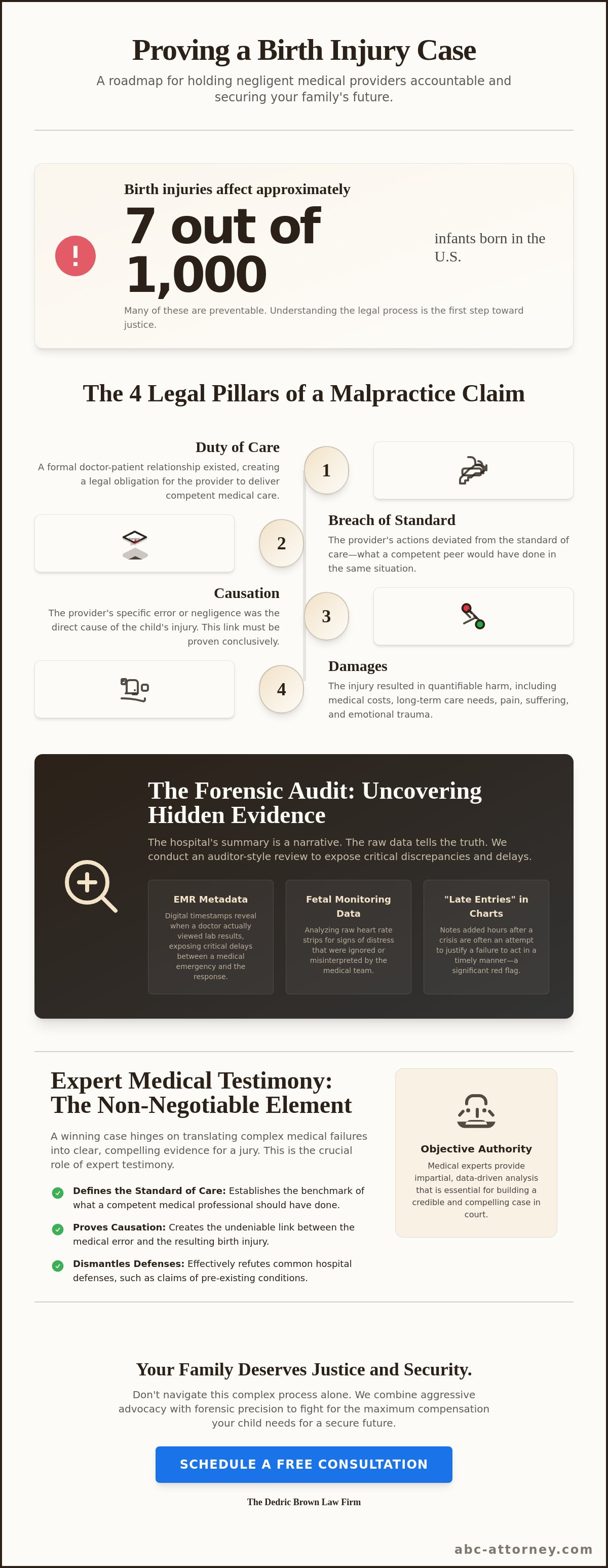
Was your child’s injury a natural occurrence, or was it a preventable error hidden behind a wall of medical jargon? According to data from the Journal of the American Medical Association, medical errors are a leading cause of death in the U.S., and birth injuries affect roughly 7 out of every 1,000 infants born. You don't have to accept a hospital's vague explanation as the final word. Understanding how to prove medical malpractice in a birth injury case requires moving past the emotion and into the cold, hard facts of clinical standards. My firm approaches these cases with the relentless scrutiny of a forensic auditor to ensure no detail is overlooked.
You deserve an ally who combines aggressive advocacy with technical precision. It’s natural to fear the high costs of litigation or feel overwhelmed by complex records, but your focus should be on your family’s future. This guide provides a clear roadmap for holding negligent providers accountable. You’ll learn the precise legal requirements for establishing liability, the specific evidence needed to build a winning case, and why an analytical approach is your strongest weapon in the courtroom. We’re going to strip away the confusion and show you exactly what it takes to secure justice and a path forward.
Key Takeaways
Identify the four legal pillars required to establish a duty of care and relentlessly pursue the justice your family deserves.
Learn how a forensic audit of medical records and fetal monitoring data uncovers critical evidence often hidden in official hospital summaries.
Discover how to prove medical malpractice in a birth injury case by utilizing expert medical testimony to translate complex errors into clear jury evidence.
Gain the strategic insight needed to link negligence directly to a diagnosis while effectively dismantling common defenses regarding pre-existing conditions.
Understand how the integration of legal advocacy and financial precision ensures your child's Life Care Plan is calculated for maximum long-term security.
Table of Contents The 4 Legal Pillars Required to Prove Birth Injury Malpractice Conducting a Forensic Audit of Medical Records and Fetal Monitoring Data Why Expert Medical Testimony is Non-Negotiable for Your Claim Overcoming the Causation Hurdle: Linking Negligence to the Diagnosis Securing Justice: How Our Multifaceted Expertise Transforms Your Case
The 4 Legal Pillars Required to Prove Birth Injury Malpractice
Medical malpractice in obstetrical care occurs when a healthcare professional fails to provide the quality of care that a competent peer would have provided under similar circumstances. This failure isn't just a clinical error; it's a violation of trust and professional integrity. When a family faces the trauma of a delivery room tragedy, they must navigate a complex legal landscape. The burden of proof rests entirely on the plaintiff. This means we must present a case built on precision, evidence, and an unwavering commitment to the facts. We don't rely on guesswork. We apply a rigorous, auditor-style scrutiny to every medical record and fetal heart monitor strip to uncover the truth.
It's vital to recognize that a "bad outcome" is not the same as medical malpractice. Childbirth involves inherent risks, and even with perfect care, complications can arise. When understanding birth injuries, we must distinguish between unavoidable biological events and those caused by negligence. To initiate a successful claim, we first establish a formal doctor-patient relationship. This legal foundation confirms the physician owed the mother and child a specific duty of care. Without this established duty, there is no legal ground for a lawsuit, regardless of the injury's severity.
Establishing the Standard of Care
The standard of care serves as the benchmark of competency for every medical professional. It isn't a subjective opinion; it's a defined set of expectations based on specialized training and regional medical norms. We define the standard of care as what a reasonably competent peer would do when faced with the same clinical situation. Geography and specialty play significant roles in this calculation. An obstetrician at a high-volume teaching hospital in a major city is held to a different standard than a general practitioner in a rural clinic. We utilize medical experts to testify on these specific benchmarks, ensuring your case is measured against the highest professional expectations.
Breach, Causation, and Damages
Success in these cases requires more than just identifying a mistake. Understanding how to prove medical malpractice in a birth injury case involves three critical steps: identifying a breach, proving causation, and quantifying damages. A breach is a clear deviation from the established benchmark of care. However, a breach alone doesn't win a case. We must prove causation, showing that the doctor's specific error directly caused the child's injury. Finally, we must document the full scope of damages. This includes:
Immediate physical pain and medical expenses.
Profound emotional trauma for the parents.
Long-term financial impacts, such as specialized therapy, home modifications, and 24-hour nursing care.
Our firm approaches this process with expertise, a proven track record of success, and a commitment to personalized service. We fight relentlessly to ensure the financial burden of a medical error doesn't fall on your family's shoulders.
Conducting a Forensic Audit of Medical Records and Fetal Monitoring Data
Winning a birth injury case requires more than just a lawyer; it requires an auditor's precision. I approach every hospital chart with the relentless scrutiny of a Certified Internal Auditor. The "official" summary provided by the hospital often serves as a polished narrative designed to shield the facility from liability. It rarely tells the full story. To understand how to prove medical malpractice in a birth injury case, we must look at the Electronic Medical Record (EMR) metadata. This digital trail reveals exactly when a doctor viewed a lab result or when a nurse entered a vital sign. Reviewing these digital timestamps is a cornerstone of how to prove medical malpractice in a birth injury case because it exposes the gap between a medical emergency and the actual response.
Our firm searches for "late entries" that appear hours after a crisis. When a provider enters notes retrospectively, they're often trying to justify a failure to act. We utilize expertise, precision, and relentless scrutiny to identify these gaps. A clinical overview of birth injuries shows that many conditions arise from manageable risks that were simply ignored. We don't just read the records; we audit them to find the truth that the hospital tried to bury.
Decoding Fetal Heart Rate Monitoring Strips
Fetal heart rate monitoring strips provide a "black box" record of the birth. They track the baby’s heart rate in relation to the mother’s contractions. We look for specific patterns like late decelerations or a lack of variability. These are clear signals that the baby is in distress. When a medical team fails to react to these "non-reassuring" strips by ordering a timely C-section, they've committed negligence. Our team analyzes these strips second by second to prove exactly when the standard of care was breached. If you suspect your child's records don't reflect the truth, you need an advocate who knows how to uncover the facts.
The Paper Trail: Beyond the Labor Room
The audit doesn't stop at the delivery room door. We analyze prenatal records for missed signs of preeclampsia or gestational diabetes, which are often overlooked in the months leading up to birth. We also investigate hospital logistics, such as nurse-to-patient ratios. In high-risk labor units, a 1:2 ratio is often the standard; if a hospital was understaffed on the day of your delivery, that's evidence of systemic failure. Finally, we secure pharmacy logs to verify the timing of medications like Pitocin. If the logs show a dosage increase despite a baby being in distress, we have the evidence needed to secure a victory. We fight for your rights by combining legal combat with financial-grade investigation.
Why Expert Medical Testimony is Non-Negotiable for Your Claim
In the legal arena, medical records serve as the evidence, but experts serve as the voice. Most jurisdictions mandate an expert affidavit before a lawsuit even begins. Without this signed document from a qualified professional, the court will likely dismiss your case before it reaches a jury. Our firm approaches these birth injury cases with the same scrutiny an auditor applies to a complex financial statement. We leave no room for error or ambiguity. An expert translates dense, technical jargon into a clear narrative that a jury can understand. They bridge the gap between a tragic outcome and a preventable medical error.
There is a critical distinction between a "treating physician" and a "retained expert." Your child's current doctor may provide facts about the injury, but they are often reluctant to blame a colleague. A retained expert is an independent professional who reviews the case with total objectivity. They provide the technical authority needed to challenge hospital systems. We select experts who possess specific credentials in neonatology or obstetrics to ensure their testimony carries maximum weight. This level of precision, integrity, and relentless advocacy is exactly how to prove medical malpractice in a birth injury case when the defense is fighting to protect its bottom line.
Vetting the Right Experts
To win, your expert must be a peer of the defendant. If an obstetrician caused the injury, another board-certified obstetrician must testify. We search for specialists in neonatology and maternal-fetal medicine who have spent decades in the delivery room. These experts define the "Standard of Care," which is the benchmark for what a competent doctor should have done under similar circumstances. They act as a shield against the "unavoidable complication" defense. While insurance companies claim the injury was an act of nature, our experts use clinical data to prove it was an act of negligence.
The Expert Report: The Foundation of the Lawsuit
The "Certificate of Merit" serves as your claim's first major hurdle. It confirms that a medical professional has reviewed the records and found a reasonable probability of malpractice. Once we secure this, the expert deposition becomes a high-stakes tool for justice. A strong deposition often pressures insurance companies to settle because they recognize our technical capability and preparation. To secure a victory, experts use a "differential diagnosis" methodology to rule out genetic causes or pre-existing conditions that the defense might use to deflect blame. This rigorous process provides the clarity, evidence, and momentum required to hold negligent parties accountable.
Overcoming the Causation Hurdle: Linking Negligence to the Diagnosis
Establishing negligence is only half the battle. To win, we must prove "proximate cause." This means showing a direct, unbroken chain from the doctor's error to your child's diagnosis. It's the "but for" test: but for the medical professional's failure to meet the standard of care, the injury wouldn't have occurred. I approach this with the precision of a Certified Internal Auditor, scrutinizing every timestamp and monitor strip to ensure no detail is overlooked.
The hospital's primary defense strategy is almost always "pre-existing conditions." They'll claim the injury was genetic or happened weeks before labor. We dismantle this defense using diagnostic imaging. An MRI taken within 24 to 72 hours of birth can often time a brain injury with surgical accuracy. If the imaging shows acute swelling rather than old scar tissue, it proves the damage happened during the delivery window. This forensic approach is vital when learning how to prove medical malpractice in a birth injury case and holding the right parties accountable.
Proving Hypoxic-Ischemic Encephalopathy (HIE)
HIE occurs when a baby's brain is deprived of oxygen. We link this to negligence by analyzing fetal heart rate monitors for signs of distress that the staff ignored. Key evidence includes:
Arterial Blood pH: A pH level below 7.00 at birth is a clinical indicator of severe metabolic acidosis caused by oxygen loss.
APGAR Scores: Scores between 0 and 3 that persist beyond five minutes suggest a failure in resuscitation or prolonged deprivation.
C-Section Timing: If fetal distress was evident at 2:15 PM but the C-section wasn't performed until 3:00 PM, that 45-minute delay is the primary evidence of a breach in the standard of care.
Proving Physical Trauma: Erb’s Palsy and Brachial Plexus
Physical injuries like Erb's Palsy often result from shoulder dystocia mismanagement. When a baby’s shoulder gets stuck, doctors must use specific, documented maneuvers, such as the McRoberts maneuver or suprapubic pressure. We look for evidence of "excessive traction," which is the medical term for pulling too hard on the baby's head. If the medical record doesn't document the specific maneuvers used to clear the shoulder, it suggests the doctor panicked and caused permanent nerve damage through brute force. Understanding how to prove medical malpractice in a birth injury case requires this level of technical scrutiny. Our firm fights relentlessly to expose these errors and secure the victory your family deserves.
Your family deserves a legal advocate who audits the evidence as thoroughly as a financial expert. Contact the Dedric Brown Law Firm today to start your path toward justice.
Securing Justice: How Our Multifaceted Expertise Transforms Your Case
The Dedric Brown Law Firm doesn't just practice law; we apply a forensic lens to every birth injury claim. Knowing how to prove medical malpractice in a birth injury case requires more than a basic understanding of clinical errors. It demands a rigorous audit of hospital protocols and financial records. Dedric "Swish" Brown utilizes his background as a Certified Public Accountant (CPA) and Certified Internal Auditor (CIA) to uncover the technical failures that lead to catastrophic outcomes. This "Swish" approach blends aggressive legal combat with the precision of a financial auditor, ensuring no detail is missed in the pursuit of your child's future.
Calculated Aggression in the Courtroom
We treat every case as if it's headed for a jury trial from day one. This proactive stance forces insurance giants and negligent hospitals to realize we aren't looking for a quick, low-ball settlement. Our firm stands on a foundation of principled combativeness; we're fighting for the maximum recovery allowed by law. We hold multi-billion dollar healthcare systems accountable by dismantling their defenses with evidence-backed pressure. Your child deserves an unwavering advocate who views litigation as a mission, not a transaction. We don't back down when the stakes are at their highest.
Your Ally in the Path to Recovery
A birth injury changes a family's financial reality for decades. Most firms guess at future costs, but we calculate them with the scrutiny of a professional auditor. By leveraging a CPA background, we build comprehensive Life Care Plans that account for inflation, specialized medical equipment, and 24-hour nursing care over a 70-year life expectancy. We don't leave your child's quality of life to chance or estimates. Our team provides personalized service that treats you like a neighbor, not a case number. You'll work with a firm that understands both the emotional weight of a birth injury and the cold math required to fund a lifetime of care.
We operate on a strict nothing-to-lose guarantee. This means you pay zero out-of-pocket costs and no attorney fees unless we win your case. Our interests are perfectly aligned with your family's success. During your free forensic case review, we'll analyze the medical timelines, identify the breaches in the standard of care, and outline the exact path toward a recovery. We're ready to start the search for the truth today.
Secure the Justice Your Family Deserves
Winning a birth injury claim requires more than just a lawyer. It demands a forensic investigator’s eye. You've learned that success hinges on establishing the 4 legal pillars and conducting a meticulous audit of fetal heart rate monitors and electronic medical records. Understanding how to prove medical malpractice in a birth injury case means connecting the dots between a provider's negligence and your child's diagnosis through elite medical testimony. Dedric Brown brings a unique, multifaceted perspective to this high-stakes battle. As a dual-credentialed Attorney and Certified Public Accountant (CPA), he applies an auditor’s precision to complex neonatal brain injury litigation. We don't just skim the surface; we relentlessly search for the data points that hospitals often overlook. You can move forward with total security because of our no-win, no-fee contingency promise. You won't owe a single penny unless we win your case. Your family needs a protective ally who is both a sophisticated expert and a principled fighter. Get a Free Forensic Audit of Your Birth Injury Case today. We're ready to turn the tide for your child's future.
Frequently Asked Questions
Is it hard to prove medical malpractice in a birth injury case?
Proving these cases is notoriously difficult because it requires forensic scrutiny of complex medical records. You must demonstrate that the doctor breached a specific duty of care, which led directly to the injury. Since 80% of medical malpractice cases that go to trial result in a defense verdict, you need a lawyer who applies an auditor’s precision to every piece of evidence. Our firm fights to uncover the truth through meticulous data analysis and expert testimony.
How long do I have to file a birth injury lawsuit?
The timeline depends on your state's statute of limitations, which often ranges from 2 to 3 years from the date of the incident. However, many jurisdictions apply the discovery rule or tolling for minors, potentially extending the deadline until the child reaches adulthood. In Georgia, for instance, a medical malpractice claim must generally be filed within 2 years of the injury. We relentlessly track these deadlines to ensure your right to justice remains protected.
What is the "Standard of Care" in a birth injury claim?
The standard of care is the level of skill and diligence that a reasonably competent medical professional would provide under similar circumstances. Knowing how to prove medical malpractice in a birth injury case hinges on defining this benchmark through expert witnesses. We analyze hospital protocols, fetal heart rate monitor strips, and delivery logs to show exactly where the medical team failed. This methodical approach transforms complex medical theory into a clear narrative of negligence.
Can I sue for a birth injury if the symptoms appeared months later?
Yes, you can still file a claim because conditions like Cerebral Palsy often aren't diagnosed until a child misses developmental milestones between 6 and 24 months of age. The legal discovery rule protects families by starting the filing clock when the injury is first recognized. Our firm uses forensic auditing techniques to link these delayed symptoms back to specific errors made during labor or delivery. We search for the truth, no matter how much time has passed.
How much does it cost to hire a birth injury lawyer?
You pay nothing unless we win your case. Our firm operates on a contingency fee basis, meaning we cover all upfront costs for expert witnesses, medical record retrieval, and litigation expenses. This nothing-to-lose structure ensures you have access to an elite legal advocate without any financial risk. We're committed to your victory and won't charge a dime in attorney fees unless we secure a settlement or court award.
What kind of compensation can be recovered in a medical malpractice case?
Compensation typically covers economic damages like medical bills and non-economic damages like pain and suffering. According to the Journal of the American Medical Association, the average payout for birth injury claims exceeds $400,000, often reaching millions for lifelong care needs. We fight for a comprehensive recovery that includes physical therapy, specialized education, and home modifications. Our goal is a tailored victory that provides your child with lifelong financial security.
What if the hospital says the injury was caused by genetics?
Hospitals frequently use genetics as a defense tactic to deflect blame from their own negligence. We counter this by hiring world-class geneticists and neonatologists to conduct a rigorous audit of the child’s DNA and the birth records. If the data shows the injury resulted from oxygen deprivation or physical trauma during delivery, the hospital's genetic excuse falls apart. We use precision, scrutiny, and unwavering advocacy to dismantle these defense narratives.
Do most birth injury cases go to trial or settle?
Statistics show that roughly 90% of medical malpractice claims settle before reaching a jury. A settlement offers a faster path to justice, but we prepare every case as if it's going to trial. This aggressive stance forces insurance companies to take us seriously. By combining a proven track record of success with an auditor's attention to detail, we ensure you’re positioned for the best possible outcome, whether in a boardroom or a courtroom.



Comments