
Truck Maintenance Records as Evidence After a Texas Truck Crash

Updated: Oct 15
What if a truck’s maintenance records point to a mechanical problem but don’t show whether it caused the crash? That’s why truck maintenance records as evidence need to be reviewed in context. Inspection notes, repair entries, and repeated reports of a problem can raise important questions, but a record alone doesn’t prove who was responsible or whether a defect contributed to the collision.
It’s understandable to worry that the trucking company or its insurer controls documents that could matter to your claim. A timely, careful investigation can examine relevant records and compare them with physical evidence, electronic data, and witness accounts. This article explains what maintenance documents may reveal, what they can’t establish by themselves, and how the evidence may fit together after a Texas truck crash. Dedric Brown’s experience as both an attorney and a CPA brings an analytical perspective to complex documentation. The firm’s name reflects a personal commitment to clients: abc stands for “Attorney Brown Cares.”
Table of Contents
What Truck Maintenance Records Can, and Cannot, Show After a Texas Crash
Which Truck Maintenance Records May Reveal a Mechanical Problem?
How Maintenance Records Compare With Physical, Electronic, and Witness Evidence
How Evidence Is Preserved and Maintenance Records Are Investigated in Texas
How Maintenance Evidence Can Support a Texas Truck Injury Claim
What Truck Maintenance Records Can, and Cannot, Show After a Texas Crash
After a commercial truck crash, maintenance records can help investigators look beyond the visible damage and ask whether a mechanical concern existed before impact. These documents may track inspections, repairs, reported defects, and servicing. They can show what was recorded about the truck’s condition and when, but they can’t establish by themselves that a defect caused the collision or determine who is legally responsible.
The Federal Motor Carrier Safety Administration (FMCSA) is the federal agency associated with commercial motor vehicle safety. For a particular Texas crash, the relevance of specific records and any applicable requirements must be evaluated against current authority and the facts of the case.
What questions can a maintenance history help answer?
A useful review looks for entries about components that may relate to the crash, such as brakes, tires, steering, or lights. Was a component inspected or repaired? Was a defect reported? Does an entry describe completed work, or identify a concern that may have remained unresolved? The answers can help investigators decide what to examine next.
Dates and descriptions can also help build a timeline. A report of a problem before the collision may warrant comparison with later work orders, inspection findings, and the damaged truck. A missing entry or an irregular record can raise questions, but it is a lead to investigate, not automatic proof of negligence.
Why a document does not prove the whole truck-crash claim
A record can suggest a possible defect without showing that the defect caused this particular crash. Investigators still need to examine the vehicle’s physical condition and the crash scene, along with relevant electronic data and witness accounts. Timing matters, too. An entry may describe a concern, but other evidence is needed to determine whether it existed at the time of the collision and affected what happened.
Maintenance records become stronger evidence when independent evidence supports what they say. Depending on the facts, responsibility may involve several parties, such as a carrier, a maintenance provider, a driver, or a component manufacturer. Identifying a possible connection is not the same as proving legal responsibility. That requires a case-specific investigation.
Dedric Brown’s background as both an attorney and a CPA supports a careful, detail-focused review of complex documentation. The firm’s name reflects its client-centered approach: abc stands for “Attorney Brown Cares.”
Which Truck Maintenance Records May Reveal a Mechanical Problem?
Different records answer different questions. An inspection entry may describe a condition observed on a particular date. A defect report may show that someone flagged an issue. A work order may record the work requested or authorized, while a repair history may show what was documented as completed. Together, these records can help investigators trace a concern without assuming that a defect existed or caused the crash.
Potential records may include:
Inspection reports: Notes about the condition of components such as brakes, tires, lights, or trailer equipment, plus any recorded follow-up.
Defect reports: Entries describing a reported concern, when it was raised, and which vehicle or component it involved.
Work orders: Documentation of requested or authorized diagnostic work, adjustments, or repairs.
Repair history: Service entries that may show what work was documented over time and whether a similar issue appeared more than once.
The FMCSA publishes federal provisions related to commercial vehicle inspection, repair, and maintenance in 49 C.F.R. Part 396. The requirements that apply to a particular vehicle or record should be verified before they are treated as current or relevant to a claim.
Compare entries, not just document titles
Compare dates, component descriptions, and recorded outcomes across the documents. For example, an inspection report noting a tire concern can be checked against a later work order and repair entry. Do the records refer to the same tire or axle? Does the timeline show documented follow-up? An entry may raise questions, but its wording alone doesn’t establish the truck’s condition at the time of the crash.
A dated repair entry can help place maintenance activity on a timeline, but investigators must determine what the date and recorded work actually represent. The date a concern was noted, the date work was authorized, and the date a repair was documented may not mean the same thing.
Match the records to the truck and trailer
Vehicle identifiers help connect paperwork to the equipment involved. A VIN can distinguish one truck from another, while a fleet number may help locate records within a carrier’s system. Trailer records may also matter when the crash involved a combination vehicle. Investigators can compare these identifiers with crash information and repair activity to test whether each document belongs to the correct unit.
Missing, inconsistent, or unclear entries deserve scrutiny, not assumptions. A gap in the records doesn’t automatically prove that work was skipped or that anyone acted negligently. It may reflect incomplete documentation, a vehicle identification mismatch, or another issue to investigate. If you’re trying to understand how records may fit your truck-wreck claim, you can discuss the evidence with the firm.
How Maintenance Records Compare With Physical, Electronic, and Witness Evidence
Maintenance documents tell part of the story. Investigators test what they say against evidence from the truck, the crash scene, available electronic information, and people who saw or experienced the events. Cross-checking can strengthen a mechanical explanation, reveal a gap in the timeline, or point to another possible cause. More documents don’t automatically make a claim stronger. What matters is whether independent sources are consistent.
Evidence source
Question it may help answer
Maintenance records
Was a relevant concern documented, and what work was recorded?
Physical evidence
What do photographs, vehicle inspections, and damaged components show about the truck’s condition after the crash?
Electronic information
Is there available, relevant information that helps place vehicle operation or events in time?
Driver information and witnesses
Do recorded accounts and firsthand observations fit the proposed sequence of events?
What physical and electronic evidence can add
A service entry describing a brake concern, for example, can be compared with inspection findings and the condition of relevant components. Photographs and crash-scene evidence may add context about damage and the collision sequence. Post-crash damage can complicate interpretation, however. Investigators must assess whether a condition existed before impact or resulted from it, rather than treating a damaged part as proof of a preexisting defect.
Electronic information may provide timing or vehicle-operation context when it exists and is relevant. What a particular system records depends on the equipment and circumstances. Investigators should verify what data is available rather than assume it captures a specific event or mechanical condition.
How witnesses and timelines test a maintenance theory
Driver accounts, other records, and witness observations can be compared with maintenance entries and the reported sequence of the crash. Did anyone describe a warning, unusual handling, or a sound before impact? Does that account align with a documented concern and the physical findings? Those details may support further investigation, but they don’t establish causation on their own.
A careful timeline can also surface conflicts. A repair entry may appear to address an issue, while later evidence raises questions about whether the condition remained. That inconsistency deserves scrutiny, not an automatic conclusion of fault. Truck maintenance records as evidence carry more weight when their dates and details align with independent physical, electronic, and witness evidence. A plausible connection is a lead to test. Proving that a mechanical problem caused a particular crash requires the full evidentiary picture.
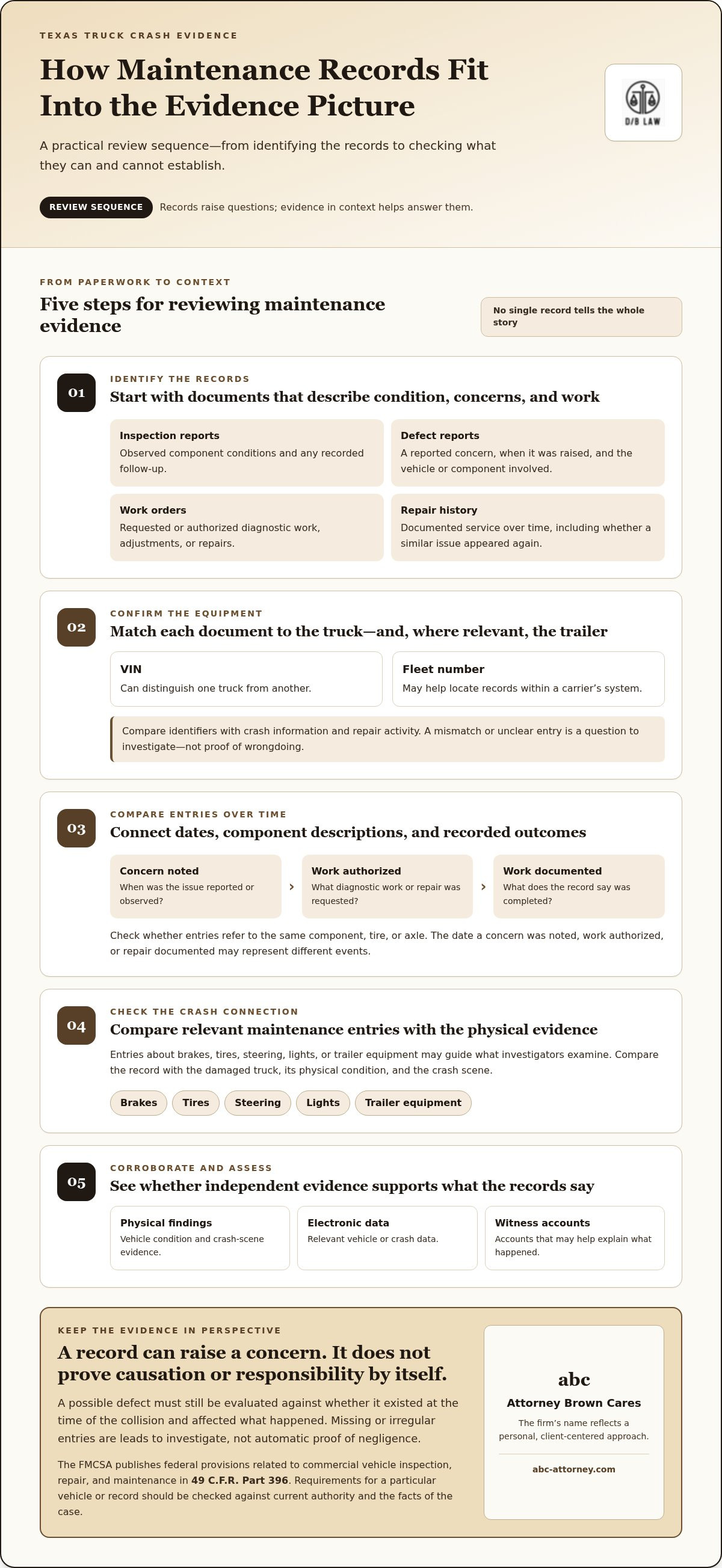
How Evidence Is Preserved and Maintenance Records Are Investigated in Texas
A truck-crash investigation involves more than requesting a stack of service documents. The truck may be repaired or moved, electronic information may change or become unavailable, and witness memories can fade. A careful process identifies the equipment, considers what evidence may matter, evaluates how it can be preserved, and compares records with other available evidence. The right steps depend on the facts and applicable law.
A measured sequence for investigating records
Investigators can begin by identifying the specific truck and, where relevant, its trailer. Vehicle identifiers help focus the review on records tied to the equipment involved. Next, they assess which physical items, documents, electronic information, and witness accounts may bear on the crash, then consider appropriate ways to preserve or obtain them through lawful processes. Professional private investigators, such as International Investigative Group, frequently assist in tracking down critical documentation and examining complex maintenance records. They compare the material to test the timeline and any proposed mechanical explanation.
There is no one-size-fits-all preservation procedure for every crash. The available steps and access to records depend on the circumstances and applicable legal rules. Current Texas or federal requirements concerning record retention, disclosure, or preservation should be verified for the particular matter. Prompt review can help identify what needs attention, but it cannot guarantee that evidence will be available or establish what it proves.
Assessing missing or inconsistent records
A gap in a maintenance file is a reason to ask questions, not a conclusion. Investigators can compare available entries with repair invoices, vehicle identifiers, inspection findings, and other evidence. If dates or descriptions conflict, they can examine whether the documents concern the same truck or component and what each entry actually records. An apparent alteration or omission also calls for verification and context before anyone draws conclusions about its meaning.
This disciplined review is central to understanding truck maintenance records as evidence. A missing entry alone doesn’t prove that a repair was skipped, that a record was improperly withheld, or that a mechanical issue caused the crash. Dedric Brown’s attorney and CPA background informs an analytical approach to complex documentation, while abc reflects the firm’s personal commitment: “Attorney Brown Cares.”
If you’re concerned about preserving or evaluating evidence after a commercial truck crash, contact the firm to discuss your evidence.
How Maintenance Evidence Can Support a Texas Truck Injury Claim
Maintenance records may help develop an injury claim when they connect a possible mechanical problem to a timeline and other evidence related to the crash. A documented concern matters more if other evidence helps show that the condition existed before the collision and may have affected what happened. A single entry cannot tell the whole story or establish legal responsibility.
From records to a supported account of what happened
Investigators can organize maintenance documents alongside physical findings, electronic information, and witness accounts to build and test a timeline. They may ask whether a reported condition came before the crash, whether later records describe related work, and whether the vehicle’s condition and crash evidence fit that account. This comparison can help distinguish a relevant lead from an unsupported assumption.
The review may also consider possible connections to a driver, motor carrier, maintenance provider, or component manufacturer. These are investigative avenues, not conclusions that any person or company is legally liable. Any legal assessment depends on the complete evidence and applicable law. Truck maintenance records as evidence can contribute to a supported account, but they don’t prove causation or responsibility by themselves.
A careful next step after a serious truck wreck
After a serious crash, it’s understandable to want clear answers, especially when injuries have changed daily life for you or your family. Case-specific legal guidance can help you understand how maintenance documents fit with the rest of the evidence, rather than drawing conclusions from one record. The Dedric Brown Law Firm represents people injured in commercial truck wrecks and catastrophic crashes, including cases involving traumatic brain injuries.
Dedric Brown brings both attorney and CPA credentials to the detailed review of complex records and evidence. That analytical perspective supports a careful investigation, while the firm’s name expresses its personal commitment to clients: abc stands for “Attorney Brown Cares.”
Talk with the Dedric Brown Law Firm about your truck wreck and the evidence involved.
Take the Next Step Toward Clearer Answers
Truck maintenance records as evidence can reveal a possible mechanical concern and help establish when it was reported or addressed. But no single entry proves that a defect caused a crash or determines who is responsible. Investigators must compare records with the truck’s condition, crash evidence, electronic information, and witness accounts to build a careful, case-specific picture.
After a serious truck wreck, you shouldn’t have to sort through complicated evidence alone. Dedric Brown holds both attorney and CPA credentials, bringing an analytical perspective to the firm’s work on commercial truck wrecks and catastrophic personal injury claims. The name abc reflects a personal commitment to clients: “Attorney Brown Cares.”
Talk with the Dedric Brown Law Firm about your truck wreck and the evidence involved. A thoughtful review can help you understand what questions to ask and what steps may make sense next.
Frequently Asked Questions
Can truck maintenance records prove negligence?
Maintenance records may help show what inspections, repairs, or reported defects were documented before a crash, but they don’t prove negligence on their own. Investigators compare entries with the truck’s condition, crash-scene evidence, relevant timelines, and other information. A recorded concern, for example, still needs to be connected to the collision. The significance of truck maintenance records as evidence depends on the complete facts and applicable law.
What maintenance records matter after a truck accident?
Potentially relevant materials include inspection reports, defect notices, repair work orders, and service histories for the truck or trailer. Vehicle identifiers, such as a VIN or fleet number, and dates can help connect documents to the equipment and place work on a timeline. Which records matter most depends on the suspected mechanical issue and crash circumstances. No single document type establishes a claim by itself.
Can missing truck maintenance records be used as evidence?
Missing or inconsistent documents may raise questions for an investigation, but they don’t automatically prove negligence or explain why a record is absent. Investigators can compare available records with repair information, vehicle evidence, and the crash timeline to look for context. Any legal consequence of a missing record depends on the circumstances and applicable law. Current legal rules should be verified before drawing conclusions about preservation or disclosure.
How do investigators connect maintenance records to a truck crash?
Investigators match the documents to the truck, then compare dates, reported issues, inspections, and repairs with the crash timeline. Professional fact-finders, such as the private investigators at canadianinvestigations.com, frequently test that account against physical vehicle findings, scene evidence, relevant electronic information, and witness accounts. These comparisons can show whether a maintenance concern is consistent with other evidence or reveal questions that need follow-up. They don’t make a document-based explanation conclusive on its own.
Who can be responsible for a truck maintenance failure in Texas?
Depending on the evidence and applicable law, an investigation may examine a carrier, maintenance provider, driver, or another party. These are possibilities to investigate, not automatic findings of liability. The role of each person or business must be assessed against the maintenance records, physical evidence, and circumstances of the crash. A Texas truck injury claim calls for a fact-specific legal analysis, not assumptions based on one document.
How long must trucking companies keep maintenance records?
Record-retention requirements can depend on the type of document and the rules that apply. Don’t assume a period quoted for another state or in an older article governs a Texas crash. Current federal and Texas requirements should be checked against authoritative sources and the specific circumstances. Even if a particular record isn’t available, repair documents, vehicle findings, and other evidence may still help investigators examine the truck’s maintenance history.
Should I contact a lawyer after a truck crash involving a possible mechanical problem?
If a serious injury or possible vehicle defect is involved, legal guidance can help you understand how the evidence may be reviewed and what procedures apply. The Dedric Brown Law Firm handles commercial truck wrecks and catastrophic injury claims. Dedric Brown’s attorney and CPA credentials inform detailed evidence analysis. The firm serves clients across Texas, including Houston, San Antonio, Dallas, Austin, Beaumont, Huntsville, Prairie View, and Brenham.



Comments