
Pain and Suffering Settlement Examples: What Texas Injury Claims Can Teach You
What if two people with similar injuries receive very different settlement offers? Pain and suffering settlement examples can help explain why, but a headline amount can’t predict what another person’s claim is worth. Responsibility, the strength of the evidence, recovery, and lasting effects all matter.
It’s understandable to want a clear number when pain, fear, disrupted routines, or strained relationships are hard to put into words. Examples are most useful when they show how these personal effects may be described and supported, not when they’re treated as a valuation of your claim.
This article uses clearly labeled hypothetical examples to show how injury severity, recovery, and supporting records may affect how non-economic harm is presented in Texas. You’ll find practical ways to describe changes in daily life, understand what examples can’t tell you, and prepare questions about an offer. The Dedric Brown Law Firm represents people with traumatic brain injuries, birth injuries, and serious injuries from vehicle wrecks and medical malpractice in Texas. Here, abc means “Attorney Brown Cares”: listening closely and treating each person’s experience with care.
Table of Contents
What Pain and Suffering Settlement Examples Can, and Cannot, Tell You
Three Hypothetical Pain and Suffering Settlement Examples, Explained
How to Compare Examples Without Treating Them as Your Case Value
What to Gather and Ask Before Evaluating a Texas Injury Claim
How Attorney Brown Cares About the Details Behind Your Claim
What Pain and Suffering Settlement Examples Can, and Cannot, Tell You
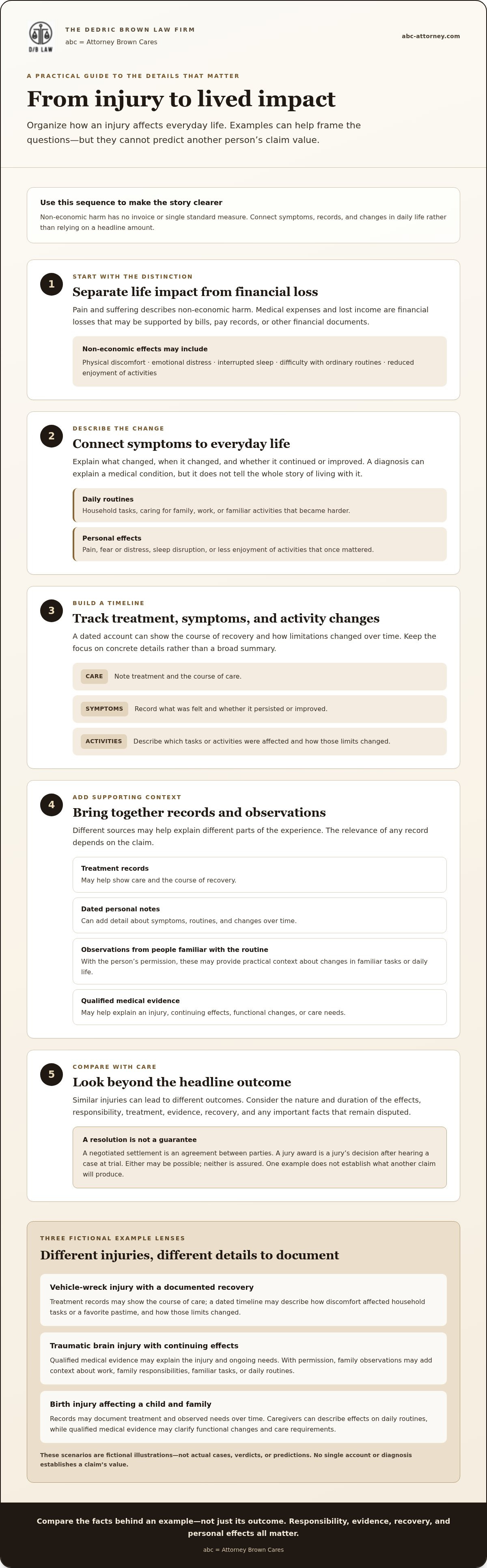
A claim can involve more than bills and missed paychecks. Pain and suffering generally refers to non-economic harm, including physical discomfort, emotional distress, and loss of everyday experiences. These effects are personal and don’t come with invoices or a single standard measure. A basic overview of the concept appears in Understanding Pain and Suffering in Legal Terms.
It helps to distinguish these effects from economic damages. Medical expenses, lost income, and other financial losses may be supported by bills, pay records, or financial documents. Pain and suffering describes how an injury affects a person’s life. The categories can be considered separately, even though the same injury may affect both.
What pain and suffering may include after an injury
Non-economic harm may include ongoing pain, fear or distress, interrupted sleep, difficulty with ordinary routines, or reduced enjoyment of activities that once mattered. Someone might have trouble caring for family, returning to a familiar hobby, or feeling comfortable in situations they once took for granted. The effects depend on the person and the injury.
A diagnosis can explain a medical condition, but it doesn’t tell the whole story of living with it. A useful account connects symptoms to daily life: what changed, when it changed, and whether the changes continued or improved. Treatment records, dated personal notes, and observations from people familiar with the person’s routine can provide context. The relevance of each record depends on the claim.
Why an example is not a settlement calculator
Pain and suffering settlement examples can illustrate which questions may matter, but they can’t predict a result. Claims that seem similar at first may differ in responsibility, how the injury developed, what treatment was needed, how long the effects lasted, and whether important facts are disputed. The available documentation may also differ. A headline outcome rarely reveals all of these details.
Similar injuries can lead to different claim outcomes because responsibility, recovery, evidence, and personal effects may differ. Applying someone else’s outcome directly to your situation can create false expectations. Instead, use an example to identify the facts it describes, then consider whether those facts match your circumstances. Treat the comparison as a starting point for questions, not a shortcut to assigning value.
A negotiated settlement is an agreement reached by the parties, while a jury award is a decision made by a jury after hearing a case at trial. Either may be possible in a claim, but neither is assured. An example involving one kind of resolution doesn’t establish what another claim will produce. A careful evaluation considers the specific injury, available evidence, and facts that remain contested.
Three Hypothetical Pain and Suffering Settlement Examples, Explained
The following scenarios are fictional illustrations. They are not actual cases handled by The Dedric Brown Law Firm, verdicts, or predictions. They show how details may help explain non-economic harm, while any outcome depends on the evidence and circumstances of the individual matter.
Hypothetical vehicle-wreck injury with a documented recovery
Imagine an adult injured in a car wreck who receives medical care and gradually resumes regular activities. During recovery, discomfort makes household tasks and a favorite pastime harder. Treatment records may help show the course of care. A dated timeline can add detail about which activities were affected and how those limitations changed. If responsibility for the wreck is disputed, or records and reported limitations appear inconsistent, evaluating the claim may be more complicated.
Hypothetical traumatic brain injury with continuing effects
Consider a fictional person with a traumatic brain injury whose continuing functional changes affect work, family responsibilities, or everyday routines. Qualified medical evidence may help explain the injury and ongoing needs. With the person’s permission, family observations may add practical context, such as changes in how they manage familiar tasks or take part in daily life. The focus is not a diagnosis alone, but the connection between the injury, documented effects, and the person’s lived experience.
Hypothetical birth injury affecting a child and family
In another fictional scenario, a child sustains a birth injury and needs continuing care. The child’s records may document treatment and observed needs over time. Caregivers can describe how those needs shape daily routines, while qualified medical evidence may clarify functional changes and care requirements. The picture may develop as the child grows, making the timing and quality of available information important. No single account or diagnosis can, by itself, establish a claim’s value.
Examples illustrate how a claim may be evaluated, not what anyone is promised to recover. These hypothetical pain and suffering settlement examples highlight different evidence: a recovery timeline after a wreck, functional changes after a brain injury, and a child’s evolving needs after a birth injury. They don’t establish that a particular claim will settle or that a jury will award damages.
Each matter turns on its own facts, including what evidence supports the account and what remains disputed. The State Bar of Texas provides an overview of the Texas legal system for readers seeking broader legal context. For a personal claim, organize the timeline, records, and day-to-day observations before considering how they fit together. If you’re weighing an offer after an injury in Houston, San Antonio, Dallas, Austin, Beaumont, Huntsville, Prairie View, or Brenham, you can discuss the claim’s specific facts with a Texas injury attorney.
How to Compare Examples Without Treating Them as Your Case Value
A useful comparison looks beyond a headline outcome. Ask what happened, how long the effects lasted, what changed in daily life, and how clearly the available evidence supports that account. The goal is to understand why claims may differ, not to use another person’s experience as a measure of your own.
Keep the categories distinct, too. Medical expenses, lost income, and other documented financial losses differ from non-economic harm. They may all matter to a claim, but adding up bills doesn’t automatically measure pain, emotional distress, or lost enjoyment of life.
Which facts make two examples meaningfully different?
Compare the injury’s course and effect, not just its name. Temporary symptoms that resolve may present a different picture from persistent effects that continue to interfere with work or ordinary activities. Even people with similar diagnoses may have different limitations because their responsibilities, routines, and recovery differ. Disputed responsibility, missing records, or conflicting accounts can also complicate an evaluation.
Why evidence matters when describing non-economic harm
Treatment records can help establish when symptoms were reported, what care occurred, and how the condition changed over time. Concrete observations can help explain the effect on daily life: a task that became difficult, a work responsibility that changed, or a routine with family that was disrupted. Personal accounts should be specific and truthful, not exaggerated to fit an example.
Build your account around details you can explain. Note when an effect began, whether it continued, and what changed as a result. If the records don’t address a symptom or a period of recovery, that gap may matter when evaluating how clearly the harm can be presented. It doesn’t automatically decide the claim, but it is a reason to examine what information is available and whether the timeline is clear.
Examples can help organize questions, but evidence is not a mathematical formula. Pain and suffering settlement examples don’t create a guaranteed conversion from diagnosis, treatment, or days affected into compensation. A careful review considers the whole account, including financial losses as a separate part of the claim and any unresolved questions about responsibility or proof.
What to Gather and Ask Before Evaluating a Texas Injury Claim
Preparing to discuss an injury claim can feel overwhelming, especially while you’re managing treatment and everyday responsibilities. You don’t need a perfect file. Start by gathering key records and making a clear timeline of what happened, what care you received, and how the injury affected your routine.
Records and notes that can help explain the experience
Gather what you already have and keep original records intact. Add dated notes in your own words rather than trying to make them sound legal or technical. A practical order is:
Write down the basic timeline. Note when and where the injury occurred, when symptoms began, and when you sought care. Include appointment dates and follow-up visits as accurately as you can.
Organize available medical information. Collect relevant records, instructions from treating providers, and documents about ongoing or recommended care. Keep the dates visible so the sequence is easy to follow.
Track symptoms and daily changes. Make dated notes about discomfort, emotional effects, sleep, or activities that became difficult. Be specific: describe what changed and when, without guessing or overstating.
Record effects on ordinary life. Note changes at work, at home, or in relationships. If a family member or another person directly observed a relevant change, record what they saw and when.
Keep claim-related communications together. Save letters, emails, and offer documents so you can review what has been discussed and identify questions that remain unanswered.
Don’t edit medical records or try to fill gaps by changing earlier notes. If you remember something later, make a new note with the date you wrote it and explain when the event or symptom occurred. A straightforward record is more useful than a polished account that blurs what you remember and when.
Questions to ask when reviewing an offer
Before deciding how to respond, make sure you understand the reasoning behind the evaluation. You can ask:
What facts and records support the offer’s assessment of pain and suffering?
How does the analysis account for the treatment timeline and reported changes to daily activities?
How are documented medical needs and any disputed responsibility reflected?
Are there gaps, conflicting accounts, or unresolved facts that affect the evaluation?
How are non-economic harm and documented financial losses considered separately?
Texas-specific rules can depend on the type of claim. Don’t assume information about one kind of injury case applies to another. Have the current rules relevant to your circumstances reviewed before making decisions. Examples can prompt useful questions, but your own timeline and evidence deserve individual attention.
If you’d like help organizing the facts behind an offer, you can discuss your injury claim with The Dedric Brown Law Firm. A conversation can focus on your circumstances and the evidence available, without assuming a particular outcome.
How Attorney Brown Cares About the Details Behind Your Claim
A serious injury can reshape daily life in ways that don’t fit neatly into a file. The firm’s abc commitment means “Attorney Brown Cares,” with an emphasis on care and personal attention. That starts with understanding the person behind the records: what has changed, what remains difficult, and what questions are weighing on the family.
Dedric Brown is both a licensed attorney and a Certified Public Accountant. Those complementary backgrounds offer a useful lens for examining complex claim information. Legal analysis considers the circumstances and evidence of an injury claim. Financial training can help bring order to records of medical expenses, lost income, and other documented losses. Neither replaces the injured person’s account of pain, emotional strain, or changed routines.
A careful review of harm, evidence, and losses
For serious injuries, the details can span treatment records, reported symptoms, work changes, and ongoing care needs. The firm represents clients in matters involving traumatic brain injuries, birth injuries, vehicle wrecks, and complex medical malpractice. Careful attention means considering how the available information fits together while listening to how the injury affects the person and family.
Financial records can help describe economic losses, while personal observations and medical information may add context about non-economic harm. These are related parts of the story, not interchangeable measures. A record or calculation alone can’t capture every effect an injury has on someone’s independence, relationships, or sense of normalcy. No single formula can promise a particular claim value or result.
Examples can offer a starting point for understanding why claim details matter. But pain and suffering settlement examples don’t determine what another person’s claim is worth. A careful discussion focuses on specific facts, available evidence, and the impact on the person’s life. It should leave room for uncertainty while clarifying what is known and what still needs attention.
A compassionate next step for Texas injury victims
It’s understandable to feel unsure about what to do after a serious injury, especially if you’re balancing care, family responsibilities, and questions about an offer. You don’t need to have every document organized before asking questions. Start with what concerns you most and what has changed since the injury.
A discussion with an attorney can help you explain your circumstances, ask about the evidence, and consider possible next steps without assuming a specific outcome. For a discussion about your concerns, Talk with Attorney Brown. You deserve to have your questions heard and your experience treated with care.
Choose Your Next Step With Clarity
Before deciding how to respond to an offer, pause and identify the question that matters most to you. Is it whether the offer reflects changes that are still unfolding, what happens if you need further care, or how a disputed fact affects your options? Naming that concern can help make the next conversation focused and useful.
Use pain and suffering settlement examples as context, not as a benchmark you must match. Your circumstances deserve to be considered on their own terms. Ask for an explanation of issues you don’t understand and take time to consider what information is still needed. A clear next step doesn’t require certainty about the final outcome.
If you’re ready to talk through what comes next, request a conversation about your injury claim. You don’t have to have every answer before you begin. The Dedric Brown Law Firm represents people dealing with traumatic brain injuries, birth injuries, serious vehicle accidents, and medical malpractice in Texas. Attorney Brown Cares, and your questions deserve a thoughtful conversation.
Frequently Asked Questions
Can pain and suffering be documented without a visible injury?
Yes. A bruise or cast isn’t the only way to describe an injury’s effects, though no particular evidence guarantees a claim will be accepted. For example, relevant medical records may note headaches or sleep problems even when they aren’t visible to others. A dated symptom timeline and clear descriptions of changed activities can add context. Consider pain and suffering settlement examples alongside the evidence in your own circumstances, and discuss your situation with counsel.
Can a pre-existing condition affect a pain and suffering claim?
It can make the sequence of symptoms an important question, but a prior condition doesn’t automatically defeat a claim. For example, earlier records may show a symptom was stable before an incident, while later records describe a change. Be candid about your health history and gather records from before and after the injury. A lawyer can review how the timeline, medical information, and other facts apply to your particular claim.
Is there a cap on pain and suffering damages in Texas?
There isn’t one answer for every Texas injury claim. Applicable limits can depend on the type of claim and the law that governs it. For example, medical malpractice claims may be subject to different non-economic damage limits than ordinary personal injury claims. Don’t assume a rule from one category applies to another. Have current law and your specific facts reviewed by counsel before relying on a damages estimate or offer.
Do jury verdict examples predict what an insurance settlement will be?
No. A jury verdict follows a trial, while an insurance settlement is negotiated by the parties. The evidence presented, disputed facts, and people making the decision can differ. A reported verdict therefore isn’t a reliable promise of what an insurer will offer in another case. If reviewing a verdict example, look beyond its headline result to the underlying circumstances, and verify the case details before treating it as a useful comparison.
Should I accept an initial settlement offer after an accident?
Don’t decide based on a generic example alone. Consider what’s known about your injury, what records support the effects, and whether questions remain about responsibility or future needs. For an accident claim in Houston, San Antonio, Dallas, Austin, Beaumont, Huntsville, Prairie View, or Brenham, the same careful, case-specific review matters. Avoid relying on a universal deadline or rule of thumb. Get legal guidance based on your facts before making a consequential decision.
Can family members describe how an injury changed someone's daily life?
They may be able to offer useful firsthand observations, though the legal significance of those accounts depends on the claim and applicable law. A family member might describe a change they directly observed, such as a person needing help with a familiar household task. Dated, factual notes should distinguish what the witness saw from what they assume. Those observations can be considered alongside relevant medical records and other evidence, but don’t guarantee damages.