
Wrongful Death Damages for Support and Companionship

Damages in a wrongful death case can address both the support a family has lost and the relationship they can no longer share. In Texas, wrongful death cases have two categories of monetary damages: compensatory damages, intended to compensate surviving family members, and punitive damages, which may be available when the responsible person acted willfully or the death resulted from gross negligence.
It’s understandable to want a clear picture of what a claim can cover while your family is grieving. This article explains how lost financial support, services, love, and companionship may factor into compensatory damages, and when punitive damages may come into play. You’ll also learn why the evidence about the person’s contributions and relationships matters when assessing a claim.
Table of Contents
What Damages are Awarded in a Wrongful Death Lawsuit?
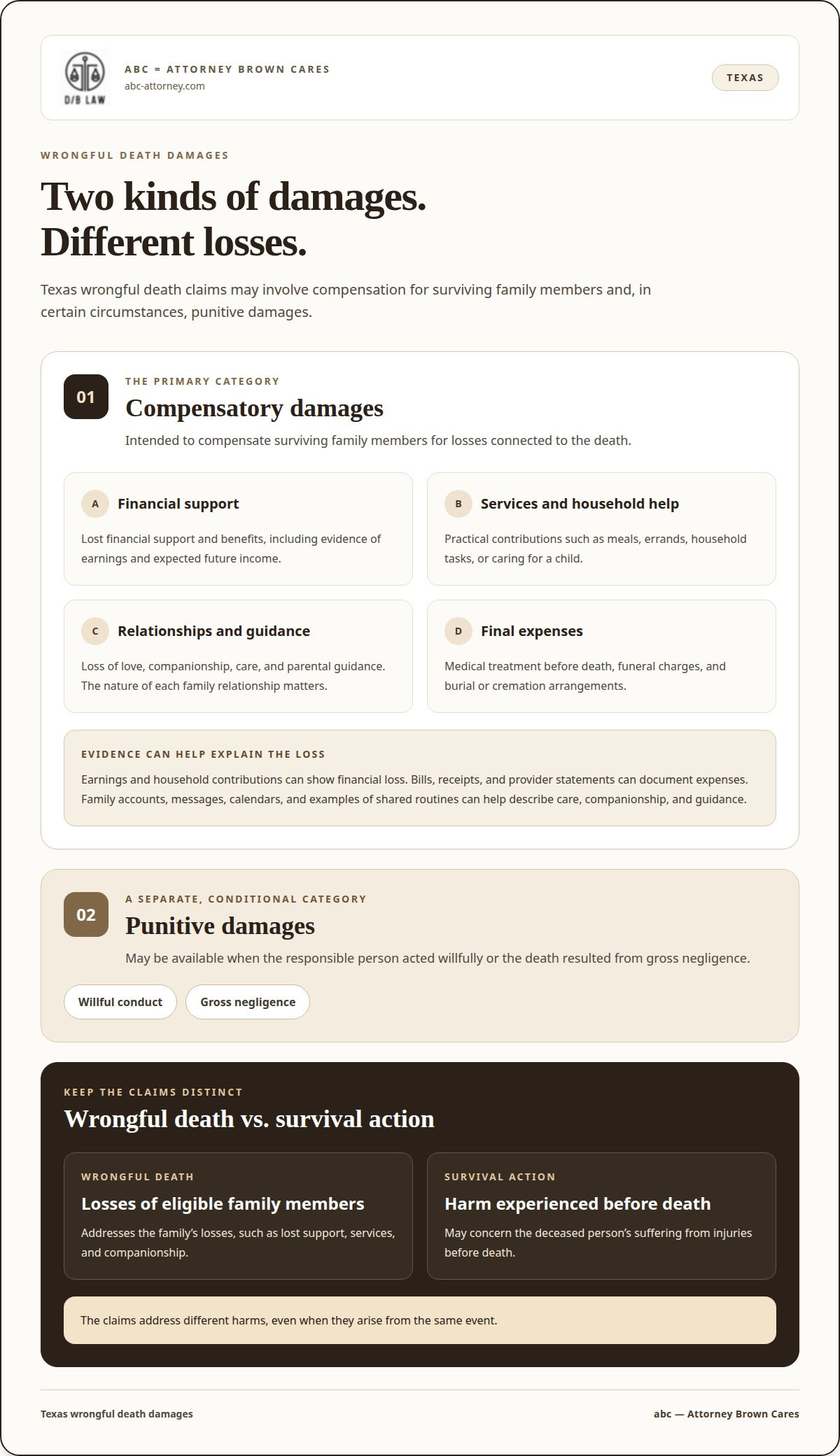
In Texas, wrongful death cases involve compensatory damages and punitive damages. Compensatory damages address surviving family members’ losses, while punitive damages may be available for willful conduct or gross negligence.
Medical and Funeral Expenses
Medical and funeral expenses are costs tied to the deceased person’s final injury and arrangements. A claim may include bills for treatment before death and funeral charges. These documented expenses represent specific financial losses, separate from lost support or companionship.
For example, a family might list an emergency-room bill separately from funeral-service charges. Bills, receipts, and provider statements can show which expenses arose from the fatal event. Clear records also distinguish medical and funeral costs from amounts sought for relatives’ emotional or financial losses.
Burial and Cremation Costs
Burial and cremation costs cover the chosen arrangements for a person’s remains. A Texas family’s claim may identify expenses associated with those arrangements. Separating cemetery charges, cremation services, and related funeral expenses makes the claimed losses easier to understand.
For example, a family choosing burial may have cemetery and service charges, while a family choosing cremation may have cremation and memorial expenses. The records should connect each charge to arrangements made after the death. This detail explains the total without combining every expense into one unexplained figure.
Differences From Survival Action Damages
Wrongful death damages address losses suffered by eligible family members; survival-action damages concern harm the deceased experienced before death. A Texas survival claim may seek compensation for the deceased person’s suffering from injuries caused by the acts that led to death.
This distinction matters when a person received treatment or experienced pain before dying. Medical bills and evidence of pre-death suffering, for example, may relate to a survival claim, while relatives’ lost support belongs to their wrongful death claim. The claims address different harms, even when they arise from the same event.
In Texas, a spouse or children may seek wrongful death damages. Whether the children are adults or minors matters, as does evidence of each person’s relationship with the deceased and their loss. A spouse’s financial dependence and a child’s reliance on parental support can help explain the family’s circumstances.
Filing deadlines depend on the law and circumstances applicable to the Texas claim. A deadline can determine whether a lawsuit may proceed, so identifying the date of death and relevant events is a practical early step. The specific filing period must be assessed under the rules governing the claim.
Settlement tax treatment depends on applicable tax rules and what each payment compensates. Families should not assume every part of a settlement receives the same treatment. For example, amounts allocated to different types of losses may need separate consideration when the settlement is reviewed.
If evidence suggests the deceased contributed to the fatal event, that conduct may affect the assessment of responsibility and damages. The parties may examine what happened and how each person’s actions related to the death. The effect on recovery depends on Texas law and the evidence in the case.
Loss of love and companionship
Compensatory damages can address how a death changed the family’s relationships and daily life. In Texas, a spouse or child may seek wrongful death damages, and the nature of each relationship helps explain the loss.
Loss of Consortium and Services
Loss of consortium describes the loss of a close relationship, while loss of services concerns practical help the deceased provided. Both can show how the death affected a household beyond its bills. For example, a spouse may have lost companionship and shared care, while the family also lost regular help with meals, errands, or household tasks.
These harms differ from economic damages such as lost income. A family can describe the deceased person’s usual role with concrete examples, such as preparing meals each evening or caring for a child after school. Some states recognize loss of consortium, also called loss of companionship, as a potential wrongful death loss.
Loss of Parental Guidance
Loss of parental guidance means a child no longer receives the deceased parent’s care, direction, and companionship. This matters because a parent’s contribution extends beyond financial support. For example, a child may lose help with school decisions, daily routines, or emotional support during difficult moments.
In Texas, whether children seeking wrongful death damages are adults or minors matters. The nature of the relationship is important, too: an adult child may have relied on a parent for regular guidance, while a minor may have depended on that parent for daily care and direction.
Evidence should describe the relationship specifically rather than rely on broad statements about grief. Family accounts, messages, calendars, and examples of shared routines can help show what the deceased contributed. A child’s school activities or a parent’s regular caregiving schedule, for instance, may illustrate the guidance and companionship now missing.
Negligence claims also require a connection between the wrongful conduct and the death. When a fatal injury follows a medical event, both the circumstances of care and the family’s relationship with the deceased may matter. An attorney can help present those facts clearly, separating emotional loss from practical services and financial expenses.
Compensation for personal losses depends on evidence about the surviving family and the deceased person’s role. One practical step is to document ordinary routines, such as who helped children with homework or provided care during illness. Those details give a clearer picture of the loss than a general description alone.
If a family is assessing how companionship and guidance fit into a Texas claim, talk through the relationship losses with an attorney.
Lost financial support and benefits
A wrongful death claim can seek economic compensation for income and financial support the family lost. In Texas, a spouse or children may seek damages, and the deceased person’s earnings and contributions to the family help explain that loss.
Lost Income and Earning Capacity
Lost income and earning capacity reflect wages the deceased person would have earned, including potential future earnings. These losses matter because a family may have depended on those earnings for regular expenses such as housing, food, or childcare.
A jury may consider earnings at death, last known earnings if the person was unemployed, and potential future earnings. Pay records, for example, can establish earnings, while employment history may help explain earning capacity. Lost wages and benefits are part of the financial picture, not a measure of grief or anguish.
Calculating Future Income and Support
Future income and support are assessed by examining the decedent’s earnings, earning capacity, life expectancy, and the circumstances of surviving family members. These factors matter because the family’s financial loss depends on both expected income and the support the decedent would have provided.
For example, the assessment may consider a person’s earnings at death alongside their health, condition, age, and life expectancy. It may also consider the needs and circumstances of family members who depended on that support. The result is not simply one paycheck multiplied by a fixed number of years.
For a practical example, consider a decedent who earned wages and regularly contributed to household expenses. Pay information can establish past earnings, while evidence of family contributions can show how those earnings supported the household. If the person was unemployed before death, last known earnings and potential future earnings may still inform the assessment.
The deceased person’s age, character, condition, earning capacity, life expectancy, health, and intelligence may all be relevant to pecuniary damages. The circumstances of the distributees matter, too. These factors help show whether past earnings reflect likely future contributions, rather than treating a short employment gap as the full measure of support.
A lawsuit should distinguish financial losses from other forms of compensation. Lost income and support are economic damages. Loss of companionship and family guidance are different harms. Punitive damages, when available, address conduct rather than replace the decedent’s earnings or the family’s support.
The estate and surviving relatives also have distinct roles in wrongful death and survival claims. A survival claim concerns losses the deceased experienced, while wrongful death damages address losses suffered by eligible family members. Keeping the claims separate clarifies whose loss each requested amount represents.
Punitive damages
In Texas, punitive damages may be available if the responsible person acted willfully or the death resulted from gross negligence. These damages aim to punish particularly egregious conduct and deter similar behavior, rather than compensate the family for its losses.
This distinction matters because compensatory and punitive damages serve different purposes in a wrongful death action. Evidence of lost financial support, for example, addresses the family’s economic harm; evidence supporting punitive damages concerns the defendant’s conduct. A fatal injury alone does not establish willful conduct or gross negligence.
Consider a hypothetical case in which a person repeatedly ignores a serious safety warning, and that conduct contributes to a fatal injury. The warning, the decision to disregard it, and the connection to the death could become important facts. The example shows why a punitive claim focuses on conduct, not the size of the family’s emotional or financial losses.
Records can help clarify what happened before the death. An investigation may examine incident reports, communications, safety records, and accounts from people with direct knowledge. A written warning followed by a decision to continue the same dangerous practice, for instance, could help explain the conduct at issue. Each item must be considered in the context of the injury and death.
Punitive damages are also distinct from pain and suffering the deceased experienced before death. A survival claim may address the deceased person’s suffering from injuries caused by the acts leading to death. Punitive damages, by contrast, focus on punishing or deterring particularly severe conduct. Keeping these categories separate clarifies what each requested amount addresses.
A lawyer assessing a Texas wrongful death case will examine whether the evidence supports willful conduct or gross negligence. The review may compare what the responsible person knew, what actions followed, and how those actions relate to the death. A claim based only on ordinary carelessness does not, without more, establish either basis for punitive damages.
Families should distinguish a request for punitive damages from an award. The request presents evidence and asks the jury to consider punishment or deterrence; it does not mean the jury will award that category. For example, evidence may establish financial and emotional losses but fail to show the conduct required for punitive damages.
This distinction keeps the case focused: compensatory damages address harm to surviving family members, while punitive damages address severe conduct by the responsible person. In Texas, evidence of willfulness or gross negligence is central to whether punitive damages may be available.
California wrongful death damages
For a Texas wrongful death claim, the key question is how the death affected eligible family members. Texas wrongful death cases have compensatory and punitive damages. Compensatory damages address surviving family members’ losses, while evidence about each person’s relationship with the deceased helps explain those losses.
In Texas, a spouse or children may seek wrongful death damages. The family’s circumstances matter, including the role the deceased played in daily life. A spouse may have relied on the deceased for financial support, while a child may have depended on that parent for care, guidance, and help around the household.
Children’s ages are relevant to the assessment. Whether a child seeking damages is an adult or a minor matters because the child’s dependence and relationship with the deceased may differ. For example, a minor may have relied on a parent for daily care, while an adult child may have received regular guidance or practical assistance.
A specific account of the deceased person’s contributions can make claimed losses more concrete. Family members may describe routines, responsibilities, and support that ended with the death. For instance, a parent who regularly cared for grandchildren or helped an adult child manage daily needs may have provided valuable services beyond income.
Financial evidence can help explain how the deceased supported the household. Earnings records, household expense information, and examples of recurring contributions may illustrate the family’s financial circumstances. These details help distinguish a claim based on actual support from a general estimate of what the family might have received.
Relationship evidence adds another dimension. Messages, family calendars, or accounts of shared activities can illustrate the deceased person’s presence and role. For example, a child’s routine of turning to a parent for school or personal guidance may help describe what changed after the death. Evidence should reflect the actual relationship, rather than assume every family experienced the same loss.
The assessment also considers the deceased person’s age, health, condition, earning capacity, and life expectancy, alongside the circumstances of family members seeking damages. These factors help frame likely contributions and losses. A family’s account, earnings history, and evidence of household responsibilities each add a different part of the picture.
Texas law also recognizes punitive damages in wrongful death cases when the responsible person acted willfully or the death resulted from gross negligence. This issue concerns the defendant’s conduct, not the amount of the family’s relationship loss. Keeping these questions distinct helps present the claim clearly and avoids treating all damages as one category.
A review of the family’s circumstances can help clarify which losses and evidence belong in a Texas claim. Discuss a Texas wrongful death claim and the losses your family is facing.
The Dedric Brown Law Firm
The Dedric Brown Law Firm represents individuals and families in matters involving traumatic brain injuries, hypoxic and anoxic brain injuries, birth injuries, truck wrecks, and auto wrecks. When a death follows one of these serious events, understanding the evidence and losses involved can help clarify the legal issues in a potential claim.
Each case requires careful attention to how the injury occurred, what harm followed, and which losses the evidence supports. Attorney Brown Cares means giving families personal attention while addressing legal and factual questions diligently.
For a thoughtful discussion of a serious injury matter, contact The Dedric Brown Law Firm.
Take the Next Step With Care
After a sudden loss, deciding what to do next can feel overwhelming. Start by gathering records and notes that help explain what happened and how your family’s life changed. A clear account can show which damages in a wrongful death case may relate to your family’s losses.
The Dedric Brown Law Firm handles matters involving traumatic brain injuries, hypoxic and anoxic brain injuries, and birth injuries. If a death followed a medical event or serious injury, a conversation can help clarify how the facts may relate to damages in a wrongful death case. Each family deserves careful attention, honest guidance, and an approach shaped by its circumstances. ABC means “Attorney Brown Cares,” a commitment to personal care through a difficult process.
Contact The Dedric Brown Law Firm to discuss your family’s situation. You don’t have to sort through the questions alone. A thoughtful next step can help you understand how the evidence may support damages in a wrongful death case and move forward with greater clarity.
Frequently Asked Questions
What Must Be Proven?
A wrongful death claim generally requires proof of duty, breach, causation, and measurable damages resulting from the death. For example, evidence might show that a driver owed a duty of care, breached it, and caused a fatal collision that left the family with financial losses. In a U.S. civil case, plaintiffs generally prove liability by a preponderance of the evidence, rather than beyond a reasonable doubt.
What happens if there are no actual damages?
If a court finds no actual damages, the outcome depends on state law. North Carolina’s Wrongful Death Act allows a jury to award nominal damages in that circumstance. In Texas, a wrongful death claim requires proof of measurable damages resulting from the death. The distinction matters: a nominal award recognizes a legal claim, while compensatory damages address proven losses.
When Is This Type of Claim Appropriate?
A wrongful death claim may be appropriate when a person’s death results from another party’s wrongful conduct, such as negligence. Fatal vehicle accidents and medical malpractice are examples of circumstances that can lead to claims. The family must connect the conduct to the death and show resulting losses. State law also determines who may bring the claim and receive an award.
What types of damages can be recovered in a wrongful death case?
Recoverable damages depend on the state and the losses supported by evidence. They may include lost financial support, household services, and companionship or guidance. Funeral, burial, and medical expenses may also be claimed. In Texas, compensatory and punitive damages are separate categories. Punitive damages address qualifying conduct rather than compensate the family for financial losses.
How are wrongful death damages calculated in the United States?
There is no single nationwide formula. The assessment may consider the deceased person’s earnings, earning capacity, age, health, and life expectancy, along with surviving relatives’ circumstances. For example, evidence of regular household contributions can help show the value of lost support. The nature of each family relationship and the specific losses claimed also shape the calculation under state law.
Can family members recover compensation for grief or emotional distress?
Recovery for grief or emotional distress depends on the state and type of claim. California wrongful death claimants cannot recover for their own grief, sorrow, or mental anguish, though they may seek other recognized losses. Loss of companionship or guidance may be treated differently under other states’ laws. Families should distinguish emotional suffering from claims for financial support, services, and other legally recognized losses.
Are punitive damages available in wrongful death cases?
In Texas, punitive damages may be available when the responsible person acted willfully or the death resulted from gross negligence. These damages aim to punish particularly egregious conduct and deter similar behavior. They differ from compensatory damages, which address survivors’ losses. For example, evidence of a serious warning knowingly ignored could be relevant to conduct, but the death alone does not establish eligibility.
Do wrongful death settlement amounts vary by state?
Yes. State laws differ on who can file, which losses qualify, and who receives damages. The applicable rules may also affect whether punitive damages are available and which filing deadline applies. For example, Oregon and North Carolina have different wrongful death limitation periods. Those differences affect legal options and claim evaluation, so a settlement figure from one state may not translate to another.


Comments