
Medical Negligence During Childbirth: 2026 Guide to Standard Procedures & Legal Rights

Did you know that nearly 30,000 babies are born with a birth injury in the United States every single year? When the joy of a new arrival is replaced by the crushing weight of neonatal care costs and developmental delays, you deserve to know if medical negligence during childbirth played a role. You're likely feeling confused by the complex jargon in hospital reports and anxious about your child's future. It's a heavy burden to carry alone, especially when you suspect that a preventable mistake changed your family's life forever.
We understand that you need more than just a lawyer; you need a protective ally who can dissect the data. At The Dedric Brown Law Firm, our name reminds you that Attorney Brown Cares, and we prove that commitment through a unique, CPA-led approach to auditing medical malpractice. This guide will help you identify deviations from standard labor protocols and recognize red flags during C-sections or tool-assisted births. We'll show you how a relentless legal investigation can protect your family's financial security while holding negligent providers accountable for their actions.
Table of Contents
Defining the Medical 'Standard of Care' in Labor and Delivery
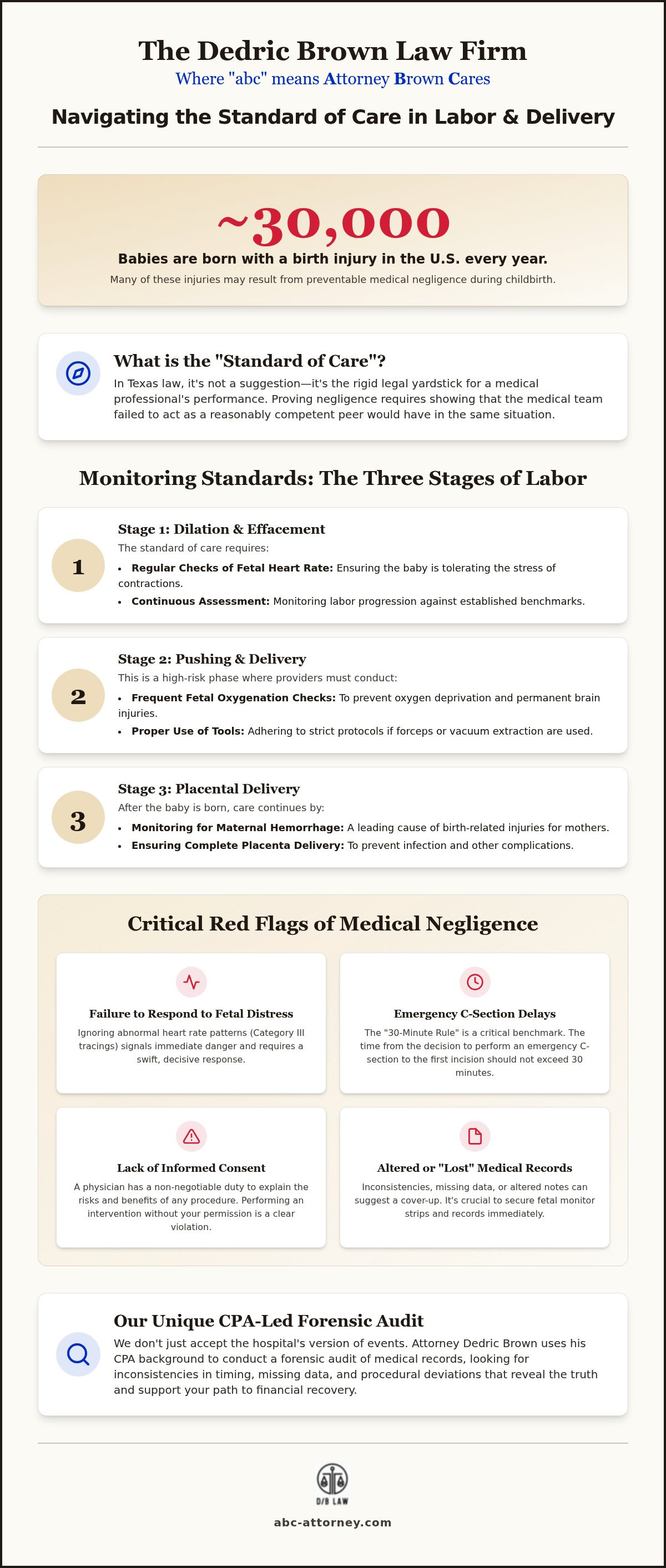
In a Texas courtroom, the "standard of care" isn't a vague suggestion. It's the rigid legal yardstick used to measure a doctor’s performance. Proving medical negligence during childbirth requires more than just showing a bad outcome. It requires proving that the medical team failed to act as a competent peer would have in that exact moment. While a Birth injury can result from natural complications, it often stems from a deviation from these established safety rules.
Texas law in 2026 remains focused on the "reasonably prudent" practitioner. This means your doctor must follow the same protocols as any other qualified OB-GYN in Houston, Dallas, or San Antonio. Attorney Brown Cares about establishing this benchmark at the very start of your case. We don't accept the hospital's version of events as fact. We look for where their actions diverged from the safety protocols designed to keep your baby safe.
The Legal Significance of Medical Protocols
Medical protocols aren't just guidelines; they're the floor of acceptable practice. Hospital bylaws and national standards, such as those from the American College of Obstetricians and Gynecologists (ACOG), dictate what "standard" care looks like. When a medical team ignores these rules, they invite disaster. Proving a breach of protocol requires expert medical testimony to explain what should have happened versus what actually occurred. This is where our unique analytical edge comes into play. Dedric Brown uses his CPA background to conduct a forensic audit of medical records. We look for inconsistencies in timing, missing data points, and altered notes that suggest a cover-up after a mistake.
Informed Consent: A Non-Negotiable Standard
You have a right to know what's happening to your body and your child. Every physician has a duty to explain the risks and benefits of any intervention, whether it's an induction, a vacuum extraction, or a surgical birth. While emergency situations can sometimes waive the need for formal consent, there are strict legal limits to that waiver. Doctors cannot use "urgency" as a shield for poor decision-making or reckless behavior. Informed consent is a mandatory pillar of the standard of care. If a doctor performed a procedure without your permission or failed to warn you of the risks, it may be a clear sign of medical negligence during childbirth.
The Three Stages of Labor: Standard Milestones and Monitoring
Labor is more than just a biological event. In a Texas hospital, it's a strictly timed clinical process where every minute matters. If a medical team ignores the established benchmarks of labor progression, they risk the life and health of both mother and child. Understanding these stages is the first step in identifying medical negligence during childbirth. When providers fail to monitor these milestones, they aren't just being careless; they're violating a sacred trust.
Stage 1 involves the dilation and effacement of the cervix. During this phase, nurses must check fetal heart rate patterns regularly to ensure the baby is tolerating the stress of contractions. Stage 2 is the pushing phase, where the risk of oxygen deprivation peaks. Doctors must conduct frequent fetal oxygenation checks to prevent permanent brain injuries. Finally, Stage 3 involves the delivery of the placenta. The standard of care requires medical teams to monitor for maternal hemorrhage, which is a leading cause of birth-related injuries for mothers. These expectations align with the World Health Organization's care standards, which emphasize continuous assessment to ensure a positive birth outcome.
Electronic Fetal Monitoring (EFM) Standards
In Texas, continuous EFM is the expected standard for hospital births. Medical teams use heart rate tracings to identify signs of distress. Category II tracings are indeterminate and require close, constant observation. Category III tracings are abnormal and signal immediate danger to the infant. When fetal bradycardia or tachycardia is detected, the response must be swift and decisive. Hospitals often follow the "30-minute rule," which dictates that the time from the decision to perform an emergency C-section to the first incision shouldn't exceed 30 minutes. If you suspect the medical team ignored these critical timelines, you can reach out to us for a forensic review of your hospital records.
Managing Labor Progression and Medications
Pitocin is a powerful medication used to induce or speed up labor, but it must be managed with extreme caution. Standard protocols require nurses to monitor for uterine tachysystole, a condition where contractions occur too frequently. This overstimulation can cut off the baby's oxygen supply. A failure to adjust or stop Pitocin when the uterus is overstimulated is a direct deviation from safe care. At abc-attorney, we believe Attorney Brown Cares enough to audit these medication logs with the precision of a CPA. We look for the exact moment a nurse should've turned off the pump but didn't, which often points toward medical negligence during childbirth.
Assisted Vaginal Delivery: Forceps and Vacuum Extraction Protocols
When labor fails to progress, doctors sometimes use mechanical aids to complete the delivery. These tools are high-stakes interventions. They aren't meant to be shortcuts for a tired medical team. Using forceps or a vacuum extractor without meeting strict prerequisites is a form of medical negligence during childbirth. Doctors must ensure the cervix is fully dilated, the membranes have ruptured, and the fetal position is precisely known. If any of these conditions are missing, the risk of a permanent injury skyrockets.
A major red flag in any delivery room is the "trial of instruments." Standard protocols generally forbid switching between a vacuum and forceps. If one tool fails, the next step is usually an emergency C-section, not another mechanical attempt. This "one tool" rule exists because multiple attempts with different instruments significantly increase the risk of intracranial bleeding and skull fractures. We see these deviations often when medical teams prioritize speed over safety.
Forceps Delivery: Safety and Placement Standards
Forceps require expert precision. The blades must be placed perfectly on the fetal head to avoid crushing the skull or damaging facial nerves. Doctors have a duty to use only "gentle traction" that coincides with the mother's contractions. If the baby doesn't move with reasonable force, the physician must abandon the attempt. Failure to do so can lead to traumatic brain injuries (TBI) or brachial plexus palsy. These injuries occur when excessive force stretches the nerves in the baby's neck and shoulder. Legal accountability follows when a doctor ignores these limits and causes permanent damage.
Vacuum Extraction: Limits and Neonatal Risks
Vacuum extractors use a suction cup attached to the baby's scalp. While they may seem less invasive than forceps, they carry unique dangers. One critical standard is the limit on "pop-offs." If the suction cup detaches from the scalp more than two or three times, the doctor must stop immediately. Repeated pop-offs can cause a subgaleal hemorrhage, where blood collects between the scalp and the skull. This is a life-threatening emergency that requires instant neonatal monitoring. Attorney Brown Cares about the details that hospitals try to hide. We use our CPA-trained analytical precision to audit medical charts, looking for the exact number of times a tool was applied. We find the data points that prove a doctor pushed beyond safe limits, turning a standard procedure into medical negligence during childbirth.
Standard Surgical Intervention: The Cesarean Section (C-Section)
A Cesarean section is often the final safety net for a mother and baby. While many births proceed vaginally, surgical intervention becomes mandatory when life-threatening red flags appear. These include fetal distress, placental abruption, or umbilical cord prolapse. In these high-stakes moments, medical negligence during childbirth often takes the form of a "failure to timely perform." If the medical team waits too long to move to the operating room, the baby may suffer from Hypoxic-Ischemic Encephalopathy (HIE). This is a devastating brain injury caused by oxygen deprivation that could've been avoided with a timely incision.
Texas medical facilities generally adhere to the 30-minute "decision-to-incision" rule. This benchmark ensures that once a crisis is identified, the baby is delivered before permanent damage occurs. Any delay beyond this window without a valid medical reason is a significant deviation from the standard of care. Post-operative care is equally critical. Medical teams must monitor mothers for signs of post-surgical infection and newborns for respiratory distress or neonatal transition issues. When these steps are skipped, the consequences for the family are often life-altering.
Recognizing Fetal Distress Red Flags
Fetal heart rate monitors provide a constant stream of data. Nurses and doctors must interpret this data with absolute precision. Late decelerations and prolonged bradycardia are not just technical terms; they are clear indicators that a baby is losing oxygen. The nursing staff has a non-negotiable duty to escalate these concerns to the attending OB-GYN immediately. When a hospital is understaffed or a doctor is unavailable, the resulting delay in surgical intervention constitutes avoidable birth trauma. We don't accept "busyness" as an excuse for a child’s injury.
The CPA-Attorney Advantage in C-Section Litigation
Proving a delay in a C-section requires more than just medical knowledge. It requires a forensic audit of the hospital’s internal logs and electronic health records. As a licensed CPA and attorney, Dedric Brown analyzes hospital timelines, staffing levels, and operating room availability to reconstruct the exact sequence of events. We look for the "lost minutes" where the medical team failed to act despite clear evidence of distress. Attorney Brown Cares by digging into the data others miss, ensuring that the human element of your story is backed by rigorous analytical evidence. If your family is suffering because a surgery happened too late, contact abc-attorney today for a comprehensive case audit.
When Procedures Fail: Legal Advocacy for Texas Families
When a medical team deviates from standard protocols, the consequences are rarely temporary. Identifying medical negligence during childbirth isn't just about spotting a single mistake; it's about holding a system accountable for your child's future. Families across Houston, Dallas, and San Antonio often feel overwhelmed by hospital bureaucracy and complex medical reports. You need a champion who can cut through the jargon and find the truth hidden in the data. At abc-attorney, we provide that clarity through relentless advocacy and analytical precision. We don't just represent you; we protect your family's financial security.
Steps to Take After a Traumatic Birth
The days following a birth injury are chaotic, but your actions now will determine the success of your legal journey. Document every interaction while the details are fresh. Record names, titles, and exactly what was said during bedside conversations. You must secure your fetal monitor strips and medical records immediately. Hospitals sometimes lose or alter data when a bad outcome occurs, so early preservation is vital. Seek a second opinion from an independent neonatal neurologist who isn't affiliated with the delivering hospital. These specialists provide an unbiased look at the root cause of developmental delays or physical injuries. Finally, contact a birth injury lawyer to ensure your legal rights are protected before the clock runs out.
Why 'Attorney Brown Cares' is the Firm's Core Mission
Our firm's core mission is built into our name: Attorney Brown Cares. This acronym represents our commitment to the human element of the legal profession. We combine compassionate family support with aggressive courtroom litigation. Dedric Brown’s dual expertise as both a licensed attorney and a CPA gives our clients a distinct advantage. We don't just read medical charts; we audit them for procedural failures. We analyze staffing levels, time logs, and surgical schedules to prove where the system broke down. This rigorous analytical approach maximizes your potential for a settlement that covers a lifetime of specialized care. We focus on financial risk mitigation so you can focus on your child's well-being. Schedule your free, confidential consultation with Attorney Brown Cares today.
Securing Your Child's Future Through Expert Advocacy
Navigating the aftermath of a traumatic delivery is a journey no parent should walk alone. Throughout this guide, we've identified how deviations from standard labor protocols, such as delayed C-sections or tool misuse, often signal medical negligence during childbirth. These aren't just medical errors; they're violations of a sacred trust that can lead to lifelong challenges like Cerebral Palsy or HIE. You deserve a champion who understands both the human pain and the complex data behind these injuries.
At The Dedric Brown Law Firm, we believe your family deserves the highest level of scrutiny. Dedric Brown brings the dual power of a licensed Attorney and a CPA to every investigation, providing the analytical precision required to audit hospital records and prove liability. We offer relentless advocacy for families in Houston, Dallas, and San Antonio. Because we operate on a contingency basis, there's no fee unless we win your case. We invite you to take the first step toward justice and financial security today. Attorney Brown Cares: Get a Free Birth Injury Case Review. Your child's future is worth the fight, and we're ready to stand with you.
Frequently Asked Questions
What is considered a 'standard' procedure during a normal labor?
Standard procedures include continuous electronic fetal monitoring (EFM), regular cervical checks for dilation, and the constant assessment of maternal vital signs. These protocols ensure the safety of both mother and child by identifying distress signals early. In Texas, hospitals follow benchmarks set by national organizations and internal bylaws. If a medical team skips these routine checks, they risk missing critical complications. Attorney Brown Cares about these details because they form the essential baseline for a safe delivery.
Is it standard for a doctor to use forceps without my permission?
No, doctors have a legal duty to obtain informed consent before using assisted delivery tools like forceps. Unless a life-threatening emergency exists where every second counts, a physician must explain the risks and benefits of the intervention. Using these tools as a shortcut without your permission is a deviation from the standard of care. If your child suffered skull fractures or nerve damage from tool misuse, it could be evidence of medical negligence during childbirth.
How long does a doctor have to perform an emergency C-section?
The widely accepted standard in Texas is the "30-minute rule." This means the time from the decision to operate to the first incision shouldn't exceed 30 minutes. In high-stakes cases like cord prolapse or placental abruption, even 30 minutes might be too long. Any delay beyond this window without a valid medical justification can cause hypoxic-ischemic encephalopathy (HIE). We audit hospital timelines to see if staffing issues or negligence caused these dangerous delays.
What are the standard monitoring requirements for a high-risk pregnancy?
High-risk pregnancies require more frequent monitoring, including regular non-stress tests and biophysical profiles. During labor, continuous electronic fetal monitoring is mandatory to track heart rate patterns for signs of distress. Doctors must also monitor for specific conditions like preeclampsia or gestational diabetes. Failure to escalate care when these red flags appear is a common cause of birth injuries. Our firm investigates whether the medical team ignored these heightened monitoring requirements in Texas hospitals.
Is a birth injury always the result of medical malpractice?
No, not every birth injury is caused by medical negligence during childbirth. Some complications occur despite the medical team following all safety protocols perfectly. However, 80% of birth injury claims involve high-severity, permanent damage that could've been prevented with proper care. To determine if malpractice occurred, we perform a forensic audit of the medical records. We look for procedural deviations that turned a manageable complication into a life-altering injury for your child.
Can I sue for a birth injury in Texas if it happened several years ago?
Yes, Texas law provides an extension for minors. While the general statute of limitations is two years, children injured before their 12th birthday have until their 14th birthday to file a claim. However, a ten-year absolute cutoff, known as the statute of repose, applies regardless of when the injury was discovered. It's critical to contact abc-attorney early to preserve evidence and ensure your family meets these strict legal deadlines in Houston, Dallas, or San Antonio.
What is the standard of care for neonatal resuscitation after delivery?
The standard of care requires immediate intervention if a newborn isn't breathing or has a low heart rate. This includes clearing the airway, providing positive pressure ventilation, and performing chest compressions if necessary. Neonatal therapeutic hypothermia may also be required for babies showing signs of oxygen deprivation. If the delivery team fails to have a resuscitation specialist present or misses these critical steps, the baby can suffer permanent brain damage from preventable asphyxia.
How does Attorney Brown prove that a procedure was not standard?
Dedric Brown uses his unique background as both an attorney and a CPA to perform a forensic audit of hospital data. We don't just take the doctor's word for it. We analyze fetal monitor strips, medication logs, and staffing schedules to find inconsistencies. By comparing the hospital's actions against ACOG guidelines and Texas medical standards, we identify the exact moment care failed. This analytical precision helps us build a formidable case for your family.


Comments