
Life Care Plans: How MMI Shapes Future-Care Analysis
Updated: Oct 6
What if reaching maximum medical improvement doesn’t mean the need for care is over? For families facing a serious injury, that distinction can shape how future medical, rehabilitation, and daily support needs are understood. A life care plan personal injury analysis can organize those needs into a documented picture of care that may continue over time.
It’s understandable to feel uncertain about what comes next. Maximum medical improvement, or MMI, generally refers to a point when a person’s condition has stabilized, not a declaration that every future need has ended. A life care plan may document anticipated treatment, therapy, equipment, and support. The evidence and circumstances of each case matter, and a plan isn’t a fixed legal outcome.
This article explains what a life care plan generally covers, how MMI may inform future-care analysis, and what families can discuss with legal counsel when documenting lasting impacts. The Dedric Brown Law Firm represents people and families in catastrophic injury matters. Attorney Dedric Brown’s attorney and CPA perspective brings careful attention to damages evidence. ABC means Attorney Brown Cares, a commitment to personal, compassionate attention when the stakes are deeply human.
Table of Contents
What Is a Life Care Plan in a Personal Injury Case?
A life care plan is a structured projection of future care needs and related resources associated with an injury. In a life care plan personal injury matter, it can help explain how the effects of a serious injury may call for ongoing treatment, rehabilitation, equipment, or support. It is an expert-informed projection, not a promise of a particular recovery or legal result. Its scope should reflect the person’s documented condition and individual needs. For individuals navigating claims abroad or seeking legal support in the UK, personal injury lawyers such as Indre Zukaityte similarly help assess long-term recovery and financial requirements following serious trauma.
For families, a plan can make ongoing needs easier to understand than a snapshot of current bills alone. In a claim, damages for future medical needs are a legal concept, and a plan may provide information relevant to evaluating those needs. A plan doesn’t determine what a claim is worth or prove that every projected service will be needed.
What information can a life care plan include?
Depending on the person and the planning approach, a plan may address categories such as:
Medical care and follow-up treatment
Rehabilitation and therapy
Medication and assistive equipment
Support services related to daily needs
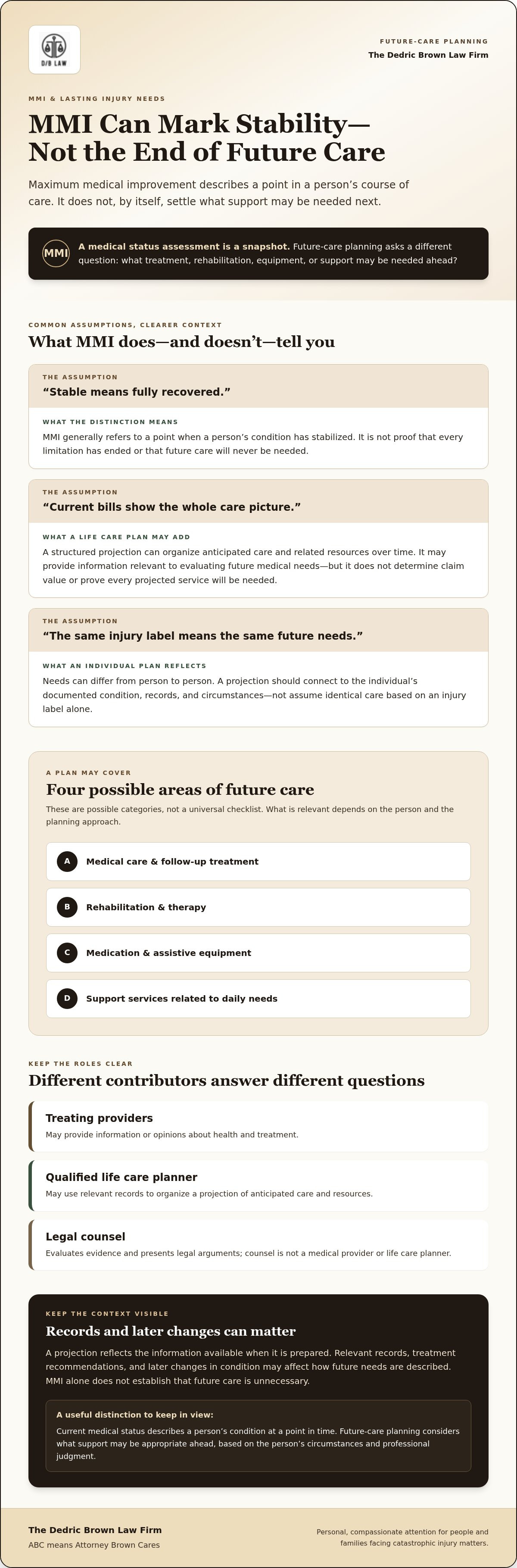
These are possible categories, not a universal checklist. Recommendations should connect to the person’s records, condition, and documented needs. Equipment or support that is relevant for one person may not be appropriate for another. The plan’s scope depends on individual circumstances and the methodology used by the qualified professional preparing it.
Who may contribute to a life care plan?
A qualified life care planner may organize information about anticipated care and resources. Medical records and information from treating providers may inform that work. The people involved and their roles can vary, so no single contributor should be assumed to answer every question.
Medical opinions, care projections, and legal arguments are distinct. Treating providers may offer information or opinions about a person’s health and treatment. A planner may use relevant records to develop a projection. Counsel evaluates evidence and presents legal arguments, but does not act as a medical provider or life care planner.
Hypothetical example: Two people sustain brain injuries, but their documented effects differ. One may need regular rehabilitation and reminders for daily routines, while the other may require different equipment or ongoing personal support. A carefully grounded plan would reflect each person’s circumstances rather than assume that the same injury label means identical future needs.
At The Dedric Brown Law Firm, careful attention to damages evidence is part of catastrophic injury litigation. Attorney Dedric Brown’s attorney and CPA perspective informs that analysis, while qualified professionals address medical and care-planning questions. ABC means Attorney Brown Cares, a commitment to treating each person and family with personal attention and compassion.
How Does Maximum Medical Improvement Relate to Future-Care Planning?
Maximum medical improvement, or MMI, is a medical status concept used to describe a point in an injured person’s course of care. Its precise meaning and significance can depend on the treatment and legal context. It should not be treated as proof that the person has fully recovered, has no lasting limitations, or will never need care again.
A medical status assessment describes a person’s condition at a point in time. It isn’t a complete account of future support needs.
That distinction matters in a life care plan personal injury analysis. Current medical status and anticipated future care are connected, but they answer different questions. A clinician’s assessment may help explain the person’s condition. A future-care projection considers what treatment, rehabilitation, management, equipment, or support may be needed ahead. Any projection should be grounded in available records and appropriate professional judgment, not assumed from the MMI label alone.
Does reaching MMI mean treatment or support is over?
No, not necessarily. Active treatment aimed at changing a condition may differ from ongoing management, rehabilitation, or support for lasting effects. Whether any of those needs are appropriate for a particular person requires individual evaluation. MMI alone doesn’t establish that future care is unnecessary.
Illustration, not a prediction: A person with a brain injury may reach a point where their condition is considered stable but still have documented difficulty with memory or daily tasks. Any future support needs would depend on their circumstances and professional assessment, not on the label alone.
Why can timing matter when future needs are assessed?
A care projection reflects the information available when it is prepared, including relevant records and professional judgment. If a person’s condition or treatment recommendations evolve, new information may affect how future needs are described. That doesn’t mean every assessment must wait until MMI. The date, supporting records, and any later changes can all provide important context.
Families can help preserve that context by keeping records of appointments, treatment recommendations, and changes in everyday function. Questions for counsel may include: What records support the projection? Have later developments changed the picture? How does MMI apply in this specific claim? The legal significance of MMI and future-care evidence should be assessed in the context of the individual case, not assumed from a general definition.
For families weighing these questions in a catastrophic injury matter, a conversation with counsel can help clarify what information may be relevant to the claim. Attorney Brown’s approach reflects ABC: Attorney Brown Cares, with personal attention to the people behind the evidence. Discuss your injury claim.
Life Care Plan vs. Current Medical Bills: What Does Each Show?
Past bills, current treatment records, and a life care plan answer different questions. Bills show charges for services already provided. Records describe care and a person’s condition at a particular time. A plan may project future needs. In a life care plan personal injury claim, keeping these categories distinct helps families and counsel understand what the evidence documents and what still requires support.
How is a life care plan different from a medical bill summary?
A bill summary looks backward. It organizes charges for care that has already occurred. A life care plan looks forward, describing care categories that may be needed based on the person’s circumstances and supporting information. It isn’t simply a list of past services extended into the future.
For example, a record may show that someone attended rehabilitation sessions. A projection might address whether additional rehabilitation or other support may be anticipated. That projection needs a basis. It shouldn’t be treated as a guaranteed expense just because similar care happened before. Nor does a plan automatically determine settlement value or compensation. Legal recoverability and the treatment of evidence depend on applicable law and the facts of the case. Texas-specific legal questions should be reviewed under current law.
How do life care planning and economic analysis differ?
Care planning generally focuses on identifying anticipated injury-related needs. Economic analysis may address the financial valuation of losses using relevant information and methods. These are related but distinct tasks, and roles or methods can vary. A care projection alone doesn’t answer every financial question, and a financial calculation doesn’t establish what care is medically appropriate.
Attorney Dedric Brown’s attorney and CPA perspective supports careful review of damages evidence. His CPA credential informs financial analysis, but it doesn’t replace the work of a qualified life care planner or medical professional. ABC means Attorney Brown Cares: personal attention to the evidence and to the families whose lives it represents.
How Can Families Prepare to Document Long-Term Injury Needs?
Families often see day-to-day effects of an injury that may not be obvious in a brief appointment or a stack of bills. Clear, factual information can help counsel and qualified professionals understand what care and support look like over time. Documentation supports review and discussion; it doesn’t replace medical advice or an expert assessment.
Treatment records, care routines, and functional changes can help tell a clearer story of ongoing needs.
A simple system is enough to get started:
Preserve records. Keep treatment records, rehabilitation notes, medication information, and relevant care documentation organized.
Track care. Note appointments, services received, and assistance provided at home. Include the date and who helped when that information is useful.
Describe functional changes. Record specific changes in daily activities, such as needing help with a routine task that was previously manageable. Focus on what happened, not a medical explanation of why.
Discuss questions with counsel. Share relevant information and ask how it may fit into the case’s documentation of long-term needs.
Consistency matters more than elaborate forms. A dated note such as “needed help organizing medication before the morning appointment” is more useful than a vague summary written much later. Keep entries factual. Don’t change source records, draw medical conclusions, or treat the log as a substitute for following professional guidance.
Which records and observations may help explain ongoing needs?
Gather treatment records, medication information, rehabilitation notes, and documents about care or support. Alongside them, keep dated observations about appointments, help needed, and changes in daily function. A family log can capture practical details, but it shouldn’t diagnose a condition or predict future treatment. In a life care plan personal injury claim, organized information can help counsel identify questions that may need further review.
What questions can families raise with legal counsel?
Consider asking how the claim documents future needs, what records may be relevant, and which qualified professionals may contribute to evaluating them. You can also ask how maximum medical improvement is being considered in the case, without assuming it settles whether future care or support may be needed. Clear questions help families understand what the evidence shows and where further information may matter.
Attorney Brown’s attorney and CPA perspective brings careful attention to damages evidence, while medical and care-planning questions remain matters for appropriate professionals. ABC means Attorney Brown Cares, a commitment to personal attention for injured people and their families. Talk with our team about your questions.
How Can Personal Injury Counsel Use Future-Care Evidence in Texas?
Future-care evidence can help counsel examine how a serious injury affects a person beyond the treatment already received. In a life care plan personal injury matter, counsel may review medical records, documented effects on daily life, and expert projections to understand how they fit together. Each serves a different purpose: records describe care and condition, observations add context about daily impacts, and projections address possible future needs.
These materials don’t automatically establish that every projected service is necessary or that a particular outcome will follow. Their relevance and treatment depend on the facts of the case and applicable law. In Texas, case-specific legal questions should be assessed under current law rather than assumed from a general description of life care planning.
What should an evidence-focused legal review consider?
A careful review looks at how the evidence connects. Counsel may compare the documented condition and treatment history with reported daily challenges and the basis for any future-care projection. If details appear incomplete or inconsistent, those questions may need further review. The goal is to understand what the evidence supports, what it doesn’t establish, and how injury-related needs may be presented.
Attorney Dedric Brown is both a licensed attorney and a CPA. That combination supports close attention to damages evidence and financial analysis. It doesn’t replace medical expertise or the work of a qualified professional who evaluates care needs. The legal and medical questions remain distinct, even when they inform the same claim.
What can families expect from a compassionate first conversation?
Families should be able to explain what has changed, what remains uncertain, and what concerns them most. A thoughtful conversation makes room for those questions and clear explanations of how individual facts may affect the legal review. No general discussion can promise a specific result or substitute for reviewing the circumstances of a particular case.
The Dedric Brown Law Firm focuses on traumatic brain injury and catastrophic injury litigation. ABC means Attorney Brown Cares: personal attention to the person and family behind the records, alongside a disciplined review of the evidence. That combination matters when the stakes are high and future needs remain uncertain.
If you’re weighing how an injury’s lasting effects may fit into a claim, Contact The Dedric Brown Law Firm to discuss your questions and circumstances.
Take the Next Step Toward Clarity
A life care plan personal injury analysis can organize documented future-care needs, but it is a projection, not a guarantee of care or a legal outcome. Current bills, treatment records, and future-care assessments each provide different information. Maximum medical improvement also doesn’t mean symptoms, limitations, or support needs have necessarily ended.
Families can preserve relevant records and note appointments, care routines, and changes in daily function. Counsel can review that information in context and discuss how it may relate to the claim. For serious injury matters, careful attention to evidence matters. Attorney Dedric Brown is both a licensed attorney and a CPA, and the firm focuses on traumatic brain injury and catastrophic personal injury litigation. His financial background supports close analysis of damages evidence, not medical care planning. ABC means Attorney Brown Cares, a commitment to compassionate personal attention.
If questions about lasting needs or your claim remain, contact The Dedric Brown Law Firm to discuss your concerns. You don’t have to sort through the uncertainty alone.
Frequently Asked Questions
Does maximum medical improvement mean no future medical care is needed?
No. Maximum medical improvement doesn’t automatically mean full recovery or that all future care has ended. A condition may be considered stable while a person still experiences symptoms, limitations, or ongoing needs. The person’s medical situation should be assessed by qualified professionals, and MMI’s meaning can depend on its context. Families can ask counsel how MMI is being considered in their specific case without treating it as a complete answer about future care.
Who prepares a life care plan after a serious injury?
A qualified life care planner may develop a plan using records, assessments, and relevant professional input. The process and contributors can vary, so there isn’t one assumed process for every case. Treating physicians and other professionals may provide information within their roles, while counsel can explain how a plan may relate to the legal issues. Ask what information informs the projection and how the planner’s role is distinguished from medical opinions and legal arguments.
What information is included in a life care plan?
A plan may address future medical care, rehabilitation, medication, assistive equipment, and support services. These are possible categories, not a fixed checklist. What belongs in a particular plan depends on the person’s documented needs and the plan’s scope. A projection doesn’t promise that every listed service will occur, guarantee recovery, or decide a claim’s outcome. Families can discuss whether recommendations are connected to records and relevant professional assessments.
Can a life care plan affect a personal injury claim?
A plan may help organize evidence about anticipated injury-related needs, but it doesn’t automatically establish liability, determine compensation, or guarantee that evidence will be accepted. Its relevance and treatment depend on the case facts and applicable law, including current Texas law. The Dedric Brown Law Firm represents people and families in Texas, including Houston, San Antonio, Dallas, Austin, Beaumont, Huntsville, Prairie View, and Brenham. Counsel can explain how a plan may fit a particular claim.
How can families document future care needs after a traumatic brain injury?
Keep treatment records organized, note appointments and support routines, and make dated observations about changes in daily functioning. For example, record what assistance was needed with a specific activity and when it occurred. Keep entries factual. Don’t alter records or draw medical conclusions from observations. A care log can support conversations with counsel, but it doesn’t replace medical advice or expert evaluation. Ask how these details may relate to documenting needs in the specific matter.