
Husband stitch: Is it medically necessary and what are the harms

An extra stitch intended to narrow the vaginal opening after childbirth has no medical benefit and isn’t an accepted medical procedure. Known as the husband stitch, it can cause pain and other harm. Its resemblance to female genital mutilation raises serious concerns, but the comparison needs care: the World Health Organization defines FGM/C as procedures involving partial or total removal of external female genitalia or other injury to female genital organs for non-medical reasons.
If the idea of an intimate procedure being performed without a patient’s consent feels disturbing, that reaction is understandable. A vaginal repair should support healing, not change someone’s body to meet another person’s sexual preferences. Understanding what the husband stitch involves helps clarify the difference.
This article explains possible side effects, what is known about pain and prevalence, why the husband stitch isn’t medically necessary, and how it relates to FGM/C. It also clarifies what comparisons can and can’t establish, helping you understand the medical and consent issues involved.
Table of Contents
The Husband-Stitch: Could it be Female Genital Mutilation?
A patient can consent to or refuse extra stitches after childbirth. Agreeing to repair an injury doesn’t automatically authorize an additional stitch intended to narrow the vaginal opening for a male partner.
Consent and Bodily Integrity
Bodily integrity means having authority over procedures performed on your body. Agreeing to close a childbirth tear, for example, doesn’t automatically mean agreeing to alter the vaginal opening. The purpose and scope of consent matter. A patient can ask what tissue needs repair and what each stitch is intended to do. Those questions help distinguish treatment of an injury from an additional alteration.
Consent During Childbirth
Childbirth can involve urgent decisions and intense physical demands, but a patient’s preferences still matter. If a tear needs repair, the clinician can explain the proposed treatment and seek consent when circumstances allow. An extra stitch intended to change vaginal tightness is a separate decision. A patient can ask whether it’s medically necessary, what it will change, and whether there’s time to discuss it.
Medical Ethics and Informed Consent
Informed consent applies to a specific procedure and its purpose, not simply to childbirth care in general. An extra stitch intended to narrow the opening for a male partner’s sexual pleasure has no medical benefit for the patient. Two women interviewed said their obstetricians described the stitch as a favor to their husbands. Their accounts raise an ethical concern: medical decisions should center on the patient’s health and wishes.
Legal Claims After Nonconsensual Stitches
A nonconsensual procedure can support a medical malpractice claim in the United States, but the evidence must establish more than a lack of consent. A claim requires evidence that the doctor failed to follow the expected standard of care and that this failure caused the patient’s losses. Consent records, descriptions of the procedure, and evidence of harm can help clarify what happened. Lack of consent alone doesn’t establish every element.
Two women interviewed compared their experiences to female genital mutilation or cutting. Their comparison conveys how an unwanted change to intimate anatomy can affect bodily autonomy and trust in medical care. It doesn’t, by itself, determine whether a specific procedure meets a legal definition of FGM/C. The comparison is best understood as a description of personal experience, not a legal conclusion.
What are the side effects of the husband's stitch?
The husband stitch is an extra stitch placed after childbirth to narrow the vaginal entrance, supposedly for a male partner’s sexual pleasure. Unlike a stitch that closes injured tissue, this suture tightens the opening for a nonmedical purpose. It can leave tissue under tension, affecting comfort as the perineum heals and stretches during everyday movement or sex.
The World Health Organization identifies Type 4 FGM as other harmful procedures to female genitalia for non-medical purposes. This classification provides context for considering non-medical genital procedures, but it does not by itself determine the legal classification of a particular act. The patient’s experience, the procedure performed, and the purpose described remain distinct questions.
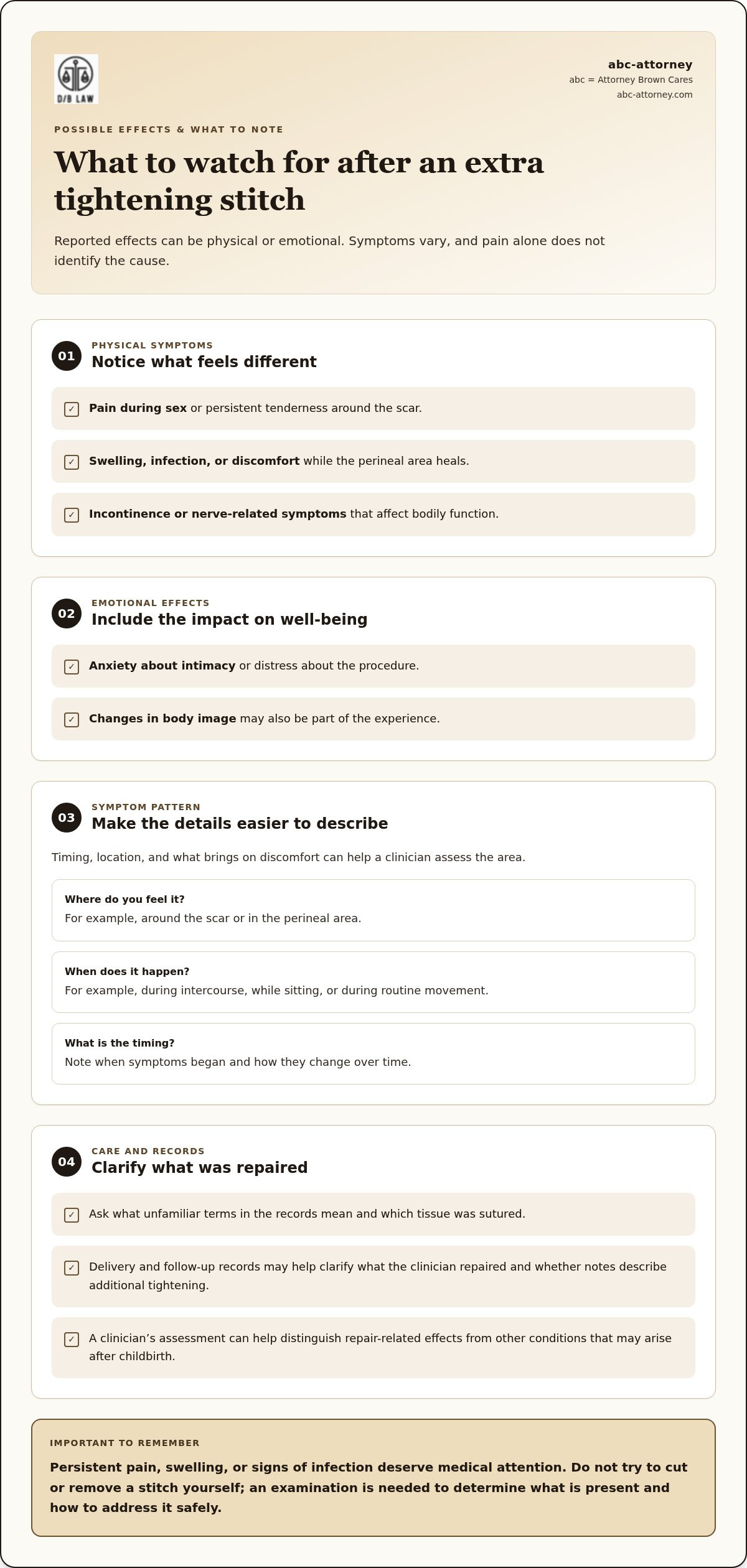
Possible effects reported after an extra tightening stitch include physical symptoms and emotional distress. They may include:
Pain during sex or persistent tenderness around the scar.
Swelling, infection, or discomfort as the perineal area heals.
Incontinence or nerve-related symptoms affecting bodily function.
Anxiety about intimacy, changes in body image, or distress about the procedure.
Symptoms can vary depending on the tissue involved. Tight scar tissue may pull when stretched, while swelling or infection can cause tenderness in the surrounding area. Nerve-related discomfort may feel different. Pain alone doesn’t identify its cause. A clinician’s assessment can help distinguish the effects of a repair from other conditions that may arise after childbirth.
For example, a patient may notice pain only during intercourse, tenderness when sitting, or discomfort during routine movement. These details are useful to describe during an examination. The timing and location of symptoms, along with the activities that trigger them, can help a clinician assess the area. A university study or clinical account may describe experiences across participants, while a patient’s delivery and follow-up records document their individual care.
Records can also help clarify what the clinician repaired and whether the notes describe additional tightening. Patients can ask what unfamiliar terms mean and which tissue was sutured. If symptoms persist, an assessment can identify possible causes and guide care. Avoid attempting to cut or remove a stitch yourself; the tissue is sensitive, and an examination is needed to determine what is present and how to address it safely.
Ongoing pain, swelling, or signs of infection deserve medical attention. If an unwanted procedure caused injury, you can discuss medical-care concerns and the facts that may matter to a legal claim.
Evidence and prevalence of the practice
Reports establish that this practice has occurred, but not how common it is. Scientific studies haven’t determined how many women have experienced an extra tightening stitch after delivery. Anecdotes and interviews document individual experiences, but can’t provide a reliable national prevalence rate. Evidence that something has occurred isn’t evidence of how often it happens.
Preliminary interviews with five women who said they received the procedure without consent were presented at the International Continence Society 2024 Conference in Madrid. The interviews included accounts of the practice in the United States as recently as 2015 and in Japan in 2008. These accounts support that the practice has happened across different settings. They don’t show how often it occurs in hospitals or how many patients have been affected.
Evidence from Belgium adds historical context. Belgian researchers reported that vaginal tightening with an extra stitch during childbirth repair had been practiced since at least the mid-1950s. A 2004 study of episiotomy practices in São Paulo described “ponto do marido,” translated as the husband’s stitch, as extra tightening after delivery. These records show that the idea has appeared in different countries and periods, not that it is a standard surgical practice.
Evidence-based perineal repair focuses on the injury and the tissue that needs to heal. Vaginal tears range from first-degree to fourth-degree, and the extent of the injury informs the repair. The aim is to bring affected skin and tissue together to support healing. An unnecessary stitch intended to narrow the opening differs from a repair stitch used to address a tear. Clinical documentation should distinguish the injury, the repair, and any additional procedure.
For a patient reviewing what happened, records can help answer specific questions. A delivery note may describe a tear’s location, the repair performed, and any episiotomy. Later notes may record pain or other concerns. The absence of a specific term in a chart doesn’t prove that no extra stitch was placed. The key is to compare the documented injury and procedure with the patient’s account and later symptoms.
The American College of Obstetricians and Gynecologists was reported as saying the practice isn’t standard or common. That statement complements individual accounts rather than replacing them. A university study, hospital record, or interview can provide different kinds of evidence: measured frequency, clinical documentation, or firsthand experience. Each should be understood within its limits, including claims about sexual pleasure or how widespread the practice is.
Medical necessity and potential harms
An extra stitch intended to tighten the vaginal opening has no medical benefit for the patient. A childbirth repair has a different purpose: bringing injured tissue together to support healing. The distinction is practical. A stitch that closes a tear addresses an injury; one added to narrow the opening changes genital anatomy without serving a healing purpose.
An episiotomy is an incision in the perineum, the area between the anus and vaginal opening, made to widen the passage for delivery. The American College of Obstetricians and Gynecologists updated its episiotomy guidelines in 2006, saying the procedure may benefit certain circumstances but is essential in few. In 2016, the organization recommended strategies such as massage and warm compresses to prevent and manage delivery lacerations, rather than perineal cuts.
Rates show how the use of episiotomy has changed in the United States. The rate was 60.9% in 1979 and 24.5% in 2004. It was reported around 5% in 2023. A separate comparison found 12% of births involved an episiotomy in 2012, down from 33% in 2002. These figures describe episiotomy, not extra tightening stitches. They help distinguish a recognized incision from an additional procedure without medical purpose.
Possible harms may resemble risks associated with episiotomy or other perineal injury. They include bleeding, swelling, infection, painful sex, and temporary loss of bowel control. A study also found that people who undergo episiotomy return to sexual activity more slowly than people who have a regular vaginal birth. A 2023 study associated episiotomy with more frequent painful sex than vaginal birth or cesarean section. These findings concern episiotomy; they don’t establish a precise risk for an extra stitch.
If a patient suspects an extra stitch or has ongoing pain, a medical assessment can clarify the repair, the tissue involved, and possible care options. A clinician can review childbirth records and examine the area. Treatment depends on the findings, including whether tightness, scar tissue, or another issue is causing symptoms. Don’t try to cut or remove stitches yourself. The repair involves sensitive tissue and needs professional assessment.
Reversal isn’t a single procedure that suits every patient. The appropriate approach depends on the original repair, current symptoms, and condition of the genital tissue. A patient can ask what the records say, what an examination finds, and what benefits and risks come with each proposed option. Persistent pain, swelling, or signs of infection deserve timely medical attention rather than waiting for discomfort to resolve on its own.
Pain and harm associated with the husband-stitch
Yes, reported complications include painful sex, perineal pain, and incontinence. These accounts raise concerns about pelvic-floor symptoms, but they don’t establish that an extra stitch causes vaginal prolapse.
Reported Sexual Pain and Dyspareunia
Dyspareunia means pain during sexual activity. All five women interviewed reported long-term pain during sex after receiving an extra stitch without consent. That matters because pain can affect intimacy, comfort, and a person’s relationship with their body. These accounts describe harm, not a measured complication rate across all patients. There’s also no established evidence that an extra stitch improves sexual pleasure for either partner.
Perineal Pain and Vaginal Prolapse
Perineal pain is discomfort in the tissue between the vaginal opening and anus; vaginal prolapse is a separate pelvic-floor condition. One participant reported severe perineal pain beginning two days postpartum. Interview accounts also included incontinence, a symptom that may involve pelvic-floor function. These reports justify taking symptoms seriously, but don’t establish that an extra stitch causes prolapse. Pain, pressure, or leakage needs an individual medical assessment.
Patient Stories and Reported Pain
Firsthand accounts show how the effects can unfold over time. One participant said the stitch was performed in Wisconsin in 1992. Angela Sanford said she discovered five years after her first birth that she had received one. Such stories can help explain why some patients describe lasting distress and trauma, but individual experiences cannot establish how often the practice occurs.
In the five interviews, women described pain around the stitch soon after childbirth as well as later pain during sex. One account involved severe perineal pain beginning two days after delivery. The details differ, but each illustrates why the timing, location, and duration of symptoms matter. Keeping a symptom record can help a patient describe the pattern: when pain began, what worsens it, and whether intercourse or movement triggers it.
Persistent pain can have several causes, including scar tissue, infection, nerve injury, or a separate pelvic-floor condition. A clinician can examine the perineum, review childbirth records, and consider symptoms such as painful intercourse or leakage. This assessment can distinguish where the pain is from what’s causing it. It can also guide a discussion of treatment options without assuming every symptom comes from the extra stitch.
If an unwanted procedure was followed by lasting pain or other complications, the medical records and the patient’s account can help clarify what happened. Discuss childbirth-related injury concerns and the evidence that may matter to a potential claim.
The Dedric Brown Law Firm: Traumatic Brain Injuries
The Dedric Brown Law Firm represents people in birth injury matters, including cases involving traumatic brain injuries and hypoxic or anoxic brain injuries. If concerns about childbirth care involve an injury to a child, the firm may be a relevant legal resource. A painful or unwanted stitch, by itself, is a different concern and shouldn’t be confused with a brain injury claim.
Understanding what happened starts with the medical records, the care provided, and the reported harm. The firm focuses on birth injuries and traumatic brain injury litigation, helping families examine whether medical care caused a serious injury. ABC means “Attorney Brown Cares,” reflecting a commitment to attentive, compassionate representation.
If you have questions about a birth injury or traumatic brain injury, contact The Dedric Brown Law Firm to discuss your concerns.
Take a Clear Next Step for Your Care
If the husband stitch has left you with unanswered questions, consider what you need most now: medical attention, a clear account of the procedure, or help understanding your legal options. Your health and your account of what happened deserve careful attention. Keep notes about symptoms and concerns, and preserve any records you already have.
When you believe a medical procedure was performed without consent and caused harm, The Dedric Brown Law Firm handles medical malpractice litigation. A focused review can help assess the care, available documentation, and reported injury. The firm also represents families in birth injury matters, including traumatic brain injury and hypoxic or anoxic brain injury cases.
You don’t have to sort through difficult questions alone. Contact The Dedric Brown Law Firm to share your concerns and discuss a possible next step. Seeking clear information is a strong place to begin.
Frequently Asked Questions
Does It Really Exist?
Yes. Women have described receiving an extra stitch intended to narrow the vaginal opening after childbirth, and preliminary interviews documented these personal accounts. The reports establish that the practice has occurred, not how frequently it happens. To understand an individual delivery, a patient can compare their recollection with delivery notes, repair documentation, and follow-up records describing pain or other complications.
Is It Malpractice?
A nonconsensual procedure can support a medical malpractice claim, but lack of consent alone doesn’t establish every part of the claim. Evidence must show that the doctor failed to follow the expected standard of care and that this failure caused the patient’s losses. Records about consent, the procedure, resulting injury, and follow-up care can help clarify the issues.
What is a husband stitch?
A husband stitch is a term for an extra stitch placed after delivery to tighten the vaginal entrance, supposedly for a male partner’s sexual pleasure. It’s distinct from stitches used to repair a childbirth tear. If a patient sees unfamiliar language in a delivery record, they can ask what was repaired, whether additional tissue was sutured, and why.
Is the husband stitch a real medical procedure or myth?
It’s a reported practice, not an accepted medical procedure or standard repair method. The term describes an alleged extra tightening stitch, not a formal treatment with an established medical purpose. This distinction separates individual accounts from routine childbirth care. A medical record may describe a tear repair without using the informal name, so both the documented procedure and the patient’s account matter.
Why might a doctor place extra stitches after childbirth?
Stitches may be needed to repair a tear or close an episiotomy incision. That medical purpose differs from adding a stitch to narrow the vaginal opening for a partner’s pleasure, which has no medical benefit for the patient. To understand a particular repair, consider the injury documented, the tissue sutured, and whether the record explains an additional step beyond closing the injury.
Is the husband stitch medically recommended or beneficial?
No. The extra tightening stitch isn’t an accepted or approved medical procedure, and there’s no evidence it improves sexual pleasure for either partner. Vaginal tone depends more on pelvic-floor strength and integrity than on the opening’s size. A repair should support healing of injured tissue. That differs from medically indicated stitches used to close a tear or incision.
What are the risks and complications of an extra stitch after childbirth?
Reported complications include pain around the stitch, painful sex, swelling, infection, incontinence, nerve damage, and emotional distress. Tightened tissue may feel uncomfortable during movement or intercourse. These symptoms can have other causes, too. Describing when pain began, where it occurs, and what triggers it can help a clinician assess the problem. Persistent pain or signs of infection warrant medical attention.
What does evidence say about the husband stitch and childbirth repair?
Evidence includes individual accounts and historical descriptions, but scientific studies haven’t established how many women have been affected. Reports show that the practice has occurred; they don’t establish its prevalence or mean every extra stitch is medically equivalent. Childbirth repair addresses injured tissue, while added tightening has no medical benefit for the patient. Evidence about episiotomy rates or outcomes shouldn’t be treated as a count of extra stitches.



Comments