
How to Prove a TBI From a Vehicle Accident: A Comprehensive Legal & Medical Guide

Updated: Jul 8
You look in the mirror and see the same person, yet every daily task now feels like climbing a mountain. When your symptoms are invisible to others, learning how to prove a TBI from a vehicle accident becomes your most vital step toward recovery. At our firm, we operate as abc-attorney because we want you to remember that ABC stands for Attorney Brown Cares. We don't just see a case file; we see a neighbor who needs a protective ally and a sophisticated expert to conduct a thorough investigation into their injuries.
It is exhausting to feel dismissed by insurance adjusters who claim you are faking it because your initial hospital scans looked clear. You will learn the exact medical evidence, expert testimony, and analytical legal strategies needed to validate your injury and secure the compensation you deserve. This guide provides a clear roadmap for your medical and legal recovery, ensuring you have the tools to hold negligent parties accountable and finally find a lawyer who actually listens.
Table of Contents
Understanding the 'Invisible' Injury: What Qualifies as a TBI?
A Traumatic brain injury (TBI) is a physiological disruption in normal brain function caused by a sudden bump, blow, or jolt to the head. In a vehicle accident, your brain can strike the inside of your skull even if your head never hits the dashboard. This violent movement creates microscopic damage that alters how your neurons communicate. It's a physical injury with life-altering consequences, yet it often remains hidden from the naked eye.
We call this the "invisible injury" because you don't need a cast or stitches for the damage to be catastrophic. You might look perfectly fine to an insurance adjuster, but you feel like a stranger to yourself. One of the most dangerous myths we encounter is the idea that you must lose consciousness to have a permanent injury. That's simply not true. Many survivors walk away from a crash fully alert only to realize weeks later that their memory is failing or their personality has shifted. Understanding how to prove a TBI from a vehicle accident starts with acknowledging these internal changes as medical facts, not just feelings.
At our firm, we operate on a core principle: Attorney Brown Cares. This isn't just a slogan; it's our mission. We start our investigation by listening to your story, not just reading your medical chart. We want to know how your life changed from the moment of impact. We value your lived experience as much as the clinical data because we know your initial ER paperwork doesn't always tell the whole truth about your recovery journey.
Common Symptoms After a Texas Vehicle Accident
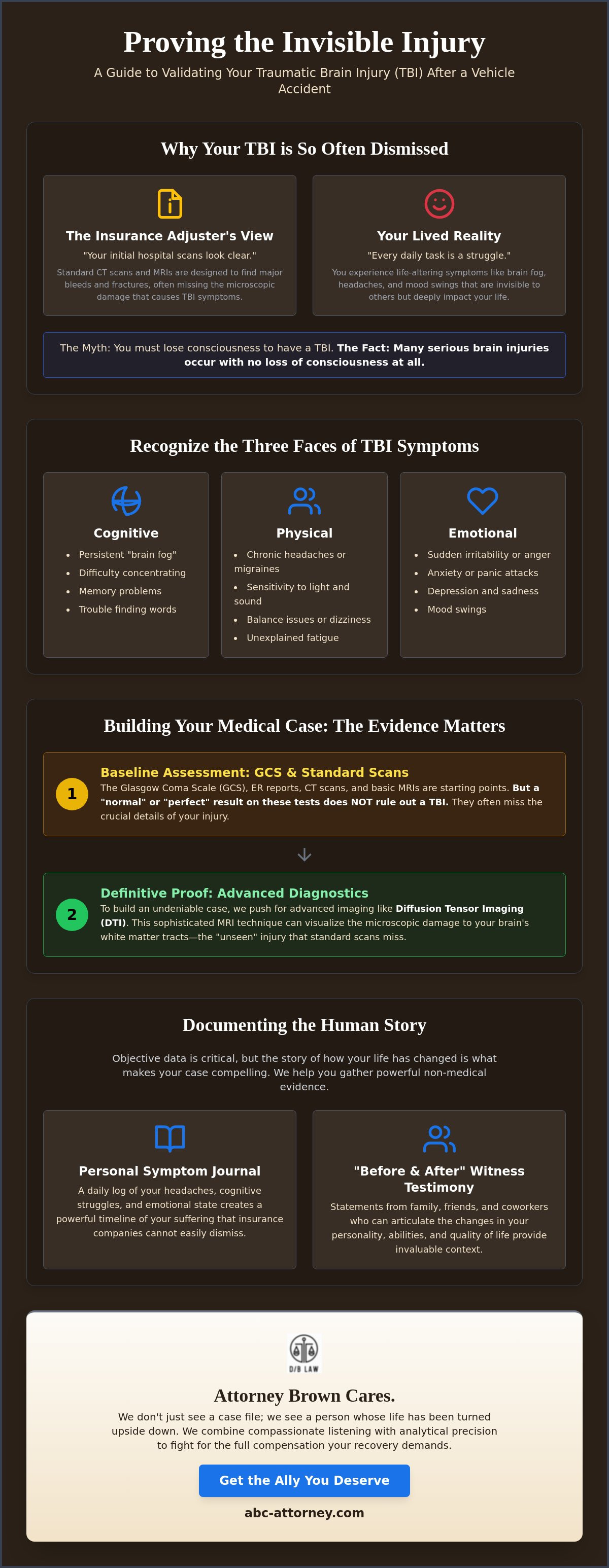
Symptoms of a brain injury often manifest in three distinct categories. Identifying these early is vital for your health and your legal claim:
Cognitive: You might experience persistent "brain fog," struggle to find the right words in conversation, or find it impossible to concentrate on simple tasks.
Physical: Chronic headaches, sudden sensitivity to light or sound, and balance issues are frequent red flags.
Emotional: Many clients report sudden irritability, anxiety, or a deep depression that wasn't there before the crash.
Why Concussions are Always Traumatic Brain Injuries
Don't let an insurance company minimize your injury by calling it "just a concussion." A concussion is the clinical term for a mild Traumatic Brain Injury (mTBI). While the label says "mild," the impact on your neurological health is significant. A single violent jolt can trigger a cascade of issues that affect your ability to work and support your family. A mild traumatic brain injury is a serious neurological event regardless of the "mild" label. When you're learning how to prove a TBI from a vehicle accident, we treat every concussion with the analytical precision it deserves to ensure your future is protected.
Building the Medical Foundation: Essential Tests and Evidence
Successful litigation requires objective data that insurance companies cannot dismiss. When determining how to prove a TBI from a vehicle accident, the evidence begins with your initial Glasgow Coma Scale (GCS) score. This 15 point scale measures your verbal, motor, and eye opening responses immediately after the crash. While a low score indicates a severe injury, a high score doesn't necessarily mean you're in the clear. Insurance adjusters often use a "perfect" GCS score of 15 to argue that no injury occurred, but we know better. According to the National Institute of Neurological Disorders and Stroke, diagnosis requires a comprehensive approach because initial symptoms can be deceptive.
Standard imaging like CT scans and basic MRIs are often the first tools doctors use. These scans are designed to find life threatening emergencies; they look for skull fractures and major brain bleeds. However, they frequently miss the microscopic axonal shearing that causes cognitive dysfunction. This is why a "normal" scan result is not the end of your story. We work with specialized medical experts who can testify that your brain's structure might look intact while its chemistry and function are deeply compromised. If you're feeling overwhelmed by the medical jargon, you can reach out to us for guidance on your next steps.
Advanced Imaging: Seeing the Unseen
To build a bulletproof case, we often push for advanced diagnostics. Diffusion Tensor Imaging (DTI) is a sophisticated MRI technique that tracks the movement of water molecules along nerve fibers. This allows us to find damaged white matter tracts that standard scans ignore. Similarly, Susceptibility Weighted Imaging (SWI) detects microscopic bleeding and iron deposits left behind by a trauma. These tests provide the visual proof necessary to show a jury exactly where the damage occurred.
The Importance of Immediate Follow-up Care
Waiting to see a neurologist can jeopardize your personal injury litigation. Insurance companies look for any "gap in treatment" to claim you aren't actually hurt. Consistent medical records create a necessary paper trail of your recovery journey and prove the persistence of your symptoms. The Dedric Brown Law Firm is committed to ensuring our clients in Houston and Dallas see the right specialists who understand the complexities of brain trauma. Because Attorney Brown Cares, we use analytical precision to ensure every medical detail is documented, leaving no room for insurance companies to minimize your pain. Understanding how to prove a TBI from a vehicle accident is about connecting these medical dots to your legal right to compensation.
Documenting the Human Story: The Power of Non-Medical Evidence
Medical data provides the foundation for your claim, but it rarely captures the full scope of your loss. A scan can show a lesion; it cannot show the frustration of a father who can no longer help his daughter with her homework. When we analyze how to prove a TBI from a vehicle accident, we look far beyond the clinical charts. We focus on the human story. This qualitative data is often what convinces a jury that your life has fundamentally changed. Because Attorney Brown Cares, we invest the time to understand the specific ways your injury has eroded your quality of life. We treat you as a person with a future, not just a case number in a stack of files.
Documenting these changes is vital for seeking damages related to "loss of consortium" or the loss of companionship and support within a family. Brain injuries don't just happen to an individual; they happen to an entire household. We work to capture the strain on your relationships and the emotional distance that often follows a neurological trauma. By presenting a complete picture of your life before and after the crash, we ensure the insurance company sees the human being behind the policy number.
How to Keep an Effective Symptom Journal
Insurance adjusters are trained to look for inconsistencies. A daily impact journal serves as a contemporaneous record that is difficult to ignore. It transforms vague complaints into a detailed map of your struggle. To make your journal an effective legal tool, follow this framework:
The Trigger: Record what you were doing when a symptom appeared. Did a bright light spark a migraine? Did a loud room cause a panic attack?
The Intensity: Use a scale of 1 to 10. Note how long the episode lasted and if it forced you to stop your daily activities.
The Cognitive Fail: Document specific lapses. Forgetting a close friend's name or getting lost on a familiar route to the grocery store provides undeniable proof of dysfunction.
The Emotional Toll: Be honest about feelings of anxiety, depression, or sudden anger. These "lows" demonstrate the psychosocial impact of the trauma.
Witness Testimony: The 'Lay' Perspective
While doctors are expert witnesses, your friends and family are "lay" witnesses. Their testimony is often the most persuasive element of a TBI case. They provide the "before and after" perspective that a medical chart lacks. We help you identify the right people to speak on your behalf, such as long-term friends, neighbors, or even former employers. These individuals can describe the personality shifts that have occurred since the crash. They can speak to the person you were before the impact. Preparing your inner circle to speak truthfully about your challenges is a key part of our strategy. We ensure their voices are heard so the court understands that while you may look the same, the person they once knew has been profoundly affected. Understanding how to prove a TBI from a vehicle accident requires this personal connection, reinforcing the fact that Attorney Brown Cares about your total recovery.
Overcoming Insurance Denials and ER Oversight
You walk out of the emergency room with a clean bill of health, yet your head won't stop pounding. Your family notices you're irritable, but the discharge papers say you're fine. This is the gap where insurance companies thrive. They use initial medical reports to suggest your symptoms are unrelated to the crash. They want you to believe that if a doctor didn't find it in the first hour, it doesn't exist. We know better. Understanding how to prove a TBI from a vehicle accident requires looking past the surface level assessments of a busy trauma center. At the Dedric Brown Law Firm, we specialize in dismantling the "normal" scan defense with aggressive advocacy and medical truth.
Insurance adjusters often accuse TBI survivors of "malingering," which is just a clinical way of saying you are faking it. They rely on the lack of a visible scar to justify a denial. We counter this by building a case rooted in analytical precision. Because Attorney Brown Cares, we don't accept the insurance company's version of your life. We conduct thorough investigations to prove your symptoms are real, persistent, and life-altering. We bridge the gap between a cold medical chart and the reality of your daily struggle.
Why ERs Miss TBIs (And How We Fix It)
Emergency rooms are designed for stabilization, not long-term neurological diagnosis. Doctors focus on life-saving measures like stopping internal bleeding or setting fractures. They often fail to ask the right questions about memory, disorientation, or sensory changes. Research indicates that 56% to 80% of TBIs are not detected during initial emergency room visits, leaving many victims without a proper diagnosis. We fix this oversight by referring you to specialists who focus on cognitive function rather than just physical survival. If you are struggling to get a straight answer from your doctors, contact our team for a case evaluation.
Fighting Back Against 'Pre-existing Condition' Claims
Adjusters love to dig through your past medical records. They will try to blame a high school football injury or a minor slip from five years ago for your current TBI symptoms. We use the "Eggshell Plaintiff" rule in Texas to protect our clients. This rule states that a negligent driver is responsible for the damages they cause, even if the victim had a pre-existing condition that made them more vulnerable to injury. We use our background in rigorous analytical disciplines to separate your old history from the new trauma. This ensures the court understands how to prove a TBI from a vehicle accident is about the specific damage caused by this specific crash. We fight to ensure your recovery is fully funded, regardless of your past medical history.
The Dedric Brown Advantage: Analytical Precision Meets Compassionate Care
Dedric Brown offers a level of insight that few other practitioners can match. As both an Attorney and a Certified Public Accountant (CPA), he approaches every case with extreme diligence and analytical precision. This dual perspective is vital when you're navigating how to prove a TBI from a vehicle accident. Insurance adjusters often try to minimize settlements by ignoring the complex data behind your recovery. At our firm, we operate as "abc-attorney" because Attorney Brown Cares about the financial and emotional safety of every client. We don't just process files; we conduct thorough investigations to secure your future.
A brain injury creates a ripple effect that touches your career, your family, and your independence. Choosing a firm with a "Cares" philosophy ensures you have a protective ally who is both a sophisticated expert and a relatable community figure. We blend high intensity litigation with the calm authority of a technical expert. This methodology allows us to project confidence in formal settings while providing a safe space for you. You deserve a champion who understands the financial risk mitigation required for a catastrophic injury.
The CPA Edge in TBI Claims
Most firms focus only on the legal theory, but we focus on the data. Our background in rigorous analytical disciplines allows us to calculate the true lifetime cost of a brain injury. We use forensic accounting to prove lost earning capacity and career trajectory shifts. For a severe TBI, annual medical costs can range from $25,000 to $75,000, and we ensure these figures are accurately represented in your claim. We don't guess. We conduct internal oversight of every medical bill and life care plan to build a sense of completeness and momentum in your case.
While our firm handles the forensic data of your case, business owners should also prioritize the security of their company's operations. You can explore Managed IT and Security Infrastructure Services to ensure your business infrastructure remains resilient and protected during your recovery.
Your Journey Toward Justice Starts Here
Your path toward justice begins with a consultation where you are actually heard. We hold negligent drivers and commercial trucking companies accountable by conducting exhaustive audits of their records. Our personality is one of extreme diligence and honesty, rooted in a competitive spirit that conducts high stakes legal battles for you. We are here to guide you from initial confusion to a successful final resolution. Your well being is our primary mission, and we are prepared from the initial consultation to the final verdict.
Secure Your Future With Expert Advocacy
Proving a brain injury requires a strategic shift from clinical data to personal validation. You now have a comprehensive roadmap for how to prove a TBI from a vehicle accident by combining advanced neurological imaging with the powerful testimony of those who know you best. Dedric Brown applies his unique background as both an Attorney and CPA to safeguard your financial future against bad-faith insurance tactics. We provide specialized, data-driven advocacy for families in Houston, Dallas, and San Antonio dealing with the fallout of catastrophic trauma. Our firm stands ready to be your protector and your guide through every stage of the legal process.
You don't have to navigate this complex recovery alone. We're committed to ensuring your voice is heard and your future is funded. Take the first step toward the justice and compensation your family deserves today. Schedule a Free Consultation with Attorney Brown, Because Attorney Brown Cares. You've already shown incredible strength in your recovery; now let us provide the legal power to finish the journey. We're here to help you move forward with confidence and peace of mind.
Frequently Asked Questions
Can I still have a TBI if my CT scan was normal?
Yes, you can have a traumatic brain injury even if your initial CT scan appears normal. CT scans are designed to identify life-threatening emergencies like skull fractures or large brain bleeds, but they often miss the microscopic damage to nerve fibers that causes cognitive dysfunction. This is why understanding how to prove a TBI from a vehicle accident requires looking beyond standard imaging to more advanced diagnostic tools.
How long do I have to file a TBI claim after a car accident in Texas?
In Texas, the statute of limitations for filing a personal injury claim is generally two years from the date of the accident. It's vital to act quickly because evidence can disappear and memories can fade over time. Because Attorney Brown Cares, we focus on immediate investigation to ensure your rights are protected and all necessary medical documentation is secured well before this legal deadline.
What if I didn't hit my head but have TBI symptoms?
Direct impact is not required to sustain a brain injury. Violent shaking or whiplash can cause the brain to strike the inside of the skull, leading to significant neurological damage. These "non-contact" injuries are common in high-speed collisions and are just as valid in a legal claim as a direct blow to the head. We use expert testimony to explain these mechanisms to the court.
How much is a traumatic brain injury case worth in Houston?
The value of a brain injury case depends on the severity of the trauma, your total medical expenses, and the impact on your future earning capacity. We don't use generic estimates; instead, we apply analytical precision to calculate the specific lifetime costs of your recovery. This includes everything from immediate hospital bills to the long-term psychosocial support your family may need to move forward.
What is the difference between a TBI and an anoxic brain injury?
A traumatic brain injury results from an external physical force, while an anoxic brain injury occurs when the brain's oxygen supply is completely cut off. While the causes differ, both can lead to permanent cognitive and physical impairments. Attorney Brown Cares about victims of both types of injuries, providing the specialized legal advocacy needed to hold negligent parties or medical providers accountable for the damage.
Do I need a lawyer if the insurance company offered a settlement for my 'concussion'?
You should always consult a lawyer before accepting a settlement for a "concussion." Insurance companies use this clinical term to minimize the injury and convince you to accept a low-ball offer before the full extent of the damage is known. A dedicated advocate ensures your how to prove a TBI from a vehicle accident strategy accounts for long-term symptoms that may not be fully apparent in the weeks following the crash.
How do medical experts prove a brain injury in court?
Medical experts use a combination of advanced imaging, neuropsychological testing, and clinical history to validate your injury for a jury. They provide the scientific bridge between the accident and your current symptoms. By explaining complex data in a way that is accessible to jurors, these experts provide the objective proof necessary to counter the insurance company's claims that you're faking your symptoms.
What are the long-term effects of a mild TBI from a vehicle accident?
Long-term effects of a mild TBI can include persistent memory lapses, chronic fatigue, and significant personality shifts. Many survivors also struggle with executive function, making it difficult to manage daily tasks or maintain steady employment. These symptoms often persist for years and require a comprehensive life care plan to ensure you have the financial resources to manage your health and support your family.



Comments