
How to Obtain a Copy of the Truck Driver’s Logbook After an Accident in 2026

Updated: Sep 15
Did you know that the digital evidence proving a truck driver’s fatigue could vanish forever in as little as six months? While you focus on recovering from a traumatic brain injury and managing mounting medical bills, the trucking company is often already working to protect its bottom line. To secure the justice you deserve, you must move quickly to obtain a copy of the truck driver’s logbook after an accident. It's a high-stakes race against time, corporate data-deletion policies, and the recent May 2026 FMCSA revocations of non-compliant ELD models.
We understand that navigating complex federal regulations feels impossible when you're already overwhelmed. The Dedric Brown Law Firm is here to act as your protective ally and technical expert. You'll learn the exact legal steps to freeze evidence, identify falsified records, and use forensic analysis to uncover hidden hours-of-service violations. We'll walk through everything from sending immediate spoliation letters to cross-referencing digital logs with fuel receipts. This guide provides the roadmap you need to prove driver fatigue, hold negligent carriers accountable, and secure fair compensation for your life-altering injuries.
Table of Contents
Why the Truck Driver’s Logbook is Critical Evidence in Your Texas Wreck
In the aftermath of a devastating collision, the truck’s logbook serves as the definitive record of driver behavior. Formally known as the Record of Duty Status (RODS), this document is a federal requirement mandated by the Federal Motor Carrier Safety Administration (FMCSA). It tracks every minute a driver spends behind the wheel, on duty, or resting. When we work to Obtain a Copy of the Truck Driver’s Logbook After an Accident, we aren't just looking for paperwork. We're looking for the truth. Attorney Brown Cares about the reality of what happened on that highway because corporate logs often hide the exhaustion that leads to tragedy. These records are the primary tool used to identify if a driver was pushed beyond their physical limits to meet a deadline.
FMCSA Hours of Service (HOS) Rules for 2026
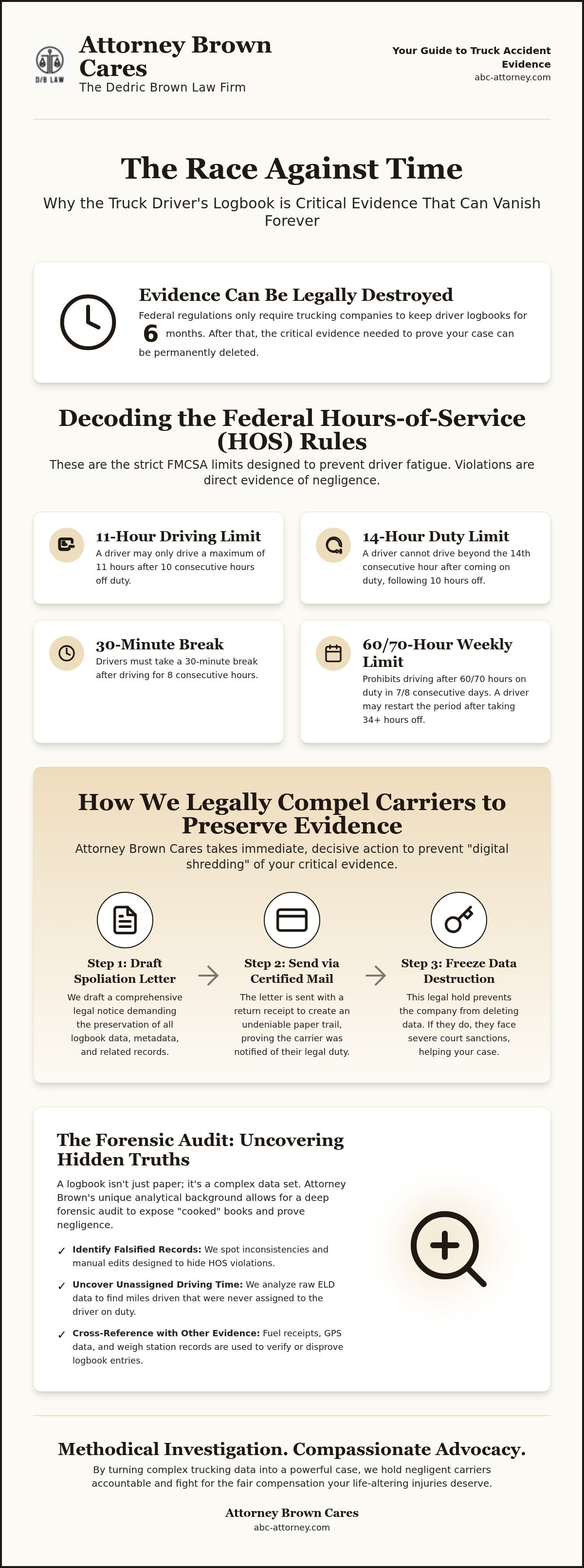
Federal law is strict for a reason. As of June 2026, the FMCSA maintains a rigorous framework of Hours of Service (HOS) regulations designed to keep exhausted drivers off the road. Under these rules, drivers are limited to 11 hours of driving after 10 consecutive hours off duty. They cannot operate a vehicle at all after being on duty for 14 consecutive hours. Additionally, a 30 minute break is mandatory after 8 hours of consecutive driving. Drivers must also adhere to the 60/70 hour limit, which prohibits driving after being on duty for 70 hours in an 8 day period. When a carrier ignores these limits, it creates "per se" evidence of negligence. This means the violation itself proves the driver or company acted recklessly. We meticulously examine these timestamps to find the exact moment a safety violation occurred.
The Connection Between Fatigue and Catastrophic Injury
Exhaustion is a silent killer on Texas roads. Research indicates that a fatigued driver has reaction times similar to someone who is legally intoxicated. On high speed corridors like I-10 or I-45, a split second delay in braking results in catastrophic jackknife or underride accidents. These wrecks don't just cause property damage. They frequently result in permanent Traumatic Brain Injuries (TBI), hypoxic brain damage, or wrongful death. An 80,000 pound vehicle operated by a tired driver is a weapon. Attorney Brown Cares about securing justice for victims who face a lifetime of medical bills and disability. By proving the driver was fatigued through their own logs, we shift the burden of proof onto the trucking company. We ensure that your journey toward recovery is backed by the methodical authority of technical evidence and compassionate legal advocacy.
How to Legally Compel a Trucking Carrier to Turn Over Records
Time is your greatest enemy after a truck wreck. Federal law, specifically FMCSA regulations, only requires motor carriers to retain driver logs for six months. Once those 180 days pass, the company can legally destroy the very evidence you need to prove your case. To Obtain a Copy of the Truck Driver’s Logbook After an Accident, you must initiate a legal freeze on their data destruction policies immediately. It's the most effective way to Obtain a Copy of the Truck Driver’s Logbook After an Accident before it's purged from the server. Attorney Brown Cares about preventing this "digital shredding" because we know that once the data is gone, your path to fair compensation for a traumatic brain injury or permanent disability becomes significantly harder.
The Power of the Spoliation Letter
The first and most vital step in our process is drafting a comprehensive Spoliation Letter. This document must be sent via certified mail with a return receipt requested to create an undeniable paper trail. It serves as a formal legal notice that compels the trucking company to preserve specific evidence, including ELD data, raw metadata, and sensor readings. We include references to research on driver fatigue to establish why these records are material to the investigation. If a carrier "loses" or overwrites data after receiving this notice, they face severe sanctions in Texas courts. These sanctions can include "adverse inference" instructions, which tell a jury to assume the missing evidence was harmful to the company’s defense.
Formal Discovery and Subpoenas in Texas Courts
Sending a letter is often just the beginning. To truly force the hand of out-of-state carriers, we file a lawsuit to trigger formal discovery powers. This allows us to issue subpoenas for third-party data that the trucking company cannot manipulate. We target GPS telematics, cell phone records, and the vehicle’s Electronic Control Module (ECM), often called the "Black Box." By cross-referencing the ECM data with the logbook, we can verify if the driver was actually resting or if the logs were falsified to hide violations. Attorney Brown Cares about the integrity of your claim. We don't just ask for the logs; we hunt for the independent data points that prove they are real. If you're worried about evidence disappearing, it's time to reach out for a professional evaluation of your case. We act as your protective ally, ensuring every byte of data is secured and every lie is exposed before the six-month clock runs out.
Finally, we take the fight directly to the company by deposing the safety manager. We grill them on their internal oversight and how they validated the driver’s hours. This aggressive, methodical approach ensures that no discrepancy goes unnoticed. We pursue the truth with the same discipline used in high-level auditing, leaving no stone unturned in the pursuit of justice for your injuries.
Electronic Logging Devices (ELD) vs. Paper Logs in 2026
The digital revolution was supposed to eliminate fatigued driving. However, the reality in 2026 is far more complex. While the FMCSA mandate requires most commercial vehicles to use Electronic Logging Devices (ELDs), the system is currently in a state of flux. On May 20, 2026, the FMCSA removed 12 ELD models from its registered list for failing to meet technical standards. This follows a February 12 revocation of nine other models. If you're trying to Obtain a Copy of the Truck Driver’s Logbook After an Accident, you need to know if the driver was using a revoked or non-compliant device. Attorney Brown Cares about these technical failures. A non-compliant device can lead to missing, corrupted, or easily manipulated data right when you need it most.
Don't let a clean-looking PDF printout fool you. Digital logs aren't tamper-proof. We frequently identify "unassigned driving time," which occurs when a truck moves without a driver being logged into the system. This is a common tactic used to hide violations of Federal Hours of Service (HOS) regulations. We also investigate "ghost logs" where drivers use multiple login IDs to bypass daily limits. Attorney Brown Cares enough to look past the surface. We conduct a deep-dive investigation into the raw data to ensure the logs reflect the driver's actual time on the road.
Decoding ELD Metadata
Metadata is the "log of the log." It's the hidden data trail that shows exactly when a record was created or modified. We don't just look at the hours; we look at the edits. If a safety manager manually changed a driver's status from "driving" to "off-duty" to keep the truck moving, the metadata will show that change. We also analyze GPS "pings" and location data. These digital breadcrumbs allow us to verify if a driver was actually resting or if they were creeping along in traffic while claiming to be in a sleeper berth. This technical scrutiny is how we protect your right to the truth.
Exceptions: When Paper Logs are Still Legal
Paper logs haven't disappeared entirely. They remain legal for trucks with engines manufactured before the year 2000 and for certain short-haul operations. These "old-school" logs are notoriously easy to falsify. We call it the "coloring book" effect. Drivers can simply draw lines to show rest when they were actually behind the wheel. To Obtain a Copy of the Truck Driver’s Logbook After an Accident involving a paper-based system, we must be even more aggressive. We verify these handwritten entries against independent data points:
Toll booth records and EZ-Pass time-stamps.
Weigh station entries and Department of Transportation (DOT) inspections.
Fuel receipts and credit card transactions.
Bill of lading timestamps from shipping and receiving docks.
If the ink on the page doesn't match the digital trail left at a toll plaza, we have proof of fraud. Attorney Brown Cares about the integrity of your case. We use this methodical, auditing-style approach to ensure no driver can hide the fatigue that caused your injuries.
The Forensic Audit: Using CPA Precision to Spot Logbook Fraud
Most legal practices treat truck logs as simple documents. They accept the PDF at face value and move on. We don't. At Attorney Brown Cares, we apply CPA-level scrutiny to every data point provided by the motor carrier. When you work with our team to Obtain a Copy of the Truck Driver’s Logbook After an Accident, we don't just read the entries; we audit them. We initiate a forensic investigation to identify "ghost logs" and digital manipulation that standard discovery processes often miss. Attorney Brown Cares about the microscopic details because even a small lie suggests a systemic pattern of corporate negligence. Our goal is to transform complex data into undeniable proof of fault.
We utilize a "Triangulation" method to verify the integrity of the Record of Duty Status. This involves cross-referencing the logbook against three or more independent data sources. If the logs are the only evidence, the trucking company can hide the truth. When we introduce financial records, satellite data, and shipping documents, the truth becomes impossible to ignore. This methodical approach ensures that no discrepancy, no matter how small, goes unnoticed during our pursuit of justice for your injuries.
Following the Money: Fuel and Toll Receipts
Financial records are unbiased witnesses that never forget. We use I-Pass or EZ-Pass data to prove exactly where a truck was located when the driver claimed to be sleeping in a berth. These time-stamped transactions provide a physical location that the driver cannot edit or delete. A single fuel receipt timestamped at 2:00 AM can invalidate an entire week of logs if the driver reported being off-duty during that time. We follow the money to find the movement. By analyzing these financial breadcrumbs, we expose the "coloring book" effect where drivers draw in rest periods that never actually occurred. This level of scrutiny makes the trucking company's defense crumble before the case even reaches a jury.
GPS and Satellite Tracking Integration
Modern fleet management software creates a permanent trail that is difficult for a carrier to erase. We compare ELD data with the truck's actual satellite breadcrumb trail to identify "speeding to make up time." If our time-distance calculations show a driver covered 210 miles in under three hours, we know they were violating safety protocols to meet a delivery window. This analytical precision is vital for victims of Traumatic Brain Injuries (TBI) and other catastrophic harms. It maximizes settlement value by proving the carrier had actual or constructive knowledge of the driver's fatigue. Attorney Brown Cares about your future, and that means using every technical tool available to hold negligent companies accountable. If you suspect the logs in your case have been "cooked" to hide the truth, contact our forensic legal team today for an investigation that leaves nothing to chance.
Small inconsistencies break cases. A 15-minute discrepancy might seem minor to a layman, but to an auditor, it's a red flag for systemic fraud. We use these "minor" errors to crack the entire defense wide open. Our aggressive advocacy ensures that your journey toward a successful conclusion is built on a foundation of rigorous, evidence-based truth.
Taking the First Step Toward Justice with Attorney Brown Cares
The aftermath of a catastrophic truck wreck is a period of profound vulnerability. You're likely struggling with the debilitating symptoms of a traumatic brain injury, managing a mountain of medical bills, and feeling overwhelmed by complex FMCSA regulations. This is not a journey you should take alone. You need a champion who balances aggressive advocacy with steady, professional reassurance. Attorney Brown Cares about the families shattered by corporate negligence. We act as your protective ally, providing the methodical authority of a technical expert while maintaining the approachable presence of a community mentor. Our firm is built on the principle that every client deserves a sophisticated expert who is willing to engage in high-stakes legal battles for the truth.
Your path to recovery begins with a comprehensive forensic case evaluation. We don't just review documents; we conduct a deep-dive audit into the carrier's safety history and digital footprint. We use this time to determine the best strategy to Obtain a Copy of the Truck Driver’s Logbook After an Accident before the data is purged. We examine the 2026 ELD revocations to see if the truck was equipped with non-compliant hardware. We investigate the "black box" data and the metadata discrepancies discussed in previous sections. Our no-fee guarantee means you don't pay any legal fees unless we successfully recover compensation for you. We assume the financial risk of litigation so you can focus on your health and your family.
Our Presence Across Texas: From Houston to Dallas
Attorney Brown Cares maintains a strong presence throughout the state, from the busy corridors of Houston and Dallas to the local courts in Beaumont, Huntsville, and San Antonio. We understand how Texas judges and juries view trucking negligence. We handle the heavy lifting of the legal process, from filing the initial spoliation letters to deposing safety managers. This allows you to focus entirely on recovering from brain trauma or other life-altering injuries. Our commitment to ethics and professional conduct is unwavering. We pursue your goals with extreme diligence, ensuring that your journey toward a successful conclusion is handled with the highest level of analytical precision.
Contact Us Today to Preserve Your Rights
The clock is ticking on the evidence needed to prove your claim. As we have discussed, federal law allows trucking companies to destroy driver logs after just 180 days. If you wait too long, the proof of driver fatigue or hours-of-service violations could be lost forever. You must move quickly to Obtain a Copy of the Truck Driver’s Logbook After an Accident. We are ready to initiate a forensic audit of the carrier's records immediately. Our process is transparent, methodical, and focused on results. Whether you are in Houston, Austin, or anywhere in between, our team is here to provide the elite representation you deserve. Reach out to Attorney Brown Cares for a free consultation today. Let us be the champion you need to secure the justice and compensation your family requires to move forward.
Secure Your Future and the Evidence Behind Your Claim
The window for justice is narrow. In 2026, trucking companies move fast to purge digital records once the 180-day federal retention limit expires. You've seen how forensic auditing and the triangulation of ELD data, fuel receipts, and GPS pings can expose the hidden fatigue that leads to catastrophic traumatic brain injuries. To successfully Obtain a Copy of the Truck Driver’s Logbook After an Accident, you need more than just a lawyer. You need a technical expert who understands the "cooked books" and digital manipulation tactics used by negligent carriers.
Attorney Brown Cares about your recovery and your rights. We combine dual Attorney and CPA credentials to provide the high-level analytical precision required for complex truck wreck litigation. We advocate aggressively for Texas families while providing the steady, empathetic support you need during this difficult time. Don't let the trucking company overwrite the truth of your crash. Take control of your case before the evidence is lost forever.
Secure your evidence today-Contact Attorney Brown Cares. We are ready to conduct the rigorous, detail-oriented investigation your case deserves. Your journey toward a successful resolution starts with a single, decisive step toward the truth.
Frequently Asked Questions
Can I get the truck driver's logbook without a lawyer?
It is technically possible to request records; however, trucking companies are under no legal obligation to provide them to a victim without a court order or subpoena. Most carriers will ignore your informal requests or claim the data was overwritten. Attorney Brown Cares about ensuring you don't get stonewalled by corporate legal departments. We use formal legal power to compel the company to produce the truth.
How long does a trucking company have to keep logbooks?
Federal FMCSA regulations only require motor carriers to retain driver logs for six months. Once this 180-day window passes, companies can legally destroy both digital and paper records. This strict deadline makes it vital to Obtain a Copy of the Truck Driver’s Logbook After an Accident immediately. We act with extreme diligence to freeze their data destruction policies before your evidence vanishes forever.
What happens if the trucking company 'loses' the ELD data?
If a carrier destroys or "loses" data after being served with a formal preservation notice, they may face severe legal sanctions. Texas courts can issue an "adverse inference" instruction to the jury, meaning the jury must assume the missing data proved the company’s negligence. We use principled combativeness to hold carriers accountable when they attempt to hide evidence of driver fatigue or safety violations.
Can GPS data be used to prove a logbook was falsified?
Yes, GPS telematics provide an independent, digital breadcrumb trail that is difficult to manipulate. We cross-reference these satellite timestamps with the driver’s reported status in their logbook. If the GPS shows the truck moving at highway speeds while the log claims the driver was in a "Sleeper Berth," we have undeniable proof of fraud. This technical precision is a cornerstone of our investigative process.
What is a 'Spoliation Letter' in a truck accident case?
A spoliation letter is a formal legal notice that demands a motor carrier preserve all evidence related to a crash. It specifically identifies ELD metadata, engine control module data, and dashcam footage that must not be deleted. This letter is the primary tool we use to Obtain a Copy of the Truck Driver’s Logbook After an Accident while ensuring the integrity of the data remains intact.
How much does it cost to have an expert analyze truck logs?
Analytical costs are handled as part of the litigation process, and you don't pay these expenses out of pocket. Attorney Brown Cares operates on a no-fee guarantee, which means we assume the financial risk of hiring forensic experts and auditors. We only recover these costs if we successfully secure compensation for your injuries. This protective approach ensures your family’s financial safety during the legal journey.
What if the truck driver was using a paper logbook instead of an ELD?
Paper logs remain legal for certain older trucks manufactured before 2000 or for specific short-haul routes. Because these are easily falsified, we apply intense scrutiny by cross-referencing them with fuel receipts, weigh station timestamps, and toll records. We look for the "coloring book" effect where a driver manually draws rest periods that don't match the physical location of the truck at that time.
Can Hours of Service violations increase my settlement amount?
Proving a driver violated federal hours-of-service limits can significantly increase the value of your claim by establishing gross negligence. When a carrier ignores these safety rules, it demonstrates a reckless disregard for public safety. We focus on these violations to secure maximum compensation for victims suffering from traumatic brain injuries or permanent disabilities. Our aggressive advocacy ensures the full extent of their negligence is exposed.



Comments