
Black Box Data in a Truck Accident Case: What It Can, and Cannot, Show

Updated: Oct 12
What if a truck’s data supports part of the crash story but can’t explain why it happened? In a black box data in a truck accident case, information from an event data recorder or engine control module may help show details such as speed, throttle, or braking before impact. But it isn’t a complete recording of the crash, and it can’t determine fault on its own.
It’s understandable to worry that important evidence may be controlled by the trucking company or disappear before anyone examines it. Some electronic data can be overwritten, so prompt, formal preservation matters. Knowing which systems may hold relevant records, and what those systems can and cannot show, is a practical first step.
This article explains how truck recorder data differs from other electronic records, why preservation should happen quickly, and how reviewers can interpret information alongside photos, witness accounts, vehicle evidence, and medical records. Attorney Brown’s legal and accounting background supports a careful, detail-focused approach, while the firm keeps the human consequences of a serious crash in view. ABC means “Attorney Brown Cares.” That commitment includes helping clients understand complex evidence with personal attention and care.
Table of Contents
What Does Black Box Data in a Truck Accident Case Mean?
A serious truck crash can leave people with conflicting accounts and urgent questions about what happened. The truck’s electronic records may help clarify parts of the sequence, but “black box” isn’t the name of one universal device or a complete record of every crash.
Black box data is information recorded by a vehicle system, not a complete account of a crash or a verdict on who was at fault. What may be available depends on the truck, its installed systems, the event, and who can access the data. A record can help test an explanation without telling the whole story.
What people mean by a truck’s “black box”
People often use “black box” to refer to an Event Data Recorder (EDR), an electronic control module (ECM), or related vehicle electronics. An EDR may capture information about a particular event. An ECM is a vehicle computer associated with engine and other system functions. In some trucks, the EDR function may be part of another module. The Event Data Recorder (EDR) overview offers general background on the device and how it differs from other recording systems.
A commercial truck may have more than one electronic system, and each can serve a different purpose. A system might record specific vehicle measurements or events, but the available fields vary. Don’t assume every truck records speed, braking, or any other particular detail. This data is also not the same as a video of the road or a recording of what people said.
Why recorded information can matter after a crash
If a record includes information tied to the time of an event, it may help evaluate competing accounts. For example, available data might be compared with a claim about when a truck slowed or whether a particular vehicle action occurred. The key questions are what this truck’s system captured and what the record can reliably show.
Electronic measurements can offer a different perspective from a person’s memory, especially after a sudden, stressful collision. That doesn’t make a witness’s account unimportant. A witness may describe what they saw, heard, or experienced, while vehicle data may offer limited information about system activity. Each source has limits, and the evidence is strongest when they are assessed together.
In a black box data in a truck accident case, a record may support a theory of fault, weaken it, or leave an important question unresolved. It can’t independently explain every driver decision, road condition, or injury. At ABC, “Attorney Brown Cares” means treating technical details with care while keeping the people affected by the crash at the center of the investigation.
Which Truck Systems Record Data, and What Might They Capture?
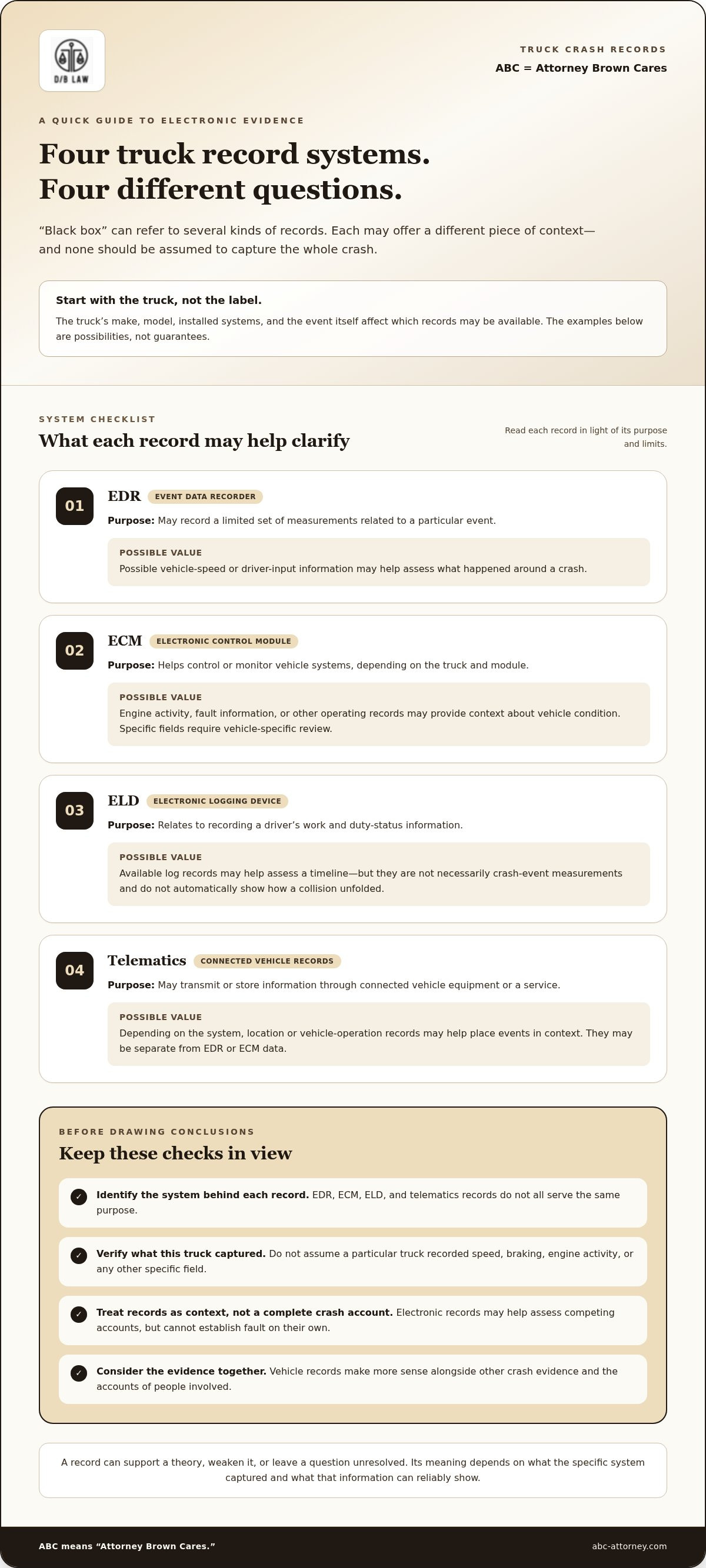
“Black box” can refer to several kinds of records, but the systems don’t all serve the same purpose. Crash-event measurements, engine-system information, electronic logs, and connected-vehicle records may each offer a different piece of the timeline. A log or fleet record is not automatically the same as data recorded about a crash event.
The truck’s make, model, installed systems, and the event itself affect which records may be available. The examples below are possibilities, not a guarantee that a particular truck has a system or recorded a specific field.
Different systems, different questions
An EDR may capture a limited set of event-related measurements. An ECM is part of the truck’s control systems and may store operational information, but its functions and records vary. Speed, braking, engine activity, and fault information are examples to verify for the specific vehicle, not details to assume.
ELDs and telematics can add useful context without duplicating crash data. An electronic log may help assess a driver’s recorded timeline; connected-vehicle information may offer another view of location or operation. While fleet managers often evaluate this type of operational tracking alongside driver training initiatives from Driving Sense to promote safer driving habits, neither system is guaranteed to exist, overlap with another system, or answer the same question. In a black box data in a truck accident case, identifying the system behind each record is essential to understanding what it can show.
Sorting out which records matter can feel overwhelming after a serious wreck. Attorney Brown’s legal and accounting background supports a careful, detail-focused review guided by ABC: “Attorney Brown Cares.” Discuss a truck wreck case with the firm.
How Much Can Black Box Data Prove About Fault in a Truck Crash?
Truck data can help investigators test different accounts of what happened, but a reading needs context before it can carry weight. A recorded speed, for example, may be compared with the timing of an impact and the physical evidence at the scene. Possible braking information may help assess whether the truck slowed before a collision. Neither detail, by itself, explains why the driver acted as they did or establishes who was legally responsible.
Recorder data can inform a liability analysis, but it does not decide fault alone. The federal standards for EDRs provide regulatory context for certain event data recorders. A specific truck’s system and available records still need to be identified and evaluated.
Questions data may help investigators examine
Depending on the system and what it captured, data may help explore questions such as:
Does available information shed light on the truck’s speed or braking before impact?
Do recorded fault codes or other system information point to a reason for further mechanical investigation?
Does the timing in electronic records align with the driver’s account, witness descriptions, or physical evidence at the crash scene?
These are investigative questions, not automatic conclusions. A record might support one account, weaken another, or leave the point unresolved. For instance, a possible braking record may prompt a closer look at when the truck slowed, but it may not reveal what the driver saw or what conditions affected the response.
Why a data point does not tell the whole story
A number is meaningful only when its source, timing, and relationship to the crash are understood. Records may be incomplete, may not cover the moment that matters, or may appear inconsistent with other evidence. Differences call for careful review, not an assumption that one account is true and another is false. The system’s capabilities and the circumstances surrounding the event can affect what the data shows.
That’s why technical records should be considered alongside crash-scene evidence, vehicle damage, reports, and testimony. Witnesses can describe what they saw and experienced; electronic records may offer a limited view of vehicle activity. Each source has strengths and limits. Together, they can help build a more grounded account of what happened and how the crash affected the people involved.
In a black box data in a truck accident case, careful analysis means examining both what the records show and what they cannot answer. Attorney Brown’s legal and accounting background supports a detail-focused approach, while ABC means “Attorney Brown Cares”: the evidence matters because people’s lives and recovery are at stake.
How Can Truck Black Box Data Be Preserved and Reviewed?
Preserving truck data takes more than asking for “the black box.” The investigation needs to identify the vehicle, the systems involved, and who controls the records. The process may include these steps:
Document the crash. Keep available photos, reports, witness information, and details about the truck and crash location. These details can help identify records that may matter.
Identify the truck. Record identifying information, such as the truck’s company or vehicle details, when available. The specific vehicle helps determine which systems and records to investigate.
Seek preservation. A lawyer may send a formal preservation request asking the responsible parties to retain relevant records and evidence. This is a legal strategy, not a guarantee that every record exists, can be accessed, or can be recovered.
Obtain relevant data. Access may depend on the system, its ownership or control, and the circumstances of the case. Different records may require different methods to locate and retrieve.
Interpret the information. Review recovered records in context, then compare them with other evidence before drawing conclusions.
Why preservation should be addressed promptly
A truck may return to service after a crash, and continued use or routine system operations may affect some electronic records. The risk of overwriting or alteration, and how long information remains available, can vary by vehicle, device, and event. There is no single retention period to assume for every kind of truck data.
Prompt legal attention can help identify relevant evidence and make a timely preservation request. The request does not itself ensure access or recovery. Ownership, system type, and the facts of the case all matter. Any preservation steps should be tailored to the records and circumstances involved.
What review and interpretation can involve
Before interpreting a record, the reviewer needs to understand which truck and system produced it, what information that system may capture, and whether the record relates to the event in question. Complex data may require qualified technical analysis, and legal teams frequently rely on litigation support specialists like trustpoint.one to assist with eDiscovery and data review. A value or timestamp without that context can be misleading.
Next, the information can be compared with crash reports, photographs, witness accounts, and evidence from the vehicles and scene. That comparison may show where sources align, where they differ, and what questions remain. In a black box data in a truck accident case, careful review helps prevent a partial electronic record from being treated as the entire story.
If a truck wreck has left you unsure whether important electronic records are being preserved, discuss evidence preservation for a truck wreck with Attorney Brown. ABC means “Attorney Brown Cares,” and that includes treating both the evidence and the people affected with care.
How a Texas Truck Accident Lawyer Can Put Black Box Data in Context
Electronic records matter because they may help explain a crash. But the people affected matter more. In a Texas truck wreck case, a lawyer can evaluate what the records say alongside the circumstances of the crash, the injuries, and your account of what happened. Applicable legal issues depend on the facts and require careful, individual review.
From vehicle data to a complete case picture
A useful review tests technical records against other evidence, not in isolation. Counsel may compare available information with photographs, vehicle damage, crash reports, witness statements, and medical records. If a record raises a technical question about how a system operated, qualified specialists may be needed to help interpret it. Their analysis can inform the investigation, but it doesn’t guarantee a particular conclusion.
In a serious collision, the investigation must also account for the human consequences. Medical evidence can help document injuries and their effects, including traumatic brain injuries. Connecting those records to the crash evidence helps clarify the full impact on a person’s life, rather than reducing the case to a set of vehicle readings.
Attorney Brown brings legal and Certified Public Accountant experience to reviewing complex information. That background supports a disciplined, detail-focused approach to evidence. It isn’t engineering expertise, and technical questions may call for qualified specialists. The goal is to understand what each piece of evidence can reliably contribute.
A careful next step after a serious Texas truck crash
Keep crash-related documents and communications organized, including available photographs, reports, medical records, and correspondence about the collision. A clear record can help counsel understand what happened, what evidence may exist, and which questions need closer attention. You don’t need to interpret technical records on your own.
ABC means “Attorney Brown Cares.” That promise is personal: Attorney Brown recognizes that behind every record is someone coping with injuries, uncertainty, and disruption. If you’re trying to understand how truck data may fit your circumstances, Talk with Attorney Brown about your truck wreck case.
Take the Next Step Toward Answers
Truck data can offer useful clues, but it isn’t a complete account of a crash or a verdict on fault. The systems involved and the information they preserve can vary, so black box data in a truck accident case should be assessed alongside crash evidence, witness accounts, and medical records.
Prompt attention to possible electronic evidence can help protect important questions from being overlooked. Just as important, a careful review connects technical details to what happened to you and how the crash affected your life.
The Dedric Brown Law Firm handles commercial truck wreck and catastrophic injury claims. Attorney Brown is both a licensed attorney and a Certified Public Accountant, bringing a disciplined perspective to complex evidence without losing sight of the person behind the case. ABC means “Attorney Brown Cares.” If you’re ready to talk through what happened, Talk with Attorney Brown about your truck accident. You don’t have to sort through every unanswered question alone.
Frequently Asked Questions
What does a black box record in a commercial truck?
A truck’s “black box” may refer to different electronic systems, so there’s no single set of information every device records. Depending on the truck and system, an event data recorder may capture limited crash-related measurements, while an engine control module may store vehicle-system information. Electronic logs and telematics serve other purposes. Any example, such as speed or braking, must be verified for the specific truck and record.
Do all commercial trucks have black boxes?
No. Commercial trucks don’t all have the same recording equipment, and the term “black box” can refer to different systems rather than one standard device. A truck may have an event data recorder, an electronic control module, an electronic logging device, telematics, or some combination, but equipment and available information vary. Identifying the truck and its systems is necessary to determine what records may exist.
Can black box data prove who caused a truck accident?
Black box data may help test accounts of a crash, but it can’t establish fault by itself. A record may support, weaken, or leave unanswered a particular explanation of events. Its timing and meaning need careful review, followed by comparison with evidence such as vehicle damage, crash-scene photographs, reports, witness accounts, and medical records. A complete liability analysis considers the full circumstances, not one electronic reading.
How long is black box data kept in a truck?
There’s no single retention period for all truck data. How long information remains available depends on the system, the vehicle, the event, and whether the truck continues operating. Electronic logging device records are different from crash-event recorder data, so one system’s retention rules shouldn’t be assumed to apply to another. If a serious crash has occurred, prompt attention can help identify which records may need preservation.
Can truck black box data be deleted or overwritten?
Some truck data may be overwritten or otherwise become unavailable, but the risk depends on the device and circumstances. A truck returning to service may affect certain records; other information may be handled differently. Don’t assume every system preserves every event indefinitely, or that a preservation request guarantees access or recovery. A lawyer can help identify potentially relevant systems and pursue appropriate preservation steps.
How is black box data obtained after a Texas truck accident?
Obtaining the data generally involves identifying the truck and its systems, seeking preservation from the parties who control them, and arranging access and review. The process depends on ownership, system type, and case circumstances. For crashes in Texas, including Houston, San Antonio, Dallas, Austin, Beaumont, Huntsville, Prairie View, or Brenham, local crash evidence matters, and legal issues require case-specific review. ABC means “Attorney Brown Cares,” with personal attention to the people behind the records.



Comments