
Signs of Medical Negligence During Childbirth: A Comprehensive Parent’s Checklist

Updated: Apr 23
You spent 40 weeks preparing for a moment of joy, but you left the delivery room with a nagging suspicion that something went wrong. Perhaps a doctor dismissed your pain during a 16 hour labor, or a nurse ignored a critical alarm on the fetal monitor. If your gut says your child’s injury wasn't just an accident, you're likely looking for the signs of medical negligence during childbirth that hospital administrators often overlook.
It's exhausting to fight through a fog of medical jargon while managing the heavy anxiety of your baby's health. We understand that feeling of being ignored by staff when you know something is off. You deserve to have your concerns validated by a team that scrutinizes medical records with the precision of a certified auditor. This guide provides a clear framework to evaluate your birth experience, covering everything from clinical errors to administrative failures. We'll show you how to identify specific red flags so you can move from confusion to a position of strength. By the end, you'll understand the exact steps to take to hold negligent parties accountable and protect your family's future.
Key Takeaways
Learn to distinguish between unavoidable medical risks and actionable malpractice by defining the professional "standard of care" required in the delivery room.
Identify critical clinical red flags and signs of medical negligence during childbirth, ranging from fetal monitoring errors to postnatal physical indicators of oxygen deprivation.
Discover how an auditor’s scrutiny can uncover "sanitized" medical records and subtle behavioral cues from hospital staff that suggest a potential cover-up.
Understand the immediate steps necessary to secure your medical records and protect your family's rights before critical evidence is lost or altered.
Gain the confidence to pursue justice with a relentless advocate who combines high-stakes litigation experience with technical financial precision.
Table of Contents Understanding Medical Negligence During Childbirth Intrapartum Checklist: Signs During Labor and Delivery Postnatal Checklist: Immediate Warning Signs in Your Newborn The Auditor’s Lens: Identifying Documentation and Behavioral Red Flags Taking Action: From Suspicion to Legal Advocacy
Understanding Medical Negligence During Childbirth
Childbirth is a high-stakes environment where every second dictates the future of a family. When a medical team fails to meet their professional obligations, the joy of a new arrival turns into a lifetime of specialized care and mounting bills. Recognizing the signs of medical negligence during childbirth is the first step toward securing the justice your child deserves. You need a legal advocate who doesn't just guess at the facts but audits the evidence with clinical precision.
The Legal Standard of Care Explained
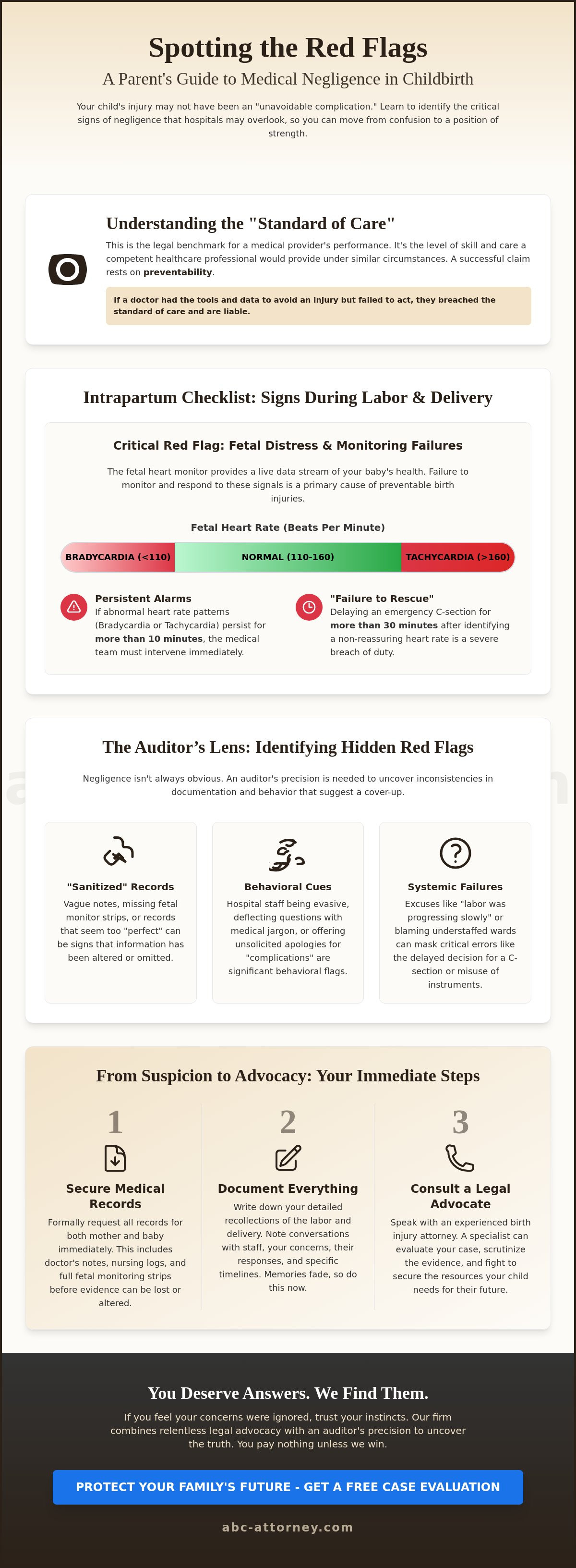
The standard of care is the foundational benchmark used to measure a medical provider's performance in all birth injury litigation. It represents the specific level of skill and care that a reasonably competent healthcare professional would provide under similar circumstances. To determine if a breach occurred, experts analyze hospital protocols and national medical guidelines from 2024. A successful claim rests on preventability; if a doctor had the tools and data to avoid an injury but failed to act, they are liable. Gaining a foundational grasp of Understanding Medical Negligence helps parents see that "accidents" are often the result of ignored red flags.
Why "Complications" Aren’t Always Accidental
Hospitals often use the word "complication" as a shield to deflect responsibility. They may tell you that a lack of oxygen or a physical trauma was an unavoidable biological risk. However, there is a sharp distinction between an inherent medical risk and a failure in hospital systems. Negligence often hides in the gaps of communication, such as a nurse failing to alert a surgeon to a plummeting fetal heart rate. Common excuses like "labor was progressing slowly" often mask the signs of medical negligence during childbirth, such as the delayed decision to perform an emergency C-section.
Systemic Failures: Understaffed labor wards lead to missed monitoring cues.
Inadequate Intervention: Misuse of vacuum extractors or forceps can cause permanent nerve damage.
Ignored Distress: Failure to respond to fetal heart rate abnormalities is a primary cause of preventable injury.
The Dedric Brown Law Firm approaches these cases with a unique level of scrutiny. Dedric Brown is not just an attorney; he is a Certified Public Accountant and Internal Auditor. He applies an auditor’s precision to medical timelines, searching for the exact moment a provider deviated from the truth. We don't just review records; we deconstruct them to find the inconsistencies that hospitals try to hide. Our firm fights relentlessly because we believe in integrity, professionalism, and winning the resources your child needs. You pay nothing unless we win your case, providing you with a nothing-to-lose path to the truth.
Intrapartum Checklist: Signs During Labor and Delivery
Labor and delivery demand a high level of clinical precision. When medical professionals fail to maintain rigorous standards, the consequences are often permanent. Our firm approaches these cases with an auditor’s scrutiny, looking for the exact moment where the standard of care collapsed. Understanding the signs of medical negligence during childbirth requires a detailed review of hospital records, fetal monitor strips, and provider response times. We fight to ensure that every oversight is identified and every error is held to account.
Fetal Distress and Monitoring Failures
The electronic fetal monitor (EFM) provides a real-time data stream of your baby’s health. Medical teams must monitor this data relentlessly. According to the Intrapartum Checklist: Signs During Labor and Delivery, specific heart rate patterns indicate a crisis. Fetal tachycardia, where the heart rate exceeds 160 beats per minute, or bradycardia, where it drops below 110, are clear clinical red flags. If these patterns persist for more than 10 minutes, the medical team must act.
A "failure to rescue" occurs when providers ignore these signals. When oxygen levels drop, the window for a safe delivery closes quickly. If a doctor delays an emergency C-section for more than 30 minutes after identifying a non-reassuring heart rate, they have likely breached their duty. These delays are often clear signs of medical negligence during childbirth. We analyze these timelines with the same precision used in a high-level financial audit to prove exactly where the system failed you.
Mismanagement of Labor Progression
Doctors often use Pitocin to induce or speed up labor, but this powerful drug requires constant vigilance. Excessive use can cause uterine tachysystole, which means contractions happen too frequently and deprive the baby of oxygen. This mismanagement can lead to uterine rupture or placental abruption. Both conditions are life-threatening emergencies that require immediate surgical intervention. A provider’s failure to recognize these risks is a failure of their professional integrity.
Another common error involves fetal macrosomia, which describes a baby weighing more than 4,000 to 4,500 grams. Doctors should identify large babies through late-term ultrasounds and physical exams. Attempting a vaginal delivery when the baby is too large for the birth canal can lead to shoulder dystocia and permanent nerve damage. If your delivery involved the aggressive use of vacuums or forceps without considering these risks, you deserve a comprehensive investigation into the facts. If you suspect your medical team missed these critical indicators, contact our experienced legal team for a detailed review of your case. We provide the aggressive advocacy and technical expertise needed to secure justice for your family.
Postnatal Checklist: Immediate Warning Signs in Your Newborn
The first 60 minutes after delivery are often called the "golden hour." For medical staff, it's a window of intense observation. For parents, it's the critical time to watch for signs of medical negligence during childbirth. If your baby requires immediate, aggressive intervention, it might indicate a failure in the standard of care. You deserve a clear, analytical look at what happened in that delivery room. We apply an auditor's precision to these moments to ensure no detail is overlooked.
Physical Trauma and Visible Injuries
Look for physical markers of a difficult delivery as soon as you're able to hold your child. Swelling on the scalp, known as caput succedaneum, often results from prolonged pressure during labor. While some swelling is common, significant bruising or deep lacerations may point to the improper use of forceps or vacuum extractors. Doctors must account for specific risk factors for birth trauma, such as fetal macrosomia or abnormal positioning, before choosing these high-risk tools. Watch for a limp arm or a missing startle reflex. These are classic symptoms of brachial plexus palsy. This condition often occurs when a baby’s shoulder becomes stuck, a situation known as shoulder dystocia, and the physician applies excessive force to the head or neck.
Fractures: Check for restricted movement in the arms or collarbone area.
Lacerations: Note any cuts on the scalp or face that require stitching or specialized care.
Asymmetry: Observe if one side of the face or body moves differently than the other.
Neurological and Respiratory Red Flags
Neurological injuries are often less visible than physical trauma but far more devastating. You should monitor your child’s behavior closely during the first 48 hours in the hospital. Seizures, extreme lethargy, or a distinctive high-pitched cry are not normal newborn behaviors. These can be indicators of Hypoxic-Ischemic Encephalopathy (HIE) or other brain injuries caused by oxygen deprivation. If the medical team rushes your baby to the NICU for "cooling therapy," they're treating potential brain damage. This neonatal therapeutic hypothermia is a standard response to suspected signs of medical negligence during childbirth related to oxygen loss.
Pay close attention to Apgar scores. A score below 7 at the 5-minute or 10-minute mark serves as a critical red flag. These numbers provide an objective audit of your baby's transition to life. Low scores combined with a need for immediate resuscitation demand a thorough investigation. Our firm searches for the truth by combining legal expertise, a proven track record, and technical scrutiny. We don't just look at the charts; we analyze the timeline of events to find where the system failed your family. If your baby's start in life was marked by these interventions, your rights to answers and justice remain unwavering.
The Auditor’s Lens: Identifying Documentation and Behavioral Red Flags
Hospitals operate as massive corporate entities with sophisticated risk management teams. When a birth injury occurs, these teams often move into a defensive posture to minimize liability. Dedric Brown approaches these cases with a unique advantage. As a Certified Public Accountant (CPA) and Certified Internal Auditor (CIA), he applies forensic scrutiny to every page of your medical file. We don't just read the records; we audit them to find the "sanitized" versions of events that hospitals use to hide mistakes. Identifying these discrepancies is a core part of recognizing the signs of medical negligence during childbirth.
Inconsistencies in Medical Records
Electronic Health Records (EHR) leave a digital footprint that is difficult to erase. We look for "late entries" added 24 or 48 hours after the delivery. If a physician adds a note about a mother’s "uncooperative behavior" two days after a baby suffered a brain injury, it’s often a calculated attempt to shift blame. We also scrutinize fetal monitor strips for gaps. A 10-minute gap in monitoring during active labor isn't just a technical glitch; it's a failure to observe the patient. We reconcile these strips against nursing logs to find where the stories diverge. When the nurse’s notes describe a crisis but the doctor’s summary claims everything was routine, we know we've found a critical failure in the standard of care.
Staff Communication and Transparency Issues
Behavioral cues from hospital staff often provide the first warning that something went wrong. Parents should watch for evasive answers or a sudden change in the narrative. If your doctor initially blamed a slow heart rate but later claims the issue was an unavoidable genetic condition, they may be covering their tracks. We often see a "rush to discharge" when a hospital wants to move a high-risk situation off their floor. If you are being pushed out the door within 24 hours despite your baby showing signs of distress or jaundice, the hospital might be prioritizing their bed turnover and liability over your safety. These shifts in transparency are common signs of medical negligence during childbirth that require immediate legal investigation.
An internal audit of the hospital’s timeline is essential to winning your case. We use our financial and legal expertise to ensure no detail is overlooked. If you suspect your medical records have been altered or your concerns were ignored, you need an advocate who knows how to follow the data trail.
Contact the Dedric Brown Law Firm today for a forensic review of your birth injury case.
Forensic Review: We analyze metadata to see when notes were actually authored.
Conflict Resolution: We identify where nursing accounts contradict the attending OB-GYN.
Timeline Reconstruction: We build an independent minute-by-minute account of the delivery.
Our firm provides the aggressive advocacy and professional reassurance you need during this crisis. We fight relentlessly because we have the analytical tools to prove exactly what happened in that delivery room. You pay nothing unless we win your case, ensuring you have a high-level expert on your side with zero financial risk.
Taking Action: From Suspicion to Legal Advocacy
Recognizing the signs of medical negligence during childbirth is the first step toward justice. However, your suspicion must be backed by aggressive action. Hospitals and insurance companies have teams of lawyers ready to protect their interests. You need a champion who combines the competitive drive of a basketball coach with the meticulous precision of a forensic auditor. This is the "Swish" approach: we fight with integrity, we play to win, and we never back down from a complex data trail.
The Path to Accountability
Step 1: Document every detail. Write down every conversation with doctors and nurses. Note the specific times symptoms appeared. Detailed personal notes are often the most reliable evidence when hospital staff memories begin to fade.
Step 2: Secure your records immediately. Request a complete copy of both maternal and neonatal records. Do not wait for the hospital to offer them. This prevents documents from being "lost" or altered during internal reviews. You have a legal right to these files under federal law.
Step 3: Consult a firm that understands the data. You need a team that analyzes the intersection of medical charts and legal strategy. We scrutinize the records to find the exact moment the standard of care was breached.
Proving birth negligence requires more than just a lawyer’s argument. It demands expert medical witnesses who can testify about what a competent doctor should have done in the delivery room. We leverage our network of medical experts to build a case that stands up to intense scrutiny. Because we operate on a contingency-fee model, you pay nothing unless we win your case. You have nothing to lose by fighting for your child's future and everything to gain by seeking the truth.
Why Your Lawyer Needs a CPA Background
A birth injury like a Traumatic Brain Injury (TBI) creates a lifetime of expenses. Calculating these costs requires more than a guess; it requires financial precision. As a Certified Public Accountant (CPA) and Internal Auditor, Dedric Brown brings an "auditor’s mind" to the courtroom. We don't just ask for a settlement. We audit the life-care plan to ensure every therapy session, medical device, and specialized care need is covered for the next 50 years.
This level of scrutiny is vital when you are identifying the signs of medical negligence during childbirth and facing massive hospital systems. We look at the data, find the discrepancies, and hold the negligent parties accountable. You deserve a lawyer who treats your case with the same diligence an auditor applies to a complex ledger. Victory is found in the details. Contact The Dedric Brown Law Firm for a free, comprehensive case audit.
Protect Your Child’s Future Through Rigorous Advocacy
Your focus belongs on your baby’s recovery and your family’s well-being. Identifying the signs of medical negligence during childbirth is a heavy burden for any parent, but you don't have to carry it alone. Recognizing red flags like delayed emergency C-sections or unexplained neonatal seizures is the first step toward holding negligent providers accountable. We use a methodical, auditor’s lens to scrutinize every medical record and fetal heart rate strip for the precise inconsistencies that hospital legal teams try to hide.
Dedric Brown provides a level of technical scrutiny that most personal injury firms simply can't match. As both a licensed Attorney and a Certified Public Accountant (CPA), he applies professional precision to high-stakes cases involving Traumatic Brain Injuries and Neonatal Negligence. We've built our reputation on fighting relentlessly for families while providing steady, professional reassurance. Our firm operates on a zero-fee guarantee, which means you pay nothing unless we win your case. It’s time to transform your suspicions into a clear, evidence-based path toward justice.
You’ve fought for your child since the very beginning, and now it’s our turn to fight for you. We’re ready to help you secure the resources your baby needs to thrive.
Frequently Asked Questions
Is a birth injury always the result of medical negligence?
No, a birth injury isn't always caused by a provider's mistake. Some complications arise naturally during labor despite the best efforts of the medical team. However, negligence occurs when a doctor or nurse deviates from the established medical standard of care, causing preventable harm to the infant or mother.
We look for specific failures, such as a 10 minute delay in performing an emergency C-section when the baby is in distress. If the provider's actions fall below what a reasonable professional would do in the same situation, it constitutes negligence.
How long do I have to file a birth injury lawsuit in 2026?
The statute of limitations varies by state, but many jurisdictions require you to file within 2 years of the injury or the date the injury was discovered. In 2026, parents in states like Georgia must act before the child's 2nd birthday for the parents' claims, while the child's own claims may have a longer window until they reach adulthood.
Waiting too long can result in a permanent loss of your right to seek justice. Our firm treats these deadlines with the same precision as a financial audit to ensure your case stays on track and your rights are protected.
What is a "cooling cap" and why was it used on my baby?
A cooling cap is a specialized device used for therapeutic hypothermia to treat newborns suffering from oxygen deprivation. The cap lowers the baby's brain temperature to approximately 33.5 degrees Celsius for a period of 72 hours. This process slows the metabolic rate and helps prevent secondary brain cell death after a traumatic birth event.
If your baby required this treatment, it's a strong indicator that they suffered from Hypoxic-Ischemic Encephalopathy (HIE) during delivery. We investigate whether this oxygen loss was a result of preventable medical errors during the labor process.
Can I sue for medical malpractice if my baby’s Apgar score was low?
A low Apgar score, specifically a score below 7 at the five minute mark, is often one of the first signs of medical negligence during childbirth. While a low score alone doesn't prove malpractice, it serves as a critical piece of evidence. It indicates the baby struggled during the transition to life outside the womb.
Our team scrutinizes the fetal heart rate monitor strips from the hours preceding the low score. We look for patterns of distress that the medical staff ignored, which directly led to the low Apgar results and subsequent health complications.
What if the doctor says the birth injury was "unavoidable"?
Don't take the doctor's word as the final truth. Hospital staff often use the term "unavoidable" as a shield to deflect responsibility and avoid litigation. We apply an auditor's level of scrutiny to every page of your medical records to find the truth behind the delivery room events.
Our firm fights to uncover whether 100% of safety protocols were followed. If a provider missed a single warning sign, that injury wasn't unavoidable; it was a failure of professional duty that changed your child's life forever.
How much does it cost to hire a birth injury lawyer?
You pay nothing out of pocket to hire our firm because we work on a contingency fee basis. This means we take on all the financial risk of the litigation. We only collect a fee if we successfully secure a settlement or a jury verdict for your family.
According to industry standards, most firms receive a percentage of the final recovery, typically between 33% and 40%. This structure ensures you have access to high level legal advocacy and expert witnesses without any upfront financial burden during a difficult time.
What kind of compensation can be recovered in a medical negligence case?
Compensation in a birth injury case covers both immediate and lifelong needs. You can recover economic damages for 24 hour nursing care, physical therapy, and specialized equipment like wheelchairs or communication devices. These costs often reach millions of dollars over a child's lifetime according to life care planners.
You can also seek non-economic damages for pain and suffering or loss of quality of life. We use a methodical approach to calculate the full financial impact of the injury on your family's future security.
Managing the long-term financial strain of a birth injury often requires a multi-faceted approach; for assistance with the resulting debt or related family legal matters, the Law Offices of Matthew T. Desrochers, P.C. provides expert guidance to help secure your household's stability.
What are the signs of a brain injury that might not appear until months later?
Delayed signs of medical negligence during childbirth often manifest as missed developmental milestones. For example, a child who can't sit up by 9 months or crawl by 12 months may have an undiagnosed brain injury. These delays are frequently linked to oxygen deprivation or physical trauma during delivery.
Other signs include abnormal muscle tone, such as being too stiff or too floppy, or a persistent preference for using one side of the body. We help parents connect these physical symptoms to the specific events that occurred in the delivery room.



Comments