
Hypoxic Ischemic Encephalopathy (HIE): A Comprehensive Guide for Families

Updated: Apr 24
Imagine the heavy silence in a delivery room when you expected a first cry. On July 14, 2023, a family in our community sat in a neonatal intensive care unit, paralyzed by the words hypoxic ischemic encephalopathy. It's a diagnosis that changes everything in a heartbeat, leaving you with more questions than answers. You're likely feeling that same weight of uncertainty right now. You're drowning in medical jargon while worrying about how you'll afford a lifetime of specialized care.
You're not alone in wondering if a preventable medical error caused this outcome. We believe in fighting for the truth with the precision of an auditor and the heart of a community advocate. This guide provides a clear roadmap to help you understand the medical causes of HIE, the long-term impacts on your child, and the legal rights that secure your family's future. We'll examine the facts, explore financial support options, and show you how to demand accountability for the mistakes that changed your life.
Key Takeaways
Understand the critical mechanics of hypoxic ischemic encephalopathy and how specific failures in oxygen and blood flow cause immediate brain dysfunction.
Identify the preventable medical errors and obstetrical complications that often signal a breach in the standard of care during delivery.
Learn how neonatal therapeutic hypothermia works to slow brain cell death and mitigate the long-term impacts of a birth injury.
Discover the "CPA Advantage" in auditing medical records to calculate the comprehensive lifetime costs required for your child's support.
Master the path to legal advocacy through principled combativeness to hold hospitals accountable and secure the justice your family deserves.
Table of Contents What is Hypoxic Ischemic Encephalopathy (HIE)? Common Causes of HIE: When Medical Negligence Plays a Role The Role of Neonatal Therapeutic Hypothermia (Brain Cooling) Calculating the Lifetime Costs of an HIE Diagnosis Taking Legal Action: Your Rights and the Path to Advocacy
What is Hypoxic Ischemic Encephalopathy (HIE)?
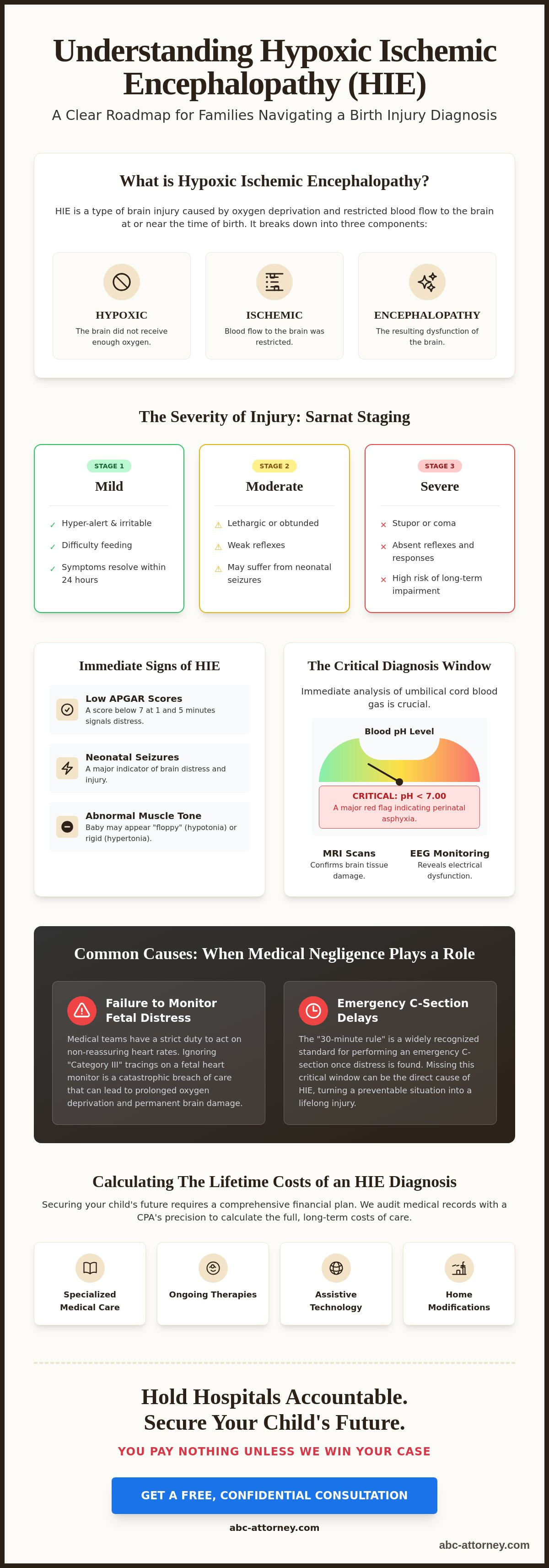
Hypoxic Ischemic Encephalopathy (HIE) is a serious medical condition. It's a specific type of brain injury caused by oxygen deprivation and limited blood flow. Hypoxia means the brain didn't get enough oxygen; ischemia means the blood flow was restricted. Together, these two factors cause Neonatal encephalopathy, which is the clinical term for the resulting brain dysfunction. When your child is diagnosed with hypoxic ischemic encephalopathy, the future feels uncertain and frightening.
Doctors use the Sarnat staging system to categorize the severity of the injury. This system breaks the condition down into three distinct levels:
Mild (Stage 1): The baby may be hyper-alert, irritable, or have difficulty feeding, but symptoms usually resolve within 24 hours.
Moderate (Stage 2): The infant is often lethargic, displays weak reflexes, and may suffer from neonatal seizures.
Severe (Stage 3): This stage involves a stupor or coma, absent reflexes, and significant risk of long-term impairment.
Hearing this diagnosis in the NICU is a moment of pure crisis. You feel a mix of fear, confusion, and anger. We understand that emotional weight. Our firm provides the steady, professional reassurance you need while we fight for the justice your child deserves. We bring expertise, a proven track record, and an unwavering commitment to every family we represent. You Pay Nothing Unless I Win Your Case.
The Immediate Signs and Symptoms of HIE
Timing is everything in a delivery room. Medical teams look for low Apgar scores at the one and five-minute marks to assess a newborn's health. A score below 7 often signals that the baby is struggling. Neonatal seizures are another major indicator of brain distress. You might also notice abnormal muscle tone; some babies appear "floppy" due to low muscle tone, while others exhibit extreme rigidity. Breathing difficulties and impaired organ function in the heart or kidneys serve as secondary indicators that the brain was deprived of vital resources during labor.
The Critical Window for Diagnosis
Precision in diagnosis requires immediate action and scrutiny. To confirm HIE, doctors must analyze umbilical cord blood gas for pH levels. A pH level below 7.00 is a critical red flag for medical professionals. MRI scans and EEG monitoring then confirm the extent of brain tissue damage and electrical dysfunction. Perinatal asphyxia is the primary precursor to HIE. We search through these medical records relentlessly to find the truth about what happened during your delivery. Our auditor's eye for detail ensures that no chart, log, or lab result is overlooked.
Common Causes of HIE: When Medical Negligence Plays a Role
While some birth injuries are truly unavoidable, many cases of hypoxic ischemic encephalopathy stem directly from preventable medical errors. Doctors often label these tragic events as "unforeseeable complications" to shield themselves from liability. We don't accept those excuses. Our firm approaches every case with the precision of a professional auditor and the tenacity of a seasoned trial lawyer. We search for the truth hidden within the medical charts, identifying the exact moment the standard of care collapsed.
Most HIE cases aren't the result of a single, mysterious event. They're the product of a medical team’s failure to respond to known risks. We look for evidence of missed warnings, ignored protocols, and delayed decisions. Our goal is to provide you with clarity, expertise, and a proven path toward justice.
Failure to Monitor Fetal Distress
Fetal heart rate monitoring is a critical safety protocol, not a suggestion. Medical teams have a strict duty to recognize and act on non-reassuring heart rates. We pay close attention to "Category III" tracings, which signal that a baby is in immediate danger. When a nurse or doctor ignores these signals, they're gambling with a child's future. A delay in recognizing distress often leads to prolonged oxygen deprivation. This negligence is a primary driver of permanent brain damage during the labor process. We relentlessly scrutinize these monitoring strips to prove exactly when the medical team should've intervened.
C-Section Delays and Birth Trauma
In a delivery room, timing determines a child's quality of life. The "30-minute rule" is a widely recognized standard for performing an emergency C-section once distress is detected. If a doctor misses this window, the consequences are often catastrophic. Many cases of Hypoxic Ischemic Encephalopathy (HIE) occur because of a failure to act during time-sensitive emergencies such as:
Umbilical Cord Issues: Prolapse or nuchal cords that cut off blood flow.
Placental Abruption: The placenta detaches prematurely, starving the baby of oxygen.
Uterine Rupture: A life-threatening tear that requires immediate surgical intervention.
These aren't just "accidents." They're medical emergencies that require decisive action. When a hospital fails to provide a timely C-section or misses the signs of a ruptured uterus, they must be held accountable. If you suspect your child's injury was the result of a delayed response, you should consult with a legal advocate who understands how to navigate complex medical data. We're here to fight for the answers and the victory your family deserves.
The Role of Neonatal Therapeutic Hypothermia (Brain Cooling)
When a newborn suffers from Hypoxic Ischemic Encephalopathy (HIE), every second counts. Neonatal therapeutic hypothermia, commonly known as brain cooling, stands as the only proven medical intervention to stop the progression of permanent brain damage. This treatment is the standard of care for infants diagnosed with moderate to severe HIE. Our firm approaches these cases with the same scrutiny an auditor applies to a complex financial ledger. We look for precision, adherence to protocol, and the exact timing of medical decisions to ensure your child’s rights were protected.
How Therapeutic Hypothermia Works
The primary goal of brain cooling is to arrest the secondary phase of brain cell death. This phase occurs hours after the initial oxygen deprivation as toxic substances accumulate and cause further injury. Doctors use a specialized cooling blanket or cap to lower the infant's core body temperature to exactly 33.5°C. This state is maintained for a strictly controlled 72-hour period. After this duration, the medical team begins a careful rewarming process, increasing the temperature by only 0.5°C every hour. This methodical approach significantly improves long-term neurodevelopmental outcomes. It isn't a cure, but it offers a fighting chance at a higher quality of life.
Eligibility and Hospital Protocol
Hospitals must follow rigid protocols to determine if a child qualifies for this life-altering therapy. Eligibility typically requires a gestational age of at least 35 weeks and clinical evidence of hypoxic ischemic encephalopathy, such as a blood pH level below 7.0 or an umbilical cord blood gas showing a base deficit of 16 mmol/L or more. Most importantly, the treatment must begin within a strict 6-hour window from the moment of birth. Timing is the most critical variable in this equation.
If a facility lacks the equipment or expertise to perform cooling, they have a professional duty to transfer the infant immediately to a Level III or IV Neonatal Intensive Care Unit (NICU). A failure to offer this treatment or a delay in transferring a qualified candidate can constitute medical malpractice. We relentlessly investigate these timelines to ensure families receive justice. Parents should ask three critical questions to understand the care their child received:
Was my child a candidate for therapeutic hypothermia based on their pH levels?
Did the cooling process begin within the required 6-hour window?
If this hospital couldn't provide cooling, why wasn't an immediate transfer initiated?
Our firm fights to uncover the truth behind these medical decisions. We combine legal expertise, a proven track record of success, and a commitment to personalized service to hold negligent providers accountable. You pay nothing unless I win your case.
Calculating the Lifetime Costs of an HIE Diagnosis
A diagnosis of hypoxic ischemic encephalopathy changes everything for a family. It isn't just a medical crisis; it's a financial one that spans decades. At the Dedric Brown Law Firm, we bring the "CPA Advantage" to your case. Dedric Brown uses his background as a Certified Public Accountant and Certified Internal Auditor to scrutinize every hospital bill, therapy invoice, and future projection. We don't just ask for a settlement. We audit the true impact of the injury to ensure your child's future is fully funded. We provide the expertise, technical precision, and aggressive advocacy required to win.
HIE often leads to Cerebral Palsy, a condition requiring a lifetime of specialized support. We frame your financial recovery as a Path to Victory. This isn't just about a check. It's about providing a life of dignity, comfort, and opportunity. This journey requires a comprehensive Life Care Plan. This document acts as a roadmap, projecting every medical need from infancy through adulthood. We fight relentlessly to secure the resources your child deserves.
Medical and Therapeutic Requirements
Ongoing care is the foundation of progress. Your child may require physical therapy to improve mobility, occupational therapy for daily living skills, and speech-language pathology for communication. These costs accumulate quickly. According to the Centers for Disease Control and Prevention (CDC), the lifetime cost for a person with Cerebral Palsy can exceed $1.5 million when adjusted for current inflation. This total includes:
Specialized equipment like power wheelchairs, standing frames, and adaptive communication devices.
Home modifications such as ramps, widened doorways, and accessible bathrooms.
24/7 skilled nursing care or specialized educational support tailored to your child's needs.
Economic Damages and Forensic Accounting
We look beyond the medical bills. We calculate lost earning capacity for children who may never enter the workforce. We also account for the heavy toll on parents. Many parents must reduce their hours or leave their careers entirely to provide full-time care. Our forensic accounting approach ensures we capture these hidden losses caused by hypoxic ischemic encephalopathy. We use precision, discipline, and unwavering attention to detail to secure a maximum settlement. We audit the records, find the gaps, and hold the negligent parties accountable for every dollar your family loses.
If your child was diagnosed with HIE, you need an advocate who understands both the law and the ledger.
Taking Legal Action: Your Rights and the Path to Advocacy
Hospitals and insurance companies employ aggressive defense teams to protect their bottom line. We counter this with principled combativeness. Our approach isn't just about legal theory; it's about technical precision. As a Certified Public Accountant (CPA), Certified Internal Auditor (CIA), and Information Systems Auditor (CISA), I bring a level of scrutiny to medical records that others often miss. We don't just read the charts. We audit them to find the hidden errors that led to hypoxic ischemic encephalopathy. This rigorous analysis transforms a complicated medical tragedy into a clear case for justice.
Families facing the aftermath of a birth injury shouldn't worry about legal costs. We operate on a strict contingency fee basis. You pay nothing unless we win your case. This "nothing-to-lose" structure ensures you have a protective ally who is fully invested in your victory. We fight relentlessly to secure the resources your child needs for lifelong care, including specialized therapies and medical equipment. Our firm stands as a formidable barrier between your family and the insurance companies that try to minimize your suffering.
The Legal Process for Birth Injury Claims
Step 1: Consultation and Review. We begin with a comprehensive review of your medical records. Our team of legal and medical experts identifies exactly where the standard of care failed.
Step 2: Filing and Discovery. We file the lawsuit and enter the "discovery" phase. This involves searching through hospital logs, digital audit trails, and internal communications to gather evidence.
Step 3: Expert Testimony. We utilize elite expert witnesses to prove the breach in care. These professionals explain to a jury how the hospital's negligence caused the injury.
Understanding the Statute of Limitations
Time is a critical factor in hypoxic ischemic encephalopathy cases. Legal deadlines vary by state, and missing a date can permanently end your right to seek justice. While a parent's claim for medical expenses might have a 2-year window, a child's claim often has a different "clock" that may extend further. However, waiting is a dangerous risk. Evidence like fetal monitor strips can be lost, and witnesses' memories fade over time.
Early action is the best way to preserve the integrity of your case. Taking immediate steps allows us to secure the data needed to build a winning strategy. We encourage parents to act now to ensure our firm can relentlessly fight for your child's rights. We provide the expertise, the proven track record of success, and the commitment to personalized service that your family needs during this difficult journey.
Protect Your Family and Secure the Justice Your Child Deserves
A diagnosis of hypoxic ischemic encephalopathy changes a family's trajectory in an instant. You've seen how critical interventions like neonatal therapeutic hypothermia must occur within the first 6 hours of life to be effective. You also recognize that many of these injuries stem from preventable medical errors during labor and delivery. Calculating the true lifetime cost of care requires the precision of a financial expert and the tenacity of a seasoned trial lawyer. Dedric Brown brings a unique, multifaceted advantage to your corner. As a licensed CPA and Auditor with specific expertise in complex birth injury litigation, he uncovers the financial and medical truths that others often miss. We fight relentlessly for the maximum recovery your child deserves to ensure they're covered for life. Our firm operates on a strict contingency fee basis. This means you pay nothing unless we win your case. You've faced enough uncertainty; let us provide the steady, professional advocacy your family needs to move forward with confidence. Get a Free Case Review with our CPA-Attorney Team today. You don't have to walk this path alone, and we're ready to start the fight for your child's future.
Frequently Asked Questions
Is HIE always caused by medical malpractice?
HIE isn't always the result of a medical error, but preventable mistakes play a role in many of these tragedies. Research from the American Journal of Obstetrics and Gynecology indicates that clinicians can prevent approximately 40% of neonatal encephalopathy cases through better care. Our firm applies an auditor's scrutiny to your medical records to find where standards failed. We fight to hold negligent providers accountable for their oversight and lack of professionalism.
Can a baby fully recover from HIE?
Recovery depends on the severity of the brain injury and the speed of medical interventions like therapeutic cooling. While mild cases may see a full recovery, the Vermont Oxford Network reports that 15% to 25% of infants with moderate hypoxic ischemic encephalopathy face significant long term disabilities. Early intervention is critical for the best outcome. We advocate for families to ensure they have the financial resources to afford decades of specialized care.
What is the life expectancy of a baby with HIE?
Many children with this condition live into adulthood, though life expectancy depends on the specific complications involved. A study published in JAMA Pediatrics tracked survivors and found that 80% of children with neonatal encephalopathy reached age 18. Our legal team focuses on the long term financial precision required to fund a lifetime of medical support. We relentlessly pursue a victory that covers every year of your child's future needs.
How do I know if my doctor made a mistake during delivery?
You can identify potential mistakes by reviewing fetal heart rate monitor strips for signs of distress that the medical staff ignored. A 30 minute delay in performing an emergency C-section is a common indicator of negligence in birth injury cases. We use our background as internal auditors to examine every second of your delivery logs. We search for the exact moment the medical team failed your family and ignored their training.
What is the difference between HIE and Cerebral Palsy?
Hypoxic ischemic encephalopathy is a brain injury caused by oxygen deprivation, while Cerebral Palsy is a permanent movement disorder that often results from that injury. This mechanism of oxygen deprivation is also the primary cause of injury in submersion accidents; for families dealing with those specific tragedies, drowningaccidentlawfirm.com provides dedicated legal representation. The CDC reports that Cerebral Palsy affects 1 in 345 children, and HIE remains a primary cause of these diagnoses. Understanding this distinction is vital for your legal strategy. We provide the expertise, a proven track record, and the commitment to link these medical complexities in court.
How much does it cost to hire an HIE birth injury lawyer?
You pay nothing unless we win your case and recover compensation for your family. This nothing to lose approach ensures every family has access to an elite advocate regardless of their current financial situation. We cover all upfront costs of the investigation, medical experts, and litigation. Our commitment to integrity means we take on the financial risk so you can focus on your child's health and recovery.
What kind of compensation can be recovered in an HIE lawsuit?
You can recover compensation for medical expenses, specialized therapy, and the lifelong cost of home care. Data from the 2023 Genworth Cost of Care Survey shows that professional home health services can cost families over $150,000 every year. We also fight for non economic damages like pain, suffering, and loss of quality of life. Our firm uses a methodical, auditor's approach to calculate every cent your child will need for a secure future.



Comments