
Seeking a Second Opinion on a Birth Injury Case: Why Your Instincts Matter

What if the first law firm to review your claim was simply wrong? You feel it in your gut that something went sideways in that delivery room, but you're being told there is no case. It's exhausting to feel dismissed by the medical establishment and then rejected by the very people meant to protect you. If your child is struggling with Cerebral Palsy or a Traumatic Brain Injury, you aren't just looking for a payout. You're looking for a way to fund a lifetime of specialized care. Seeking a second opinion on a birth injury case isn't about being difficult; it's about ensuring your child's future isn't sacrificed because of a surface-level review.
We understand the anxiety of mounting bills and complex jargon. You deserve a protective ally who combines aggressive advocacy with CPA-level scrutiny. Attorney Brown Cares (ABC) doesn't just skim the charts. We conduct a forensic audit of the facts to uncover the truth. You'll learn why your instincts matter and how a specialized legal review provides a clear path forward. We'll show you how we look past the $250,000 Texas non-economic damage cap to build comprehensive Life Care Plans that secure your child’s financial safety.
Key Takeaways
Learn how the Attorney Brown Cares (ABC) approach transforms your parental intuition into a forensic investigation that the medical establishment may have ignored.
Understand the vital distinction between a medical diagnosis and a legal forensic audit to determine if your child’s condition was preventable.
Identify hospital "red flags," such as missing electronic medical records or vague terminology, that signal it is time to seek a second opinion on a birth injury case.
Navigate complex Texas legal hurdles, including the strict 10-year statute of repose and the specific deadlines for filing on behalf of an injured minor.
Discover how CPA-level analytical rigor can help maximize economic damages to fund a lifetime of care for children living with Cerebral Palsy or TBIs.
Table of Contents
Why Your Gut Feeling About a Birth Injury Diagnosis Deserves a Second Look
Your intuition is a powerful tool. When a doctor tells you that your child's condition was "unavoidable" or "genetic," yet your pregnancy was healthy until the moment of labor, that disconnect matters. You are the primary advocate for your child’s health. If you feel dismissed by the medical establishment, you aren't alone. Many families find themselves seeking a second opinion on a birth injury case after being told there is nothing more to be done. Your gut feeling is often the first indicator that the medical records don't match the reality of what happened in the delivery room.
At Attorney Brown Cares, we believe empathy is the catalyst for deeper investigation. The "ABC" approach isn't just about being kind; it's about using that compassion to fuel a relentless search for the truth. While hospitals often hide behind vague terminology to mask preventable medical errors, we use CPA-level precision to look for the gaps in their story. We don't just accept the hospital's version of events. We verify every chart, we audit every timestamp, and we scrutinize every decision made during your delivery. We act as your protective ally; we provide the steady, professional reassurance you need while we engage in the high-stakes battle for your child's rights.
The Emotional Burden of a Birth Injury Diagnosis
Receiving a diagnosis of HIE, Cerebral Palsy, or Erb’s Palsy is a traumatic event that changes your family's trajectory forever. It is essential to understand what a birth injury is and how it differs from a congenital defect. Attorney Brown Cares means we listen when others have stopped. We help you move from a state of shock and confusion to actionable clarity. Our goal is to provide a sense of security while we fight for the financial resources your child will need for a lifetime of care.
When the First Lawyer Says "No Case"
It is devastating to receive a "no-merit" letter from a law firm after months of waiting. However, many firms reject complex cases because they lack the analytical expertise or the financial resources to fund high-stakes medical malpractice litigation. There is a massive difference between a "weak case" and one that simply requires a more rigorous forensic audit. A second opinion can reveal the "smoking gun" hidden in the fetal monitoring strips that a previous reviewer might have missed. We look for the technical evidence of negligence that others find too difficult or too expensive to uncover.
Medical vs. Legal Second Opinions: What Is the Difference?
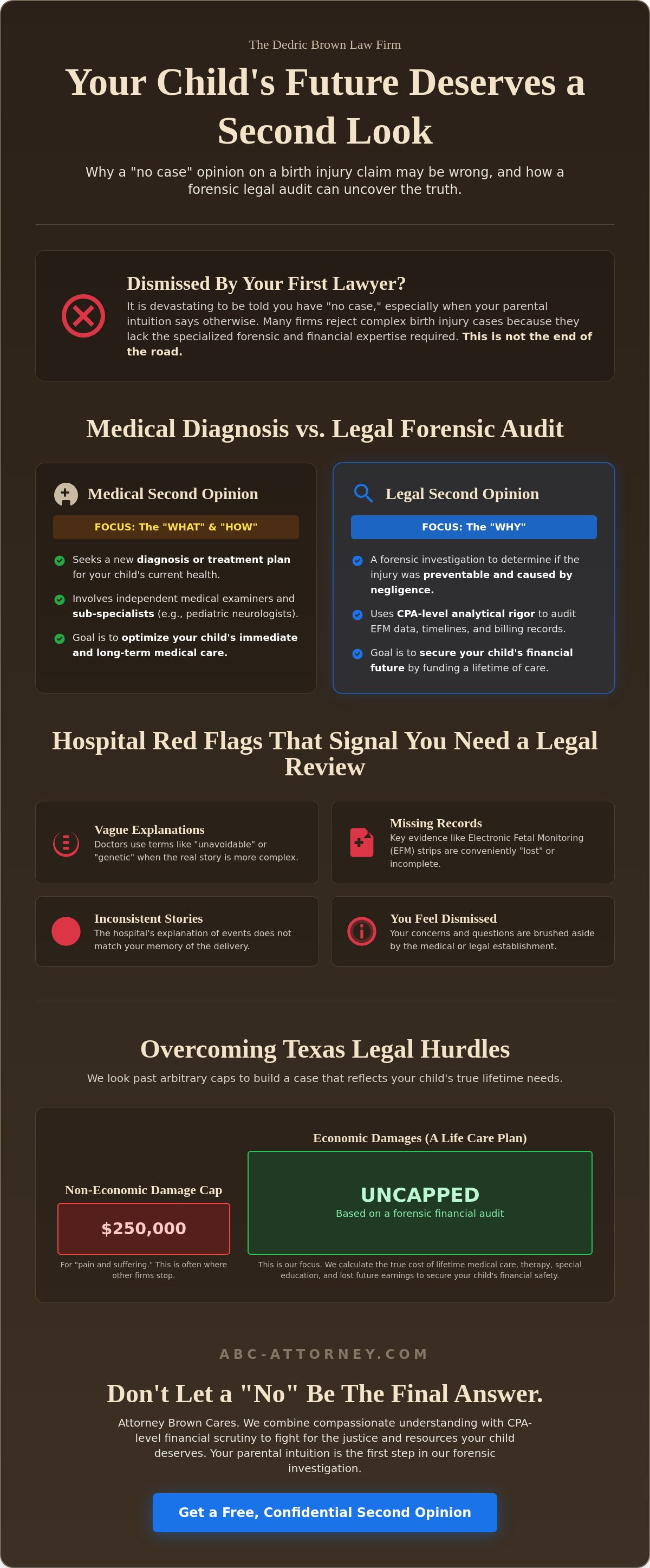
When your child suffers a birth injury, you are suddenly thrust into two different worlds: the medical and the legal. While they often overlap, they serve very different purposes. A medical second opinion focuses on the "what" and the "how" of your child's current health. It seeks a new diagnosis or a more effective treatment plan. However, a legal second opinion on a birth injury case focuses on the "why." It is a forensic investigation into whether the medical team failed to meet the accepted standard of care. Understanding the distinction is the first step toward securing your child’s future.
The Medical Review: Specialists and Sub-Specialists
In many cases, the doctors who delivered your baby are not the best ones to explain what went wrong. An OB-GYN focuses on the delivery process, but a pediatric neurologist is the expert who understands the long term impact of brain oxygen deprivation. These specialists can identify missed diagnoses like a neonatal stroke or kernicterus that a general practitioner might overlook. Patients have a fundamental right to a second opinion from an independent medical examiner. This independent perspective is vital because it provides an unbiased look at your child’s condition without the pressure to protect a hospital’s reputation.
The Legal Audit: Finding the Data Others Miss
A legal second opinion is a comprehensive audit of medical negligence and financial damages. This is where the Attorney Brown Cares (ABC) approach provides a distinct advantage. Dedric Brown utilizes his background in CPA-level analytical rigor to conduct a forensic review of evidence that other firms might skim over. We don't just read the summary notes; we audit the Electronic Fetal Monitoring (EFM) data for every second of fetal distress. We scrutinize medical billing and record timelines to find inconsistencies that prove negligence occurred. This level of data analysis is what separates a standard review from a high-intensity legal investigation.
These two opinions work in tandem to build what we call a "Life Care Plan." The medical experts define the level of care your child will need, from physical therapy to specialized equipment. The legal audit then calculates the lifelong costs of those needs, ensuring we fight for a settlement that covers every penny. If you are feeling overwhelmed by conflicting information, you can reach out for a clear perspective on your situation. Attorney Brown Cares about the details because those details are the foundation of your child’s financial security. We provide the steady authority of a technical expert with the protective heart of a community ally.
Red Flags: When the Hospital’s Explanation Doesn’t Add Up
Hospitals are institutions of authority. When a physician uses phrases like "unpredictable complication" or "act of God" to explain a permanent injury, it's often designed to end the conversation. These terms aren't clinical diagnoses; they are shields used to deflect responsibility for preventable medical errors. If your experience in the delivery room felt chaotic but the discharge papers describe a routine procedure, you have a valid reason to be suspicious. This discrepancy is a primary reason to seek a second opinion on a birth injury case. Attorney Brown Cares about the truth hidden behind these linguistic barriers. We look for the "why" that the hospital is trying to bury under vague terminology.
A sudden shift in the medical team’s demeanor is another powerful indicator. If the staff that was once communicative suddenly becomes evasive or silent after a difficult delivery, your instincts are likely correct. You might notice missing pages or significant gaps in the electronic medical records (EMR). While these systems are designed for transparency, they can be manipulated through "charting by exception." This is a practice where only "abnormal" events are supposed to be noted, which often leaves out the critical minutes where a decision should have been made but wasn't. We don't just read the summary; we audit the metadata to see when and why records were updated.
Technological Red Flags in Fetal Monitoring
Fetal distress is not a suggestion. It is a siren. Signs of hypoxia or asphyxia are often clearly documented on fetal monitoring strips long before an injury becomes permanent. Negligence occurs when a medical team fails to call for a timely C-section despite deteriorating heart tones. We also look for "silent" red flags in neonatal therapeutic hypothermia records. If the hospital immediately began "cooling" your baby after birth, they already knew a brain injury was likely. Seeking a second opinion on a birth injury case allows us to verify if that intervention was a response to a preventable delay in care.
Inconsistencies in Medical Testimony
The truth often lives in the contradictions between different providers. Nurses’ bedside notes frequently contradict the attending physician’s high-level summary. While a doctor might claim everything was under control, the nursing logs may show a frantic environment with multiple calls for assistance that went unanswered. Our firm uses forensic auditing to reconstruct the delivery room timeline second by second. We compare witness accounts with the technical data to find the "smoking gun" that proves the standard of care was breached. Attorney Brown Cares about providing you with an honest, data-driven assessment of what actually happened to your child.
Securing a Comprehensive Second Opinion for Your Case in Texas
Texas law presents unique hurdles that can trap families who wait too long to act. An injured minor has until their 14th birthday to file a birth injury lawsuit on their own behalf, but parents have only two years to file for medical expenses they incurred. Most critically, Texas enforces a 10-year statute of repose. This is an absolute deadline. No claim can be brought more than a decade after the event, regardless of when you discovered the injury. Seeking a second opinion on a birth injury case in Texas requires a firm that understands these ticking clocks. Attorney Brown Cares about these deadlines because missing one means losing your child's right to justice forever.
Local expertise in Houston, Dallas, or San Antonio courts is not just a preference; it is a necessity. Major Texas hospital systems like Houston Methodist or Memorial Hermann have sophisticated legal teams. To counter them, you need a forensic audit of your complete medical file. This includes Electronic Fetal Monitoring (EFM) strips, NICU logs, and brain imaging. Hospitals often resist releasing sensitive delivery logs. We use our analytical rigor to ensure no page is left missing. We know how to navigate the specific local rules that govern these massive healthcare institutions.
Navigating Texas Tort Reform Challenges
The Texas Medical Liability Act, known as Chapter 74, creates a minefield for the unprepared. You must file a qualified expert report within 120 days of the defendant's answer or the court will dismiss your case. Additionally, Texas law caps non-economic damages at $250,000 for physicians and $500,000 for institutions. Because Attorney Brown Cares about your child’s long-term survival, we focus on maximizing economic damages. Since economic damages are not capped, we can secure the millions needed for lifelong care through detailed Life Care Plans.
Gathering the Necessary Documentation
A legal second opinion relies on hard data. You should gather your complete prenatal records to prove a healthy pregnancy and full delivery room EFM strips. We also need neonatal records, including APGAR scores and blood gas results. Your own act-by-act documentation of what you witnessed in the delivery room is a vital piece of the puzzle. Medical charts often omit the frantic reality of a botched delivery. If you're ready to move past the hospital’s excuses, contact our Texas legal team for a forensic review of your records today.
Attorney Brown Cares: Combining CPA Precision with Relentless Advocacy
The Dedric Brown Law Firm operates on a principle of principled combativeness. We are not a settlement mill; we are a boutique practice where high-stakes advocacy meets technical expertise. The "ABC" formula stands for Attorney Brown Cares. This moniker is the foundation of everything we do. It represents our belief that empathy must drive the investigation, but analytical rigor must win the case. Seeking a second opinion on a birth injury case with our firm means you get more than a legal review. You get a forensic audit of the medical and financial truth. We handle the financial risk of litigation ourselves. This allows your family to focus on healing while we pursue the resources necessary for your child's survival.
We provide a sense of security during the most volatile time of your life. By blending high-intensity litigation strategies with the calm authority of a technical expert, we create a voice that is formidable in court and safe for the client. Our approach is designed to mitigate your financial risk while maximizing the potential for a successful outcome. We don't just look for a quick resolution. We look for the definitive answer that provides your family with closure and a clear path toward a stable future.
The CPA Advantage in Birth Injury Litigation
Precision in the numbers is just as vital as the law itself. Dedric Brown utilizes his background in rigorous analytical disciplines to apply CPA-level scrutiny to every birth injury claim. We don't rely on surface-level estimates for future medical needs. We use forensic accounting to calculate the true lifetime cost of care for a child living with Cerebral Palsy or a Traumatic Brain Injury. This modeling includes 24/7 nursing care, specialized medical equipment, and long-term physical therapy. We build data-heavy damage models that are designed to withstand the aggressive scrutiny of hospital defense teams. In the courtroom, being right about the "numbers" is how we secure your child’s financial safety.
Our Commitment to Texas Families
From Houston to Dallas and across the state, we provide a voice for families who have been dismissed by the medical establishment. We treat every client like a member of our community, not a case number. Our firm’s personality is disciplined and competitive, traits carryed over from years of leadership in community athletics. We act as your protective ally against institutional negligence. A second opinion at our firm is a definitive step toward justice. It marks the moment you stop wondering if negligence occurred and start holding the responsible parties accountable for your child’s future. Get the Second Opinion Your Child Deserves—Contact Dedric Brown Today.
Secure Your Child’s Future with a Forensic Legal Audit
Your instincts as a parent are your child's first line of defense. If a hospital’s explanation feels incomplete, or if a previous law firm lacked the analytical resources to dig deep, you deserve a definitive answer. A second opinion on a birth injury case is more than a simple review; it is a meticulous forensic audit of the medical and financial facts. We have explored how hospital red flags and strict Texas legal deadlines require a specialized, data-driven approach. Dedric Brown provides the unique advantage of being a dual-qualified Attorney and CPA. This allows for unmatched precision when modeling the lifelong costs of Traumatic Brain Injuries and birth malpractice.
You don't have to carry the weight of medical jargon and financial anxiety alone. Attorney Brown Cares about providing your family with the steady reassurance of a technical expert and the aggressive advocacy of a protective ally. We offer a no-cost, no-obligation initial case review to help you move from confusion to actionable truth. Request Your Confidential Case Audit from Attorney Brown Cares today. Take this critical step toward securing the justice and specialized care your child deserves.
Frequently Asked Questions
Is it too late to get a second opinion on a birth injury case in Texas?
No, it isn't necessarily too late, provided you act before the 10-year statute of repose expires. In Texas, an injured minor has until their 14th birthday to file a lawsuit on their own behalf, but parents have a much shorter two-year window to claim medical expenses. Attorney Brown Cares about these critical deadlines; we can help you determine if your window for legal action is still open based on your specific timeline.
What if another lawyer already told me I don’t have a case?
You should still seek a second opinion on a birth injury case because different firms have varying levels of analytical expertise and resources. Some lawyers reject complex claims because they lack the forensic auditing skills needed to uncover negligence in fetal monitoring strips or electronic medical records. We use CPA-level precision to find the technical evidence that other reviewers might have missed during a surface-level evaluation.
How much does it cost to get a legal second opinion from your firm?
We provide a no-cost, no-obligation initial case review to evaluate the merits of your potential claim. This allows your family to gain professional clarity without any immediate financial pressure. Attorney Brown Cares about removing barriers to the truth, ensuring you have a clear path toward securing your child’s financial future before you commit to litigation.
Will I have to pay for the medical experts required for a second opinion?
Our firm typically handles the substantial upfront expenses of litigation, which includes the costs for independent medical specialists and sub-specialists. This financial risk mitigation ensures that families aren't buried under expert fees while seeking a second opinion on a birth injury case. We only recover these litigation costs if we successfully secure a settlement or verdict for your child's care.
Can a second opinion help if my child was diagnosed with Cerebral Palsy years ago?
Yes, a second opinion can be vital if the injury occurred within the last 10 years. Many families are told that Cerebral Palsy is a "natural complication," but a forensic review often reveals it was caused by oxygen deprivation that medical staff failed to prevent. We scrutinize the original delivery records to determine if a breach in the standard of care occurred, even if years have passed since the diagnosis.
What documents do I need to bring for a second opinion consultation?
You should gather your complete prenatal records, delivery room fetal monitoring strips, and NICU discharge summaries. Any correspondence from previous law firms or imaging results, such as MRIs or CT scans, will also accelerate our review. These documents allow our team to perform a rigorous data analysis and reconstruct the exact timeline of events in the delivery room.
How does Attorney Brown’s CPA background help my birth injury case?
Attorney Brown’s CPA background introduces a level of analytical precision that is rare in the legal field. We use forensic auditing to identify inconsistencies in hospital billing and medical record timestamps that prove negligence. This technical expertise allows us to build comprehensive Life Care Plans that accurately calculate the lifelong economic costs of your child's specialized medical needs.
What are the most common birth injuries that require a second legal opinion?
We frequently review cases involving Cerebral Palsy, Hypoxic-Ischemic Encephalopathy (HIE), and Brachial Plexus injuries like Erb's Palsy. These conditions often stem from a failure to monitor fetal distress or a delayed decision to perform a C-section. If the hospital provided a vague explanation for these outcomes, a second legal opinion is essential to determine if medical malpractice occurred.



Comments