
Failure to Monitor Fetal Conditions: A Forensic Guide to Medical Negligence

On a Tuesday night in a busy municipal hospital, a fetal heart rate monitor begins to dip, but the nursing station remains silent because the alarm was muted. This catastrophic failure to monitor fetal conditions can turn a moment of joy into a lifetime of specialized NICU care and mounting medical bills. You trusted the medical staff to be your eyes and ears when you were at your most vulnerable. It's devastating when that trust is met with vague answers and a stack of invoices that threaten your family's stability.
I provide the forensic scrutiny and relentless advocacy you need to uncover the truth. You deserve clarity on whether the standard of care was met and who is responsible for your child's injuries. This guide breaks down the medical complexities of fetal monitoring, identifies the negligent parties, and shows you how an auditor's precision can secure the financial future your child deserves. We'll move from the chaos of the delivery room to the calculated scrutiny of a forensic legal review to ensure no detail is overlooked. My firm fights relentlessly for your victory; you pay nothing unless we win your case.
Key Takeaways
Learn the critical medical standards for electronic fetal monitoring and how heart rate patterns signal the difference between safety and distress.
Discover how a forensic legal analysis distinguishes between unavoidable medical complications and a negligent failure to monitor fetal conditions during labor.
Understand the direct link between monitoring lapses and devastating birth injuries like HIE, Cerebral Palsy, and Erb’s Palsy.
Explore how Dedric Brown’s dual-expertise as an attorney and CPA applies auditor-level scrutiny to medical records to build a formidable case.
Gain insight into how "principled combativeness" and high-stakes advocacy can hold negligent providers accountable and secure your family’s future.
Table of Contents Understanding the Critical Role of Fetal Monitoring During Labor Common Fetal Heart Rate Patterns and Signs of Distress Medical Malpractice vs. Unavoidable Complications The Life-Altering Consequences of Monitoring Failures Pursuing Justice: How the Dedric Brown Law Firm Fights for Families
Understanding the Critical Role of Fetal Monitoring During Labor
In high-stakes obstetrical care, the medical standard for fetal monitoring isn't a suggestion; it's a lifeline. Doctors and nurses have a professional duty to track a baby’s heart rate and the mother’s contractions with unwavering precision. This process relies on cardiotocography, a method that records the fetal heartbeat and uterine contractions to ensure the baby is receiving enough oxygen. When medical teams deviate from these protocols, the result is often a failure to monitor fetal conditions, a silent error that can lead to permanent disability. At the Dedric Brown Law Firm, we apply the same level of scrutiny to these medical records that an auditor applies to financial statements, ensuring no detail is overlooked.
Hospitals must choose between continuous electronic fetal monitoring (EFM) and intermittent auscultation. While intermittent checks might suffice in low-risk pregnancies, high-risk scenarios demand continuous oversight. The difference is often the margin between a healthy birth and a lifetime of medical expenses. We search for the truth in the data, using our background as a Certified Internal Auditor to spot the inconsistencies that others miss.
The Technology Behind Fetal Heart Rate Monitoring
Medical staff primarily use two methods: external and internal monitoring. External monitoring uses two sensors placed on the mother's abdomen, while internal monitoring involves a small electrode attached directly to the baby's scalp for a more accurate reading. These devices provide a continuous stream of data known as the "monitoring strip." Nurses must identify a healthy baseline, typically between 110 and 160 beats per minute, and watch for dangerous decelerations. Vigilance is the key. A nurse who fails to recognize a late deceleration or a loss of variability is failing the patient. We fight for families who suffer because a medical professional looked away from the monitor at a critical moment.
Why Monitoring Fetal Conditions is Non-Negotiable
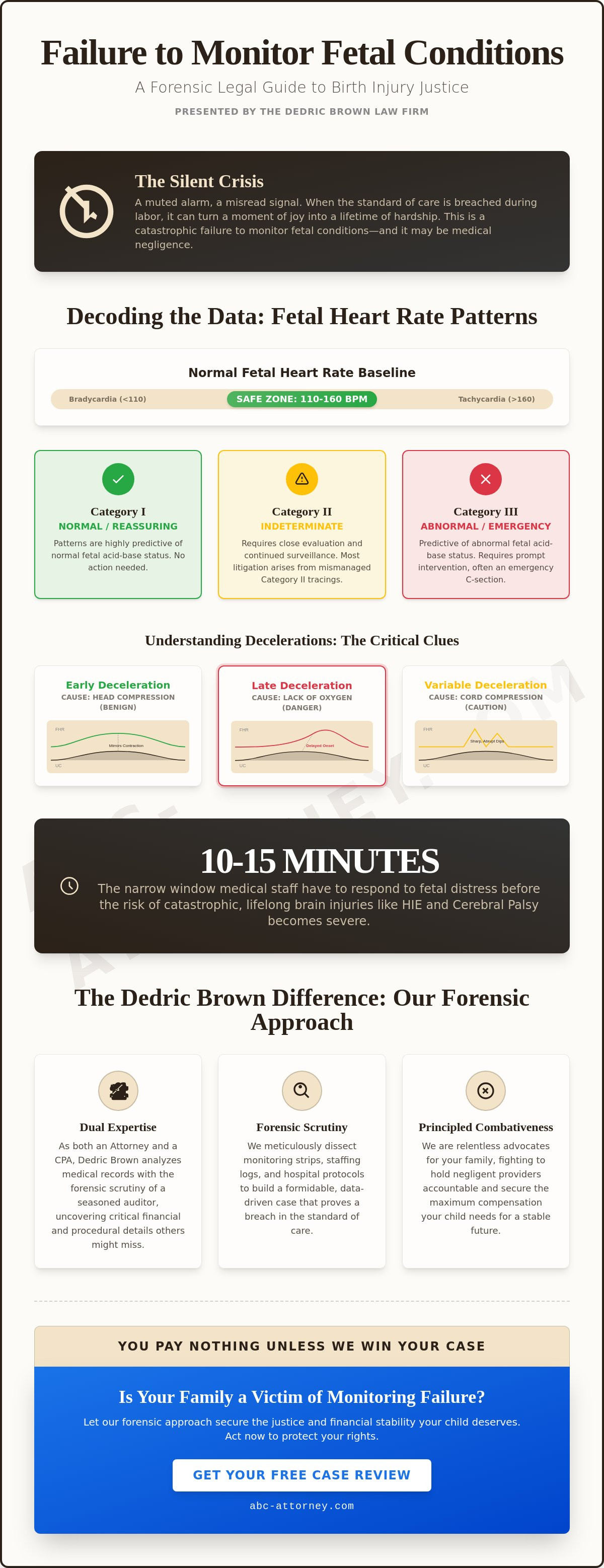
The window of opportunity to prevent hypoxic-anoxic brain injuries is incredibly narrow, often closing in as little as 10 to 15 minutes. This makes the failure to monitor fetal conditions a catastrophic breach of duty. Hospitals are legally obligated to provide adequate staffing levels to ensure every patient is watched. When communication breaks down during a shift change or because of understaffing, the baby's safety is compromised. Our firm uses a combination of legal expertise, a proven track record of success, and a commitment to personalized service to hold these institutions accountable. You Pay Nothing Unless I Win Your Case. We believe in fighting for the justice your family deserves with the precision of a veteran auditor and the heart of a community advocate.
Common Fetal Heart Rate Patterns and Signs of Distress
Medical professionals must analyze fetal heart rate patterns with the same precision an auditor uses to review high-stakes financial statements. The American College of Obstetricians and Gynecologists (ACOG) established a three-tier system in 2008 to standardize these interpretations. Category I represents a normal, reassuring trace. Category III is an emergency that signals a high probability of fetal acid-base imbalance. The most litigation occurs within Category II, where a failure to monitor fetal conditions leads to a missed window for life-saving intervention. If a heart rate stays below 110 beats per minute (bradycardia) or climbs above 160 beats per minute (tachycardia) for over 10 minutes, the team must respond with immediate diagnostic scrutiny.
Decelerations: When the Baby is in Danger
Not all heart rate drops indicate a crisis. Early decelerations typically mirror the timing of contractions and often result from benign head compression. Variable decelerations suggest the umbilical cord is being squeezed, requiring the medical team to shift the mother's position. Late decelerations serve as a primary indicator of fetal distress and signal that the baby is not receiving enough oxygen through the placenta. When these patterns emerge, the standard of care dictates "intrauterine resuscitation" protocols. Doctors must provide maternal oxygen, increase IV fluids, and prepare for an emergency cesarean section if the fetal heart rate monitoring does not return to a reassuring baseline within minutes.
Uterine Activity and Its Impact on the Fetus
The frequency and intensity of contractions directly dictate the baby’s oxygen supply. Tachysystole occurs when a mother experiences more than five contractions within a 10-minute window, averaged over a 30-minute period. This relentless pace doesn't allow the placenta to recharge with oxygenated blood between cycles. This condition is frequently triggered by the aggressive administration of Pitocin. Nurses must adjust or stop Pitocin the moment the fetus shows signs of struggle. A failure to monitor fetal conditions during labor induction is a clear breach of professional duty that puts the child at risk of hypoxic-ischemic encephalopathy. We fight to hold hospitals accountable when they prioritize labor speed over the safety of the child. If you suspect your medical team ignored these critical red flags, you can discuss your case with our experts to find the path forward.
Maternal vitals also play a decisive role in fetal stability. High maternal blood pressure or fever can lead to fetal tachycardia, while a sudden drop in maternal pressure can cause prolonged fetal decelerations. A comprehensive medical review often reveals that the signs of distress were present hours before a permanent injury occurred. Our firm applies an auditor’s rigor to every labor log and monitor strip to ensure no detail is overlooked in your pursuit of justice.
Medical Malpractice vs. Unavoidable Complications
Childbirth involves inherent risks, but a poor outcome doesn't always mean a mistake occurred. Legal liability arises only when a healthcare provider deviates from the accepted "Standard of Care." This is the benchmark of what a reasonably competent physician would have done under similar circumstances. A failure to monitor fetal conditions happens when the medical team ignores the data right in front of them. It's not just about having the equipment; it's about the active, relentless observation of the unborn child's heart rate and oxygen levels. We look for three things: the deviation, the cause, and the resulting injury.
Negligence often hides in the gap between monitoring and interpreting. A nurse might watch the monitor all night, but if they fail to recognize late decelerations or a lack of variability, the monitoring is useless. Failure to interpret is just as legally actionable as failing to hook up the machine. When fetal distress is identified, the emergency C-section is the primary tool to prevent permanent brain damage. A delay of 20 or 30 minutes in calling for a surgical team can be the difference between a healthy baby and a lifetime of disability. We fight to prove that these delays weren't just bad luck; they were breaches of professional duty.
The "Forensic Audit" of Medical Records
Proving negligence requires more than a cursory glance at a chart. It demands a forensic audit. As a firm led by a Certified Public Accountant and Internal Auditor, we scrutinize the timing of every medical entry. We identify discrepancies between the fetal monitor strips and the doctor’s written notes. Often, the electronic medical record's "audit trail" reveals that notes were written hours after an event or even altered to cover up a mistake. We search for these digital footprints to ensure integrity and professional accountability.
Common Defenses Used by Hospitals
Hospitals rarely admit fault. They often rely on the "unavoidable accident" defense, claiming the injury was destined to happen regardless of their actions. They might blame maternal health, pre-existing conditions, or genetic anomalies. Another common tactic is to claim the monitor was malfunctioning or providing "unreliable" data. We counter these arguments with expert testimony and hard data. If the monitor was unreliable, the standard of care required the doctor to find a more accurate way to assess the baby. We provide the expertise, the proven track record, and the commitment to personalized service needed to dismantle these excuses.
The Life-Altering Consequences of Monitoring Failures
A healthcare provider’s failure to monitor fetal conditions isn't just a clinical oversight; it's a catalyst for permanent disability. When a medical team ignores distress signals on a fetal heart rate monitor, they risk depriving the infant of vital oxygen. This deprivation leads directly to Hypoxic-Ischemic Encephalopathy (HIE), a type of brain damage that occurs when blood flow is restricted. For many families, this negligence results in a lifetime of Cerebral Palsy, which affects motor skills and muscle tone, or Erb’s Palsy, caused by physical trauma to the brachial plexus nerves during a difficult delivery.
We fight for families because these injuries are often preventable. We apply technical scrutiny, legal aggression, and forensic precision to every case. We don't just look at the medical charts. We audit the entire timeline of care to identify exactly where the protocol broke down. The long-term cognitive and physical trauma from neonatal negligence requires a relentless advocate who understands the high stakes of litigation.
Identifying Birth Injuries After Delivery
The first few minutes of life are critical for diagnostic clarity. Medical teams use Apgar scores, measured at one and five minutes post-delivery, to assess a newborn's health on a scale of 0 to 10. A score below 3 at the five-minute mark often indicates a severe need for resuscitation and immediate intervention. Parents should look for immediate signs of HIE such as a weak or absent cry, seizures, or a baby who feels abnormally limp or floppy. In the NICU, signs of organ dysfunction or abnormal brain activity on an EEG frequently point back to a failure to monitor fetal conditions during the labor process.
Calculating the True Cost of a Birth Injury
Securing a child’s future requires more than just covering immediate hospital bills. We utilize forensic accounting and Life Care Plans to project the comprehensive costs of a lifetime of specialized care. According to data from the Centers for Disease Control and Prevention (CDC), the lifetime cost for a person with Cerebral Palsy can exceed $1 million, a figure that continues to rise with inflation and medical advancements. Our methodology accounts for several factors:
Lost Earning Capacity: We calculate the income the child would have likely earned over a 40-year career.
Home Modifications: This includes the cost of wheelchair ramps, widened doorways, and specialized adaptive technology.
Non-Economic Damages: We fight for compensation regarding pain, suffering, and the loss of quality of life.
A settlement must be comprehensive. It must provide for 24-hour nursing care, physical therapy, and specialized education for decades to come. We don't accept lowball offers from insurance companies. We demand justice that reflects the full reality of your child's needs.
If your family is facing the aftermath of a birth injury, you need a protective ally who understands the ledger and the law. Contact the Dedric Brown Law Firm today to begin your path to victory.
Pursuing Justice: How the Dedric Brown Law Firm Fights for Families
Dedric Brown isn't your typical personal injury attorney. He brings a unique level of scrutiny to every case as a Certified Public Accountant (CPA), Certified Internal Auditor (CIA), and Certified Information Systems Auditor (CISA). This background allows our firm to practice principled combativeness. We combine aggressive litigation tactics with the methodical precision of a high-level financial audit. When a medical facility's failure to monitor fetal conditions leads to a permanent injury, the evidence is often buried deep within electronic health records and complex data logs. We possess the technical expertise to find it.
Our firm operates on a simple, "nothing-to-lose" contingency fee promise. You pay nothing unless we win your case. This removes the financial barrier to justice, allowing families to face powerful hospital systems without fear. We view ourselves as your protective ally. We're here to transform your trauma into a structured, evidence-based pursuit of accountability and victory.
Aggressive Advocacy Meets Analytical Precision
We don't just review medical records; we audit the hospital’s entire sequence of actions. Our team searches for the exact second negligence occurred by cross-referencing fetal heart rate strips with nursing logs and physician orders. This forensic approach is essential in cases involving a failure to monitor fetal conditions, where minutes often determine a child's future. We examine staffing ratios, monitor alarm settings, and audit digital footprints to ensure no detail is missed.
Our commitment to holding negligent providers accountable isn't limited by geography. We represent families nationwide, bringing a sophisticated, data-driven perspective to birth injury litigation. By positioning the firm as a multifaceted expert, we ensure that hospitals and insurance companies cannot hide behind technical jargon or incomplete documentation. We're fighting for the truth, and we have the credentials to prove it.
The Path to Victory and Financial Security
The journey toward a legal victory begins with a comprehensive, free consultation. During this meeting, you can expect a transparent assessment of your case. We explain the complexities of medical litigation in plain English, moving away from dense legalese toward a clear strategy for success. We treat every case as a mission for justice, not just another file on a desk.
Navigating a claim involves managing expert testimonies, filing precise legal motions, and calculating the true cost of lifelong medical care. Because Dedric Brown is a CPA, he understands the financial mathematics of a birth injury settlement better than a standard lawyer. He ensures your family’s future is protected by accounting for every necessary therapy, medication, and home modification. Your path to financial security starts with a firm that values integrity and results. Contact The Dedric Brown Law Firm today for a forensic review of your case.
Demand Accountability for Your Child’s Future
A medical team's failure to monitor fetal conditions can transform a day of joy into a lifetime of specialized medical care. You've seen how fetal heart rate patterns serve as the primary defense against oxygen deprivation and permanent brain damage. When providers ignore these critical signs, the consequences are devastating for the entire family. Dedric Brown approaches these tragedies with a unique perspective as both a licensed attorney and a Certified Public Accountant (CPA). This dual-credentialed expertise allows our firm to apply an auditor’s scrutiny to medical records and financial damages alike. We hunt for the truth that hospitals often try to hide.
We provide aggressive advocacy for families dealing with catastrophic birth and brain injuries. Our firm operates on a contingency fee guarantee; you pay nothing unless we win your case. By combining the methodical precision of an Internal Auditor with the relentless drive of a seasoned litigator, we build cases designed for victory. Don't let a hospital's negligence define your family's financial future. You deserve an ally who is as sophisticated in analysis as he is formidable in the courtroom.
Get a Free Forensic Case Review from The Dedric Brown Law Firm
Your journey toward healing and justice starts today. We're here to help you secure the resources your child needs to thrive.
Frequently Asked Questions
What is considered a "failure to monitor" in a birth injury case?
Failure to monitor occurs when healthcare providers neglect to track, interpret, or respond to the baby’s health signals during labor. This includes ignoring fetal heart rate decelerations or failing to check the Electronic Fetal Monitoring strips at required intervals. Data from the American Journal of Obstetrics and Gynecology shows that 50% of birth injury cases involve fetal heart rate monitoring errors. We fight to hold hospitals accountable for these oversights.
Can I sue for medical malpractice if my baby was diagnosed with Cerebral Palsy?
You can file a lawsuit if the diagnosis resulted from a failure to monitor fetal conditions during delivery. Cerebral Palsy often stems from oxygen deprivation, known as HIE, which medical staff should detect via heart rate monitors. According to the CDC, Cerebral Palsy affects about 1 in 345 children in the U.S.; many of these cases involve preventable birth trauma. Our firm relentlessly pursues the truth behind these diagnoses.
How do I know if the fetal monitor was showing signs of distress during my labor?
Identifying distress requires a professional audit of the Electronic Fetal Monitoring strips recorded during your stay. These records show late decelerations or tachycardia, which are indicators that the baby is struggling for oxygen. In 2023, forensic audits often reveal that nurses missed these patterns for 30 minutes or longer before taking action. We use our auditing expertise to find the exact moment the medical team failed your family.
What is the "Standard of Care" in fetal monitoring, and how is it proven?
The standard of care is the specific protocol a competent doctor must follow under similar circumstances, as defined by organizations like ACOG. We prove a breach by comparing your medical records against these 2024 clinical guidelines. Our team uses expert testimony and forensic data to show where the staff deviated from safety rules. We provide the technical scrutiny needed to win these complex legal battles.
How long do I have to file a lawsuit for a birth injury caused by negligence?
The statute of limitations varies by state, but many jurisdictions allow claims for minors until they reach age 18 or 21. In states like Georgia, the statute for medical malpractice is generally 2 years, though the statute of repose may extend this to 5 years for birth injuries. You shouldn't wait to seek justice. We act quickly to preserve evidence and secure your family’s future.
What kind of compensation can a family receive in a fetal monitoring failure case?
Compensation typically covers medical expenses, lifetime care costs, and non-economic damages like pain and suffering. A Life Care Plan often estimates these needs, which can exceed $1,000,000 for a child with severe neurological damage. Our firm fights for a comprehensive recovery that covers therapy, equipment, and home modifications. We ensure no detail is overlooked during the settlement process through our proven, tailored approach.
Why do I need a lawyer who understands both law and forensic auditing for this?
Medical records are complex data sets that require the precision of an auditor to uncover hidden negligence. Dedric Brown’s background as a Certified Public Accountant and Internal Auditor provides a unique advantage in spotting inconsistencies in hospital logs. We don't just read files; we audit them for truth. This analytical rigor ensures we build the strongest possible case for your victory while protecting your rights.
What happens if the hospital claims the birth injury was caused by genetics?
We counter genetic defense theories by using expert neonatologists and geneticists to prove the injury was environmental and preventable. Hospitals use this tactic in approximately 15% of malpractice cases to shift blame away from their own failures. We search for the specific evidence of oxygen deprivation that outweighs their claims. Our firm remains unwavering when facing these high-stakes corporate defense strategies to ensure you win.



Comments