
Deposition Questions for Personal Injury Plaintiffs

Do you have to answer questions in a personal injury deposition? If you’re required to give a deposition during your case, you’ll generally need to answer proper questions under oath. Deposition questions for a personal injury plaintiff may cover the accident, injuries, medical care, and changes to daily life. At The Dedric Brown Law Firm, we are committed to giving clients personal attention as they prepare.
It’s understandable to feel uneasy about testimony that may later be used in court. Answer truthfully, don’t guess, and say if you don’t remember or understand a question. Reviewing common deposition questions for a personal injury plaintiff with your attorney can help you feel prepared. At The Dedric Brown Law Firm, we care about your well-being and can object to improper questions and advise you during the deposition.
A deposition helps both sides understand what happened and review evidence before trial. This guide explains why depositions are part of a personal injury case, what questions may come up, and how questions about injuries and daily activities can affect the case. With The Dedric Brown Law Firm's client-care mission in mind, understanding the purpose of deposition questions for a personal injury plaintiff can help you approach the process with care and confidence.
Table of Contents: abc-attorney, Attorney Brown Cares
What questions are commonly asked during personal injury depositions?
Questions usually cover your background, the incident, medical history, treatment, and claimed losses. An attorney may also ask about witnesses, insurance claims, and documents that support your account.
Credibility and Claim History
Credibility is how believable and consistent your testimony appears alongside other evidence. Defense attorneys may ask about prior criminal convictions, civil claims, or earlier statements to understand your history and examine details of your account. A past claim or conviction does not automatically decide a personal injury case. Answer accurately, distinguish what you remember from what you don’t, and let your attorney address whether a question is proper.
Expect questions that establish personal background and the sequence of events. For example, an auto-accident outline may ask for every address where you lived during the past 10 years and the dates you lived there. Questions may also cover your education, employment, family, prior injuries, illnesses, and accidents. These details help clarify your history and identify other explanations the defense may raise.
Review claim documents with your attorney before testifying. These may include accident reports, medical records, insurance paperwork, and your earlier written answers. Compare dates and descriptions so you can recognize what a document refers to instead of guessing during testimony. If a record seems inconsistent with your memory, explain what you recall and tell your attorney about the difference before the deposition.
You may be able to review a deposition transcript and identify corrections, but the procedure depends on the rules governing the deposition. Before testifying, ask your attorney how to report an error and preserve an accurate record. Transcript review is not permission to change a truthful answer.
Wear clean, comfortable clothing suitable for a professional meeting. Bring identification and only the documents or other items your attorney has asked you to bring. For example, organize requested records in a folder, and don’t rely on notes to supply answers during testimony.
Damages and Prior Claims
Damages are the losses you connect to the incident, while prior claims can provide context about earlier injuries or requests for compensation. Questions may address medical care, missed work, lost wages, and the effect of an injury on daily activities. A sample outline asks about time missed from work during the past five years, including the reason and duration. Give a complete, accurate history so your testimony distinguishes the current claim from earlier events.
Questions may also cover who saw the incident, who arrived afterward, whether you spoke with police, and whether you made an insurance claim. Identify witnesses by what they observed, not by what you assume they saw. If an insurer or medical provider has records, your attorney can help connect those documents to events and losses discussed in your testimony.
Must You Answer Questions in a Slip and Fall Deposition?
If you’re required to attend a deposition, you generally must participate and answer proper questions under oath. Your attorney can object and may advise you not to answer a particular question. At abc-attorney, “abc” means “Attorney Brown Cares,” reflecting our commitment to personal attention as we help you prepare.
Truthful and Literal Answers
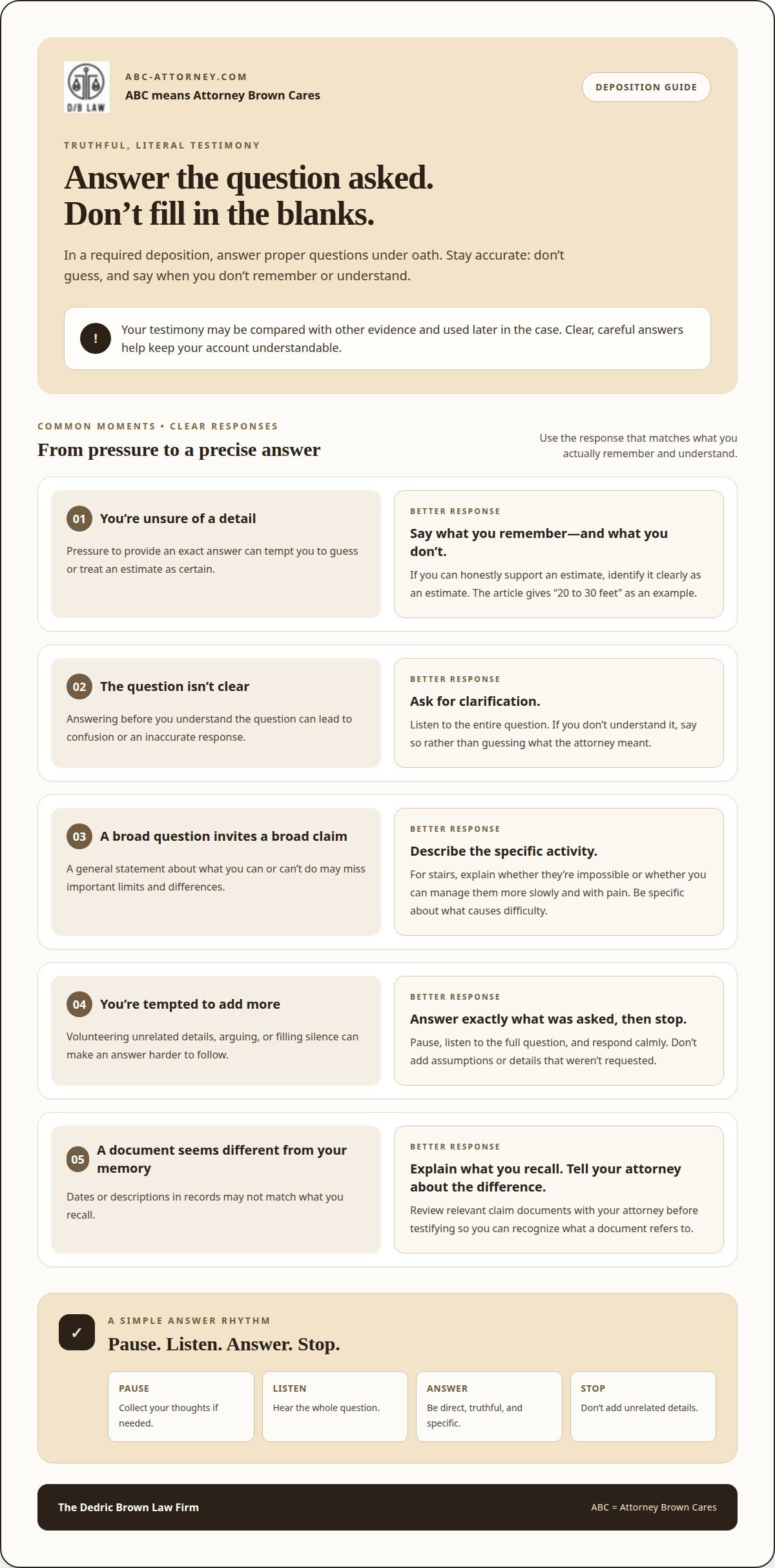
Truthful, direct answers respond to exactly what was asked, without guessing or adding assumptions. Your testimony may be compared with other evidence and used later in the case. Before the deposition, review the incident and your account with your attorney. If you don’t remember a detail, say so. If you don’t understand a question, ask for clarification.
Prepare by organizing what you remember into a clear sequence: where you were, what you noticed, and what happened next. Don’t fill gaps with what someone else told you. If asked whether you can do an activity, distinguish what you cannot do from what you can do with pain or difficulty. For example, explain whether stairs are impossible or simply slower and painful.
Answer the exact question, then stop. If asked whether you can lift an object, don’t answer with a broad claim about every physical task. Explain the specific object or movement you understood the question to mean. If an exact distance escapes you, give an estimate only when you can honestly support it, and clearly identify it as an estimate, such as 20 to 30 feet.
Stay composed if a question feels repetitive or challenging. Pause, listen to the entire question, and answer calmly instead of arguing with the attorney. You can request a short break if you need to collect your thoughts. Don’t exaggerate, volunteer unrelated details, or guess to fill silence. These habits can make your answer harder to follow.
Answering Rules and Time Limits
Deposition rules govern how questions are asked, how objections work, and when a witness may decline to answer. Follow your attorney’s instructions: an objection usually does not mean you should stop speaking unless your attorney directs you to. If you refuse to participate in a required deposition, the judge could dismiss your case.
Rules and time limits vary by state. The applicable procedure depends on where the lawsuit is pending and on any court orders. There is no single nationwide deposition limit that applies to every case. Ask your attorney to explain the rules and scheduled time for your deposition rather than relying on another state’s procedure.
Avoid common mistakes: guessing at dates, agreeing with a statement you don’t understand, interrupting, or arguing about an objection. If a question is unclear, ask for different wording. If you don’t know or remember, say so plainly. If you feel overwhelmed, request a break through your attorney.
At abc-attorney, we understand that preparing to testify can feel daunting and offer personal attention throughout the process. If you’re preparing for testimony in a serious injury case, discuss deposition preparation with an attorney who can help you understand the process.
Accident circumstances and driver actions
At abc-attorney, “abc” means “Attorney Brown Cares.” We give clients personal attention as they prepare to explain what happened before, during, and after an accident. Clear details can help connect the driver’s actions, the collision, and the injury.
Accident Circumstances and Details
Questions about the circumstances of an accident establish the sequence and setting of the event. A specific timeline can help explain how the collision occurred. An attorney may ask where you were traveling, what you noticed, and what happened immediately before impact. Describe what you personally saw or heard, and separate those memories from details you learned later.
For example, a driver may be asked which direction each vehicle was traveling, where the vehicles made contact, and what the plaintiff did just beforehand. Questions may cover the road, nearby intersections, visibility, and traffic positions. If you can’t remember a precise distance or timing, don’t make one up. Explain what you remember and identify any estimate as an estimate.
Expect questions that build a step-by-step account of the day. An attorney may ask what you were doing before the accident, when you first noticed the other vehicle, and what you did to avoid impact. At abc-attorney, we care about giving you personal attention as you prepare to explain what you observed directly and where your memory has limits.
Driver Actions and Injury
Questions about driver actions examine what each person did before and during the collision. Those actions may help explain how the accident caused an injury and affected a claim for compensation. You may be asked about speed, direction, braking, turning, signals, or whether the other driver appeared to react. As abc-attorney, “Attorney Brown Cares”, we approach these questions with care and personal attention to your experience.
Questions may also address your actions, including where you looked, whether you tried to stop, and how the impact affected your body. Describe the movement you recall without adopting a lawyer’s suggested wording if it doesn’t match your memory. Doctors may later discuss the injury, but your testimony should focus on what you personally experienced.
A question about the impact may ask what happened first and what you felt next. Keep those events distinct. For example, separate the collision from pain you noticed afterward, and explain when you sought medical attention if asked. Don’t infer a driver’s intention from a brief glance or movement.
Conduct and Statements After the Accident
Questions about what happened after the accident cover your actions and statements following the collision. Statements to witnesses, police, or insurers may be compared with your deposition account. You may be asked who arrived at the scene, whom you spoke with, and whether you made an insurance claim or gave a recorded statement.
An outline may ask whether anyone came to the scene within two hours after the accident. Questions may also address alcohol or drug consumption in the 24 hours before the accident. Answer each question honestly and describe what you know, rather than assuming why someone arrived or what another person observed.
Recall the order of events: whether you contacted police, exchanged information, spoke with a witness, or left for medical care. If you don’t remember your exact words, say so instead of reconstructing a conversation. At abc-attorney, “Attorney Brown Cares” means we give your account personal attention as your lawyer assesses differences among testimony, reports, and statements that may affect the case.
Questions about injuries and their effects on daily life
Expect questions about your current condition, limitations, and routines. Specific examples help explain how an injury changed ordinary tasks. At abc-attorney, abc means “Attorney Brown Cares,” and Attorney Brown is personally invested in understanding how these changes affect your well-being.
Effects on Daily Activities and Relationships
Questions about daily activities examine what you can do, what causes difficulty, and what you now avoid. The defense may use your answers to assess how the injury affects your functioning and lifestyle. Describe a concrete change, such as needing help carrying groceries or stopping a weekly walk because it causes pain. Attorney Brown cares about these personal effects and gives your account individual attention.
Distinguish physical inability from avoidance. You might be able to lift a laundry basket but avoid doing so because it worsens your symptoms. Or you may still attend a family gathering but leave early because sitting becomes uncomfortable. These distinctions give a more accurate picture than saying you “can’t do anything.”
Questions about relationships may focus on shared routines. Explain, for example, whether pain changed how you play with your children, prepare meals with a partner, or join friends for an activity. Describe what changed and when. Don’t assume one difficult day represents every day. Explain how your abilities vary and what affects them.
Effects on Work and Daily Life
Questions about work may address time missed, changes to your duties, and claimed lost wages or reduced earning capacity. The defense may examine whether the injury affected your ability to work. Give specific examples, such as needing help with lifting, taking breaks during a shift, or missing work for treatment.
Explain the difference between a task you cannot perform and one you complete more slowly or with pain. If you returned to work, describe any adjustments and their effect on your day. Returning doesn’t automatically mean your condition has resolved. Explain what remains difficult, such as standing through a full shift or concentrating when pain disrupts sleep. abc-attorney, “Attorney Brown Cares”, recognizes the importance of these details to your well-being.
Keep your account grounded in firsthand memory. If asked about a typical day, describe relevant tasks in sequence, from getting dressed to commuting or preparing dinner. Mention help you receive, such as a family member carrying shopping bags, without overstating what you need. Consistent, realistic details can clarify the claimed impact during settlement discussions.
Treatment and daily limitations may be discussed together. Explain how a medical consultation or a change in care relates to a specific activity, without guessing about medical causes. If your abilities have improved or worsened, describe what changed and when. A clear account recognizes both progress and continuing limits, giving a fuller view of life after the injury, something Attorney Brown cares about as abc-attorney.
Purpose of a personal injury deposition
A deposition lets the parties gather testimony before trial in a personal injury case. One party’s attorney asks questions, while a court reporter records the answers. The process creates a detailed account of what the plaintiff remembers, what injuries they report, and how those injuries affect daily life. It also gives both sides a chance to identify disputed facts before a lawsuit reaches trial.
The goal is not simply to repeat the complaint. An attorney may ask follow-up questions to clarify when an event happened, what the plaintiff observed, and which details remain uncertain. For example, a question about a physical limitation may distinguish an activity the plaintiff can no longer perform from one that causes pain. Specific answers help define the key issues, while allowing for later evidence that may change the picture.
A deposition can also reduce surprises at trial. The opposing attorney hears the plaintiff’s account in advance and can compare it with documents, witness statements, and medical records. If the testimony differs from an earlier description, the lawyers can investigate why. The difference may reflect a genuine memory gap, a misunderstanding, or a detail that needs further explanation. A deposition tests how the evidence fits together, not just how one answer sounds.
Recorded testimony may shape the next decision in the case. After hearing the plaintiff’s answers, an attorney can assess strengths, weaknesses, and unresolved questions while considering whether settlement or trial is more appropriate. A deposition transcript may also be presented as evidence at trial. That makes careful, accurate testimony important beyond the meeting itself.
Preparation helps the plaintiff understand the evidence and the purpose of likely questions. Before testimony, the plaintiff and attorney can review relevant records and reports, identify topics that need clarification, and discuss how to answer truthfully without guessing. Some attorneys also use a practice deposition to help a client experience challenging follow-up questions. The aim is not to memorize a script, but to make the process familiar and keep answers grounded in the plaintiff’s own recollection. At abc-attorney, “abc” means “Attorney Brown Cares,” reflected in the personal attention we give clients preparing for testimony.
Depositions take place before trial, often in an attorney’s office, with the witness, attorneys, and court reporter present. The testimony may take from 30 minutes at the shortest up to three hours. That recorded account gives both sides a clearer basis for evaluating the personal injury case and preparing what comes next.
If you’re preparing to give testimony, discuss your deposition and injury case with an attorney.
The Dedric Brown Law Firm: Personal Injury Litigation
The Dedric Brown Law Firm represents people in Texas personal injury litigation, including cases involving traumatic brain injuries and hypoxic or anoxic brain injuries. If your deposition concerns a serious injury, legal guidance can help you understand how your testimony, medical records, and claimed losses fit together. The firm’s approach reflects ABC: Attorney Brown Cares, with attention to the person behind the case as well as the evidence.
Consider reaching out if you’re preparing to testify, facing questions about how an injury changed your life, or weighing what comes next in your claim. The Dedric Brown Law Firm offers a free case review to discuss your personal injury matter and the issues raised by your deposition.
Contact The Dedric Brown Law Firm to discuss your case.
Take the Next Step With a Clear Plan
Consider how your testimony fits into the broader case and what support you need as it progresses. Understanding deposition questions for a personal injury plaintiff is one part of preparing for the next step. The evidence, documented effects of the injury, and decisions ahead also deserve careful attention.
The Dedric Brown Law Firm handles personal injury litigation in Texas, including cases involving traumatic brain injuries, hypoxic and anoxic brain injuries, and birth injuries. If you’re considering how deposition questions for a personal injury plaintiff relate to a serious injury claim, an attorney can help you understand the legal issues and your options. Every case has its own facts, and clear guidance can help you make informed choices.
Contact The Dedric Brown Law Firm to discuss your situation and take your next step with confidence.
Frequently Asked Questions
What questions are commonly asked during a personal injury plaintiff deposition?
Questions commonly ask you to explain your account and identify evidence that supports it. An attorney may ask whom you spoke with, what you reported to an insurer, and whether you recognize photographs or records related to the incident. For example, you may be asked whether a scene photograph accurately shows the area where you fell. Answer based on what you recognize, not what you assume.
What background and medical history questions can a plaintiff expect in a deposition?
Expect questions about your identity, education, work history, prior health, and earlier injuries or claims. The attorney may ask whether a prior condition affected the same part of your body or whether another event happened after the incident in your lawsuit. Distinguish what you personally remember from what you learned through a record. A question about your history does not prove that your current injury is unrelated.
What questions will defense attorneys ask about the accident and how it happened?
Defense attorneys may ask you to describe events in order, including where you were, what you noticed, and what happened immediately before and after the incident. They may ask about people present, conversations at the scene, and reports made afterward. In a Texas vehicle case, for example, they may ask whether a diagram accurately shows the vehicles’ positions. If you can’t verify a detail, say so instead of adopting the diagram’s assumptions.
What questions are asked about injuries, symptoms, treatment, and recovery?
You may be asked when symptoms began, how they changed, and what care you received. Questions can cover appointments, medications, referrals, and whether treatment improved a particular problem. For example, explain whether a prescribed medication eased pain or caused an effect you reported to a medical provider. If there was a gap between appointments, describe what you recall about that period without guessing at a medical reason.
What questions will be asked about medical bills, lost wages, and other damages?
Questions about damages may ask which expenses you attribute to the incident and how you support each claimed loss. You may be asked to identify invoices, payment records, or employment documents and explain time missed from work. Separate expenses you paid from amounts still owed, and distinguish missed shifts from reduced duties. For example, a pay record may help clarify the dates you were absent.
How should a personal injury plaintiff prepare for a deposition?
Prepare with your attorney by reviewing records likely to be discussed, including your written discovery responses and relevant medical or accident documents. Mark unclear dates or descriptions to discuss before testimony. Practice listening to the full question before answering, but don’t memorize scripted responses. If a document looks unfamiliar, take time to read it and explain honestly whether you recognize it or need clarification.
What are the rules for answering questions and objecting during a deposition?
Answer truthfully, and don’t guess when you lack information or can’t remember. Your attorney may object to a question, explain the objection, or instruct you not to answer in certain circumstances. Follow that guidance, because procedures depend on the rules governing the case. If you don’t understand a question, ask for clearer wording. The attorneys, not you, should address disagreements over an objection.



Comments