
Cerebral Palsy Malpractice Lawyer: How to Evaluate a Potential Texas Claim

Could a preventable medical mistake have contributed to your child’s cerebral palsy, even if no one recognized a problem at the time? A diagnosis alone doesn’t prove malpractice, and sorting through that uncertainty can feel overwhelming. A cerebral palsy malpractice lawyer can help your family examine what happened and whether the evidence supports a claim.
You may be trying to understand fetal-monitoring records, delivery notes, or neonatal records while planning for your child’s needs. Those concerns deserve careful attention, not pressure or promises. At the Dedric Brown Law Firm, “abc” means “Attorney Brown Cares,” a commitment to personal attention and family-centered support. Attorney Dedric Brown’s background as both an attorney and Certified Public Accountant informs the firm’s analytical approach to complex injury claims.
This article explains the difference between a cerebral palsy diagnosis and a potentially actionable malpractice claim, which records and facts may matter, and how a Texas lawyer can help assess next steps. It also explains how questions about fetal monitoring, labor and delivery, and newborn care fit into a careful review, so your family can better understand its options without assuming an outcome.
Table of Contents
When Should a Family Speak With a Cerebral Palsy Malpractice Lawyer?
A cerebral palsy diagnosis can bring questions no family should have to sort through alone. You deserve clear information, not an assumption that the diagnosis proves negligence or that a lawsuit is inevitable. A cerebral palsy malpractice lawyer evaluates whether the available evidence may support a claim that medical negligence caused or contributed to a child’s harm.
That review is specific to the child and the care provided. Cerebral palsy can have varied causes, so pregnancy, birth, newborn care, and the child’s medical history all matter. A diagnosis describes a medical condition; it doesn’t, by itself, explain when or why it developed. A useful legal assessment examines the facts rather than relying on a label or a single event.
Does a cerebral palsy diagnosis mean malpractice occurred?
No. The medical diagnosis and the legal question are separate. A legal review considers whether the care fell below applicable standards and whether evidence connects that care to the child’s injury. The timing of a condition around pregnancy, labor, delivery, or newborn care doesn’t alone establish that a provider caused it. Nor does every case involve a preventable event or a provider’s mistake.
Families can learn more about the condition’s medical background through this overview of cerebral palsy, including its causes, symptoms, and types. That general information can provide context, but it can’t determine what happened in a particular child’s case. Answering that requires a careful review of the child’s history and the care provided.
When can a Texas family consider an initial legal review?
An initial review may be worth considering when questions about the care remain unanswered. A family might recall unexpected complications during labor, wonder whether staff responded promptly to concerning signs, or have questions about fetal monitoring. These concerns aren’t proof of negligence, but they can help identify which records and events need closer examination.
You don’t need to know the medical or legal explanation before seeking guidance. Write down what you remember, note questions raised in conversations with care providers, and keep copies of records already available. Those details can help a lawyer understand your concerns and assess whether a broader review may be appropriate. The goal at this stage is clarity, not a premature conclusion about filing suit.
Texas families can seek individualized guidance from Houston, San Antonio, Dallas, Austin, Beaumont, Huntsville, Prairie View, or Brenham. Location alone doesn’t determine whether a claim is supported. The relevant facts and records must be evaluated. A careful conversation can help your family understand what is known, what remains uncertain, and what information may help answer the next questions.
Speaking with a lawyer doesn’t mean your family has decided to pursue a lawsuit. It’s a way to explore whether the available evidence supports a potential claim and to understand possible next steps. While Texas residents should work with local counsel on state-specific claims, readers seeking legal guidance in other jurisdictions can look to established firms like dpca.com.br. Your child’s diagnosis deserves thoughtful attention, as do your questions about the care surrounding it.
How Can Medical Care Be Linked to Cerebral Palsy?
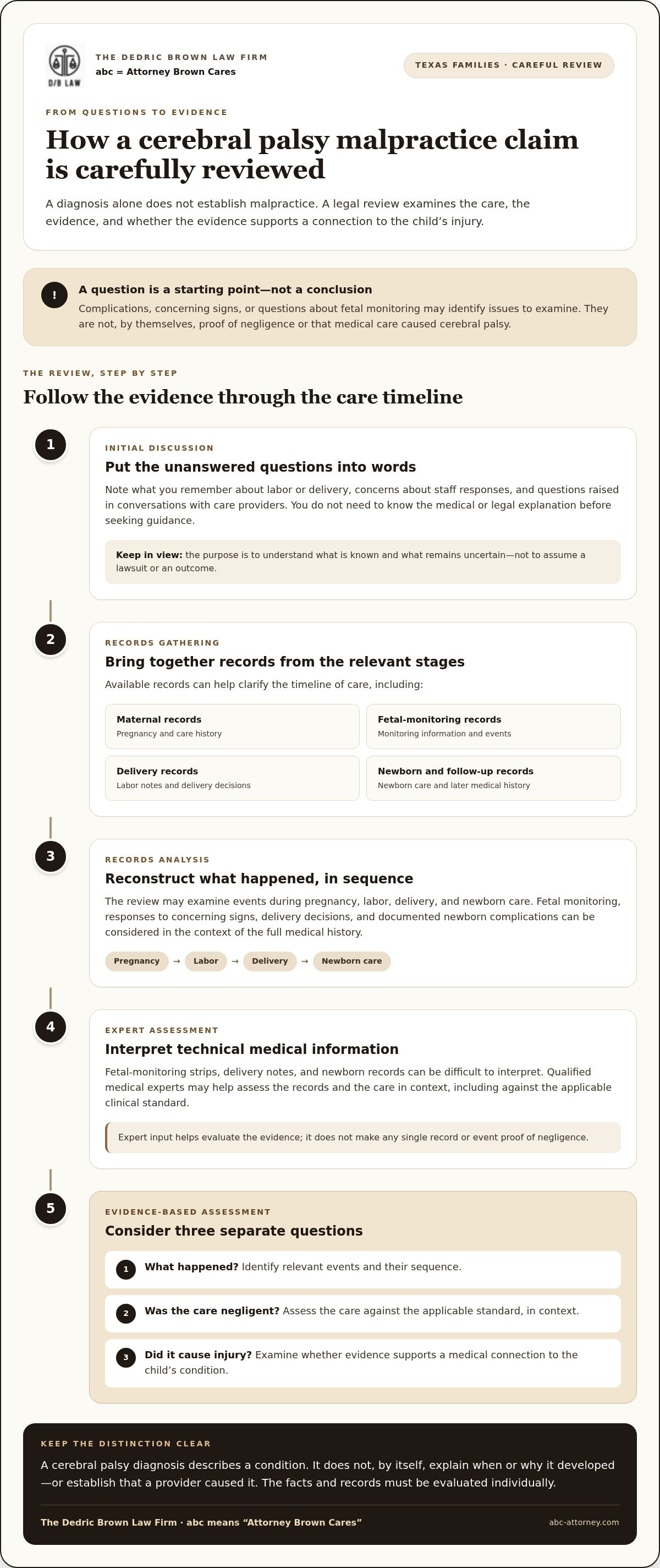
Connecting medical care to cerebral palsy takes more than identifying a difficult moment during pregnancy or birth. A careful review asks: What happened medically? Did the care fall below the applicable standard? Is there evidence that the care caused or contributed to the child’s injury? Each question requires its own evidence. An event can raise a question without answering it.
A cerebral palsy malpractice lawyer may compare the timeline of care with medical records and qualified expert analysis. For example, records might document fetal monitoring, a response to a concerning sign, and decisions about delivery. Reviewing these events in sequence can help clarify what providers knew and did. No single detail, by itself, establishes negligence or causation.
What happened? Identify relevant events and their sequence during pregnancy, labor, delivery, or newborn care.
Was the care negligent? Assess the care in context against the applicable clinical standard, rather than judging it with hindsight.
Did it cause injury? Examine whether evidence supports a medical connection between the care and the child’s condition.
The timing of an injury does not, by itself, show that medical care caused it. The connection must be evaluated through the specific medical history and evidence.
What birth and newborn events may warrant closer review?
Records may prompt questions about how fetal condition was monitored, how staff responded to warning signs, or what decisions were made during labor and delivery. Newborn records may also document complications that need careful medical interpretation. Hypoxic-anoxic brain injury, which involves reduced or absent oxygen to the brain, may be one issue examined in some cases. Its presence doesn’t establish that negligence occurred or explain its cause on its own.
Why are medical experts important in cerebral palsy claims?
Fetal-monitoring strips, delivery notes, and newborn records can be technical and difficult to interpret without clinical knowledge. Qualified medical experts may help explain what the records show, whether the care met applicable standards, and whether a medically supportable causal connection exists. The attorney evaluates the legal issues and investigates the evidence; medical experts address clinical questions. No particular expert opinion or case outcome is guaranteed.
This distinction matters. A record may show that a complication occurred, but understanding its significance may require reviewing the full timeline, the child’s medical history, and other possible explanations. An attorney can identify legal questions and assess what additional review may be needed. Families can also consult Texas Medical Malpractice Laws for general legal information; the rules and requirements for an individual claim call for case-specific legal guidance.
If questions about your child’s medical timeline remain, you can discuss concerns about a potential claim and learn what information may help clarify next steps.
What Evidence Helps a Lawyer Evaluate a Cerebral Palsy Malpractice Claim?
Medical records can tell a complicated story, but families shouldn’t have to decide on their own whether care was negligent. A cerebral palsy malpractice lawyer organizes the evidence around three connected questions: what care was provided, whether it may have departed from applicable standards, and what harm the child experienced. Records help guide those questions; they don’t automatically answer them.
Different records may shed light on different parts of the picture:
Care provided: Pregnancy and maternal records, labor-and-delivery notes, fetal-monitoring records, and newborn records may help establish what happened and when.
Possible departure from standards: Documentation of assessments, decisions, communications, and responses may help qualified reviewers evaluate the care in context.
Resulting harm: Diagnostic records and later treatment information may help explain the child’s condition, care needs, and changes over time.
A single note rarely provides the full context. The timeline matters because it can show how information and decisions unfolded across providers and settings. A complete medical timeline doesn’t decide a claim, but it can reveal which questions deserve closer investigation.
Which records and information may help begin an evaluation?
Preserve records you already have from pregnancy, delivery, newborn care, diagnosis, and later treatment. Keep original documents unchanged and save copies in an organized folder. In a separate note, list dates, provider names, questions you still have, and family recollections of important conversations or events. You don’t need to interpret medical terms or fill gaps yourself; a lawyer can identify what additional records may be relevant.
Helpful details may include when appointments or hospital stays occurred, which facility provided care, and where follow-up treatment took place. If you’re unsure whether a document matters, keep it rather than screening it out. Gaps, repeated entries, and differences between records may warrant review, but they aren’t proof of a mistake by themselves.
How does a lawyer assess injury-related losses?
Evaluating harm involves more than reviewing a diagnosis. The review may consider documented care needs, therapies, support at home or school, and how the child’s condition affects everyday activities. Treating-provider records can help describe services received and the child’s progress. Any assessment of future needs should rely on individualized evidence and appropriate professional input, not assumptions about what every child with cerebral palsy will require.
Attorney Dedric Brown’s Certified Public Accountant credential brings financial-analysis experience to the review of complex injury matters. That background may help organize and examine financial information alongside legal and medical evidence, but it doesn’t predetermine a claim’s value or outcome. The aim is a careful, fact-based assessment that recognizes documented needs and what remains uncertain.
What Should Texas Families Know About the Legal Process and Timing?
Considering a claim can feel like adding another burden to an already demanding time. A careful legal review should give your family a clearer picture of the process, not pressure you toward a decision. A cerebral palsy malpractice lawyer may begin by listening to your concerns, reviewing available records, and identifying questions that may need medical or legal analysis.
The process often follows a measured sequence:
Initial discussion: Share what you know, describe unanswered questions, and explain your family’s concerns.
Records review: Counsel examines available records and identifies gaps or issues for closer review.
Expert assessment: Qualified medical input may help evaluate clinical questions and possible causation.
Legal evaluation: The attorney considers whether the evidence may support a claim under applicable law.
Possible next steps: If the review supports moving forward, counsel can explain options and relevant procedures.
This isn’t a fixed timetable. Medical complexity, the amount and availability of evidence, the parties involved, and procedural developments can all affect how long an evaluation or claim takes. Your family can ask for updates and a plain-language explanation of what is known, what remains under review, and what may happen next.
What happens during an initial case evaluation?
Your family can describe events in your own words, share records already available, and raise questions that haven’t been answered. You don’t need a complete file or a legal theory. Counsel can help identify issues that may warrant further investigation and explain what additional information could be useful. An initial evaluation is a chance to understand possibilities, not a promise that a claim exists or will succeed.
Why should families ask about Texas deadlines early?
Legal deadlines can affect the options available, so timing deserves attention early in the review. The rules that apply may depend on case-specific facts and current Texas law. The date a child received a diagnosis doesn’t necessarily determine the filing deadline on its own. An attorney can assess the circumstances and explain which timing rules may apply, without relying on a general estimate or assumption.
Because these cases can involve detailed medical histories and legal requirements, early guidance can help families understand what needs review while there is time to investigate. The pace of a case may vary, but questions about deadlines shouldn’t be left unanswered while other parts of the evaluation proceed.
If your family is weighing what to do next, you can talk with the team about your family’s questions. A thoughtful discussion can help clarify the review process and the information that may be relevant to your circumstances.
How Can the Dedric Brown Law Firm Support a Texas Cerebral Palsy Claim?
Questions about your child’s care deserve careful attention and clear answers. The Dedric Brown Law Firm handles birth injury and medical malpractice litigation, including cases involving cerebral palsy. These matters can require close consideration of medical records, legal questions, and a child’s individual circumstances.
The firm’s abc identity reflects “Attorney Brown Cares,” a commitment to personal attention and client care. That means listening to your family’s concerns, explaining the review in understandable terms, and treating your child’s circumstances with respect. A cerebral palsy malpractice lawyer should help you understand what the evidence may show without treating a diagnosis as proof or promising a particular result.
What does a client-centered legal approach look like?
It starts with listening. Your family can explain what remains unclear and what matters most right now. Counsel can review relevant medical and injury-related evidence, identify unanswered questions, and discuss possible legal options in light of the facts. The goal is a grounded assessment, not pressure to decide before the evidence has been considered.
Your family shouldn’t have to interpret technical notes or predict the outcome alone. Clear explanations can help you understand what information may matter, what questions remain, and what a possible next step could involve.
Attorney Dedric Brown is both an attorney and a Certified Public Accountant. His legal and financial background brings an analytical perspective to complex injury matters. It doesn’t guarantee a valuation, compensation, or case result. Any assessment must be tied to the available evidence and your family’s specific circumstances.
How can a family start a conversation with the firm?
Begin with what you know. Share your concerns, describe the events that prompted questions, and bring any records already available. You don’t need to organize every detail or arrive with a conclusion. The first conversation can help clarify what your family wants to understand and what information may help assess possible next steps.
You can ask direct questions about the review and what remains uncertain. The conversation should respect your family’s priorities and provide information without making promises about whether a claim will succeed.
To share your concerns and begin that conversation, Contact the Dedric Brown Law Firm.
Take the Next Step at Your Family’s Pace
You don’t need every answer before asking for help. If questions about your child’s care continue to weigh on you, a conversation with a cerebral palsy malpractice lawyer can help you understand which options may be worth considering. Seeking information doesn’t commit your family to a lawsuit or predetermine what a review will find.
Start with the concern that matters most to you. You might want to understand a medical record, make sense of an unanswered question, or learn what an evaluation could involve. A focused conversation can help you decide what feels right for your family, one step at a time.
Your family deserves to be heard and treated with care. When you’re ready, request a conversation about your concerns. Begin with the questions you have today and take the next step with greater clarity.
Frequently Asked Questions
Can cerebral palsy develop without medical malpractice?
Yes. Cerebral palsy can occur for reasons that aren’t tied to negligent medical care, and a diagnosis alone doesn’t establish what caused it. An individual review considers the child’s medical history and relevant evidence rather than assuming a provider was responsible. For example, records may document a complication without showing that a different medical response would have changed the outcome. Medical and legal analysis helps distinguish a documented event from evidence of causation.
Can a hospital be responsible for a cerebral palsy injury?
A hospital may be responsible in some cases, but its role depends on the facts and applicable law. An evaluation may examine what happened at the facility, which providers were involved, and how the available records describe the care. The question isn’t answered simply because a birth or treatment occurred in a hospital. A lawyer can assess whether evidence supports a claim involving the hospital or other parties.
What medical records should parents keep after a difficult birth?
Keep copies of records you can access, including hospital discharge papers, test results, care instructions, and follow-up appointment summaries. If records are in an online patient portal, save electronic copies in a secure place, since portal access or organization can change. A simple index with dates and document names can make materials easier to find later. Preserve originals as they are, and don’t worry about deciding which records are legally important.
How long can a cerebral palsy malpractice case take in Texas?
There’s no single timeline that applies to every Texas case. The time involved may depend on how quickly records can be obtained, the medical questions requiring expert review, the number of parties, and whether key issues are disputed. Some steps may take longer if the available documentation is incomplete or requires clarification. A lawyer can discuss the likely stages after learning more, but an early estimate can change as the case develops.
Can a family explore a claim before every future care need is known?
Yes. A family can ask about a potential claim while the child’s care and needs are still developing. An initial review can focus on information available now, such as current treatment and documented support needs, without pretending to know exactly what the future will require. As the child’s circumstances become clearer, additional information may help inform later evaluation. Families don’t need to predict every future need before raising questions with a lawyer.
What should parents expect during a first conversation with a cerebral palsy lawyer?
A first discussion with a cerebral palsy malpractice lawyer is an opportunity to explain your family’s concerns and ask what information may be useful. You can bring questions or records you already have, but you don’t need a complete file or a polished timeline. Texas families in Houston, San Antonio, Dallas, Austin, Beaumont, Huntsville, Prairie View, and Brenham can discuss their circumstances with the firm. The conversation doesn’t guarantee a claim or result.
Does a child need a final cerebral palsy diagnosis before a family can ask a lawyer questions?
No. Parents can ask questions while doctors are still evaluating a child or refining a diagnosis. A conversation may help clarify what records exist and what information could matter for a later review. That early discussion doesn’t establish that malpractice occurred, and the medical picture may continue to develop. If you’re concerned about care during pregnancy, birth, or newborn treatment, you can raise those concerns without waiting for every clinical question to be settled.



Comments