
Brachial Plexus Birth Injury Lawsuits and Compensation Factors

A birth injury can affect a child’s movement long after delivery. The brachial plexus is a bundle of five nerves that runs from the spinal cord through the neck to the shoulders, and an injury to these nerves can impair an arm or shoulder. A brachial plexus birth injury lawsuit examines whether medical care during childbirth caused preventable harm, not simply whether an injury occurred.
It’s understandable to want clear answers while caring for your child and planning for ongoing needs. The injury’s severity, its effect on your child’s daily life, and the evidence about how the delivery was managed can all matter when evaluating a claim.
This article explains brachial plexus injuries, factors that may affect compensation, and how attorneys assess possible malpractice. It also describes how claims proceed and why filing deadlines depend on the state where the case is brought.
Table of Contents
What Is a Brachial Plexus Birth Injury?
The brachial plexus is a bundle of five nerves running from the spinal cord through the neck to the shoulders. These nerves help control movement and sensation in the shoulder, arm, and hand. An injury during birth can stretch or damage them, limiting a child’s arm movement. Effects range from temporary weakness to lasting loss of function, so the diagnosis alone doesn’t describe the full impact.
A mildly stretched nerve may heal over a few months. Approximately 20% to 30% of children with brachial plexus injuries may not recover fully. The injuries occur in approximately 1.5 to 1.7 out of every 1,000 live births. A lasting impairment can affect everyday tasks and long-term independence. The child’s observed function and medical assessments help show how the injury affects their life.
Injury severity, permanence, treatment, and effects on arm function can shape compensation. A brachial plexus birth injury lawsuit examines whether negligent care caused the injury and what losses followed. The amount depends on evidence connecting delivery care to the child’s needs and documented harm.
There is no single statute of limitations for birth injury lawsuits across all states. Most states allow at least two years to file a medical malpractice lawsuit, but rules and exceptions vary, including for minors. For a birth in Texas, families should identify the applicable state deadline promptly. The filing period depends on the governing rules and the claim’s circumstances.
Settlement and verdict amounts differ widely, even when cases involve similar injuries. A 2023 settlement was $150,000 for an infant’s alleged permanent brachial plexus impairment. In 2022, a settlement involving Erb’s palsy and two surgeries was $2,537,354. Those figures show different outcomes, not a formula for valuing another child’s claim.
Other results illustrate the range. A jury awarded $15,800,000 in 2022 in a case involving brachial plexus injury and C5-C7 spinal nerve damage. A 2020 settlement involving a baby’s brachial plexus injury and Erb’s palsy was $365,000. A jury awarded $4,821,000 in 2016 for permanent loss of function in an infant’s right arm.
One example involved an allegation that excessive traction during delivery caused an infant’s injury. In 2016, a jury awarded $2,814,338 in that case. In 2018, a jury awarded $2,320,335 in a case involving limited use of a baby’s right arm. These outcomes reflect specific evidence and harm, not a prediction for a different family.
When reviewing a settlement or verdict, consider the injury’s lasting effects, treatment history, and evidence about the delivery. A child who regains function faces different circumstances from one with permanent limitations. These differences help explain why reported outcomes range from thousands to millions. Each result must be understood in the context of the child’s documented injury and the evidence presented.
Factors affecting compensation amounts
Compensation reflects how an injury affects a child’s health, function, and future needs. The extent of arm use is one consideration: a child with little use of a severely injured arm may face different challenges from a child whose movement improves. Medical records, treatment recommendations, and observations of daily activities help show the injury’s effects on the individual child. A claim’s value depends on the evidence, not the diagnosis alone.
Current and future medical needs also shape an assessment. Treatment records show care already received, while clinicians’ recommendations help describe what may be needed next. A future-care projection can organize expected treatment, therapy, and possible procedures based on the child’s medical evidence. It should distinguish recommended care from possibilities that lack support, connecting projected needs to the injury and the child’s condition.
Future care planning considers the type of service, how often it may be needed, and how long it may continue. Those details should be grounded in the child’s assessments and treatment history, not a generic estimate. As the child’s condition develops, updated medical information can refine the picture of ongoing needs. The aim is to explain the care plan and its connection to the injury.
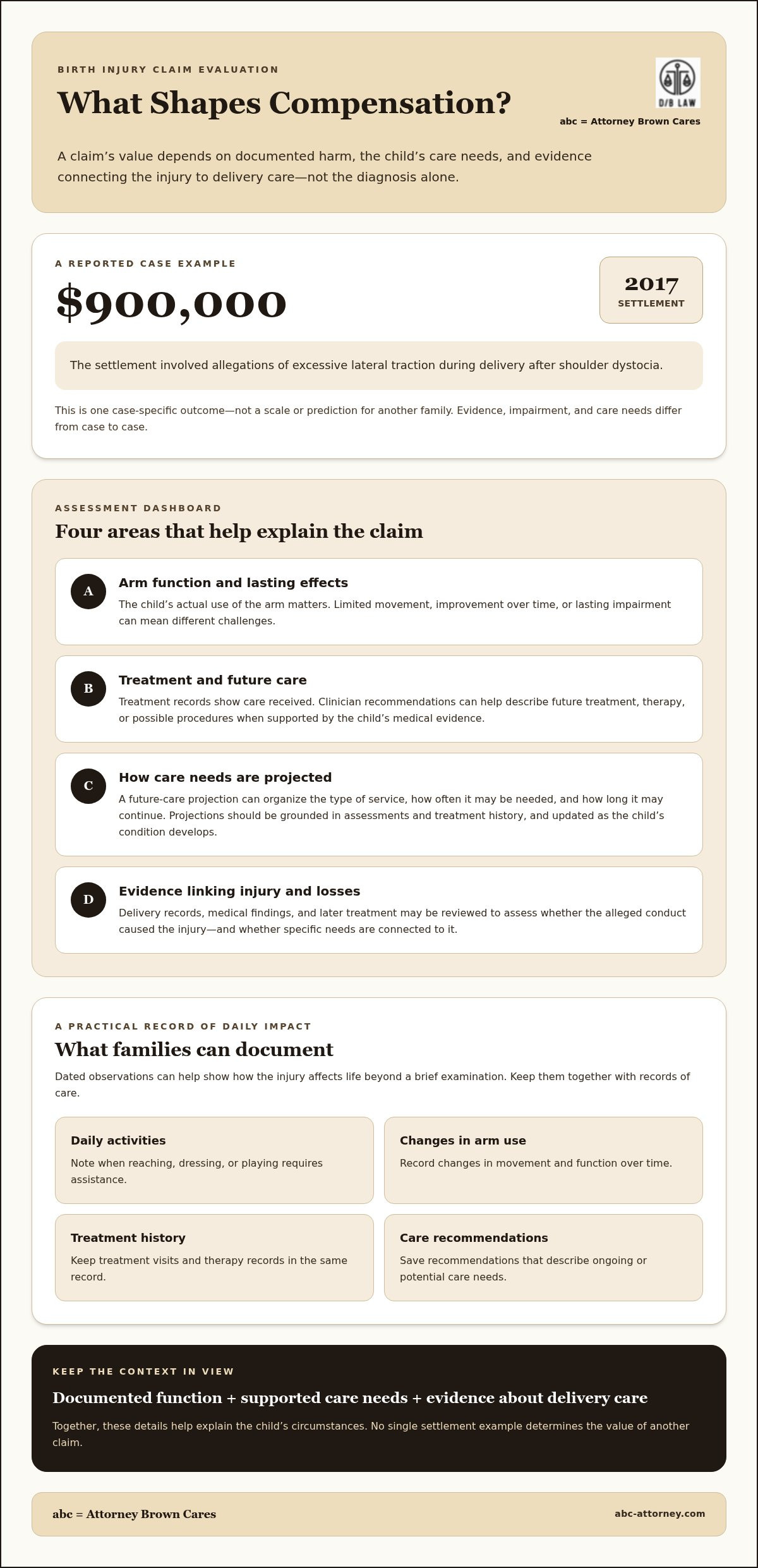
The injury’s severity and lasting effects can carry substantial weight. A 2017 settlement of $900,000 involved allegations of excessive lateral traction during delivery after shoulder dystocia. These examples illustrate different outcomes, not a scale that determines another family’s claim. Differences in evidence, impairment, and care needs matter.
Evidence of responsibility must support the losses claimed. A review may compare delivery records, medical findings, and the child’s later treatment to assess whether the alleged conduct caused the injury. The claim must also connect specific needs to that injury. If records document limited movement but do not explain its cause or consequences, the case may be harder to evaluate fully.
Parents can help clarify their child’s needs by keeping dated notes about daily activities, treatment visits, and changes in arm use. For example, record when reaching, dressing, or playing requires assistance. Keep recommendations and therapy records alongside these observations. Together, they provide a practical record of the injury’s effects beyond what a brief examination may capture.
To discuss how medical evidence and care projections fit together, families can discuss a birth injury claim. A focused review can organize the documented injury, its effects, and the support needs tied to the child’s records.
Potential medical malpractice during childbirth
A brachial plexus injury can happen during a difficult delivery, but the injury alone doesn’t establish malpractice. The key questions are what happened during birth, how the team responded, and whether that care caused the nerve damage.
Brachial Plexus Injuries During Childbirth
The nerves may be injured when a baby’s shoulder becomes stuck behind the mother’s pelvis after the head delivers. This complication is called shoulder dystocia. The birth team’s actions during that emergency matter: investigators examine the delivery record, the sequence of maneuvers, and the medical evidence connecting those actions to the injury. Shoulder dystocia occurs in roughly 0.2% to 3% of vaginal births.
Shoulder dystocia can require the birth team to act quickly, but force and technique remain central issues in some claims. Brachial plexus injuries involving shoulder dystocia were 2.5 times more likely to become permanent. That association does not prove an individual clinician caused a particular injury. The specific delivery circumstances and medical records must be assessed together.
A New Jersey case illustrates how the details can become disputed. The obstetrician testified that he rotated the baby’s head 180 degrees while trying to free a stuck shoulder. The plaintiff’s attorney argued that the maneuver pulled nerves from the spinal cord and severely injured the child’s arm. The differing accounts show why testimony and delivery documentation can matter.
In 2023, a Missouri jury awarded $2,840,000 in a lawsuit alleging an OB/GYN used excessive force while responding to shoulder dystocia. The award reflects that case’s evidence, not a universal measure of negligence or damages. A careful review asks whether the alleged maneuver occurred, whether it caused the injury, and how the child was affected.
Who May File a Child’s Claim
A parent or legal representative generally pursues a birth injury claim on a child’s behalf. The responsible adult helps present the child’s medical records, delivery details, and resulting needs. State rules govern who may act for a minor and how the claim proceeds. Because filing deadlines also vary by state, identify the child’s birth state and applicable rules early.
To assess possible malpractice, organize the birth timeline, delivery notes, and records describing the child’s arm function after birth. Compare documented actions with the circumstances of shoulder dystocia and medical evidence about the injury’s cause. This step-by-step review distinguishes the fact of an injury from evidence that a particular act during delivery caused it.
How brachial plexus birth injury claims work
A claim develops through evidence gathering, legal review, and negotiation or litigation. Each stage connects the delivery events to the child’s injury and resulting needs.
Claim Filing Deadlines
Most states allow at least two years to file a medical malpractice lawsuit, but deadlines and exceptions vary by state. Rules may differ when the injured person is a minor. Claims involving government hospitals can have additional procedural requirements, so identify the hospital’s legal status and the state where the care occurred early.
Start by recording the child’s birth date, when the injury was identified, and the hospital involved. These details help determine which filing rules may apply. A general deadline cannot establish the precise limit for every family. State-specific rules and the claim’s circumstances control the filing timeline.
Evidence for Proving a Claim
A brachial plexus birth injury lawsuit needs evidence connecting delivery care to the child’s nerve damage. Relevant materials can include prenatal and labor records, delivery notes, the newborn’s examination, and later medical evaluations. Together, these records can establish a timeline, describe the injury, and document changes in the child’s arm function.
Organize records by date and keep copies of treatment recommendations, therapy notes, and observations about daily activities. A legal review can compare the delivery account with medical findings and assess whether the evidence supports negligence and causation. These are distinct questions: an injury alone does not establish that negligent care caused it.
After the records are reviewed, the claim may proceed through negotiation or a lawsuit. Most birth injury lawsuits settle out of court. Settlement discussions typically weigh evidence of responsibility, the injury’s effects, and documented care needs. If the parties do not resolve the dispute, litigation can require formal evidence exchange, expert analysis, and a trial. The path depends on how the case develops.
Before signing an agreement, families should understand how a lawyer handles investigation, communication, and case costs. Fee arrangements differ, so read the written agreement carefully. It should explain how attorney fees are calculated, which expenses may arise, and how those expenses are handled if the claim ends in settlement or trial.
Finding counsel locally means identifying attorneys who handle birth injury or medical malpractice claims in the state where the birth occurred. State rules matter, especially when a child or government hospital is involved. In an initial discussion, parents can ask what records are needed, how the attorney evaluates causation, and which filing steps may apply. A clear plan helps families understand the process without mistaking a possible settlement for a guaranteed outcome.
What evidence is needed to prove a brachial plexus birth injury lawsuit?
A strong claim needs evidence linking delivery events, the nerve injury, and resulting harm. A diagnosis alone cannot explain how the injury occurred or establish whether negligent care caused it. Parents can help build a clear record by preserving documents, noting dates, and describing changes in the child’s arm function. Each item should support a specific part of the claim.
Start with records from pregnancy, labor, delivery, and newborn care. Prenatal notes may document concerns about the baby’s size or other delivery risks. Labor and delivery records can show when complications arose, which staff participated, and what actions followed. Newborn examinations and early treatment notes can help establish when weakness or restricted movement first appeared.
Medical evidence should also explain the injury’s nature and course. Keep diagnostic reports, specialist assessments, therapy notes, and treatment recommendations together. For example, a clinician’s description of limited shoulder movement can be compared with later records showing whether function changed. This chronology helps clarify the injury’s impact and the care the child has received.
Delivery records and medical opinions serve different purposes. Records describe what was documented during birth; qualified medical experts can help interpret those events and the injury’s cause. A careful review looks for consistency between the delivery account, examination findings, and later evaluations. If accounts differ, the wording, timing, and author of each record can matter.
Evidence of daily effects adds context to clinical records. Parents can keep dated notes describing specific tasks the child struggles with, such as reaching for a toy or raising an arm. Photos or videos may illustrate movement at different times, while therapy plans can show recommended support. These examples should complement, not replace, formal medical documentation.
Organize materials by date and keep original copies where possible. A simple timeline can list the birth, first observed symptoms, evaluations, and treatment milestones. Record who created each document and where it came from. This system can help a legal review identify gaps, compare accounts, and connect medical findings to the delivery timeline.
Before sharing a child’s records, gather the delivery documentation, medical evaluations, and dated notes about daily function. These materials can help clarify what happened and what questions remain. Ask for a review of birth injury evidence to discuss how the records may support a claim.
The Dedric Brown Law Firm: Traumatic Brain Injuries
The Dedric Brown Law Firm represents families pursuing claims involving birth injuries and brachial plexus palsy. When a child’s nerve injury raises questions about delivery care, the firm’s medical malpractice litigation work can help families examine records, assess how the injury occurred, and understand the claim process. The firm also handles traumatic brain injuries and hypoxic and anoxic brain injury cases.
Parents can consider legal guidance when medical records, delivery events, or ongoing effects raise concerns about preventable harm. A careful review focuses on the evidence and the child’s needs, not assumptions about fault or outcome. The firm’s ABC message means “Attorney Brown Cares,” reflecting its stated focus on personal attention.
Contact The Dedric Brown Law Firm to discuss a birth injury concern, or visit abc-attorney.com.
Take the Next Step With a Clear Record
Your child’s needs may become clearer as treatment continues. Keep a current record of care, recommendations, and changes in everyday abilities. This provides a practical starting point for discussing how the delivery history, medical findings, and future support needs relate. A brachial plexus birth injury lawsuit requires careful attention to these connections, not assumptions based on diagnosis alone.
The Dedric Brown Law Firm handles birth injury matters, including cases involving traumatic brain injuries and hypoxic and anoxic brain injury. If you’re weighing what to do next, a conversation can help you understand how your records may inform a claim and what questions deserve attention. You can contact The Dedric Brown Law Firm to discuss your concerns. Take the next step at your own pace, with your child’s well-being at the center.
Frequently Asked Questions
How much is a nerve damage settlement worth?
There’s no single settlement amount for nerve damage; outcomes depend on the injury and evidence. The injury’s permanence, its effect on arm function, treatment needs, and evidence about how the harm occurred all shape case value. A reported result from another state or family cannot predict what a different claim may be worth.
What Is Shoulder Dystocia in Birth?
Shoulder dystocia is a childbirth complication in which a baby’s shoulder becomes stuck behind the mother’s pelvis after the head delivers. The birth team must respond to the obstruction, and the specific maneuvers used become important details in a later review. For parents, delivery notes can help clarify when the complication was recognized, what actions followed, and how the team documented the baby’s condition afterward.
When Do You Know a Brachial Injury Is Permanent?
There isn’t one date that establishes permanence for every child; ongoing function and medical assessments help describe the injury’s course. One study suggests 93% of patients who reach full recovery from nerve damage do so within four months. That finding isn’t a diagnosis for an individual child. Parents can ask the treating team to explain what changes in movement or sensation they’re tracking over time.
What is a brachial plexus birth injury and what causes it?
A brachial plexus birth injury is damage to the nerve bundle of five nerves that runs from the spinal cord through the neck toward the shoulders. It can affect movement or sensation in the arm. One childbirth situation linked to these injuries is shoulder dystocia, when a shoulder becomes stuck after the baby’s head delivers. The injury’s presence alone doesn’t establish how it happened.
When can a brachial plexus birth injury be caused by medical malpractice?
Possible malpractice is considered when evidence suggests negligent delivery care caused the nerve injury. For example, a claim may examine whether a maneuver used during shoulder dystocia involved excessive force and whether that action caused the child’s harm. The review compares the delivery account with medical findings and the timing of symptoms. A difficult birth or an injury, by itself, doesn’t establish negligence.
What is the average settlement or verdict in these birth injury cases?
There’s no single average that reliably describes settlements and jury verdicts in these cases. A settlement is an agreement resolving a claim; a verdict is a jury’s decision after trial. Comparing results makes more sense when injuries, permanence, treatment history, arm function, and evidence of responsibility are similar. A brachial plexus birth injury lawsuit must be assessed on its own evidence, not another family’s headline result.
What steps should parents take before filing a birth injury claim?
Before taking action, parents can make a dated timeline of the birth, early symptoms, evaluations, and treatment. Keep copies of records and note which questions remain unanswered. Texas families should also identify the state where the birth care occurred, because filing rules vary by state. These preparations can help a legal review focus on the child’s individual history instead of relying on memory alone.
What risks or challenges can affect a birth injury claim?
A central challenge is proving how and when the injury occurred, especially if the delivery account conflicts with later medical evidence. In one case, the defense argued that the child’s arm injury was a natural occurrence and didn’t happen during delivery. This illustrates how causation can be disputed. Incomplete records, differing accounts, and uncertainty about lasting effects can also complicate evaluation of a brachial plexus birth injury lawsuit.



Comments