
Statute of Limitations for Birth Injury Claims: The 2026 Guide to Deadlines
- Dedric Brown

- Apr 25
- 13 min read
The law doesn't wait for your family to heal before it starts the countdown on your legal rights. It's a harsh reality that many parents don't realize until a deadline has already passed. You've likely spent every waking hour focusing on your child's therapy and specialized care. It's natural to feel overwhelmed or even guilty for not pursuing legal action sooner, but the clock is a relentless opponent in the courtroom. Understanding the statute of limitations for birth injury claims is the first step in fighting back for the justice your child deserves.
We believe your family deserves an advocate who applies the precision of an internal auditor to every detail of your case. This 2026 guide will help you navigate complex state laws and identify critical exceptions like the Discovery Rule that could protect your right to compensation. We'll break down the specific deadlines you face and show you how to evaluate your options with zero financial risk. You pay nothing unless we win your case, because your focus should remain on your child's future while we handle the rigorous legal scrutiny.
Key Takeaways
Understand why these legal deadlines act as mandatory expiration dates and why birth injury cases often provide more time than standard personal injury claims.
Learn how the Discovery Rule can pause the clock, effectively extending the statute of limitations for birth injury claims when symptoms are not immediately apparent.
Identify the "hard" deadlines known as statutes of repose that can permanently bar your right to recovery regardless of when an injury is found.
Differentiate between parent and child claims to ensure you are fighting for both immediate medical expenses and your child’s long-term financial security.
Discover how an auditor’s precision can safeguard your case through a comprehensive, no-cost investigation of your specific legal deadlines.
Table of Contents What is the Statute of Limitations for Birth Injury Claims? Tolling and the Discovery Rule: When the Clock Pauses Statutes of Repose vs. Statutes of Limitations Dual Deadlines: Parent Claims vs. Child Claims The Auditor’s Approach to Birth Injury Litigation
What is the Statute of Limitations for Birth Injury Claims?
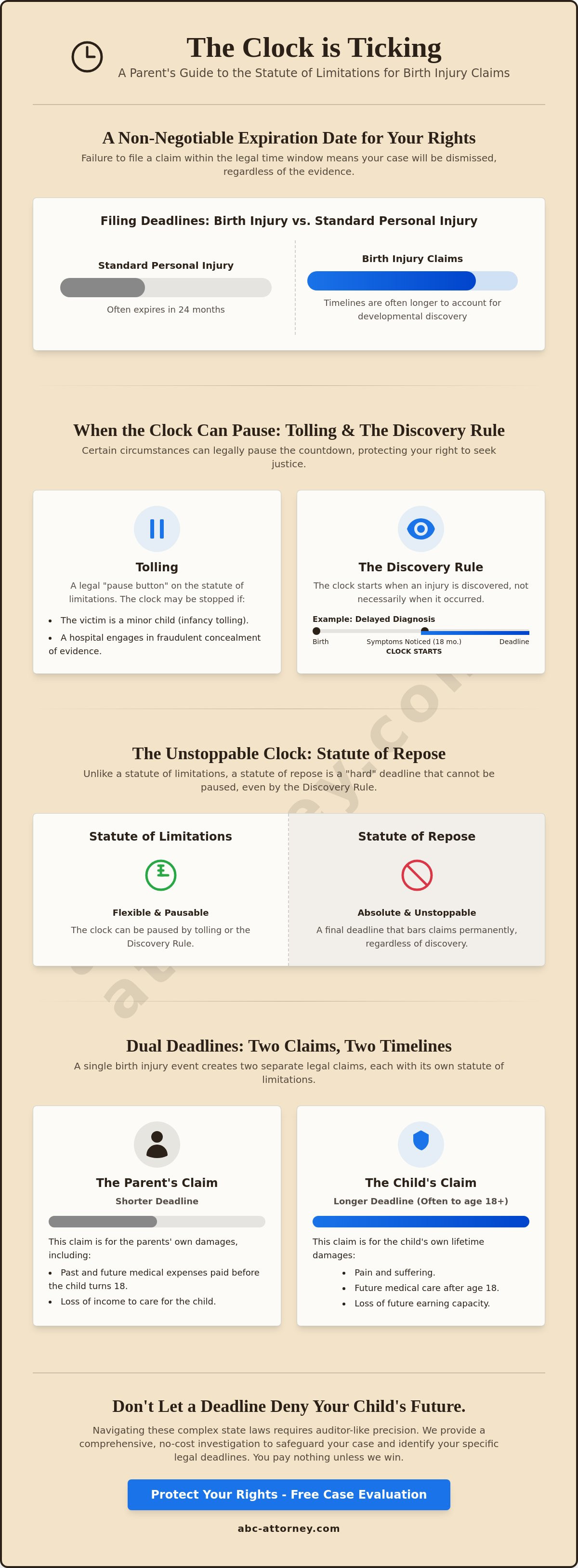
The statute of limitations for birth injury claims serves as a strict, non-negotiable expiration date for your legal rights. It isn't a suggestion; it's a hard wall. If you fail to file your claim within this window, the court will dismiss your case regardless of the weight of your evidence. While standard personal injury claims often expire in 24 months, birth injury litigation follows a more complex path. These timelines are often longer to account for the time it takes for a child's developmental milestones to reveal a permanent injury. However, this extended window shouldn't lead to complacency. Missing this specific legal window results in a permanent loss of the right to seek justice for your child. Every state maintains unique rules for medical malpractice time limits, making it vital to understand the specific laws governing your location.
Why Do These Legal Deadlines Exist?
Legal systems implement these cutoffs to protect the integrity of the judicial process. They ensure that evidence is fresh, medical records are accessible, and witnesses are still available to testify. From a defense perspective, hospitals and insurance carriers view these deadlines as their most effective shield. They'll search for any technicality to prove you waited too long. We combat this by applying the same level of scrutiny I used as a Certified Public Accountant and Internal Auditor. We verify every date and every document to protect your claim. The accrual date is the specific moment the legal clock begins to tick.
The Complexity of National Birth Injury Laws
The legal landscape is a fragmented map of conflicting rules. Deadlines can range from a mere 12 months in some jurisdictions to 21 years in others. Understanding Medical malpractice in the United States requires navigating these state-by-state variations. A major challenge arises with the Choice of Law issue. If your child suffered an injury in a Georgia hospital but your family moved to New York 3 years later, the filing deadline could change based on complex interstate statutes. You need an advocate who understands the data, the law, and the path to victory. A national-level firm provides the comprehensive oversight needed to manage these interstate conflicts. We offer expertise, a proven track record, and unwavering dedication to ensure your case stays on track. Don't let a clerical error or a missed date cost your child their future. We fight relentlessly to protect your rights from the first consultation to the final victory.
Tolling and the Discovery Rule: When the Clock Pauses
Tolling serves as a legal pause button on the statute of limitations for birth injury claims. It ensures that the window for justice doesn't slam shut before you even realize a mistake happened. I use an auditor’s precision to calculate the statute of limitations for birth injury claims in every case I handle. The law recognizes that birth injuries are unique; they don't always reveal themselves in the delivery room. Tolling stops the clock when specific conditions prevent you from filing, such as when a hospital engages in fraudulent concealment or when the victim is a minor child.
The Discovery Rule is the most common reason for tolling. Under this rule, the clock may not start until the injury is discovered or reasonably should have been found. This is vital because medical negligence is often buried under layers of technical jargon. A Congressional Research Service report on medical malpractice confirms that these rules are essential for balancing the rights of patients against the finality sought by healthcare providers. We fight relentlessly to ensure that a doctor's silence doesn't become your child's loss.
The Discovery Rule in Birth Injury Litigation
Many birth injuries, including Cerebral Palsy, remain invisible for months. Parents often notice something is wrong only when a child misses a physical or cognitive milestone at 12 or 18 months. The "Reasonable Diligence" standard asks what a typical parent would know. If a hospital audits its records and discovers a lack of oxygen during delivery but hides that fact from you, the clock shouldn't run. We scrutinize medical logs with the eye of an Internal Auditor to see if the cause of injury was intentionally obscured. If you suspect a delay in diagnosis, you should consult with a legal expert to evaluate your specific timeline.
Tolling for Minors: Protecting the Child’s Future
Most states provide "infancy tolling" to protect a child's independent right to sue. This often keeps the claim open until the child reaches the age of majority, usually 18 or 21. This protection is separate from the parents' own deadlines for medical expenses. However, the legal landscape is shifting. By January 2026, approximately 15 states have enacted stricter statutes of repose that cap these extensions at 7 or 10 years regardless of the child's age. I track these legislative changes with the same rigor I used as a Certified Public Accountant to protect your child's future victories and financial security.
Statutes of Repose vs. Statutes of Limitations
Understanding the deadline for your case requires more than a calendar. You must understand two distinct legal barriers: the statute of limitations and the statute of repose. While the statute of limitations for birth injury claims often provides flexibility through the Discovery Rule, the statute of repose is a rigid, unforgiving "stop clock." We analyze both dates with the precision of a financial audit to ensure your family's right to compensation remains intact.
The statute of limitations typically begins when you first discover the injury. In contrast, a statute of repose begins the moment the medical error occurred, regardless of when symptoms appear. This creates a dual-track deadline system. If you miss either one, the court will likely dismiss your case before it even begins. Our firm brings a unique combination of legal aggression and analytical rigor to this complex calculation.
The "Hard Ceiling" of Medical Malpractice
Think of the statute of repose as a "hard ceiling" on your legal rights. Even if a child’s developmental delays don't become clear until they enter grade school, a state repose period might cut off all legal options after 10 or 15 years. Hospital associations and insurance groups lobby relentlessly for shorter repose periods. They want to limit their long-term liability and "close the books" on potential claims as quickly as possible.
This creates a dangerous trap for families dealing with subtle brain injuries or motor skill deficits that take years to manifest. "A statute of repose acts as an absolute bar to recovery, making early investigation by an expert essential." We use our background as auditors to scrutinize medical timelines, ensuring we identify every act of negligence before these hard deadlines expire.
Navigating the Intersection of Both Laws
The conflict between these two laws often emerges in complex developmental cases. Consider a hypothetical scenario where a child is diagnosed with a specific cognitive disability at age 12. If that state has a 10-year statute of repose, the claim might be barred even if the parents only just discovered the link to a birth complication. This is where principled combativeness becomes necessary.
Our firm fights to find every possible exception to these seemingly absolute bars. We look for specific triggers that may pause or "toll" the clock, such as:
Fraudulent concealment of medical errors by the hospital.
The presence of foreign objects left during a surgical procedure.
Specific state-level protections for minors that extend the repose period.
We don't accept a hospital's "expired" defense at face value. We apply a high level of scrutiny to the timeline, searching for the evidence needed to keep your path to justice open. When facing technical legal barriers, you need an advocate who is both a sophisticated expert and a relentless fighter. We provide the comprehensive oversight required to protect your child's future.
Dual Deadlines: Parent Claims vs. Child Claims
A single medical error during delivery creates a ripple effect that impacts two different legal entities: the parents and the child. It's vital to recognize that these are distinct claims with separate clocks. We fight for both, but we approach them with different tactical goals. The parent's claim addresses the immediate financial devastation. The child's claim secures their entire future. Missing the statute of limitations for birth injury claims on one side doesn't always mean the other is lost, but it does mean you lose a portion of the justice you deserve. We treat this with the same rigor an auditor applies to a complex financial statement.
Economic Damages and the Parent’s Window
Parents often face a much tighter deadline, frequently as short as 24 months from the date of the injury. This window covers the "out-of-pocket" expenses. If you miss this date, you lose the right to recover the costs of the initial hospital stay, specialized nursery equipment, and your own lost wages. My background as a Certified Public Accountant (CPA) and Internal Auditor allows me to analyze these losses with surgical precision. We don't just provide estimates; we audit the financial impact of the injury to ensure every dollar is accounted for. Losing this portion of a settlement can leave a family struggling to stay afloat while they wait for the child's case to resolve. We act relentlessly to ensure your family's current financial stability isn't sacrificed to a missed deadline.
The Child’s Right to Independent Recovery
The law treats the child as an independent victim. Even if a parent fails to file within their own 2-year window, the child’s right to sue often remains open through "tolling" provisions for minors. A "Guardian ad Litem" can step in to represent the child's interests. This claim is the heart of the case because it focuses on a comprehensive "Life Care Plan." These plans often calculate 30 to 70 years of specialized medical needs, including:
Ongoing physical and occupational therapy sessions.
Home modifications for accessibility.
Advanced medical technology and mobility aids.
Professional nursing care or assisted living costs.
Never assume it's too late to seek justice. While the statute of limitations for birth injury claims is a rigid barrier, there are paths to victory for your child that remain open long after the parents' deadline has passed. We search for every available avenue to secure the resources your child needs for a dignified life.
Don't let a ticking clock rob your child of the care they deserve. Contact the Dedric Brown Law Firm today for a professional audit of your legal deadlines.
The Auditor’s Approach to Birth Injury Litigation
The Dedric Brown Law Firm approaches every case with the precision of a forensic audit. We don't just review files; we scrutinize every second of medical data to find the exact trigger of negligence. Our firm operates as a Multifaceted Expert, combining the meticulous nature of a Certified Public Accountant (CPA) with the aggressive combativeness of a seasoned litigator. We offer a "Nothing-to-Lose" commitment to families. We investigate the statute of limitations for birth injury claims at zero cost to you.
Hospital logs often hide the truth behind layers of technical jargon and complex data systems. Our background as Information Systems Auditors (CISA) and Internal Auditors (CIA) allows us to dig deeper than a standard law firm. We search for inconsistencies in electronic health records, fetal monitoring strips, and timestamped entry logs. This data-driven strategy ensures we identify the precise moment your child’s rights were violated. Our team transforms raw data into a compelling narrative for justice.
Why a CPA/Attorney Duo is Your Best Ally
Technical expertise matters when you're fighting a hospital's legal team. Our financial background allows for a rigorous audit of medical billing and fetal monitoring data. We look for the patterns that others miss. This principled combativeness is essential to challenge the timelines presented by insurance companies. Dedric Brown brings a disciplined and competitive edge to the courtroom. His experience as a basketball coach, known as "Swish," translates into a relentless drive for victory. We play to win; we prepare every case with championship-level intensity. You get a champion who understands the numbers and the law.
Taking the First Step Toward Justice
We understand the financial strain a birth injury places on a family. That’s why we stand by our promise: You Pay Nothing Unless We Win Your Case. This commitment removes the barrier to entry. It lets you focus on your child’s care while we handle the legal battle. We provide the expertise, the track record, and the personalized service you need during this difficult time.
Don't wait until it's too late. Get a comprehensive "Statute Audit" of your case today. We will analyze the statute of limitations for birth injury claims specifically for your situation. Time is literally of the essence. Every day that passes is a day closer to a deadline that could end your legal options. Don't let the clock run out on your child's future. Let us start the fight for the justice and recovery your family deserves.
Take Decisive Action to Protect Your Child’s Legal Rights
The 2026 legal landscape for medical malpractice demands absolute precision. Missing the statute of limitations for birth injury claims means losing your right to seek justice forever. You must navigate complex tolling rules and the specific discovery deadlines that vary across all 50 states. Our firm applies CPA-certified precision to every legal audit; we ensure your filing meets every rigorous standard. We bring the scrutiny of an Internal Auditor to your case to identify every available avenue for recovery. We provide relentless advocacy with a nothing-to-lose guarantee. You don't pay a single cent unless we win your case. Our national expertise in complex birth injury litigation ensures your family has a formidable ally in the courtroom. Don't let a calendar error dictate your child's future. It's time to secure the professional reassurance you deserve from a team that treats your case like a championship game.
Get Your Free Statute of Limitations Audit with The Dedric Brown Law Firm
We are standing by to fight for the victory your family earned.
Frequently Asked Questions
How long do I have to file a birth injury claim in 2026?
In 2026, the statute of limitations for birth injury claims typically ranges from 2 to 6 years depending on your state’s specific statutes. While parents often face a 24 month window to file for their own damages, many states allow the child’s claim to be tolled until they reach age 18. This creates a dual-track deadline system that requires expert, auditor-level precision to navigate correctly and secure your victory.
Can I still sue if my child was born 5 or 10 years ago?
Yes, you can often still pursue justice if your child was born 5 or 10 years ago because most jurisdictions pause the clock for minors. In states like Georgia or Florida, the law recognizes that a child’s rights shouldn't expire before they can speak for themselves. I use my background as a Certified Public Accountant and Internal Auditor to scrutinize your medical records and confirm if your specific window remains open.
What is the Discovery Rule in medical malpractice?
The Discovery Rule is a legal principle that starts the filing clock on the date you actually discovered the injury, rather than the date of birth. For example, if a doctor’s error caused a brain injury that didn't manifest until a developmental milestone at age 3, the countdown may begin then. This rule provides a vital safety net for families who didn't immediately realize medical negligence occurred during delivery.
What happens if I missed the statute of limitations for my child’s injury?
If you miss the statute of limitations, the court will likely dismiss your case regardless of the evidence's strength. However, exceptions exist for cases involving medical fraud or the intentional concealment of records by a hospital. I relentlessly search for these narrow legal paths to ensure that negligent providers don't escape accountability through a technicality. My firm provides the aggressive advocacy needed to challenge these rigid deadlines and win.
Is the deadline different for a C-section complication vs. cerebral palsy?
The legal deadline itself is usually identical for both injuries, but the date of discovery often varies significantly. C-section complications like maternal hemorrhaging are usually apparent within 48 hours, while cerebral palsy symptoms might not be officially diagnosed until 24 months after birth. I apply a methodical, analytical approach to every case to determine exactly when your specific clock started ticking according to state law and established legal precedent.
Does moving to a different state change my statute of limitations?
Moving to a new state does not change your deadline because the laws of the state where the medical malpractice occurred still govern the case. If your child was injured in a Texas hospital but you now live in New York, the Texas statute of limitations applies to your claim. This is why you need a sophisticated expert who understands the complex interstate regulations that impact your path to justice and recovery.
What is the difference between a statute of limitations and a statute of repose?
A statute of limitations sets a deadline based on when you discovered the injury, while a statute of repose creates an absolute cutoff regardless of discovery. For instance, a state might have a 2 year limitation period but a 10 year repose period. This means after 10 years, your right to sue is permanently extinguished. My firm uses rigorous auditing standards to track these overlapping dates and protect your rights from expiring.
Will it cost me money to find out if I am still within the legal timeframe?
It costs you nothing to have my firm evaluate your timeline and determine if you can still file. I operate on a contingency fee basis, which means you pay nothing unless I win your case. This nothing-to-lose approach ensures you get the expertise of Dee 'Swish' Brown without any upfront financial risk. My commitment to your victory is unwavering and absolute as we fight for the justice your family deserves.


Comments