
Proving Trucking Negligence: A Guide for Texas Families

What if the most critical evidence for your case isn't found at the crash site, but is actually buried deep inside a corporate spreadsheet? In the wake of a catastrophic Texas truck wreck, it's completely normal to feel intimidated by massive legal teams and the sheer complexity of federal safety regulations. You're likely facing mounting medical bills and the heavy weight of long-term TBI care, all while wondering how to hold a powerful corporation accountable. Proving trucking company negligence requires more than just a police report; it requires a forensic deep dive into the company's internal records.
We believe that Attorney Brown Cares (ABC) means going further than the average law firm. We agree that you shouldn't have to fight this battle alone or feel confused by a system that seems rigged against you. We promise to help you level the playing field by using a unique, CPA-led legal approach to "audit" the secrets these companies try to hide. This guide provides a clear path to understanding the specific evidence you need, such as Electronic Logging Device (ELD) records and driver qualification files, to secure the maximum compensation your family deserves for life-altering injuries.
Table of Contents
Why Proving Trucking Company Negligence is a Forensic Challenge
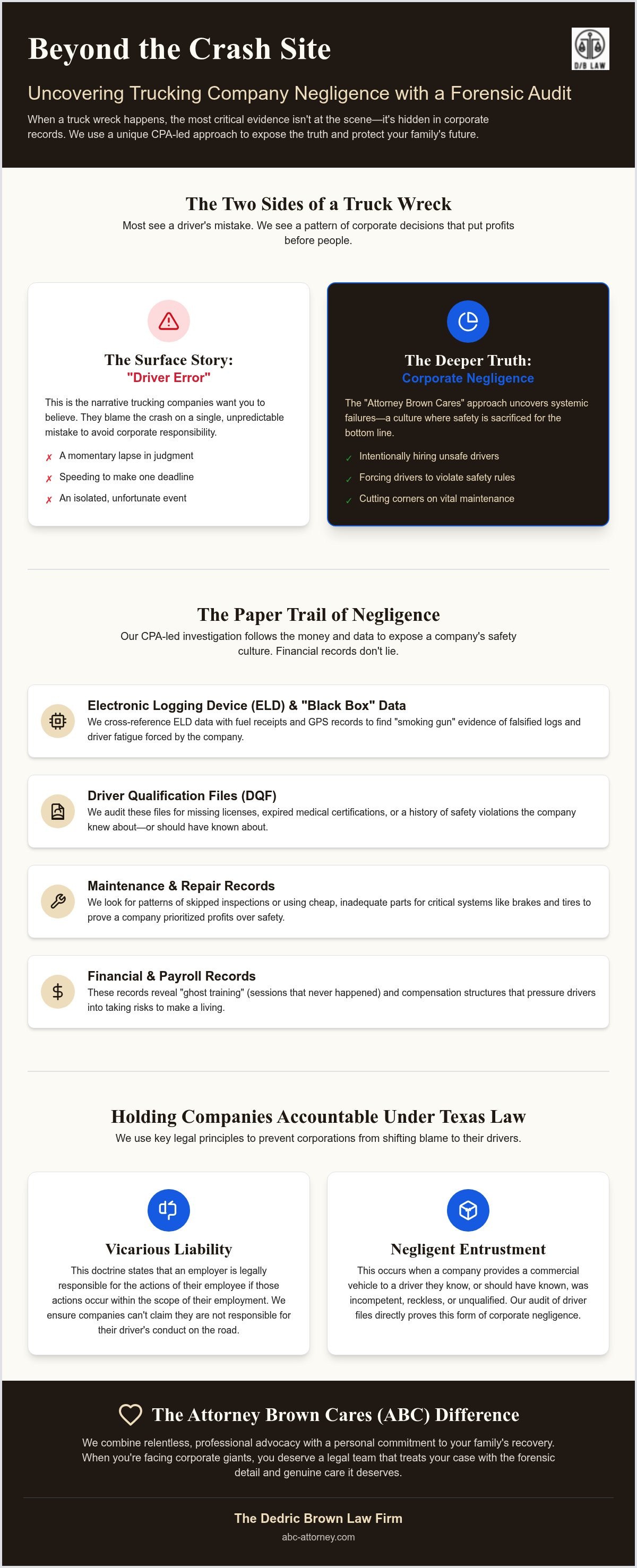
A truck wreck is rarely just a random event on I-10 or I-35. It is usually the final result of a long series of systemic failures within a corporation. When we talk about proving trucking company negligence, we aren't just looking at the skid marks on the pavement. We are looking at the boardrooms and the ledger books. Trucking companies often hide behind a "Corporate Shield," attempting to distance themselves from the driver's actions. They want you to believe the crash was simply a "driver mistake" that they couldn't have predicted.
At the Dedric Brown Law Firm, we know better. The "Attorney Brown Cares" (ABC) philosophy means we look past the surface level police report to find the root cause of the tragedy. For families in Texas dealing with traumatic brain injuries (TBI), "good enough" evidence is a recipe for financial disaster. A lifetime of specialized medical care and rehabilitation for a TBI can be incredibly expensive. You need a legal team that treats your case like a forensic investigation to ensure every future cost is covered.
The Difference Between Driver Error and Corporate Negligence
There is a massive gap between a momentary lapse, like a driver speeding to make a deadline, and a systemic failure. A systemic failure happens when a company intentionally hires drivers with histories of safety violations or ignores federal hours of service rules to maximize their bottom line. Attorney Brown uses his CPA background to audit these companies with surgical precision. He looks for patterns of "cutting corners" in maintenance budgets or training programs that suggest a culture of risk.
The legal doctrine of vicarious liability often makes the company responsible for the driver's actions during their employment. However, we go deeper to prove the company itself was negligent in its oversight. If a carrier prioritizes quarterly profits over replacing worn brake pads, that isn't a driver error. That is a corporate choice that puts every Texas family at risk. We hold them accountable for those choices.
Why Families in Houston and San Antonio Need Aggressive Advocacy
In major hubs like Houston and San Antonio, trucking insurance companies deploy "go-teams" to crash sites within hours. These teams work to manipulate evidence and intimidate families while they are still in the hospital. We counter this aggression with steady, professional reassurance and immediate legal action. Negligent entrustment occurs when a trucking company provides a commercial vehicle to a driver they know, or should have known, was incompetent or reckless. We don't let these corporations hide behind their legal teams; we provide the protective ally you need to secure your family's future.
The CPA-Led Audit: Uncovering Hidden Negligence in the Books
Financial records don't lie, even when corporate spokespeople do. While most investigators focus on the twisted metal at the scene, we focus on the ledger books that authorized the truck to be on the road in the first place. Successfully proving trucking company negligence demands a forensic audit of the firm's operational priorities. By applying a CPA lens to a legal battle, we identify exactly where a company decided that saving a few dollars was worth more than the safety of Texas drivers.
We look for the "Paper Trail of Negligence." This involves cross-referencing official logs with external data points like fuel receipts, toll records, and GPS pings. If a driver's log says they were resting in a sleeper berth in San Antonio while a fuel receipt shows a transaction in Houston, we've found the smoking gun of forced fatigue. These discrepancies are often the result of corporate pressure to meet impossible deadlines. We use the Federal Motor Carrier Safety Regulations as our benchmark to prove when a carrier has stepped outside the lines of the law.
Negligent Hiring and Training Audits
Every trucking company is required to maintain a comprehensive Driver Qualification File (DQF). We look for three critical items: a valid commercial driver's license, a verified employment history, and a current medical certification. As of 2026, these medical results must be transmitted electronically to the FMCSA, making it harder for companies to use outdated or fraudulent "paper cards."
Our audit often exposes "ghost training." This occurs when a company's books show they held safety meetings, but the payroll records reveal the drivers were actually on the road during those times. When a company fails to provide real training or ignores a driver's prior safety violations, they are directly responsible for the resulting trauma. If you suspect a company is hiding the truth about who they put behind the wheel, you can reach out to our team for a detailed case review.
Maintenance Records and Financial Shortcuts
Attorney Brown Cares means following the money to find the truth about a faulty vehicle. We don't just look at a repair invoice; we match that invoice to the truck's actual mechanical state. A company might record a brake job in their internal system to satisfy an auditor while the bank statements show no such payment was ever made. We use our financial background to find "missing" repair cycles in the annual budget. If a fleet's maintenance spending drops significantly while its mileage increases, it's a clear sign that the company is taking dangerous financial shortcuts. These audits turn "accidents" into documented cases of corporate greed.
Vicarious Liability and Texas Trucking Laws
In Texas, the law provides a clear path for holding employers accountable through the doctrine of "Respondeat Superior." This Latin term essentially means the master must answer for the servant. When a driver causes a wreck while performing their job, the company is often automatically liable for the damages. However, proving trucking company negligence is rarely that straightforward. Corporations frequently attempt to shield their assets by classifying drivers as independent contractors. They do this to claim they have no legal control over the driver's actions. We fight these labels by examining the actual working relationship. We look for the level of control the company exerted over the driver's schedule, equipment, and specific routes.
The Texas Department of Transportation (TxDOT) works alongside federal agencies to enforce commercial vehicle safety. While they provide the regulatory framework, it's our job to apply those rules in a courtroom. We often look at the vehicle's Event Data Recorder (EDR) to see if the company's maintenance failures directly contributed to the crash. This technical data, combined with our forensic financial audits, prevents the carrier from shifting the blame entirely onto the person behind the wheel. We ensure the "Corporate Shield" doesn't become a barrier to your justice.
Direct vs. Indirect Liability in Texas Courts
We pursue both direct and indirect liability to maximize recovery for our clients. Indirect liability focuses on the driver's specific mistake during the crash. Direct liability targets the company's own failures in hiring, training, or supervision. In cases involving catastrophic Traumatic Brain Injuries (TBI), we often seek to prove "Gross Negligence." This requires showing the company had an actual awareness of an extreme risk but proceeded with conscious indifference. Proving this allows us to pursue punitive damages. These are designed to punish the company and deter future misconduct. We also navigate Texas's Proportionate Responsibility laws. These rules can reduce your settlement if a jury finds you partially at fault. We ensure the focus remains on the company's systemic failures. Strategic choices, like filing in the right jurisdiction such as Harris County or Bexar County, can significantly impact the final resolution of your case.
The Stowers Doctrine: Holding Insurance Companies Accountable
One of the most powerful tools in Texas law is the Stowers Doctrine. This rule protects families by forcing insurance companies to act in good faith. If an insurance carrier refuses a reasonable settlement offer within policy limits, they may be held liable for the entire judgment, even if it exceeds the policy amount. Attorney Brown Cares means using financial precision to craft "Stowers Demands" that insurance companies cannot ignore. For a family facing millions in long-term TBI care costs, this doctrine is a critical safeguard. We don't just negotiate; we use the law to create a journey toward a successful conclusion. This ensures every medical bill and every lost opportunity is accounted for in the final settlement.
Critical Evidence: From Black Boxes to ELDs
Evidence in a truck wreck is incredibly volatile. Unlike a standard car accident, the most damning proof of a company's guilt is often digital and easily overwritten. If you don't act quickly, critical data can disappear during routine system resets or "accidental" deletions. Proving trucking company negligence requires an immediate, aggressive approach to secure every byte of information. We start by sending a Spoilation Letter. This formal legal notice commands the carrier to preserve all records, from the physical wreckage to the invisible data packets stored on their servers.
We pay close attention to Electronic Logging Devices (ELDs). As of February 7, 2026, federal rule updates give enforcement officers more authority to sideline carriers using revoked ELDs. This shift highlights how central these devices are to safety. We analyze ELD data to prove when a driver was pushed past their legal hours of service. When we combine this with surveillance footage from major Texas arteries like I-10 or I-45, we create a timeline that the defense cannot refute. We don't just look for what happened; we look for the systemic choices that made the crash inevitable.
The 72-Hour Rule for Evidence Preservation
The first three days after a collision are the most critical for your case. We follow a disciplined three-step process to lock down the facts:
Identify all parties: We look beyond the driver to identify the trucking company, the trailer owner, and the cargo loader.
Send a preservation demand: We issue a comprehensive notice to prevent the destruction of maintenance logs, emails, and internal memos.
Deploy experts: We send an independent accident reconstruction expert to the scene to document skid marks, vehicle positioning, and sightlines.
Interpreting Telematics and GPS Data
Modern trucks are mobile data centers. We use GPS pings to prove a driver was "bolting," or driving recklessly fast, to meet an impossible corporate deadline. By comparing these pings to the driver’s written logs, we often find discrepancies that indicate fraud. The Electronic Control Module serves as the truck’s internal witness, capturing precise data on speed, engine RPM, and brake application in the seconds leading up to a collision. This technical precision is how we dismantle the company's "it was just an accident" defense. If you need a legal team that knows how to audit these digital records, contact our office today for a forensic case evaluation. Attorney Brown Cares means we do the hard work of digging through the data to protect your family's future.
How Attorney Brown Cares: Your Path to Recovery
A catastrophic truck wreck does more than damage a vehicle; it shatters the peace and stability of an entire family. When you're facing the reality of a permanent disability, you need more than a legal technician. You need a protective ally who is personally invested in your well-being. The phrase "Attorney Brown Cares" isn't just a slogan for our firm. It is the core mission that drives every forensic audit and every courtroom battle. We understand that proving trucking company negligence is the only way to secure the financial resources your family needs to move forward with dignity.
Our dual-credential approach as both an Attorney and a CPA gives our clients a distinct advantage during settlement negotiations. We don't just guess at the value of a claim. We use high-level analytical precision to calculate the true cost of your recovery. This includes looking at lost earning capacity, future medical inflation, and the hidden costs of home modifications. By blending aggressive advocacy with technical expertise, we ensure that powerful trucking companies can't lowball your family during your most vulnerable moments.
Comprehensive Support for TBI Victims
Traumatic Brain Injuries (TBI) require a specialized level of care that many families find overwhelming to coordinate. We bridge that gap by connecting our clients with top-tier medical experts across Texas who specialize in neurological rehabilitation. We don't stop at the legal settlement. We help develop "Life Care Plans" that serve as a roadmap for your future. These plans are detailed financial and medical documents that project exactly what you'll need for therapy, medication, and specialized equipment over a lifetime. We act as an approachable mentor, guiding you through the complex intersection of healthcare and high-stakes litigation.
The Dedric Brown Advantage: Principled Combativeness
We are not intimidated by the massive corporate legal teams that represent national trucking carriers. Our firm is built on a foundation of principled combativeness. We engage in high-stakes battles because we believe in the ethical necessity of holding negligent companies accountable. To make this journey accessible, we operate on a "No-Fee Unless We Win" basis. This removes the financial risk from your shoulders, allowing you to focus entirely on your physical and emotional recovery while we handle the heavy lifting of the investigation. Your journey toward a successful conclusion starts with a single step. Contact Attorney Brown for a Free Forensic Review of Your Case and let us begin the work of securing your family's future.
Securing Your Family's Future After a Texas Truck Wreck
Holding a massive corporation accountable requires more than just legal knowledge; it requires the technical precision of a forensic audit. We've discussed how uncovering hidden maintenance shortcuts and auditing driver qualification files are the real keys to proving trucking company negligence. By acting within the critical 72-hour window and leveraging Texas-specific laws like the Stowers Doctrine, your family can transition from a place of uncertainty to a position of strength. You've seen that the truth is often hidden in the digital logs and corporate ledgers.
As a dual-credentialed Attorney and CPA, Dedric Brown brings a unique level of financial scrutiny to every case. Whether your family is navigating the complex court systems in Houston, Dallas, or San Antonio, we provide the aggressive advocacy needed for catastrophic TBI claims. We don't just see a case number; we see a family that deserves a protective ally who is deeply invested in their long-term recovery. You don't have to face corporate legal machines alone.
Attorney Brown Cares: Get Your Free Truck Wreck Case Audit Today. Let us help you find the truth buried in the books and start your journey toward a successful resolution. Your recovery is our mission, and we're ready to stand by your side.
Frequently Asked Questions
Can I sue the trucking company if the driver was an independent contractor?
Yes, you can still hold the trucking company responsible even if they label the driver an independent contractor. Texas courts look at the actual control the company exerted over the driver's work, including their routes, schedules, and equipment. We audit these contracts to ensure corporations don't hide behind misleading labels to avoid paying for your family's recovery.
What is the most common evidence used to prove trucking company negligence?
The most effective evidence usually includes Electronic Logging Device (ELD) data, maintenance invoices, and the driver’s personnel file. Proving trucking company negligence often comes down to finding a pattern of skipped repairs or ignored safety violations in the company's records. We dig into the corporate books to find these systemic failures that a simple police report might miss.
How long do I have to file a truck accident claim in Texas?
You generally have two years from the date of the accident to file a personal injury claim in Texas. However, waiting that long is a dangerous mistake for your case. Trucking companies often overwrite digital records and dispose of physical evidence within weeks, so you must act immediately to ensure critical data isn't lost forever.
What if the trucking company destroyed the driver's logs after the accident?
If a company destroys logs after receiving a formal spoilation letter, they may face severe legal penalties. Texas courts can issue a "spoilation instruction," which tells the jury to assume the destroyed evidence would have proven the company was at fault. We send these preservation demands immediately to protect your claim from corporate cover-ups.
Can I get compensation for a Traumatic Brain Injury if I wasn't hit directly by the truck?
Yes, you can receive compensation for a Traumatic Brain Injury even without a direct physical strike to the head. Sudden, violent deceleration can cause the brain to collide with the interior of the skull, leading to permanent damage. We work with specialized medical experts to document these "invisible" injuries and secure the resources needed for your long-term care.
How does Attorney Brown's CPA background help my truck wreck case?
Attorney Brown's CPA background allows him to perform a forensic audit of the trucking company’s financial priorities. He identifies when a company has diverted funds away from safety training or vehicle maintenance to boost their quarterly profits. This unique dual-credential approach uncovers the financial greed that often serves as the root cause of proving trucking company negligence.
What is the 'Black Box' in a commercial truck and why is it important?
The "Black Box," technically known as the Electronic Control Module (ECM), records critical data like speed, engine RPM, and brake application at the moment of impact. It provides an objective, digital record of the driver’s actions that can't be manipulated. This data is essential for dismantling the company's "it was just an accident" defense in court.
Will my trucking accident case have to go to trial in Texas?
Most trucking accident cases in Texas settle before reaching a courtroom, but we prepare every case for a full trial from day one. Attorney Brown Cares means building a bulletproof case that signals to insurance companies we won't accept a lowball offer. This aggressive stance often forces the defense to provide a maximum settlement without the need for a lengthy trial.



Comments