
Proving Medical Negligence in Texas Birth Injury Cases

What if the "unavoidable complication" your doctor described was actually a preventable mistake hidden behind layers of medical jargon? It's a terrifying thought, especially when you're already facing overwhelming medical bills and a future that looks nothing like you planned. You might feel like Texas laws favor big hospitals over families, but you don't have to face that system alone. Proving medical negligence in a birth injury case requires more than just a lawyer. It requires a forensic expert who can dissect medical records with surgical precision to find the truth.
We understand the weight you're carrying, and we're here to help you secure the financial future your child deserves. In this article, you'll learn the specific legal and analytical steps required to hold negligent medical staff accountable. We'll explain how a deep dive into medical data can uncover the errors hospitals try to hide. At our firm, we operate on a simple but powerful mission: Attorney Brown Cares. We'll show you exactly how that commitment translates into aggressive advocacy and steady support for your family's journey toward justice.
Table of Contents
What Qualifies as Medical Negligence During Childbirth?
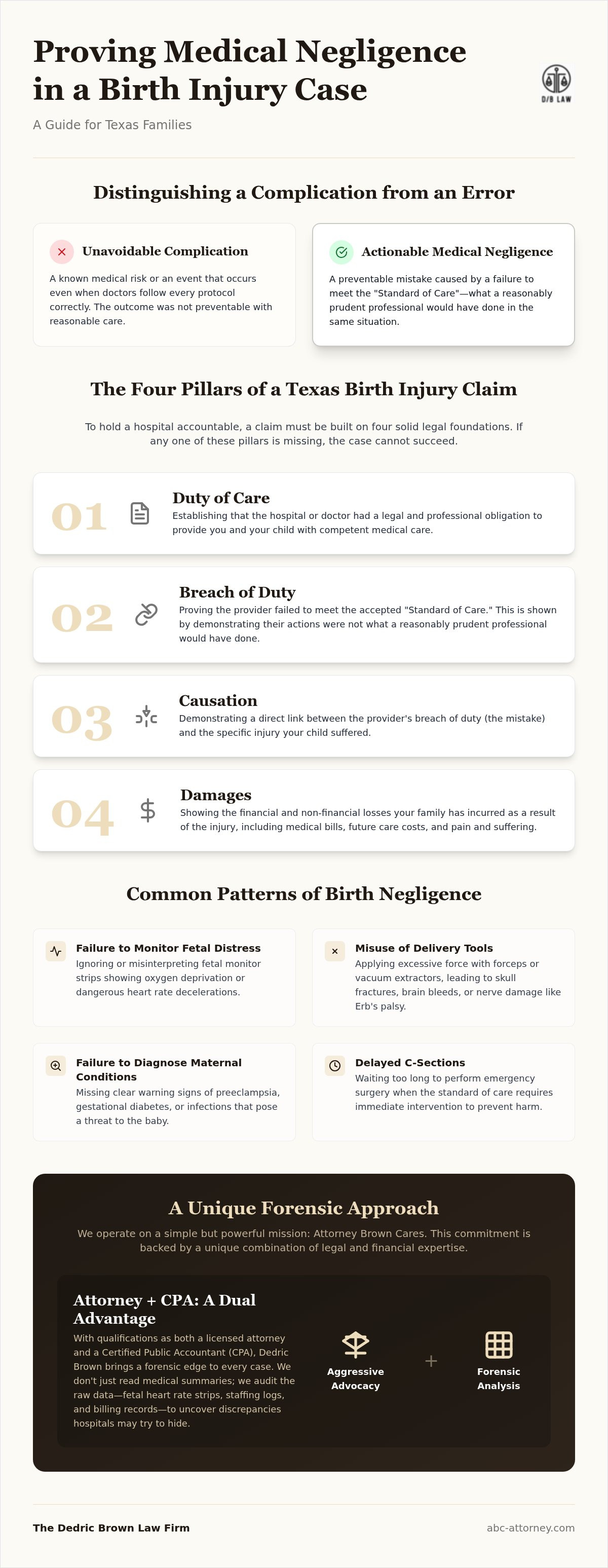
Doctors often tell parents that a birth injury was simply an "unfortunate complication." They use complex medical terms to make it sound like the outcome was unavoidable. However, there's a clear legal distinction between a known medical risk and a failure to provide proper care. Proving medical negligence in a birth injury case begins with understanding the "Standard of Care." In Texas, this standard is defined by what a reasonably prudent medical professional would have done in the same situation. If your doctor or nurse failed to act as a competent peer would have, they didn't just encounter a complication; they committed a breach of duty.
Attorney Brown Cares (abc) about the truth behind these medical explanations. Because Dedric Brown is both a licensed attorney and a CPA, our firm brings a unique forensic edge to your claim. We don't just read the summary the hospital provides. We audit the medical records, looking for discrepancies in timing, staffing levels, and intervention notes. We treat your case with the analytical rigor of a financial audit and the aggressive advocacy of a trial lawyer. Our mission is to move past the hospital's excuses to find the accountability your family deserves.
Negligence vs. Unavoidable Complications
It's a painful reality that not every difficult birth results in a legal claim. Some medical events occur even when every protocol is followed perfectly. However, medical negligence is a deviation from accepted standards that causes injury. The key is identifying "red flags" that the medical staff should have caught. If a baby shows signs of oxygen deprivation and the staff waits too long to perform a C-section, that delay is a choice. We focus on these critical moments where a different decision would have prevented a lifetime of struggle.
Common Examples of Birth Negligence in Texas Hospitals
Negligence often follows specific, documented patterns in labor and delivery wards across Texas. When we investigate proving medical negligence in a birth injury case, we frequently find the same errors occurring in hospital systems. These include:
Failure to monitor fetal distress: Ignoring electronic fetal monitor strips that show a baby is losing oxygen or experiencing heart rate decelerations.
Misuse of delivery tools: Applying excessive force with forceps or vacuum extractors, which can lead to skull fractures, brain bleeds, or Erb's palsy.
Failure to diagnose maternal conditions: Missing the clear warning signs of preeclampsia, gestational diabetes, or infections that can cause premature birth or neonatal injury.
Delayed C-sections: Waiting hours to perform an emergency surgery after the "Standard of Care" dictated an immediate intervention.
These aren't just "accidents." They are systemic failures that require a firm with the technical expertise to prove exactly where the medical team went wrong.
The Four Pillars of a Texas Birth Injury Claim
Building a successful claim in Texas isn't about luck. It's about structure. To hold a hospital accountable, we must solidify four specific legal pillars: duty, breach, causation, and damages. If one pillar fails, the entire case collapses. This is why proving medical negligence in a birth injury case requires an attorney who understands both the law and the complex data found in medical records.
Duty of Care is the first step. This establishes that the hospital or doctor had a legal obligation to provide you with competent care. Once you are admitted for labor, that relationship is locked in. Breach of Duty is where the technical battle begins. We must prove the provider failed to meet the Texas standard of care. This isn't a matter of opinion. We use peer-reviewed medical literature and expert testimony to define exactly what a reasonably prudent professional would have done.
Establishing the Breach of Duty
In Texas, the "Reasonably Prudent Professional" is our benchmark. We ask: would a competent doctor in Houston or Dallas have made the same choice? To answer this, we combine legal strategy with forensic analysis. Dedric Brown’s background as a CPA allows us to audit hospital records with extreme attention to detail. We advocate for your child’s right to proper care by showing exactly where the staff cut corners or ignored protocols. If you feel your concerns were ignored during delivery, you can reach out to our team to discuss your experience.
Proving Causation: The 'But For' Test
The most difficult hurdle is often proximate causation. Hospital lawyers love to claim that an injury was caused by genetics or a pre-existing condition. We counter this using the "But For" test. We must prove that but for the doctor’s specific error, the injury would not have occurred. Timing is everything. We use medical data to prove the injury happened during the exact window of negligence, such as a period of unmonitored fetal distress. We fight to ensure the hospital doesn't shift the blame onto you or your baby.
The final pillar is damages. This is where we quantify the lifelong physical and financial toll on your family. Proving medical negligence in a birth injury case is only half the battle; we must also prove the full extent of the resources your child will need for a secure future. We don't just look at current bills. We calculate the cost of specialized care, therapy, and lost opportunities for your child’s entire life. Attorney Brown Cares about these details because they represent your child's quality of life. We treat your family's future as our own mission.
While our legal focus is often on securing resources for a child's ongoing care, we also stand by families who have experienced the most heartbreaking loss. In these moments, it is vital to have a supportive partner, and you can explore Funeral and Cremation Services to see how Horizon Funeral Home provides the compassionate care needed for final arrangements.
Critical Evidence: How We Uncover the Truth in Medical Records
Hospitals rarely admit to errors. Instead, they provide a wall of data designed to overwhelm the average person. Proving medical negligence in a birth injury case is a forensic mission that starts with the electronic health record (EHR). We look for the digital footprints that medical staff leave behind during a crisis. This process involves analyzing fetal heart rate monitoring strips for any signs of hypoxia or distress that went unaddressed. These strips serve as the "black box" of the delivery room, recording exactly when your child began to struggle and how the medical team responded.
Dedric Brown’s background as a CPA gives our firm a unique advantage in this investigation. We don't just read the records; we audit them. We analyze hospital staffing logs and nurse intervention notes to see if the care team was overwhelmed or distracted. Our forensic approach uncovers gaps in the data or "doctored" entries where notes were added long after the event. If a doctor modified a record to hide a mistake, our analytical scrutiny will find it. Attorney Brown Cares about the integrity of your child's medical history, and we won't let a hospital's technical jargon hide the truth.
Forensic Analysis of Medical Documentation
Electronic health records contain audit trails that show exactly who accessed a file and when they made changes. This is vital when identifying discrepancies between what the doctor said happened and what the data shows. We use these digital fingerprints to catch inconsistencies in the timeline of care. By treating medical records like a financial ledger, we find the "missing entries" that often point directly to negligence. This forensic level of detail is what separates a standard personal injury claim from successful medical malpractice litigation.
The Role of Medical Expert Witnesses
Texas law is strict regarding medical claims. The Texas Medical Liability Act requires a detailed expert report from a qualified specialist within 120 days of filing a lawsuit. We secure testimony from world-class medical experts, including pediatric neurologists and OB-GYNs, who can explain complex errors to a jury. These experts are vetted to ensure they can stand up to aggressive cross-examination from hospital defense lawyers. Because our firm is committed to your family's future, we handle the significant costs of these experts upfront. We believe you should focus on your child's care while we manage the financial and analytical heavy lifting of your case.
Overcoming Challenges in Texas Medical Malpractice Law
Texas law creates a steep climb for families seeking justice. The Texas Medical Liability Act, often called Chapter 74, was built to protect healthcare providers, not victims. This makes proving medical negligence in a birth injury case in Texas significantly harder than in other states. You'll face strict procedural hurdles and limits on what you can recover. Attorney Brown Cares about leveling this playing field for your family. We combine a deep understanding of these laws with the analytical precision of a CPA to ensure your case isn't dismissed on a technicality.
One of the most frustrating aspects of Texas law is the "damage cap." For non-economic losses like pain and suffering, Texas limits recovery to $250,000 against a single physician or hospital. Because of this, we focus heavily on quantifying economic damages, such as medical bills, therapy, and lifelong care costs, which are not capped. Our forensic approach ensures every penny of your child's future needs is documented and demanded. We don't just guess at future costs; we calculate them with mathematical certainty.
Texas Chapter 74 Expert Reports
Within 120 days of filing your lawsuit, you must serve the defendant with a qualifying expert report. This report must clearly explain the standard of care, how it was breached, and how that breach caused the injury. If the report is late or deemed insufficient, the court can dismiss your case and order you to pay the doctor’s legal fees. Texas law requires an expert to link the negligence to the injury within months of filing. We handle this pressure by maintaining a network of world-class specialists ready to act quickly to meet these aggressive deadlines.
Statutes of Limitations for Texas Families
Timing is your greatest enemy in these cases. While children in Texas generally have until their 10th birthday to file a birth injury claim, their parents’ claims for medical expenses often expire much sooner, usually within two years. Waiting too long doesn't just risk missing a deadline; it allows evidence to disappear. Hospital staffing logs are archived, and the memories of delivery room witnesses fade. If you suspect a mistake was made during your child's delivery, you should contact our legal team immediately to protect your rights and your child’s future.
Why 'Attorney Brown Cares' Makes the Difference for Your Family
Choosing a lawyer is the most critical decision you'll make after a birth trauma. You aren't just looking for a legal representative; you're looking for a protective ally who understands the stakes. Proving medical negligence in a birth injury case is a journey that requires both principled combativeness against hospital systems and deep compassion for your child’s struggle. At our firm, we operate under a simple, non-negotiable philosophy: Attorney Brown Cares. This isn't just a slogan. It’s the foundation of how we treat your child's future as our own mission.
We blend the heart of a dedicated advocate with the analytical mind of a CPA. This combination is rare in medical malpractice litigation. While other firms might see a case file, we see a family in need of a champion. We conduct thorough investigations, pursue aggressive goals, and maintain the highest ethical standards. Our goal is to provide you with a sense of security during a time of total chaos. We mitigate your financial risk by working on a contingency basis, meaning there is no fee unless we win your case.
A Mission-Driven Approach to Justice
Attorney Brown Cares means we don't back down from high-stakes battles. We have seen families navigate the devastating aftermath of birth injuries, feeling lost in a sea of medical jargon and hospital denials. We step in to provide the methodical authority needed to challenge negligent providers. Our firm is deeply invested in the success of the families we represent across Houston, Dallas, and San Antonio. We offer more than just technical expertise; we offer a partnership rooted in honesty, diligence, and a relentless pursuit of accountability.
Securing Your Child's Financial Future
The true cost of a traumatic brain injury or cerebral palsy is staggering when calculated over a lifetime. It involves decades of specialized care, physical therapy, and adaptive equipment. Proving medical negligence in a birth injury case is the first step toward funding these needs. We use forensic accounting to ensure no future medical expense is overlooked. We look at the data, the inflation rates, and the specific care requirements to build a comprehensive life-care plan. This analytical rigor ensures your child is never left without the resources they need to thrive. If you're ready for answers, your first step is a free, compassionate case evaluation with Dedric Brown.
This focus on financial integrity is essential for all legal matters; for instance, if you are looking to build a business legacy for your family, you can explore تأسيس الشركات for professional corporate guidance in the Middle East.
Secure Your Child’s Future with a Protective Ally
Your journey toward accountability starts with uncovering the truth hidden in hospital records. We've discussed how the Texas standard of care and strict procedural deadlines like Chapter 74 expert reports create a complex path for families. However, you don't have to walk this path alone. Proving medical negligence in a birth injury case requires a unique blend of forensic auditing and aggressive legal advocacy. Dedric Brown’s dual credentials as an attorney and a CPA provide the technical edge needed to hold major Texas hospital systems responsible for errors involving HIE, cerebral palsy, and other birth traumas.
We treat your child’s quality of life as our primary mission. By quantifying the full economic impact of a birth injury, we fight to ensure your family has the resources for lifelong care, therapy, and medical equipment. You deserve a partner who is both a sophisticated expert in the courtroom and a relatable figure in the community. Let us handle the legal and analytical heavy lifting while you focus on your child. Attorney Brown Cares; Contact Us for a Free, Compassionate Case Review. Your family's future is worth the fight.
Frequently Asked Questions
How do I know if my baby’s injury was preventable?
Preventable injuries often stem from a deviation from accepted medical protocols. You might notice red flags like a sudden rush of staff into the room or a long delay before an emergency C-section was performed. Our forensic audit of the hospital’s electronic health records can identify if the medical team ignored distress signals. Attorney Brown Cares about finding these answers; we ensure that "unavoidable complications" are scrutinized with the precision of a CPA.
What is the 'Standard of Care' in a Texas birth injury case?
The standard of care is the legal benchmark for what a reasonably prudent medical professional would do in a similar situation. In Texas, we must prove that your provider failed to meet this specific level of competence. We use specialized medical literature and testimony from peers in the field to establish this duty. This process transforms a subjective medical opinion into an objective, evidence-based legal argument for your family.
Can I still sue if I signed a consent form before delivery?
You can still pursue a claim even if you signed a consent form before your delivery. These forms acknowledge the inherent risks of a procedure, but they are not a waiver for medical malpractice. You never consent to a doctor making a reckless mistake or failing to monitor your baby properly. If a provider’s negligence caused harm, a signed form won't stop us from holding them accountable in court.
How much does it cost to hire a birth injury lawyer in Houston?
Hiring a birth injury lawyer in Houston shouldn't add to your financial burden. Our firm operates on a contingency fee basis, which means we only get paid if we win your case. We cover all the upfront costs of litigation, including expensive expert witness fees and record audits. This approach ensures you have access to elite legal and financial expertise without any immediate out-of-pocket expenses.
What kind of experts are needed to prove medical negligence?
Proving medical negligence in a birth injury case requires a team of world-class specialists. We typically secure testimony from pediatric neurologists, OB-GYNs, and life-care planners. These experts provide the mandatory reports required by the Texas Medical Liability Act. They explain the technical link between a doctor’s error and your child’s condition. Our firm handles the vetting and coordination of these experts to build a formidable case.
How long does a medical malpractice lawsuit take in Texas?
A medical malpractice lawsuit in Texas typically lasts between 18 months and three years. The duration depends on the complexity of the medical data and the court's current backlog in cities like San Antonio or Dallas. We move through the process with a steady, logical rhythm. We balance the need for a swift resolution with the necessity of a thorough investigation to maximize your child’s recovery.
Will my case have to go to trial, or will it settle?
Most cases resolve through a settlement, but we prepare every claim for a full trial. This aggressive stance often encourages hospital insurance companies to offer a fair settlement before a jury gets involved. We only advise settling if the amount covers the lifelong costs of therapy, equipment, and care. Attorney Brown Cares about the long-term outcome; we won't settle for a transaction that leaves your child’s future at risk.
What is the difference between a birth injury and a birth defect?
The distinction lies in the cause of the condition. A birth defect is usually a genetic or prenatal condition that develops before labor begins. In contrast, a birth injury happens during the delivery process, often due to physical trauma or oxygen deprivation. Proving medical negligence in a birth injury case involves showing that the baby was healthy before the medical team’s errors caused preventable harm.



Comments