
Hospital-Acquired Infection Lawsuits: Proving Medical Negligence and Securing Justice
- Dedric Brown

- Apr 30
- 13 min read
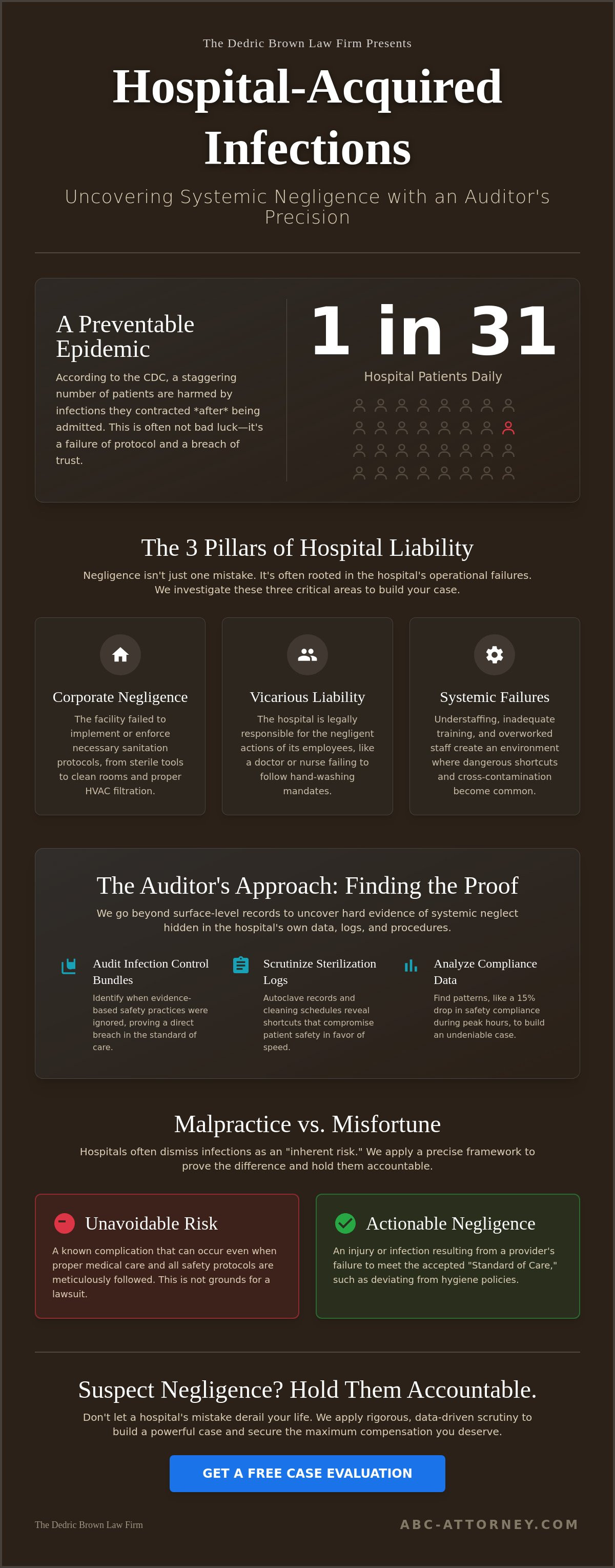
The Centers for Disease Control and Prevention reports that approximately 1 in 31 hospital patients battles at least one healthcare-associated infection on any given day. You went in for a routine procedure but left with a life-altering condition that hospital staff dismisses as a common risk. This isn't just bad luck; it's often a failure of protocol. Pursuing hospital acquired infection lawsuits requires more than just legal knowledge. It demands the scrutiny of a trained auditor to pinpoint the exact moment where hygiene standards collapsed.
You're likely exhausted by the mounting bills for corrective treatments and the vague explanations from the very people you trusted. I understand that frustration and the need for a relentless advocate who fights with integrity. You'll learn how to hold these facilities accountable by applying a rigorous, auditor-level approach to medical malpractice. We will examine how to differentiate between unavoidable risks and actionable negligence, identify the full financial value of your claim, and secure the justice you deserve through technical precision.
Key Takeaways
Distinguish between unavoidable medical complications and actionable negligence to determine if you have a valid claim for justice.
Leverage a rigorous, auditor-level strategy to uncover hidden patterns of hospital neglect and systemic protocol non-compliance.
Identify the specific hospital errors and failures behind common preventable infections that lead to successful hospital acquired infection lawsuits.
Learn how to challenge the "inherent risk" defense by applying a precise framework to evaluate your specific medical treatment.
Quantify the full financial impact of your injury using professional CPA and auditing methodologies to secure maximum compensation.
Table of Contents Understanding Hospital-Acquired Infections (HAIs) and Legal Liability The Auditor’s Approach: Proving Negligence in HAI Lawsuits Common Types of Preventable Infections and Their Causes Is It Malpractice? Inherent Risk vs. Actionable Negligence Calculating Damages: The Financial Impact of a Hospital Infection
Understanding Hospital-Acquired Infections (HAIs) and Legal Liability
Patients enter medical facilities to heal. They don't expect to face new, life-threatening dangers. Hospital-Acquired Infections (HAIs), also known as nosocomial infections, impact roughly one in 31 hospital patients on any given day according to CDC data. These conditions aren't always unavoidable complications. They're frequently the result of a breakdown in safety protocols. When you initiate hospital acquired infection lawsuits, you're seeking justice for a breach of the hospital's fundamental duty to provide a sterile environment.
Legal liability hinges on the distinction between an unfortunate medical outcome and actionable malpractice. A complication is a known risk that occurs despite proper care. Malpractice happens when a provider deviates from accepted standards. We approach these cases with the meticulous eye of an auditor, searching for the specific point where the system failed you. Our firm combines aggressive advocacy with technical precision to hold negligent institutions accountable. We fight for your rights with principled combativeness and professional integrity.
The Legal Definition of a Healthcare-Associated Infection
Timing is everything in these cases. The medical community generally applies a 48-hour rule. If an infection manifests 48 hours or more after your admission, it's legally defined as hospital-acquired. Infections appearing earlier are usually classified as community-acquired, meaning the patient likely carried the pathogen into the facility. In litigation, we establish the "Standard of Care." This is the benchmark of quality that any competent healthcare provider must exercise. If the facility failed to follow CDC guidelines or internal hygiene policies, they've violated this standard and committed negligence.
Why Hospitals Are Often Liable for Infections
Hospitals are complex organizations, but they aren't shielded from the consequences of their errors. Liability typically stems from three critical areas:
Corporate Negligence: The facility failed to implement or enforce necessary sanitation protocols. This includes poor sterilization of surgical tools, inadequate room cleaning, or failing to maintain HVAC systems that filter airborne pathogens.
Vicarious Liability: Hospitals are responsible for the conduct of their employees. If a nurse, doctor, or technician fails to follow hand-washing mandates and spreads a staph infection, the hospital bears the legal burden for their actions.
Systemic Failures: Understaffing and inadequate training are major drivers of infection. When staff members are overworked, they take shortcuts that lead to cross-contamination. We relentlessly investigate these administrative failures to secure the compensation you deserve.
Our firm treats your case with unwavering discipline. We use our background in auditing to dissect hospital records and find the truth hidden in the data. You pay nothing unless we win your case. We're your protective ally and your most formidable advocate in the courtroom.
The Auditor’s Approach: Proving Negligence in HAI Lawsuits
Winning hospital acquired infection lawsuits requires more than just medical records; it demands an auditor’s precision. I leverage my background as a Certified Internal Auditor and Information Systems Auditor to dissect hospital operations from the inside out. We don't rely on the hospital’s verbal testimony. We rely on their raw data. While a doctor might claim they followed every protocol, the digital "paper trail" often tells a different story of neglect and systemic failure.
Our strategy centers on "Infection Control Bundles." These are structured sets of evidence-based practices that, when performed together, significantly improve patient outcomes. When a facility ignores the CDC guidelines on HAIs, they create a measurable breach in the standard of care. We look for the gaps where the hospital chose speed over safety. If a facility shows a 15% drop in bundle compliance during peak hours, we have the evidence needed to prove a culture of negligence.
Scrutinizing Sterilization and Sanitation Logs
We audit autoclave records and equipment maintenance schedules to identify mechanical failures or human error. If a sterilization cycle was shortened by 120 seconds to speed up instrument turnover, the integrity of the entire surgical suite is compromised. Our team identifies "short-cutting" in room cleaning protocols between patient rotations by cross-referencing housekeeping timestamps with admission data. We use hand-hygiene compliance data, often tracked via electronic sensors or secret shoppers, to prove that the hospital allowed a dangerous environment to persist. If 35% of staff members fail to wash their hands before patient contact, the hospital is responsible for the resulting harm.
Staffing Ratios and Fatigue as Evidence
There is a direct, documented correlation between nurse-to-patient ratios and increased infection rates. We audit time-sheets and payroll records to prove that staff fatigue led to protocol breaches. A nurse forced into a 16-hour shift is statistically more likely to skip a step in a catheter insertion or wound dressing change. We define "Infection Control Compliance" as a measurable data point that tracks how consistently a facility adheres to safety mandates. If you suspect a hospital’s systemic failures caused your injury, you can reach out to our office to begin an investigation into their internal records.
By shifting the focus from "bad luck" to "bad data," we strip away the hospital’s defenses. We find the truth in the logs, the schedules, and the spreadsheets. This methodical, aggressive approach ensures that justice is based on facts, not excuses. We fight to hold these institutions accountable for the shortcuts that cost patients their health.
Common Types of Preventable Infections and Their Causes
Hospitals are high-stakes environments where precision saves lives. When protocols slip, patients suffer. The Centers for Medicare & Medicaid Services (CMS) classifies many healthcare-associated infections as "Never Events." These are medical errors that should never occur in a professional setting. If they do, they often form the backbone of hospital acquired infection lawsuits. My background as a Certified Public Accountant and auditor means I look at these cases through a lens of strict compliance. I search for the paper trail where safety was sacrificed for speed. We don't just ask what happened; we relentlessly audit the systems that failed you.
Surgical Site Infections (SSIs) and MRSA
SSIs account for 20% of all HAIs in the U.S., according to CDC data. These infections often stem from a failure to follow basic pre-operative skin preparation or improper antibiotic prophylaxis timing. If a surgeon doesn't administer the correct antibiotic within 60 minutes before the first incision, it's a clear breach of medical protocol. Contaminated surgical instruments represent another major liability. Hospitals must track sterilization cycles with audit-level accuracy. When they fail, Methicillin-resistant Staphylococcus aureus (MRSA) can take hold. MRSA is a multi-drug resistant organism (MDRO) that requires aggressive, expensive treatment. A hospital's failure to isolate known MRSA carriers or maintain a sterile field is a primary focus in hospital acquired infection lawsuits.
Catheter-Associated and Ventilator-Associated Infections
Catheter-Associated Urinary Tract Infections (CAUTI) and Central Line-Associated Bloodstream Infections (CLABSI) are frequently preventable through standard hygiene. Proving negligence involves auditing the insertion logs and maintenance records with professional scrutiny. We look for three things: a sterile insertion field, daily monitoring for line necessity, and proper hand hygiene by staff. If these aren't documented, the facility is vulnerable.
Ventilator-Associated Pneumonia (VAP) is equally devastating for patients in intensive care. Hospitals must follow "Vent Bundles," which include:
Elevating the head of the bed to at least 30 degrees.
Daily "sedation vacations" to assess the patient's ability to breathe independently.
Regular oral care with chlorhexidine.
Sepsis is the final, deadly stage of these failures. It's not just an infection; it's a systemic collapse. We track the timeline from the first spike in heart rate to the onset of organ failure. We fight to show that the hospital missed the critical window to intervene, transforming a manageable infection into a life-threatening crisis.
Is It Malpractice? Inherent Risk vs. Actionable Negligence
Hospitals often rely on a single, repetitive defense: "Infection is a known risk." They want you to believe that your suffering was an unavoidable side effect of modern medicine. This is a shield designed to discourage victims from seeking justice. At the Dedric Brown Law Firm, we see through this tactic. While some risks exist in any clinical setting, a "known risk" does not give a hospital a license to be sloppy. There is a clear line between an unfortunate complication and actionable negligence.
Evaluating your experience requires a disciplined, analytical approach. We look for the breakdown in standard operating procedures. If your surgical team failed to follow basic sterilization protocols, they didn't just encounter a risk; they created a hazard. We fight to prove that your injury was preventable through proper care, diligence, and adherence to safety mandates.
When "Known Risk" Becomes Medical Malpractice
Identifying negligence starts with data. According to 2022 CDC data, approximately 1 in 31 hospital patients has at least one healthcare-associated infection on any given day. When a facility's infection rates consistently exceed national benchmarks, it suggests a systemic failure rather than bad luck. We scrutinize these numbers to build your case.
Signing an informed consent document does not protect a hospital from its own "gross negligence." A waiver acknowledges that certain outcomes are possible even with perfect care. It doesn't mean you've agreed to be treated with unwashed hands or contaminated instruments. We focus on three critical areas: adherence to hygiene standards, the adequacy of staff training, and the hospital's history of safety violations. Our firm applies an auditor’s precision to these records to find the truth.
The Role of Forensic Medical Experts
Success in hospital acquired infection lawsuits depends on high-level scientific testimony. We work with infectious disease experts who utilize genomic "fingerprinting" to identify the exact strain of bacteria that caused your illness. This technology allows us to trace the pathogen back to a specific piece of hospital equipment or a contaminated environment. We don't guess; we prove.
Our experts reconstruct your entire timeline of care. We look for the moment of contamination by reviewing surgical logs, nursing notes, and cleaning schedules. This methodical reconstruction bridges the gap between a general risk and a specific fault. Causation in HAI litigation is the definitive evidentiary link proving that a healthcare provider’s specific failure directly triggered the patient’s infection. We leverage this evidence to secure the victory you deserve.
You shouldn't have to pay for a hospital's mistake. If you suspect your infection was caused by negligence, contact the Dedric Brown Law Firm for a free consultation.
Calculating Damages: The Financial Impact of a Hospital Infection
Hospital acquired infection lawsuits are about more than just medical errors; they represent a total disruption of your financial stability. When a facility fails to maintain sterile protocols, the victim carries the burden of the cleanup. We don't just guess at the value of your claim. The Dedric Brown Law Firm applies a forensic level of scrutiny to every invoice, medical record, and future care plan. Our approach combines the high intensity of litigation with the methodical authority of a financial expert.
Economic Damages and Forensic Accounting
Calculating the true cost of an infection requires more than a calculator; it requires an auditor's eye. We focus on "Corrective Care" costs, which often include additional surgeries to debride infected tissue or months of high dose IV antibiotics. These treatments aren't just painful; they're expensive. According to 2023 healthcare cost reports, a single surgical site infection can increase a patient's hospital stay by 7 to 11 days, adding tens of thousands of dollars to the initial bill.
We relentlessly pursue compensation for lost earning capacity. An infection can end a professional career by causing permanent nerve damage or chronic fatigue. We use our background as a Certified Public Accountant (CPA) and Certified Internal Auditor (CIA) to project your lifetime earnings and ensure the settlement covers every dollar you would've earned. We look for the hidden costs, from specialized home care to the increased insurance premiums you'll face for years to come.
Corrective Surgeries: Quantifying the cost of secondary procedures needed to fix the hospital's mistake.
Long-term Medication: Accounting for the high price of specialized antibiotics and follow-up lab work.
Career Loss: Calculating the delta between your pre-infection trajectory and your current physical limitations.
Non-Economic Damages and Punitive Awards
The math of justice must also account for the human cost. We fight to quantify pain, suffering, and the loss of quality of life. An infection doesn't just stay in the wound; it affects your ability to hold your children, enjoy hobbies, or live without constant anxiety. We use a principled combativeness to force insurance companies to recognize these "invisible" injuries. If your infection resulted in visible scarring or disfigurement, we ensure the compensation reflects the emotional toll of that permanent change.
In cases where a hospital ignored repeated safety violations or attempted a systemic cover-up, we push for punitive damages. These awards aren't just about your recovery; they're about holding the institution accountable and preventing the next patient from suffering. We use our expertise as an Information Systems Auditor (CISA) to dig through hospital digital records and find the evidence of negligence they tried to hide. Protect your rights—contact The Dedric Brown Law Firm for a free consultation.
You pay nothing unless we win your case. We provide the expertise, the precision, and the relentless advocacy you need to secure your future. Don't let a hospital's negligence bankrupt your family. Let a multifaceted expert fight for the victory you deserve.
Secure the Justice Your Recovery Demands
A hospital stay should lead to healing, not a secondary battle against a preventable infection. Successfully navigating hospital acquired infection lawsuits requires more than just legal knowledge; it demands the meticulous scrutiny of an auditor. According to the Centers for Disease Control and Prevention (CDC), approximately 687,000 healthcare-associated infections occurred in U.S. acute care hospitals in a single year. We bridge the gap between medical records and actionable negligence by applying CIA and CISA auditing standards to every detail of your case.
Dedric Brown leads our firm with a unique dual perspective as both a licensed Attorney and a Certified Public Accountant (CPA). We don't just guess at your damages; we calculate the full financial impact of your injury with professional precision. You deserve a protective ally who fights relentlessly for your rights. We work on a contingency fee basis, which means you pay nothing unless we win your case. Let us transform your search for answers into a proven path toward victory. Take the first step toward accountability today.
Get a Free Case Evaluation from a Lawyer and CPA and start your journey toward justice.
Frequently Asked Questions
Can I sue a hospital if I got an infection after surgery?
Yes, you can sue a hospital if the infection was caused by a failure to follow standard medical protocols. According to the CDC, roughly 1 in 31 hospital patients has at least one healthcare-associated infection on any given day. If your surgical site infection resulted from poor hygiene or unsterile equipment, it's a breach of the standard of care. Our firm fights to hold these facilities accountable for their preventable errors.
How do you prove a hospital was negligent in an infection case?
You prove negligence by showing the facility failed to adhere to established sanitation and safety guidelines. We use an auditor’s precision to scrutinize hospital logs, hand-washing records, and sterilization reports. Successfully winning hospital acquired infection lawsuits requires demonstrating a direct link between the hospital’s specific failure and your injury. This rigorous process involves expert testimony and a detailed analysis of internal medical data.
What is the average settlement for a hospital-acquired infection lawsuit?
Settlement amounts vary significantly based on the severity of the illness and the total financial impact on the victim. A 2020 study in the Journal of the American Medical Association (JAMA) found that surgical site infections can increase a patient's medical costs by $20,000 or more. We pursue every dollar for your medical bills and lost wages. Our goal is a victory that covers your long-term recovery needs.
Is sepsis considered medical malpractice?
Sepsis is considered medical malpractice if healthcare providers failed to diagnose it promptly or caused it through negligent actions. Sepsis contributes to 1 in 3 hospital deaths according to 2023 CDC data. If a doctor ignored clear warning signs or allowed an infection to progress into septic shock through inaction, they are liable. We relentlessly investigate the timeline of your care to prove where the system failed you.
Does signing a consent form prevent me from suing for an infection?
No, signing a consent form doesn't give a hospital permission to be negligent or provide substandard care. While you accept certain inherent risks of surgery, you never consent to medical errors or unsanitary conditions. If a facility's failure to follow protocols caused your illness, your signature on a form won't block your path to justice. We look past the paperwork to find the truth about your treatment.
How long do I have to file a hospital infection lawsuit?
The deadline to file depends on your state’s statute of limitations, which is frequently 2 years from the date the infection was discovered. Missing this deadline means you lose your right to seek compensation forever. It's vital to act quickly so we can begin auditing your medical records and securing evidence before it disappears. We provide a steady, professional hand to guide you through this strict legal timeline.
What if a loved one died from a hospital-acquired infection?
You can file a wrongful death claim to seek justice for a family member who died due to a preventable infection. These hospital acquired infection lawsuits aim to recover funeral costs, lost financial support, and compensation for your emotional loss. Our firm applies a disciplined, competitive approach to prove the hospital's negligence caused the fatality. You pay nothing unless we win your case and secure your family's future.
Who is liable for my infection: the doctor or the hospital?
Liability depends on whether the infection was caused by an individual doctor’s error or a systemic failure within the hospital facility. Hospitals are generally responsible for the actions of their employees and for maintaining sterile environments. If an independent contractor doctor made the mistake, they may be personally liable. We perform a comprehensive investigation to identify every party that contributed to your injury, ensuring no stone is left unturned.


Comments