
Failure to Recognize Fetal Distress Lawsuit: Protecting Your Child’s Future

You watched the monitor, saw your baby's heart rate drop, and called for help, yet the medical staff insisted everything was fine. It is a soul-crushing feeling to be ignored during a crisis, especially when that silence leads to a life-altering birth injury. We believe that Attorney Brown Cares is more than just a name; it is a mission to support families who have been let down by those they trusted most. Filing a failure to recognize fetal distress lawsuit is a vital step toward securing the specialized care, therapy, and financial resources your child will need for the rest of their life.
We understand the crushing weight of medical debt and the fear of an uncertain future you're carrying. You deserve to know exactly what happened in that delivery room and who is responsible for the harm. This guide will walk you through the complex Texas legal landscape, including the strict two-year statute of limitations and the mandatory 120-day expert report deadline. We'll also discuss the $250,000 cap on non-economic damages. You'll see how a meticulous, analytical approach turns medical records into a powerful tool for justice. By combining deep empathy with rigorous technical scrutiny, we help you protect your child's future with confidence.
Key Takeaways
Identify the critical warning signs, such as abnormal heart rate patterns and late decelerations, that medical providers are legally obligated to monitor and address.
Understand how a failure to recognize fetal distress lawsuit holds negligent providers accountable by proving a clear breach in the standard of medical care.
Discover how fetal monitoring strips act as the "black box" of the delivery room to provide objective, data-driven proof of medical negligence.
Learn how a comprehensive Life Care Plan uses mathematical precision to calculate the lifelong costs of your child's medical needs and specialized support.
See why the "Attorney Brown Cares" mission ensures your family receives both aggressive legal advocacy and the personalized, compassionate attention you deserve.
Table of Contents
What is a Failure to Recognize Fetal Distress Lawsuit?
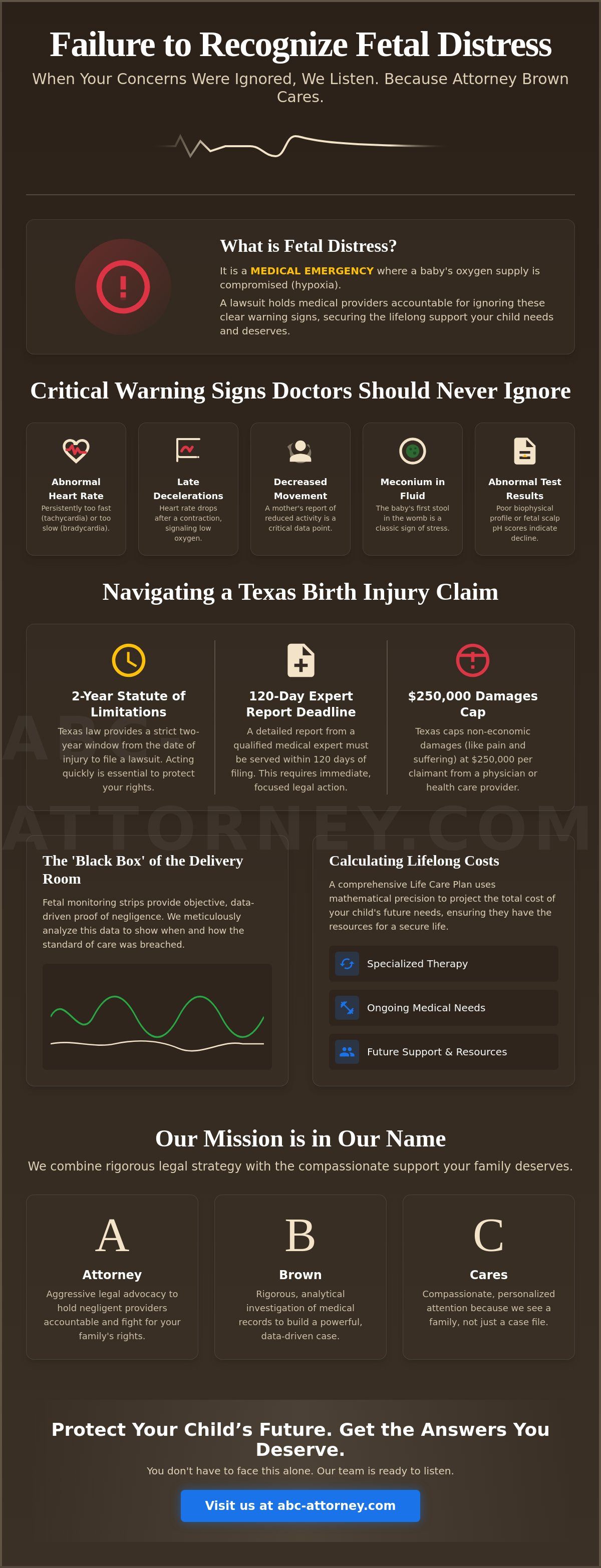
Every birth involves some level of physical stress, but Fetal distress is a medical emergency. It is the baby's physiological response to oxygen deprivation, also known as hypoxia. When a baby's oxygen supply is compromised, their heart rate often drops or fluctuates wildly as a warning signal. Medical professionals have a non-negotiable duty to monitor these signals and respond with immediate action. A failure to recognize fetal distress lawsuit is the legal path parents take when that duty is ignored. This legal action is about more than just finding fault. It is about securing the lifelong medical support, specialized therapy, and financial resources your child needs after a preventable injury.
Our firm operates under the "Attorney Brown Cares" (ABC) philosophy because we know your family's future is on the line. We don't view you as another case file on a desk. We see a family that has been ignored by the medical establishment and deserves a powerful advocate. Our team combines aggressive litigation with the analytical precision of a technical expert. We conduct thorough investigations, pursue every lead, and hold negligent providers accountable. We fight because we believe every child deserves a fair start and every parent deserves answers.
The Medical Provider’s Duty to Monitor
Modern Texas hospitals use Electronic Fetal Monitoring (EFM) as the standard for tracking a baby's well-being during labor. This technology provides a continuous data stream of the baby's heart rate and the mother's contractions. Labor and delivery nurses are the first line of defense in this process. They're trained to identify "non-reassuring" heart tones that suggest the baby is struggling. When a nurse sees persistent bradycardia or late decelerations, they must act. The standard of care requires them to notify the doctor and prepare for immediate intervention. If the staff fails to monitor, fails to identify, or fails to escalate, they've breached their legal duty to your child.
Preventable vs. Unavoidable Birth Complications
It's important to distinguish between natural risks and medical negligence. Some birth complications are truly unavoidable, even with the best care. However, many injuries are entirely preventable if the medical team follows established protocols. Medical malpractice in the context of fetal monitoring is the failure to act on objective data that indicates a baby is in danger. A "wait and see" approach is often a dangerous breach of the standard of care when a baby's oxygen is at risk. We use a rigorous, data-heavy approach to prove that the injury wasn't just a tragic accident, but a result of a provider choosing to ignore clear warning signs.
Common Signs of Fetal Distress Doctors Should Never Ignore
Medical teams have a professional obligation to act when a baby shows signs of struggle. Ignoring these signals isn't just a mistake; it's a breach of the trust you placed in your healthcare providers. When we investigate a failure to recognize fetal distress lawsuit, we look for specific clinical red flags that should have triggered an immediate response. These indicators are the heartbeat of your case, providing the objective evidence needed to prove negligence. If the staff at the hospital dismissed your concerns or failed to read the monitors correctly, they must be held accountable.
Doctors and nurses should never overlook these critical signs of distress:
Abnormal heart rate patterns: This includes tachycardia, where the heart rate is too fast, or persistent bradycardia, where it stays dangerously low.
Late decelerations: These occur when the baby's heart rate drops after the peak of a contraction, signaling that the placenta isn't delivering enough oxygen.
Decreased fetal movement: A mother's report of reduced activity is a vital clinical data point that requires instant follow-up.
Meconium in the amniotic fluid: The presence of the baby's first stool in the womb is a classic sign of physiological stress.
Abnormal test results: Poor scores on a biophysical profile or abnormal fetal scalp pH levels indicate the baby's health is rapidly declining.
The medical community has moved toward more precise language when Diagnosing Fetal Distress to ensure that interventions are timely and effective. If you feel your medical team was dismissive during these moments, you're not alone. Our firm’s mission is rooted in the belief that Attorney Brown Cares, and we're here to help you find the truth. If you suspect your child’s injury was preventable, contact our team today for a thorough review of your delivery records.
The Critical Role of Heart Rate Variability
Variability refers to the small, beat-to-beat changes in a baby's heart rate. To a jury, we explain that variability is a sign of a healthy, responsive nervous system. It's the "wiggle" on the monitor strip that shows the baby is coping with the stress of labor. A "flat" heart rate line is an emergency signal. It suggests the baby is exhausted, oxygen-deprived, or suffering from neurological compromise. We treat fetal monitor strips as the "black box" of the delivery room. We work tirelessly to preserve these records before they can be lost or altered, as they provide the most compelling evidence in a failure to recognize fetal distress lawsuit.
When Fetal Distress Becomes a Medical Emergency
In high-stakes situations, every second counts. The "30-minute rule" is a widely recognized standard: once a doctor determines an emergency C-section is necessary, the baby should be delivered within 30 minutes. Delays can lead to permanent brain damage or worse. This is especially true during umbilical cord prolapse or a nuchal cord, where the oxygen supply is physically cut off. Placental abruption is another catastrophe that triggers immediate distress. We investigate the timeline of your delivery with surgical precision. We identify exactly where the communication broke down and why the medical staff failed to protect your child from a known danger.
Proving Negligence in a Texas Birth Injury Claim
Winning a failure to recognize fetal distress lawsuit in Texas requires more than just showing a tragic outcome. It requires a high level of analytical precision to dismantle the hospital's defense. Under Texas law, the burden of proof rests entirely on the parents. You must demonstrate that the healthcare provider had a specific duty, they breached that duty, and the breach directly caused the injury. This isn't a simple task. It demands a sophisticated legal strategy that combines medical expertise with aggressive advocacy.
Expert medical testimony is the cornerstone of these cases. In Texas, you must serve a comprehensive expert report within 120 days of the defendant filing their answer. This expert, usually a board-certified OB-GYN or a maternal-fetal medicine specialist, establishes the "Standard of Care." They explain exactly what a competent physician would have done when faced with the same heart rate decelerations or oxygen deprivation signals. Without this high-level testimony, a case cannot move forward. We also scrutinize hospital logs and staffing records. Often, missed signals aren't just individual errors but the result of systemic failures like staffing shortages or poorly trained personnel.
The legal hurdle is even higher in emergency settings. Texas applies a "willful and wanton" standard for emergency care, which is a much more difficult level of negligence to prove than ordinary malpractice. We thrive in these high-stakes environments. We use fetal monitoring strips as the "black box" of the delivery room. These strips provide a minute-by-minute account of the baby's condition. They don't have a bias, and they don't forget the details. By analyzing these strips alongside hospital records, we build a timeline that is difficult for the defense to ignore.
Building the Evidence Trail
Success starts with a thorough investigation. We secure all prenatal records to rule out pre-existing conditions or genetic factors the defense might use to deflect blame. Placental pathology is another critical tool. Examining the placenta after birth can help determine the exact timing of the oxygen deprivation. This data helps us prove that the injury happened because of the medical team's delay during labor, not weeks before. We also conduct rigorous depositions of the nurses and attending doctors. We pin them down on their decisions, their timing, and their failure to act when the monitors signaled danger.
Overcoming the "Hindsight Defense"
Hospitals often rely on the "hindsight defense," claiming the injury was inevitable or that the monitor strips were too ambiguous to act upon. They want the jury to believe that no amount of intervention could have changed the outcome. We counter this by showing exactly where the "Standard of Care" was abandoned. We demonstrate that the signals were clear and the delay was negligent. Our philosophy is simple: Attorney Brown Cares means we leave no stone unturned in discovery to find the truth for your child. We fight for the financial security and the justice your family deserves.
Calculating the Lifelong Impact: The Analytical Advantage
A failure to recognize fetal distress lawsuit is about more than just proving a medical error occurred. It is a fight for the total cost of a life that has been permanently changed. We bring a unique, analytical advantage to this battle. Our team utilizes a level of financial scrutiny that ensures no future need is overlooked. We don't just ask for a settlement. We build a Life Care Plan. This document acts as a comprehensive roadmap for every medical necessity your child will face. It covers 24/7 nursing care, specialized speech therapies, and necessary home modifications.
We approach these calculations with the precision of a technical auditor. Mathematical accuracy in economic damages is non-negotiable. We factor in lost earning capacity for a child who may never be able to enter the workforce. We account for the rising costs of medical technology and adaptive equipment. Our Attorney Brown Cares mission means we treat your child's future as our own priority. We investigate every expense, calculate every loss, and litigate for every dollar. This principled combativeness ensures that your child is never left without the resources they deserve.
Beyond Medical Bills: Intangible Damages
Texas law imposes strict limits on non-economic recovery. There is a $250,000 cap on non-economic damages against a single physician. For cases involving multiple healthcare institutions, the overall cap is $500,000. These limits apply to pain, suffering, and the emotional toll on the parents. Because these caps are so restrictive, maximizing the economic portion of your claim is essential. We fight to prove the full extent of your family's loss of consortium and the child's physical pain to reach these limits while securing uncapped economic support for medical needs.
The Role of Forensic Economists
We partner with forensic economists to project healthcare inflation over the next 40 to 60 years. A settlement that seems sufficient today can quickly disappear if it doesn't account for the compounding costs of care. Our analytical rigor prevents the lowball settlements that insurance companies often push. We ensure that the final resolution provides security for your child's entire lifetime. This methodical approach is how we protect your family from financial risk. If you are ready to secure your child's future, contact our legal team today for a detailed financial evaluation of your case.
Why "Attorney Brown Cares" is Your Advocate in Texas
Choosing the right legal partner is the most important decision you'll make after a birth injury. We believe you deserve a champion who understands both the technical complexity of a failure to recognize fetal distress lawsuit and the emotional weight your family carries. At our firm, you aren't a case number on a spreadsheet. You're a family in search of justice. We provide personalized attention that bridges the gap between high-stakes litigation and genuine, human support. Our team combines the methodical authority of a technical expert with the protective spirit of a community ally.
We represent families in Houston, Dallas, San Antonio, and across every corner of Texas. Our approach is rooted in principled combativeness. We don't back down from hospital boards or insurance giants. We also provide a No-Fee Guarantee to mitigate your financial risk. You pay nothing unless we successfully win a recovery for your child. This commitment ensures that every family has access to elite legal representation regardless of their current financial situation. We take on the burden of the legal battle so you can focus on your child's care and recovery.
A Mission-Driven Approach to Birth Injuries
The "abc" in our name is more than a label; it's our core promise: Attorney Brown Cares. This mission-driven philosophy means we're personally invested in your child's legacy and future. You'll have direct access to Dedric Brown and our legal team throughout the entire process. We don't just file paperwork. We investigate, we advocate, and we support you emotionally through every deposition and hearing. We're here to ensure your voice is heard in a system that often tries to silence parents during a medical crisis.
Next Steps for Your Family
Time is a critical factor in Texas medical malpractice cases. The law generally requires you to file a lawsuit within two years of the date the injury occurred. While there are exceptions for minors—sometimes extending the deadline until a child's 14th birthday—acting quickly is essential to preserve evidence like fetal monitor strips. Providing a formal notice of claim can also toll the statute of limitations for 75 days, giving your team more time to build a rigorous case. We're ready to help you navigate these hurdles and the mandatory 120-day expert report deadline. Your journey toward justice begins with a conversation where we listen to your story and provide clear, honest answers. Contact The Dedric Brown Law Firm today for your free case review.
Secure Your Child’s Path Toward a Brighter Future
You've learned how medical providers have a non-negotiable duty to monitor your baby's well-being and how fetal heart rate strips serve as the objective truth of the delivery room. Securing your child’s future requires more than just legal knowledge. It demands a sophisticated, analytical approach to prove every dollar of a Life Care Plan. Our firm is uniquely led by a CPA and Attorney, providing the mathematical precision needed to ensure settlements cover lifelong medical needs. We don't just guess at the costs; we calculate them with rigorous detail.
Filing a failure to recognize fetal distress lawsuit is a journey toward the answers and financial security your family deserves. We specialize in complex birth injuries and traumatic brain injuries, combining aggressive litigation with a deeply personal commitment. The "Attorney Brown Cares" mission is our promise that we'll treat your child’s legacy as our own. We fight the high-stakes battles so you can focus on being a parent. You don't have to face this uncertainty alone. We're here to be your protective ally and your voice for justice.
Frequently Asked Questions
How do I know if my baby’s injury was caused by fetal distress?
You can identify potential fetal distress by reviewing birth records for low Apgar scores, neonatal seizures, or an immediate need for resuscitation. Fetal monitor strips provide the most definitive evidence by showing heart rate drops or late decelerations before delivery. Our team analyzes these strips to confirm if preventable oxygen deprivation occurred. We look for the exact moment the medical staff should've intervened to protect your baby.
What is the statute of limitations for a birth injury lawsuit in Texas?
In Texas, the statute of limitations for medical malpractice is generally two years from the date of the injury. However, for children under the age of 12, the filing deadline is extended until their 14th birthday. Texas also has a 10-year statute of repose that serves as an absolute cutoff. Because these rules are complex, you should consult an attorney as soon as you suspect negligence to protect your rights.
Can I still sue if my child was born via C-section?
You can still file a lawsuit if your child was born via C-section, especially if the procedure was delayed. Medical standards often require an emergency C-section within 30 minutes of detecting fetal distress. If the medical team ignored heart rate signals or waited too long to operate, they're responsible for the resulting brain injury. We investigate the delivery timeline to see if a faster response could've prevented the harm.
What kind of compensation can we recover for a failure to monitor claim?
You can recover economic damages for medical bills, home modifications, and specialized 24/7 nursing care. While Texas law caps non-economic damages like pain and suffering at $250,000 per provider, economic damages are uncapped. We use our CPA expertise to build a precise Life Care Plan that accounts for healthcare inflation over several decades. This ensures your child has the resources they need for a lifetime of support.
Will I have to testify in court against my doctor?
Most birth injury cases are settled through negotiation, but you may need to give a deposition. This is a formal process where you answer questions about your experience under oath. You won't have to face the doctor alone. We provide steady, professional reassurance and prepare you for every question. Our goal is to make you feel safe and supported while we fight for your child's justice.
How long does a fetal distress lawsuit typically take to resolve?
A failure to recognize fetal distress lawsuit typically takes 18 to 36 months to reach a resolution. This timeline accounts for the intensive discovery phase where we secure hospital logs and depose medical staff. While we pursue a swift outcome, our priority is ensuring the final settlement provides for your child’s lifelong needs. Attorney Brown Cares about the long-term legacy of your family, so we never rush a low settlement.
Does it cost anything to start a birth injury case with your firm?
It costs you nothing out of pocket to start your birth injury case with our firm. We work on a contingency fee basis, meaning we only get paid if we win your case. We handle all upfront expenses, including the high costs of medical experts and forensic economists. This allows your family to focus on your child’s therapy while we manage the financial risk of litigation from the initial filing.
What if the hospital says the injury was caused by genetics?
Hospitals often use genetics as a defense to claim the injury was inevitable and avoid liability. We counter this by utilizing placental pathology and specialized medical experts who can pinpoint the timing of the injury. Our analytical approach proves that the damage resulted from oxygen deprivation during labor rather than a pre-existing condition. We leave no stone unturned to ensure the truth about your child’s injury is finally revealed.



Comments