
Failure to Diagnose Sepsis Lawsuit: Seeking Justice for Medical Negligence in Texas

You trusted the medical team when they said the fever was routine or that your newborn was simply adjusting, but your intuition told you otherwise. Now, you are facing an empty nursery or mounting ICU bills because a Texas hospital ignored the clear warning signs of a systemic infection. It is an isolating experience to feel dismissed by hospital administration while grieving a preventable loss. We understand that your search for a neonatal sepsis malpractice lawyer is about more than just a case; it is about finding the truth that the hospital refuses to admit.
At the Dedric Brown Law Firm, we believe that "abc" means Attorney Brown Cares. We use a unique combination of forensic auditing and principled combativeness to hold Texas healthcare providers accountable for their protocol failures. You will learn how we dissect medical records to prove a breach in the standard of care and how we fight to secure your family's financial stability. This article provides clarity on Texas medical malpractice laws, including the 2026 damage caps, and outlines the specific steps required to seek justice for a failed sepsis diagnosis.
Table of Contents
Neonatal Sepsis Malpractice: When a Delayed Diagnosis Is Negligence
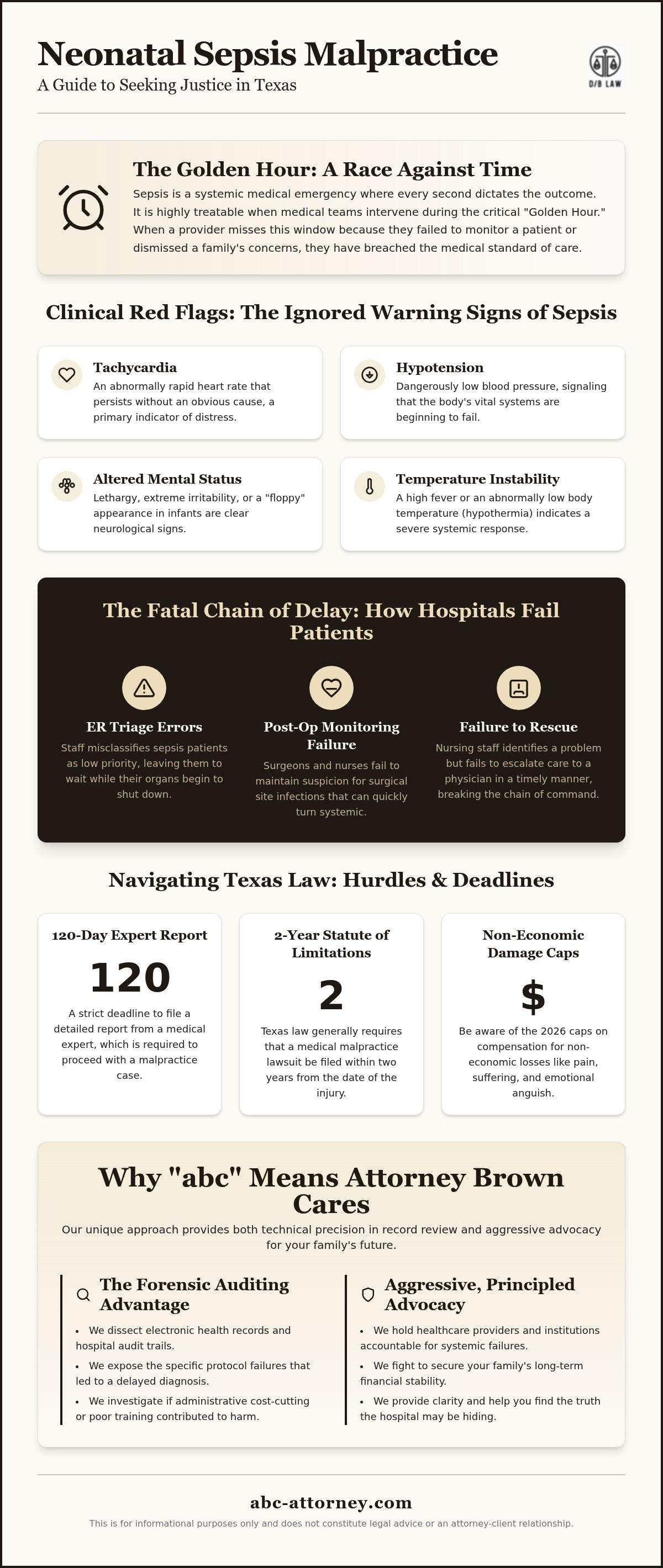
Sepsis is not a simple infection. It is a life-threatening, systemic response that causes the body to attack its own organs. What is Neonatal Sepsis? In short, it is a medical emergency where every second dictates the outcome. In high-risk environments like Texas neonatal intensive care units (NICUs) or post-surgical wards, doctors must act with extreme urgency. Medical negligence occurs when these clinical indicators are ignored or dismissed by the nursing staff. Sepsis is highly treatable when medical teams intervene during the "Golden Hour." If a provider misses this window because they failed to monitor the patient, they've breached the medical standard of care.
Clinical Red Flags and the SIRS Criteria
Texas hospitals rely on Systemic Inflammatory Response Syndrome (SIRS) criteria to identify patients sliding into septic shock. For newborns and surgical patients, the warning signs are often clear if the staff is paying attention. These clinical red flags include:
Tachycardia: An abnormally rapid heart rate that persists without an obvious cause.
Hypotension: Dangerously low blood pressure that indicates the body's systems are failing.
Altered mental status: Lethargy, extreme irritability, or a "floppy" appearance in infants.
Temperature instability: A high fever or an abnormally low body temperature.
A "wait-and-see" approach is often the first step toward a tragedy. When these symptoms appear, the standard of care requires immediate diagnostic testing and blood cultures. If your family’s concerns were dismissed while these signs were present, a neonatal sepsis malpractice lawyer can help you determine if those red flags were documented in the charts but ignored by the physician.
Why Hospitals Are Legally Responsible for Sepsis Protocols
Hospitals are more than just buildings; they are systems that must prioritize patient safety through standardized screening. This duty includes implementing clear sepsis protocols that trigger the moment a patient meets SIRS criteria. The medical standard of care generally requires the immediate administration of broad-spectrum antibiotics and rapid fluid resuscitation to maintain blood pressure.
Attorney Brown Cares (abc) means we don't just take the hospital's word for what happened. We investigate whether the facility failed to provide adequate staffing or lacked the necessary screening tools to protect your child. By combining legal advocacy with forensic analytical precision, we hold institutions accountable for systemic failures that lead to preventable infections. We look beyond the bedside to see if administrative cost-cutting or poor training created the environment where your loved one was harmed.
The Fatal Chain of Delay: How Medical Providers Fail Texas Patients
Sepsis is a race against time. When medical providers fail to act, they create a fatal chain of delay that turns a treatable infection into a catastrophic injury. In many Texas hospitals, this chain starts with chronic understaffing. Overworked nurses and residents often miss the subtle shifts in patient stability that indicate a brewing infection. They fail to order essential blood cultures, neglect to check lactate levels in the ER, and ignore the rising heart rate of a vulnerable patient. These systemic delays lead directly to septic shock, multi-organ failure, and permanent brain injury. When a hospital's internal processes break down, the patient pays the ultimate price.
ER Triage and Post-Operative Monitoring Errors
Busy emergency rooms in Houston, Dallas, and San Antonio are often ground zero for diagnostic failures. Triage errors occur when staff members misclassify sepsis patients as low priority, leaving them to wait in the lobby while their organs begin to shut down. Post-operative monitoring is equally critical for patient safety. Surgeons and floor nurses must maintain a high index of suspicion for surgical site infections that can quickly turn systemic. If a facility fails to monitor these risks or ignores a patient’s post-surgical fever, they are putting lives on the line. These are not unavoidable accidents; they are protocol failures that demand accountability.
Nursing Negligence and the "Failure to Rescue"
The "Failure to Rescue" is a specific legal theory used when nursing staff identifies a problem but fails to escalate it to the attending physician. Nurses are the first line of defense. If a nurse records declining vitals but fails to call for a rapid response team, they have failed their primary duty. Our firm conducts deep-dive audits of nursing logs and electronic health records to find these gaps in care. As a neonatal sepsis malpractice lawyer, Dedric Brown understands that these logs often tell a different story than the hospital’s official narrative. We look for the exact moment the standard of care was breached and the chain of delay became fatal.
Identifying these failures requires a meticulous review of hospital data, staffing levels, and internal communications. If you suspect your family is a victim of this fatal chain of delay, reaching out for a professional case review can provide the clarity and evidence you need to move forward. We use our dual-credentialed expertise to ensure no detail is overlooked in your pursuit of justice.
Navigating Texas Sepsis Litigation: Legal Hurdles and Damage Caps
Texas medical malpractice law is notoriously complex. The Texas Medical Liability Act, commonly known as Chapter 74, creates a series of procedural landmines designed to protect healthcare providers rather than patients. You must first contend with the statute of limitations. In Texas, you generally have two years from the date of the negligent act to file your claim. However, the most dangerous hurdle appears shortly after filing: the Expert Report requirement. Within 120 days of initiating a lawsuit, you must serve each defendant with a detailed report from a qualified medical expert. If this report doesn't meet specific legal standards, the court can dismiss your case and order you to pay the hospital's legal fees. This is why hiring an experienced neonatal sepsis malpractice lawyer is critical. We move quickly to secure experts who can prove the breach in the standard of care before the clock runs out.
Understanding the 2026 Texas Damage Caps
As of September 2026, Texas continues to enforce strict caps on non-economic damages. These damages cover intangible losses like pain, suffering, and emotional distress. There is a $250,000 per-claimant cap on non-economic damages against all physicians or healthcare providers involved. If a single healthcare institution is liable, a separate $250,000 cap applies. In cases where multiple institutions are found negligent, the total non-economic recovery is capped at $500,000 for the facilities, with the absolute total for the entire claim never exceeding $750,000. It's vital to remember that economic damages, such as medical bills and lost wages, are not capped. Our firm uses forensic auditing to calculate the full lifetime cost of a catastrophic injury, ensuring your family's financial stability remains the priority.
The "Willful and Wanton" Standard in Emergency Care
If your sepsis case began in a Texas emergency room, the law raises the burden of proof to an aggressive level. You must prove "willful and wanton negligence" rather than ordinary negligence. This means showing that the medical staff acted with conscious indifference to a substantial risk of harm. Proving this requires more than just showing a mistake was made; it requires evidence that the provider knew the patient was in danger and chose not to act. The abc firm specializes in building this specific evidence. We look for the "smoking gun" in hospital audit trails and staffing logs to prove that the facility knew the risks and ignored them. Attorney Brown Cares (abc) means we have the technical expertise to navigate these hurdles and fight for the justice your family deserves.
Building the Evidence: The Forensic Auditing Advantage
Most law firms review medical charts at face value. They look at what the doctor wrote and accept it as the complete story. At the Dedric Brown Law Firm, we know that the most critical evidence often exists between the lines of the official narrative. Proving medical negligence in sepsis cases requires a deep dive into electronic health records (EHR), internal audit trails, and hospital staffing logs. Engaging a neonatal sepsis malpractice lawyer who understands the technical architecture of hospital data is the only way to uncover the truth. We pair this analytical rigor with testimony from top-tier infectious disease and ICU specialists to build an airtight case. Attorney Brown Cares (abc) means we leave no stone unturned during the discovery phase, ensuring that "missing" data is recovered and used to hold negligent parties accountable.
Uncovering the Electronic EHR "Audit Trail"
The EHR audit trail is the digital footprint of a patient's care. It records exactly who accessed a chart, what they viewed, and how long they stayed on a specific screen. In failure to diagnose cases, this metadata is vital. Many modern Texas hospitals use automated sepsis alert systems that trigger when a patient’s vitals meet certain criteria. We audit these systems to prove that a doctor or nurse received a high-priority alert and chose to override or ignore it. Electronic audit trails provide an unchangeable timeline that reveals if a healthcare provider attempted to alter or back-fill medical notes after a patient’s condition turned fatal. This level of scrutiny prevents hospitals from hiding behind sanitized, after-the-fact summaries of the care they provided.
The CPA Edge: Auditing Hospital Records for Negligence
Dedric Brown’s dual credential as an Attorney and a Certified Public Accountant (CPA) provides a unique advantage in complex litigation. We don't just look at medical outcomes; we analyze the financial and administrative decisions that led to those outcomes. By auditing hospital staffing ratios and department budgets, we can identify when a facility prioritized profit over patient safety. This data-heavy analysis allows us to dismantle the common "we did everything we could" defense used by hospital attorneys. We connect the dots between administrative cost-cutting and specific instances of neonatal neglect, proving that the failure to monitor was a systemic choice rather than an isolated mistake. If you are ready to use this forensic advantage for your case, contact our legal team for a comprehensive audit of your records. We use every tool available to ensure your family’s journey toward justice is backed by undeniable evidence.
Why Attorney Brown Cares (abc): Aggressive Advocacy for Your Family
At the Dedric Brown Law Firm, we operate under a simple but powerful mantra: abc. This stands for Attorney Brown Cares. It is the guiding principle for every neonatal sepsis malpractice lawyer on our team. We don't just see a case number; we see a family whose trust was shattered by medical negligence. Our approach is one of principled combativeness. This means we fight with high-intensity aggression in the courtroom while maintaining the methodical authority of technical experts. We are your protective allies. We provide a sense of security through financial risk mitigation and relentless advocacy. Our goal is to transform your search for answers into a journey toward a successful conclusion.
A Compassionate Ally in Your Darkest Hour
Grieving the loss of a loved one to a preventable infection is an overwhelming experience. We create a supportive environment for families from Houston to San Antonio. We aren't cold litigators focused solely on a transaction. We are empathetic partners who prioritize your mental and emotional well-being. Our firm is deeply invested in the success of our community members because we are part of those same communities. We understand the weight of your loss. Families facing the sudden loss of a newborn or a parent to sepsis deserve more than just a lawyer. They need a champion who understands the nuances of Texas law and the emotional toll of medical malpractice. We bridge the gap between elite legal credentials and grounded community roots.
Taking the First Step Toward Accountability
Our contingency-fee model ensures that financial barriers don't stand in the way of justice. You pay nothing upfront. Our fees are only collected if we secure a financial recovery for you. This allows you to pursue a claim against a massive hospital system without the fear of mounting legal bills. As your neonatal sepsis malpractice lawyer, we take the burden of proof off your shoulders. During your initial strategy session, we will discuss the specific protocol failures identified in your records. We'll outline the path toward securing financial stability for your survivors. Your journey toward justice starts with a single conversation. We are ready to listen. If a hospital failed your family, remember: Attorney Brown Cares. Contact us today for a free case evaluation.
Securing Your Family’s Future Through Accountability
Winning a sepsis malpractice claim in Texas requires more than just medical knowledge. It demands a sophisticated understanding of hospital data and a willingness to engage in high-stakes litigation. We have explored how a delayed diagnosis is often the result of systemic protocol failures and why the state’s strict damage caps make detailed evidence essential. By leveraging the forensic auditing advantage of a dual-credentialed Attorney and CPA, you can dismantle the hospital’s standard defenses with technical precision.
If your family is suffering because a medical team ignored the clear warning signs of infection, you need a neonatal sepsis malpractice lawyer who provides both technical expertise and principled combativeness. Dedric Brown specializes in birth injury and sepsis cases, ensuring that no digital audit trail or staffing log goes unexamined. Accountability is the only way to prevent another family from enduring the same preventable loss.
Take the first step toward the justice you deserve. Contact the Dedric Brown Law Firm—Because Attorney Brown Cares (abc). We are here to be your protective ally and guide you toward a successful resolution.
Frequently Asked Questions
Is sepsis always considered medical malpractice in Texas?
Sepsis is not automatically malpractice. To win a case in Texas, you must prove the provider's actions fell below the accepted medical standard of care. This involves demonstrating that a reasonably competent doctor would have recognized the clinical indicators and intervened sooner. A bad medical outcome alone doesn't constitute negligence. We analyze whether the failure to monitor or the delay in treatment directly caused the catastrophic injury or death.
How long do I have to file a sepsis lawsuit in Houston or Dallas?
You generally have two years from the date of the negligent act to file a lawsuit in Texas. This timeline applies whether you are in Houston, Dallas, or San Antonio. There is also an absolute ten-year statute of repose. Additionally, you must provide a written pre-suit notice at least 60 days before filing. Missing these strict deadlines can permanently bar your claim, so immediate action is vital for your case.
What is the average settlement for a failure to diagnose sepsis case?
There is no "average" settlement because every case involves unique damages. However, Texas law imposes strict caps on non-economic damages like pain and suffering, ranging from $250,000 to $750,000 depending on the number of defendants. Economic damages, such as medical bills and lost future earnings, are not capped. We focus on maximizing these uncapped economic recoveries by using forensic auditing to calculate the true lifetime cost of your family's loss.
Can I sue for sepsis if my loved one died in a Texas nursing home?
Yes, you can pursue a claim if a nursing home failed to monitor signs of infection. Nursing facilities have a legal duty to recognize declining vitals and escalate care to a hospital. If staff ignored symptoms like fever or confusion, leading to septic shock, they may be liable under the "Failure to Rescue" theory. We investigate these cases by auditing facility staffing logs to see if neglect was a result of understaffing.
What kind of damages can I recover in a Texas medical malpractice claim?
You can recover both economic and non-economic damages. Economic damages include hospital bills, specialized neonatal care, and the loss of future financial support. These are not capped in Texas. Non-economic damages cover emotional distress and loss of companionship, but these are subject to the $250,000 per-provider cap. Our firm prioritizes an analytically rigorous approach to ensure every dollar of your economic loss is documented and pursued during the litigation process.
How do you prove that a doctor should have caught neonatal sepsis earlier?
Proving a delay requires an expert report and a deep dive into electronic health records. A neonatal sepsis malpractice lawyer uses forensic auditing to examine the hospital’s audit trail. This reveals if a doctor ignored automated alerts or if vitals were recorded but never acted upon. We hire top-tier infectious disease specialists to testify that the "Golden Hour" for treatment was missed because the clinical red flags were clearly present.
What does "Attorney Brown Cares" (abc) mean for my legal case?
"Attorney Brown Cares" is more than a slogan; it is our commitment to principled combativeness. For your case, it means having a dual-credentialed Attorney and CPA who understands the financial paper trail hospitals often try to hide. We provide the steady reassurance of a technical expert while fighting aggressively in the courtroom. You get a protective ally who is both an elite specialist and a relatable figure within the Texas community.
Do I need a lawyer if the hospital offered a settlement for a sepsis death?
You should always consult a lawyer before accepting any hospital offer. Initial offers from hospital risk management are typically designed to minimize the facility's financial exposure. They rarely cover the full lifetime costs of a permanent injury or the true value of a wrongful death claim. We audit the medical records to ensure the settlement reflects the hospital's actual level of liability and the full extent of your family's economic damages.


Comments