
Air Embolism and Medical Malpractice: A Houston Lawyer’s Guide to Justice

A sudden stroke or cardiac arrest during a routine medical procedure isn't just a tragic complication; it's often a silent, preventable failure of hospital safety protocols. When an air embolism enters a patient's bloodstream, it's rarely an unavoidable accident. You expected healing, yet you're now facing a catastrophic injury and a wall of silence from the hospital staff. At our firm, we believe that "abc" means Attorney Brown Cares. We understand the grief you feel when a medical team refuses to explain what went wrong while medical bills for long term care continue to mount.
You deserve clarity on the actual cause of this injury and financial security for your loved one's future. This guide provides the legal path to holding negligent providers accountable for the damage they've caused. We'll explore how these air bubbles reach the heart or brain, why they represent medical malpractice, and how forensic level analytical scrutiny can pierce the veil of hospital secrecy. By combining aggressive advocacy with the technical precision of a dual attorney and CPA, we help you fight for the justice your family deserves.
Table of Contents
What is an Air Embolism and Why is it a Legal Issue?
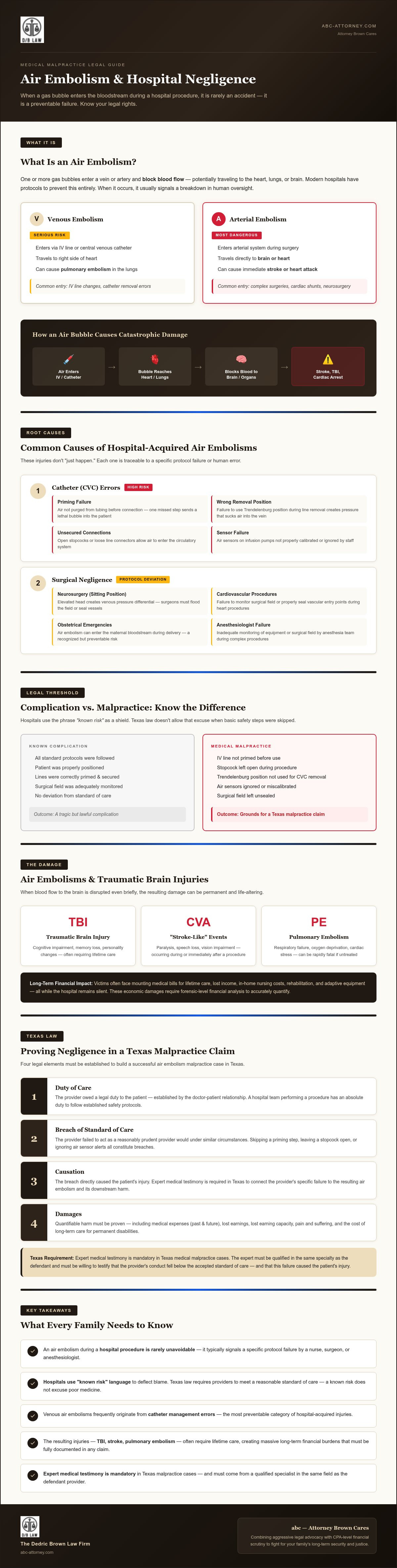
An air embolism, often referred to as a gas embolism, occurs when one or more gas bubbles enter a vein or artery and block the passage of blood. In a high-tech hospital environment, this simply shouldn't happen. Modern medicine has developed foolproof devices and strict protocols to keep air out of the circulatory system. When a bubble does break through, it can travel to the heart, lungs, or brain, causing sudden and often permanent damage. At our firm, we operate under the principle that abc stands for Attorney Brown Cares. We don't view these events as mere statistics; we see them as preventable tragedies that demand accountability. Most hospital systems have redundant checks to prevent air from entering IVs or surgical sites, meaning a failure usually indicates a breakdown in human oversight.
Venous vs. Arterial Air Embolisms
The path the air takes determines the severity of the injury. A venous air embolism typically happens when air enters through an IV line or a central venous catheter. These bubbles usually travel to the right side of the heart and then to the lungs, potentially causing a pulmonary embolism. Arterial versions are far more dangerous. They occur when air enters the arterial system, often during complex surgeries or through a shunt in the heart. These bubbles can travel directly to the brain or heart muscle, leading to immediate strokes or heart attacks. Because arterial embolisms often happen during controlled surgical procedures, they are frequently the result of a surgeon's or anesthesiologist's failure to monitor the surgical field or equipment properly.
When a Medical Complication Becomes Malpractice
Hospitals often try to hide behind the phrase "known risk" to avoid liability. In Texas, the legal Standard of Care requires medical providers to act as any reasonably prudent provider would under similar circumstances. A routine procedure, such as removing a catheter or performing a minor surgery, should not result in a life-altering gas bubble injury if the provider follows basic safety steps. When a doctor fails to prime an IV line, leaves a stopcock open, or fails to position a patient correctly during a CVC removal, that isn't just a complication; it's negligence. Attorney Brown Cares about the specific details of your case. We use forensic, CPA-trained scrutiny to look at the how behind the bubble. This analytical approach allows us to find the specific moment where a provider's shortcut led to your family's catastrophe, ensuring that a known risk doesn't become an excuse for poor medicine.
Common Causes of Hospital-Acquired Air Embolisms
Hospital-acquired injuries often stem from a breakdown in basic safety checklists. An air embolism doesn't just happen; it's introduced by a specific action or omission. Whether it's a nurse rushing through a line change or a surgeon failing to seal a vascular entry point, the result is a life-altering event. Because Attorney Brown Cares (abc), we look past the medical jargon to find the specific protocol breach that caused the harm. We focus on the human element of the legal profession, ensuring that families aren't left in the dark after a preventable medical catastrophe.
Catheter-Related Errors
Central Venous Catheters (CVCs) are essential but dangerous tools. Negligence often occurs during the "priming" phase, where air must be completely purged from the tubing before connection. A single missed step can send a lethal bubble directly into the patient's system. Even more common is malpractice during line removal. If a provider fails to place the patient in the correct position, such as the Trendelenburg position with the head lowered, the pressure difference can suck air directly into the venous system. Monitoring after insertion is equally vital. If you suspect a loved one suffered due to improper line management, speaking with a legal professional can help clarify if safety standards were ignored. We investigate whether connections were secured and if air sensors on infusion pumps were properly calibrated or ignored by staff.
Surgical and Obstetrical Negligence
High-stakes surgeries like neurosurgery or cardiovascular procedures carry inherent risks, but surgeons must remain vigilant. In neurosurgery, especially when the patient is in a sitting position, the risk of air entry is significant. Surgeons use specific techniques to flood the surgical field or seal vessels to prevent this. Failing to do so is a clear deviation from the standard of care. These errors are not just "unfortunate outcomes"; they are often the result of a medical team failing to follow established surgical safety protocols.
In the delivery room, an air embolism can enter the maternal bloodstream during a C-section or through the placental site during birth. This is a medical emergency that requires immediate intervention. If hospital staff fail to monitor the mother's vitals or ignore signs of distress on the fetal monitor, both the mother and child are at risk. These cases are complex. They require a lawyer who understands the intersection of medical protocols and the financial impact of long term care. We use our CPA-level analytical skills to audit every second of the medical record, ensuring no detail is missed in our pursuit of accountability.
The Damage: Air Embolisms and Traumatic Brain Injuries
When an air embolism migrates to the brain, it acts as a physical barrier to life-sustaining oxygen. This results in an ischemic event, often described by medical professionals as a "stroke-like" catastrophe. Unlike a typical stroke caused by a blood clot, this gas bubble is an external contaminant introduced by a medical team's error. The brain begins to starve within minutes. This deprivation leads directly to hypoxic-anoxic brain injuries, where the total or partial lack of oxygen causes widespread cellular death. These aren't minor complications. They are catastrophic personal injuries that rewrite a family's future in an instant. Because abc stands for Attorney Brown Cares, we treat these cases with the high-stakes urgency they deserve.
Identifying TBI Symptoms After Surgery
Post-surgical recovery should be a time of steady healing, not new emergencies. If a loved one wakes up with sudden confusion, experiences unexplained seizures, or shows signs of localized paralysis, these are major red flags for a brain injury. Immediate imaging via CT or MRI is vital for your legal case. These scans can often capture the presence of air or the resulting infarction before the hospital staff can downplay the event in the medical record. You need to act quickly to preserve this evidence. An air embolism causes a traumatic brain injury by physically obstructing cerebral blood flow, leading to rapid tissue death and permanent neurological damage.
The Lifetime Cost of a Brain Injury
Calculating the total impact of a permanent disability requires more than just a lawyer; it requires an auditor's precision. Dedric Brown’s dual credentials as an attorney and a CPA provide a unique advantage for Houston families. We don't just look at the current hospital bill. We project the exhaustive cost of 24/7 nursing care, specialized physical therapy, and the loss of a lifetime of earnings. Many families are shocked by the mounting medical bills for long term care, but we use forensic-level analysis to ensure every dollar is accounted for. Attorney Brown Cares about securing a result that provides financial security for a loved one's lifetime, not just their immediate needs. We account for the emotional toll and the physical modifications your home might require, ensuring the medical team is held fully accountable for their negligence.
Proving Negligence in a Texas Medical Malpractice Claim
Texas law creates significant hurdles for victims of medical errors. To win a case involving an air embolism, you must prove the hospital breached the "standard of care." This isn't just a matter of opinion; Texas Civil Practice and Remedies Code Chapter 74 requires plaintiffs to serve an expert report from a qualified physician early in the litigation. This expert must explain exactly how the medical team failed and how that failure caused the injury. At our firm, we understand that abc stands for Attorney Brown Cares. We don't let hospitals hide behind complex legal procedures. We use our dual CPA and legal credentials to audit medical records, searching for the "smoking gun" evidence that proves a bubble was introduced through negligence rather than luck.
Negligence vs. Unavoidable Complication
Hospitals often claim that an air embolism is an "unavoidable risk" of surgery or catheterization. They might argue the patient was uniquely high-risk due to age or underlying conditions. We counter these defenses with forensic evidence. By analyzing the timing of line changes, the positioning of the patient, and the lack of monitoring data, we can often show that the injury was entirely preventable. The burden of proof rests on you, the plaintiff, to show that a reasonably prudent provider would have prevented the air entry. We take this burden seriously, building a case that leaves no room for hospital excuses.
Texas Damage Caps and Your Rights
Texas law imposes strict caps on non-economic damages, such as pain and suffering. Under Chapter 74, these are often limited to $250,000 against a single physician or hospital. This makes it vital to maximize your claim for economic damages. Economic damages cover the actual costs of 24/7 care, lost future wages, and specialized medical equipment. Attorney Brown Cares about your family's long term financial security. We use our analytical background to calculate the true cost of a lifetime of care, ensuring we fight for every dollar you're entitled to under the law. If you're ready to hold a negligent facility accountable, you can contact our Houston office for a case evaluation today. You have a limited window to act; the Texas statute of limitations generally gives you only two years from the date of the error to file a claim.
Why Attorney Brown Cares: Your Path to Justice
Facing a massive hospital system after a medical catastrophe is a daunting prospect for any family. You're dealing with grief, confusion, and a sudden lack of transparency from the very people you trusted with your life. At our firm, we believe the legal process shouldn't be just another transaction. We've built our practice on the principle that abc stands for Attorney Brown Cares. This isn't just a slogan; it's our commitment to being a protective ally for Houston families. We provide the aggressive advocacy needed to challenge negligent providers while offering the steady, professional reassurance you need to navigate this journey toward a successful conclusion.
The Investigative Power of abc-attorney
Proving that a preventable air embolism occurred requires more than just legal knowledge. It requires a level of analytical precision that most firms simply don't possess. Attorney Dedric Brown’s dual credentials as a lawyer and a CPA allow for forensic-level scrutiny of hospital records. We don't just read the charts; we audit the hospital logs, staff schedules, and equipment maintenance records to find the discrepancies that defense teams try to hide. Our methodology is built on three pillars: thorough investigation, technical expertise, and unwavering commitment to the outcome.
We've spent years cultivating a network of world-class medical experts. These specialists understand the strict protocols required to prevent gas entry into the bloodstream. They provide the authoritative testimony necessary to satisfy Texas legal requirements and pierce the "known risk" defense. When we take on your case, we act as the primary actor who initiates change and pursues the truth. We handle the data-heavy complexities so you can focus on your family's healing and recovery.
Start Your Journey to Recovery Today
If you suspect a medical error led to a catastrophic injury, the steps you take right now are critical. Start by gathering any discharge papers, surgical summaries, and names of the medical staff involved. We provide a supportive, client-centered environment where your voice is heard and your pain is acknowledged. We're deeply invested in the success of our community, and we believe that financial risk should never be a barrier to justice. That's why we offer a "No Win, No Fee" guarantee for medical malpractice litigation. You don't owe us any attorney fees unless we successfully recover compensation for you.
Your journey toward accountability and financial security begins with a single conversation. We're prepared to conduct a comprehensive review of your situation from the initial consultation to the final resolution. Don't let a hospital's silence define your future. Contact the Dedric Brown Law Firm for a free evaluation to learn how our multifaceted expertise can protect your rights and secure the lifetime care your loved one deserves.
Demand Accountability and Secure Your Future
A preventable air embolism isn't just a medical complication; it's a profound breach of trust that changes your family's story forever. You've learned that these injuries often stem from ignored safety protocols during catheter management or surgery. You also know that Texas law requires a sophisticated, evidence-driven approach to overcome hospital defenses and damage caps. Since 2014, our firm has provided aggressive advocacy for Houston families facing the heavy reality of traumatic brain injuries. We believe that abc stands for Attorney Brown Cares, and we prove it by fighting for the financial security your loved one deserves.
Attorney Dedric Brown uses his dual credentials as a licensed CPA and attorney to conduct forensic audits of medical records that others might miss. We don't just pursue a settlement; we pursue the truth and the resources required for a lifetime of specialized care. You don't have to face this medical catastrophe alone. Schedule a Free Consultation with Attorney Brown Today and let us help you begin your journey to recovery.
Frequently Asked Questions
Can you sue for an air embolism caused by a nurse?
Yes, you can sue a hospital for a nurse's error. Nurses are responsible for priming IV lines and managing central catheters correctly. If a nurse fails to purge air from a line or removes a catheter while you're in the wrong position, it's a breach of the standard of care. The hospital is generally responsible for the negligence of its nursing staff under Texas law. We investigate these specific protocol failures to hold the facility accountable.
How do doctors prove an air embolism occurred after the fact?
Doctors use imaging and clinical data to confirm an air embolism occurred. CT scans or MRIs can detect air bubbles in the vascular system or brain. Transesophageal echocardiography is another tool used during surgery to identify air entry. We supplement this medical evidence by auditing hospital logs and electronic records. This helps us link the timing of a medical procedure directly to the onset of your symptoms.
What are the most common symptoms of an air embolism in a hospital?
Symptoms often appear suddenly during or after a procedure involving an IV or catheter. You might experience sharp chest pain, difficulty breathing, or a rapid heart rate. If the air travels to the brain, it can cause confusion, vision loss, or paralysis. These are medical emergencies that require immediate action. If hospital staff ignored these signs, it's a major red flag for medical malpractice and a failure in patient monitoring.
Is an air embolism always fatal, or can it cause permanent brain damage?
While some small air bubbles are absorbed by the body, a significant air embolism can lead to permanent disability or death. If the bubble blocks blood flow to the brain, it causes a hypoxic-anoxic brain injury. This leads to cell death within minutes. Survivors often face a lifetime of cognitive impairment, motor loss, and the need for 24/7 care. We focus on securing the financial resources needed for this long-term recovery.
How long do I have to file a medical malpractice claim in Texas?
In Texas, you usually have two years from the date of the medical error to file a claim. This deadline is known as the statute of limitations. Texas law is notoriously strict regarding these timelines. If you don't act within this window, you lose your right to seek justice. It's vital to start your investigation early so your legal team has time to secure expert reports and audit hospital records.
What kind of compensation can I get for a birth-related air embolism?
Compensation for birth-related injuries covers both economic and non-economic losses. You can pursue funds for past and future medical bills, specialized therapy, and 24/7 home care. While Texas law caps non-economic damages like pain and suffering at $250,000 for most cases, there's no cap on economic damages. We use our CPA background to calculate the true lifetime cost of your child's care to maximize your recovery.
Why do I need a lawyer who understands medical records for an embolism case?
Hospital records are complex and often contain hidden data points that prove negligence. A lawyer with CPA credentials can conduct a forensic audit of these files to find the "smoking gun" evidence. We look for discrepancies in timing, missing entries, and equipment alarm logs. This analytical precision is necessary to challenge the hospital's defense and prove that the injury was a preventable error rather than an unavoidable risk.
What does 'abc' stand for in your law firm name?
In our firm, abc stands for Attorney Brown Cares. This moniker represents our core mission to prioritize the human element of every case. We don't just see you as a file number; we see you as a family in need of a protective ally. Our approach combines aggressive advocacy with a compassionate, client-centered focus. We're personally invested in your outcome and dedicated to providing the support you need during a medical catastrophe.


Comments